


EUR/USD Forecast: Euro Remains Under Pressure Amid Concerns Over French Debt
Recent trading sessions continue to present a challenging environment for the euro in the short term. This can be seen in the performance of EUR/USD, which has declined by approximately 0.5%, reflecting another loss of ground for the European currency and highlighting the continued strength of the U.S. dollar.
Share this:

Recent trading sessions continue to present a challenging environment for the euro in the short term. This can be seen in the performance of EUR/USD, which has declined by approximately 0.5%, reflecting another loss of ground for the European currency and highlighting the continued strength of the U.S. dollar.
For now, selling pressure remains supported by two key factors. On one side, the dollar continues to display resilience across recent trading sessions. On the other, growing concerns surrounding France's fiscal situation are beginning to attract more attention, creating a broader sense of caution across the eurozone. As long as these factors remain in place, selling pressure around EUR/USD could continue to play an important role in the sessions ahead.

Is a Debt Problem Emerging in France?
Over recent weeks, concerns surrounding France's fiscal position have become increasingly evident. The country's fiscal deficit currently stands near 5.4% of GDP, a level that reflects government spending continuing to outpace revenues and that remains well above the European Union's 3.0% fiscal deficit threshold.
At the same time, public debt has already surpassed €3.6 trillion, representing more than 100% of GDP and marking a significant increase compared with previous years. These figures have raised concerns because they point to a fiscal trajectory that is becoming increasingly challenging for one of the eurozone's largest economies.
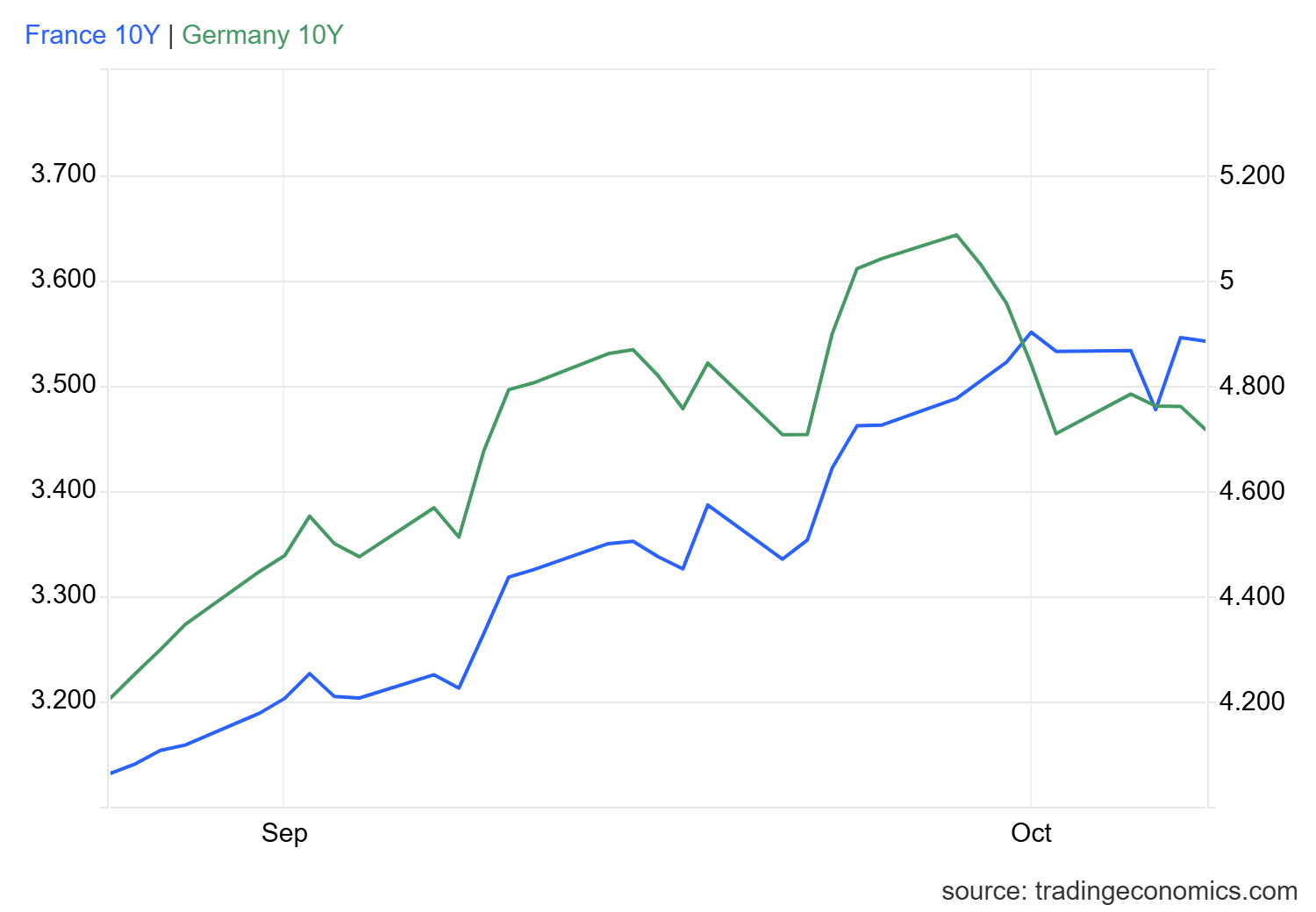
This situation is also being reflected in the bond market. French government bonds have begun offering significantly higher yields relative to safer markets such as Germany. Currently, 10-year French government bonds yield around 4.8%, while equivalent German bonds remain near 3.4%.
The widening spread is particularly important because it shows that investors are demanding a growing risk premium to maintain exposure to French debt. In other words, markets are perceiving a higher level of risk than they did months ago and require greater compensation to justify holding French government bonds. Furthermore, this dynamic could become an additional challenge for public finances, as persistently higher borrowing costs increase debt-servicing expenses and make fiscal stabilization more difficult.
Source: TradingEconomics
This situation extends beyond France itself. It is also beginning to create concerns about the broader financial stability of the eurozone by increasing fears of potential financial fragmentation within the bloc.
As a result, some investors may begin reducing exposure to euro-denominated assets due to a higher perception of risk surrounding one of the region's largest economies. This could encourage a shift toward markets viewed as more stable and limit the euro's ability to attract consistent demand. If concerns surrounding France's fiscal outlook continue to intensify, confidence in the common currency could deteriorate further and continue supporting downside pressure on EUR/USD.
Is the Dollar Still a Threat?
It is also important to monitor the dynamics surrounding the U.S. dollar. Following the release of the latest Federal Reserve minutes, markets continue to expect that another rate hike could take place before the end of 2026.
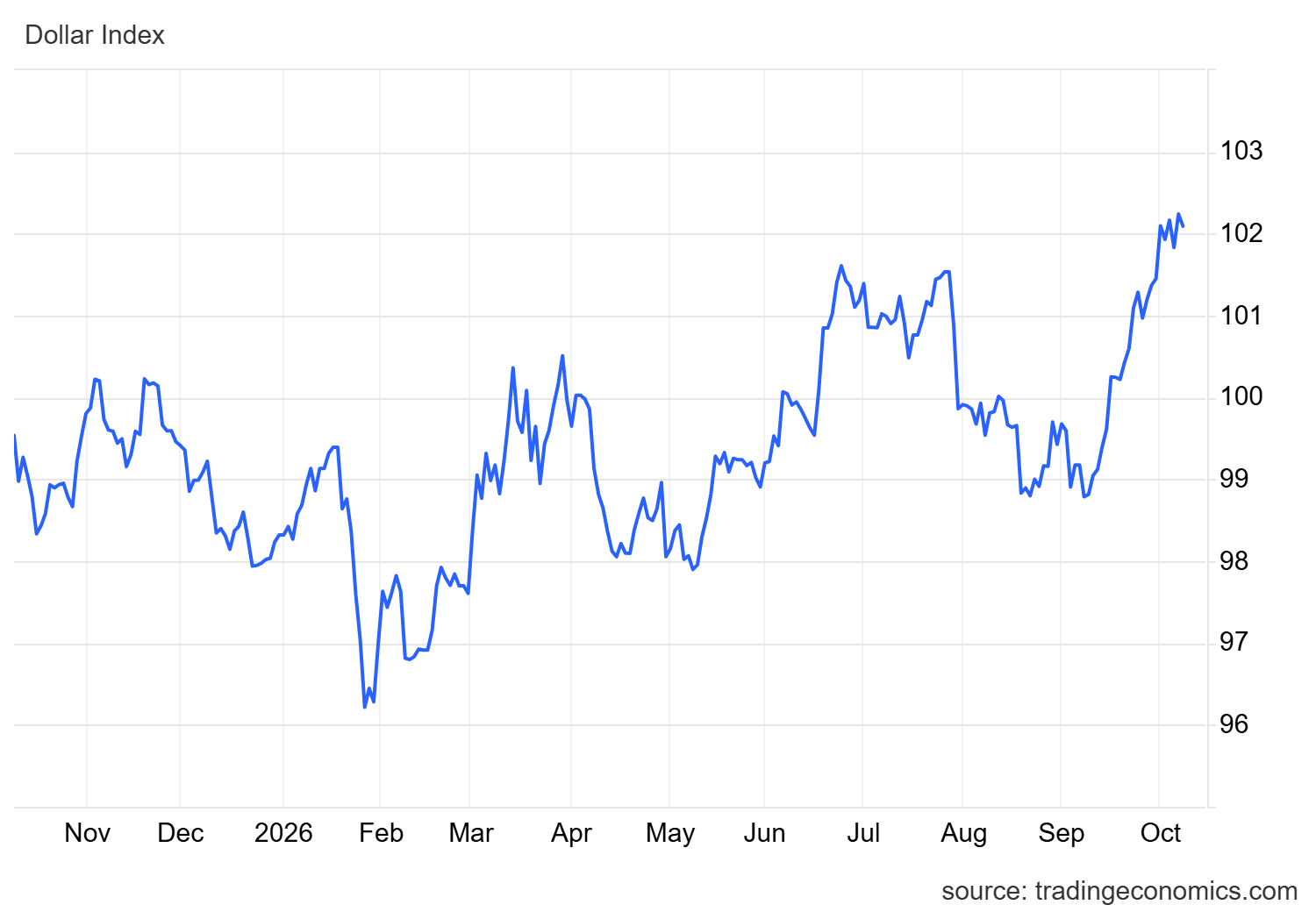
This outlook continues to support the relative attractiveness of dollar-denominated assets and helps explain the resilience that the U.S. currency has maintained in the short term. The situation can be observed through the DXY, the index that measures the dollar's performance against its major counterparts, which continues to trade around the 102-point area, highlighting that demand for the dollar remains relatively stable.
Source: TradingEconomics
This dynamic remains important because it limits the euro's ability to recover. As long as the dollar continues benefiting from relatively supportive U.S. monetary policy expectations and maintains its current strength, EUR/USD may continue facing difficulties in regaining momentum during the coming sessions.
EUR/USD Technical Forecast
Source: StoneX, Tradingview
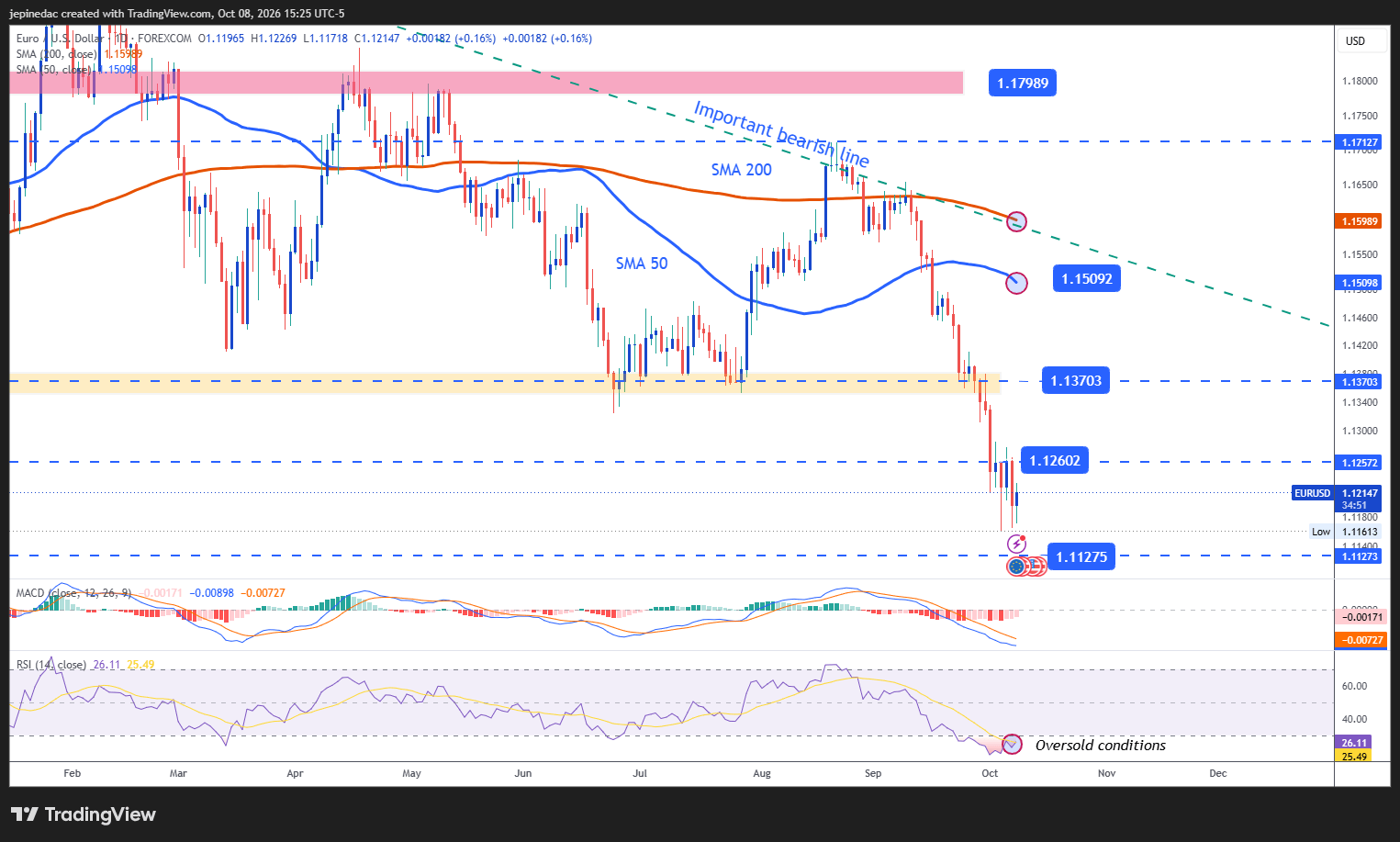
- The major bearish trendline is regaining relevance: Since January 2026, a long-term bearish trendline has been developing on the EUR/USD daily chart. Although this technical structure lost some relevance during the more neutral market conditions seen in previous months, the recent weakness in the euro has begun to restore the importance of the bearish bias. As long as this dynamic remains in place, the downtrend could continue developing as the dominant technical structure in the weeks ahead.
- MACD: The MACD histogram continues to trade below the 0 neutral line, a reading that suggests short-term moving-average momentum remains tilted to the downside. As long as this condition persists, selling pressure could continue dominating price action.
- RSI: A similar picture can be observed in the RSI, which remains below the 50 neutral level, reinforcing the relevance of bearish momentum across the market. However, it is also important to note that the indicator is already trading below the 30 oversold threshold, a situation that could signal excessive selling pressure and create room for short-term corrective rebounds.
Key Levels:
- 1.13703 – Key Resistance: This level coincides with an important support zone that was broken in recent weeks and now acts as the most relevant upside barrier on the chart. Price action returning toward this area could begin to weaken the recent bearish momentum and support a more neutral trading environment.
- 1.12602 – Near-Term Barrier: A level that aligns with an important retracement zone observed over recent weeks and could become the primary reference to monitor in the event of short-term bullish corrections.
- 1.11275 – Major Support: A level not seen since May 2025 that remains the most important downside reference on the chart. Sustained moves toward this zone could reinforce the dominant bearish bias and open the door to a more aggressive extension of the current downtrend in the weeks ahead.
Written by Julian Pineda, CFA, CMT – Market Analyst
Follow him on: @julianpineda25
Latest market news




Open an account in minutes
Experience award-winning platforms with fast and secure execution, and enjoy tight spreads from 0.5 pts on FX and 0.3 pts on indices.
Economic calendar
Web Trader platform
Our sophisticated web-based platform is packed with features.
Related articles
EUR/USD Forecast: Euro Remains Under Pressure Amid Concerns Over French Debt
Recent trading sessions continue to present a challenging environment for the euro in the short term. This can be seen in the performance of EUR/USD, which has declined by approximately 0.5%, reflecting another loss of ground for the European currency and highlighting the continued strength of the U.S. dollar.
USD/MXN Forecast: Peso Struggles to Recover Despite Mexico's Inflation Data
Despite the recovery attempt seen at the start of the week, a renewed phase of weakness has become increasingly evident around the Mexican peso in the short term. This can be observed in recent USD/MXN price action, with the pair gaining more than 1.2% during today's session, reflecting a stronger U.S. dollar and a renewed loss of ground for the peso.
US Dollar Short-term Outlook: USD Four-Week Rally Stalls Below Key Resistance 10 8 2026
DXY is holding in a tight range beneath major resistance as traders await the next catalyst from inflation expectations and Fed repricing.

This report is intended for general circulation only. It should not be construed as a recommendation, or an offer (or solicitation of an offer) to buy or sell any financial products. The information provided does not take into account your specific investment objectives, financial situation or particular needs. Before you act on any recommendation that may be contained in this report, independent advice ought to be sought from a financial adviser regarding the suitability of the investment product, taking into account your specific investment objectives, financial situation or particular needs.
StoneX Financial Pte. Ltd., may distribute reports produced by its respective foreign entities or affiliates within the StoneX group of companies or third parties pursuant to an arrangement under Regulation 32C of the Financial Advisers Regulations. Where the report is distributed to a person in Singapore who is not an accredited investor, expert investor or an institutional investor (as defined in the Securities Futures Act), StoneX Financial Pte. Ltd. accepts legal responsibility to such persons for the contents of the report only to the extent required by law. Singapore recipients should contact StoneX Financial Pte. Ltd. at 6826 9988 for matters arising from, or in connection with the report.
In the case of all other recipients of this report, to the extent permitted by applicable laws and regulations neither StoneX Financial Pte. Ltd. nor its associated companies will be responsible or liable for any loss or damage incurred arising out of, or in connection with, any use of the information contained in this report and all such liability is hereby expressly disclaimed. No representation or warranty is made, express or implied, that the content of this report is complete or accurate.
StoneX Financial Pte. Ltd. is not under any obligation to update this report.
Trading CFDs carries a high level of risk that may not be suitable for some investors. Consider your investment objectives, level of experience, financial resources, risk appetite and other relevant circumstances carefully. The possibility exists that you could lose some or all of your investments, including your initial deposits. If in doubt, please seek independent expert advice. Visit www.forex.com/en-sg/terms-and-policies for the complete Risk Disclosure Statement.