



EUR/USD: Can the pair reach parity?
Can it reach parity? If so, what is stopping it from moving below parity?
Share this:

Can the pair reach 1.0000? EUR/USD had been moving lower since May 2021, as concerns kicked in that the ECB wasn’t doing enough to help the European economy starve off high inflation. Indeed, inflation continued to move higher over the next year to a recent high of 8.6% in May 2022, and the ECB has still yet to raise interest rates which are currently sitting at -0.50%. However, at the last ECB meeting, the Committee said that it would raise rates by 25bps at the July meeting. Some ECB members are arguing for 50bps. But will it be too little, too late? Two weeks ago, the theme switched from one of inflation fears to one of growth fears as the S&P Global Manufacturing PMIs were released. In the Eurozone, many of the country’s individual results were weaker than expected, prompting fears that a recession may lie ahead. The overall Euro Area PMI was 52.1 from June, down from 54.6 in May. This may leave the ECB stuck between a rock and a hard place as it must decide whether to raise rates during a period of surging inflation or leave them unchanged during a period of slowing growth! The Euro Area releases May Retail Sales this week, with expectations of +0.4% vs -1.3% in April.
The US is having similar problems to those in the Euro Area, except the Fed is currently in a position of strength. The Fed has raised rates from 0.25% to 1.75% over the last several meetings. At the European Central Bank forum last week, Fed Chairman Powell said that although it may be painful, and may even crash growth, bringing down inflation must be done quickly to prevent rapid price growth from becoming entrenched. At the upcoming FOMC meeting in July, the decision is whether to raise rates by 50bps or 75bps. This could potentially bring rates to 2.50%, whereas the ECB could be sitting at -0.25%. A growth slowdown is on the tips of everyone’s tongues in the US as well, however with interest rates at current levels, the US Dollar is screaming vs other currencies. The US Dollar recently traded to its highest level since December 2002 near 106.75. The main reason the Fed can raise rates as quickly as it does, is due to the low Unemployment Rate that the US currently enjoys, at 3.6%. This week, the US will release Non-Farm Payrolls for June. The expectations are for the US to have added 268,000 jobs to the economy last month vs +390,000 in May. The Unemployment Rate is expected to remain unchanged at 3.6%. Powell has stated before that getting inflation down may come at the expense of the Unemployment Rate. This reading will be closely monitored by the markets and the Fed!
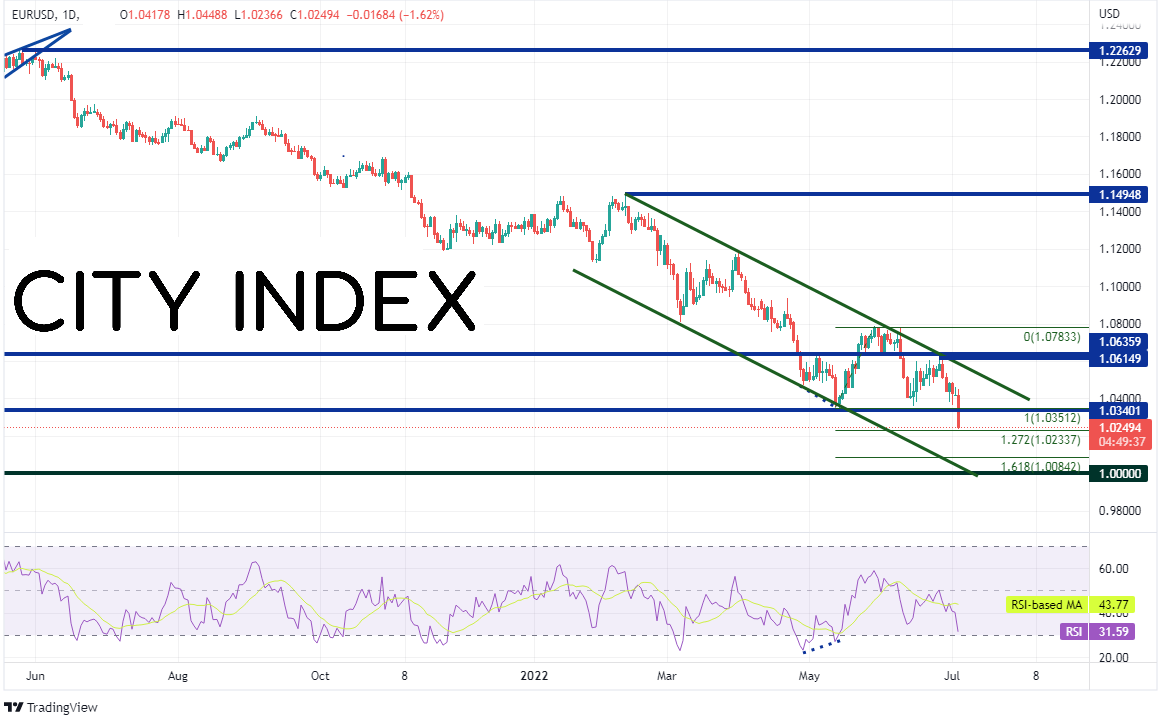
EUR/USD has come a long way since the May 2021 highs at 1.2263. By February 10th, the pair made a 2021 high at 1.1495 and it hasn’t looked back since. On the daily timeframe, the pair continues to put in a series of lower lows and lower highs, forming a downward sloping channel. Currently, EUR/USD is trading near the middle to the channel, below 1.0340 to its lowest level since December 2002. Support is just below at the 127.2% Fibonacci extension from the lows of May 13th to the highs of May 27th, near 1.0234. Below there, the pair can fall to the 161.8% Fibonacci extension from the same timeframe at 1.0082, then the bottom trendline of the channel and the psychological round number support level at parity, or 1.0000. Resistance is at the previous support level of 1.0340, then the top of the channel near 1.0580.

Source: Tradingview, Stone X
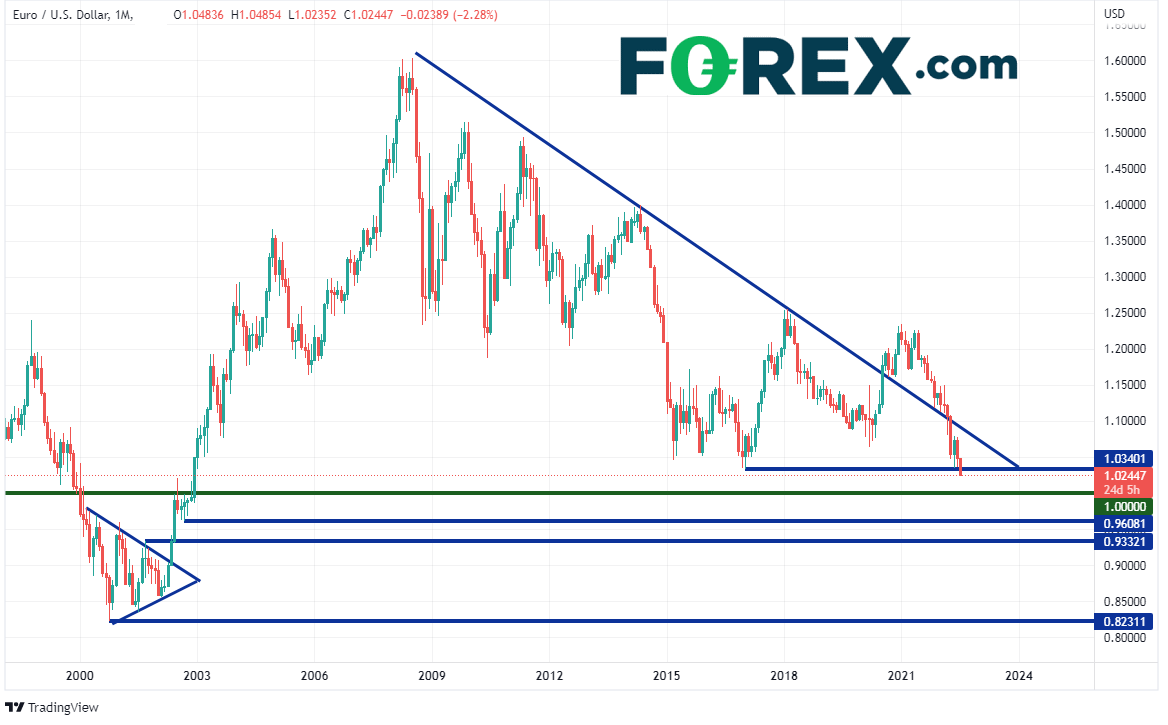
However, parity, or 1.0000, is just a psychological number. It doesn’t mean anything. EUR/USD can trader lower than parity. The last time the pair traded below 1.0000 was December 2002. Between January 2000 and July 2002, EUR/USD also traded below parity. Monthly horizontal support sits at 0.9608 and 0.9332. In October 2000, EUR/USD reached a low of 0.8231!
Source: Tradingview, Stone X
EUR/USD has been on the move lower for over 1 year now. Can it reach parity? If so, what is stopping it from moving below parity? Given that the US currently enjoys of a low Unemployment Rate, the pressure will be on the ECB to not only bring rates positive, but also to keep the economy from entering a recession.
Can the pair reach 1.0000? EUR/USD had been moving lower since May 2021, as concerns kicked in that the ECB wasn’t doing enough to help the European economy starve off high inflation. Indeed, inflation continued to move higher over the next year to a recent high of 8.6% in May 2022, and the ECB has still yet to raise interest rates which are currently sitting at -0.50%. However, at the last ECB meeting, the Committee said that it would raise rates by 25bps at the July meeting. Some ECB members are arguing for 50bps. But will it be too little, too late? Two weeks ago, the theme switched from one of inflation fears to one of growth fears as the S&P Global Manufacturing PMIs were released. In the Eurozone, many of the country’s individual results were weaker than expected, prompting fears that a recession may lie ahead. The overall Euro Area PMI was 52.1 from June, down from 54.6 in May. This may leave the ECB stuck between a rock and a hard place as it must decide whether to raise rates during a period of surging inflation or leave them unchanged during a period of slowing growth! The Euro Area releases May Retail Sales this week, with expectations of +0.4% vs -1.3% in April.
Everything you need to know about the ECB
The US is having similar problems to those in the Euro Area, except the Fed is currently in a position of strength. The Fed has raised rates from 0.25% to 1.75% over the last several meetings. At the European Central Bank forum last week, Fed Chairman Powell said that although it may be painful, and may even crash growth, bringing down inflation must be done quickly to prevent rapid price growth from becoming entrenched. At the upcoming FOMC meeting in July, the decision is whether to raise rates by 50bps or 75bps. This could potentially bring rates to 2.50%, whereas the ECB could be sitting at -0.25%. A growth slowdown is on the tips of everyone’s tongues in the US as well, however with interest rates at current levels, the US Dollar is screaming vs other currencies. The US Dollar recently traded to its highest level since December 2002 near 106.75. The main reason the Fed can raise rates as quickly as it does, is due to the low Unemployment Rate that the US currently enjoys, at 3.6%. This week, the US will release Non-Farm Payrolls for June. The expectations are for the US to have added 268,000 jobs to the economy last month vs +390,000 in May. The Unemployment Rate is expected to remain unchanged at 3.6%. Powell has stated before that getting inflation down may come at the expense of the Unemployment Rate. This reading will be closely monitored by the markets and the Fed!
EUR/USD has come a long way since the May 2021 highs at 1.2263. By February 10th, the pair made a 2021 high at 1.1495 and it hasn’t looked back since. On the daily timeframe, the pair continues to put in a series of lower lows and lower highs, forming a downward sloping channel. Currently, EUR/USD is trading near the middle to the channel, below 1.0340 to its lowest level since December 2002. Support is just below at the 127.2% Fibonacci extension from the lows of May 13th to the highs of May 27th, near 1.0234. Below there, the pair can fall to the 161.8% Fibonacci extension from the same timeframe at 1.0082, then the bottom trendline of the channel and the psychological round number support level at parity, or 1.0000. Resistance is at the previous support level of 1.0340, then the top of the channel near 1.0580.
Source: Tradingview, Stone X
Trade EUR/USD now: Login or Open a new account!
• Open an account in the UK
• Open an account in Australia
• Open an account in Singapore
However, parity, or 1.0000, is just a psychological number. It doesn’t mean anything. EUR/USD can trader lower than parity. The last time the pair traded below 1.0000 was December 2002. Between January 2000 and July 2002, EUR/USD also traded below parity. Monthly horizontal support sits at 0.9608 and 0.9332. In October 2000, EUR/USD reached a low of 0.8231!

Source: Tradingview, Stone X
EUR/USD has been on the move lower for over 1 year now. Can it reach parity? If so, what is stopping it from moving below parity? Given that the US currently enjoys of a low Unemployment Rate, the pressure will be on the ECB to not only bring rates positive, but also to keep the economy from entering a recession.
Learn more about forex trading opportunities.
Related tags:
Latest market news




Open an account in minutes
Experience award-winning platforms with fast and secure execution, and enjoy tight spreads from 0.5 pts on FX and 0.3 pts on indices.
Economic calendar
Web Trader platform
Our sophisticated web-based platform is packed with features.
Related articles
AUD/USD outlook: Aussie slips despite hawkish RBA ahead of key data
The AUD/USD was unable to benefit from the Reserve Bank of Australia’s 25-basis-point rate hike overnight. The RBA lifted the cash rate to 4.60%, in line with expectations. However, the Australian dollar weakened following the decision, with much of the Bank’s hawkish stance seemingly priced in ahead of the announcement. The US dollar has also remained largely supported following the recent turmoil in the bond markets.
Canadian Dollar Technical Outlook: USD/CAD Seven-Day Rally Tests Major Resistance 9 29 2026
USD/CAD is pressing into a major technical barrier after an extended advance, raising the risk for price inflection as momentum stretches.

RBA delivers 25bp hike, Bullock now the main event
The RBA delivered the expected 25bp hike, but Bullock’s press conference now looms as the bigger volatility risk for AUD/USD and the ASX 200.

This report is intended for general circulation only. It should not be construed as a recommendation, or an offer (or solicitation of an offer) to buy or sell any financial products. The information provided does not take into account your specific investment objectives, financial situation or particular needs. Before you act on any recommendation that may be contained in this report, independent advice ought to be sought from a financial adviser regarding the suitability of the investment product, taking into account your specific investment objectives, financial situation or particular needs.
StoneX Financial Pte. Ltd., may distribute reports produced by its respective foreign entities or affiliates within the StoneX group of companies or third parties pursuant to an arrangement under Regulation 32C of the Financial Advisers Regulations. Where the report is distributed to a person in Singapore who is not an accredited investor, expert investor or an institutional investor (as defined in the Securities Futures Act), StoneX Financial Pte. Ltd. accepts legal responsibility to such persons for the contents of the report only to the extent required by law. Singapore recipients should contact StoneX Financial Pte. Ltd. at 6826 9988 for matters arising from, or in connection with the report.
In the case of all other recipients of this report, to the extent permitted by applicable laws and regulations neither StoneX Financial Pte. Ltd. nor its associated companies will be responsible or liable for any loss or damage incurred arising out of, or in connection with, any use of the information contained in this report and all such liability is hereby expressly disclaimed. No representation or warranty is made, express or implied, that the content of this report is complete or accurate.
StoneX Financial Pte. Ltd. is not under any obligation to update this report.
Trading CFDs carries a high level of risk that may not be suitable for some investors. Consider your investment objectives, level of experience, financial resources, risk appetite and other relevant circumstances carefully. The possibility exists that you could lose some or all of your investments, including your initial deposits. If in doubt, please seek independent expert advice. Visit www.forex.com/en-sg/terms-and-policies for the complete Risk Disclosure Statement.