


How to use market sentiment in trading
This guide covers keys things you need to know about market sentiment: including what it is, how to measure it, the best sentiment indicators to use, and examples of market sentiment in forex trading.
Share this:
What is market sentiment?
Market sentiment refers to the general attitude of traders in a specific market. A measure of market sentiment reflects the collective opinions, beliefs, and emotions of traders. It may also be referred to as trader sentiment or just sentiment. As you can imagine, this can be quite subjective, but there are multiple methods that market participants will use in attempt to make this a more objective variable.
When a majority of traders have open long positions, the market is described as a bull market and trader sentiment is positive. A market is said to have negative sentiment when it is in a bearish trend, meaning most of the open orders are sell orders. This idea of long being positive and short being negative comes from stock trading, where long and short positions correlate with share prices.
How to measure stock market sentiment
There are several ways to measure market sentiment, from manually reviewing comments online made by traders to using traditional indicators that gauge bearish and bullish positions. In this section, we’ll briefly review some of the most popular methods.
Social media and market coverage
Monitoring social media posts by analysts and traders can give you a broad understanding of how participants view a particular market. However, it's important to recognize that this approach can be anecdotal and may not always provide a comprehensive view of sentiment.
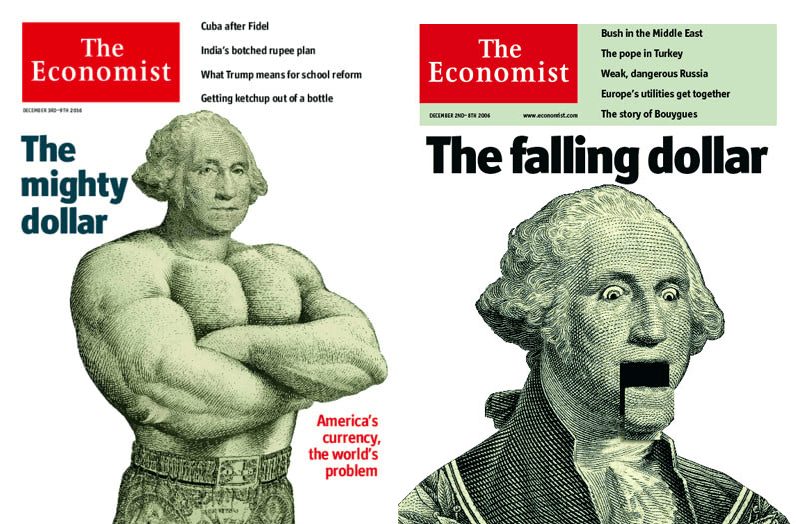
Market headlines can also be a good indicator of market sentiment. Article titles may either be bleak or uplifting, indicating current extremes on sentiment that occur during market tops and bottoms. It's essential to consider this information as part of a broader analysis.
*Dual coverage of USD sentiment from The Economist
There are also summaries of exchanged-based sentiment, such as the Commitment of Traders (COT) report, which is published weekly with data on positions held in numerous markets including options and futures markets. While informative, traders should be aware that these reports may have reporting lags and may not capture the full spectrum of sentiment.
The VIX
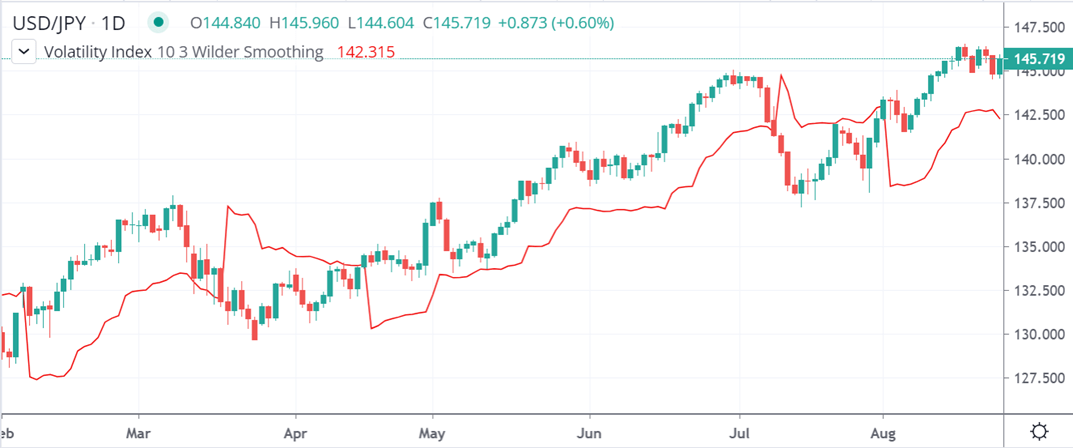
The CBOE Volatility Index (VIX) is one of the most popular sentiment indicators. It measures 30-day options prices on the S&P 500 and is often used to track levels of ‘fear’ and ‘greed’ based on whether options prices are lower or higher than current stock market values. For this reason, it’s sometimes referred to as the fear index. While useful, traders should remember that it primarily reflects sentiment in the options market but it can be applied to other markets like currency pairs, as shown in the example below.
*Source: City Index. Past performance is not indicative of future results
Technical indicators
Technical indicators such as the bullish percent index (BPI) or 52-week highs and lows index can also be used to gauge market sentiment. Like the VIX, these are mainly applied to the broader stock market to determine bearish or bullish sentiment. Their relevance in forex trading may vary, and traders should exercise caution when interpreting their signals.
How to measure market sentiment in forex
Measuring market sentiment in forex is more difficult than for stocks and indexes because the FOREX market is over the counter and there’s not a centralized exchange a single source that tallies overall long and short positions. Consequently, traders have developed various methods to gauge sentiment, each with its advantages and limitations. While some of the technical indicators have been translated from the stock market to forex in an attempt of reading sentiment, other, newer tools may do a better job of judging market sentiment.
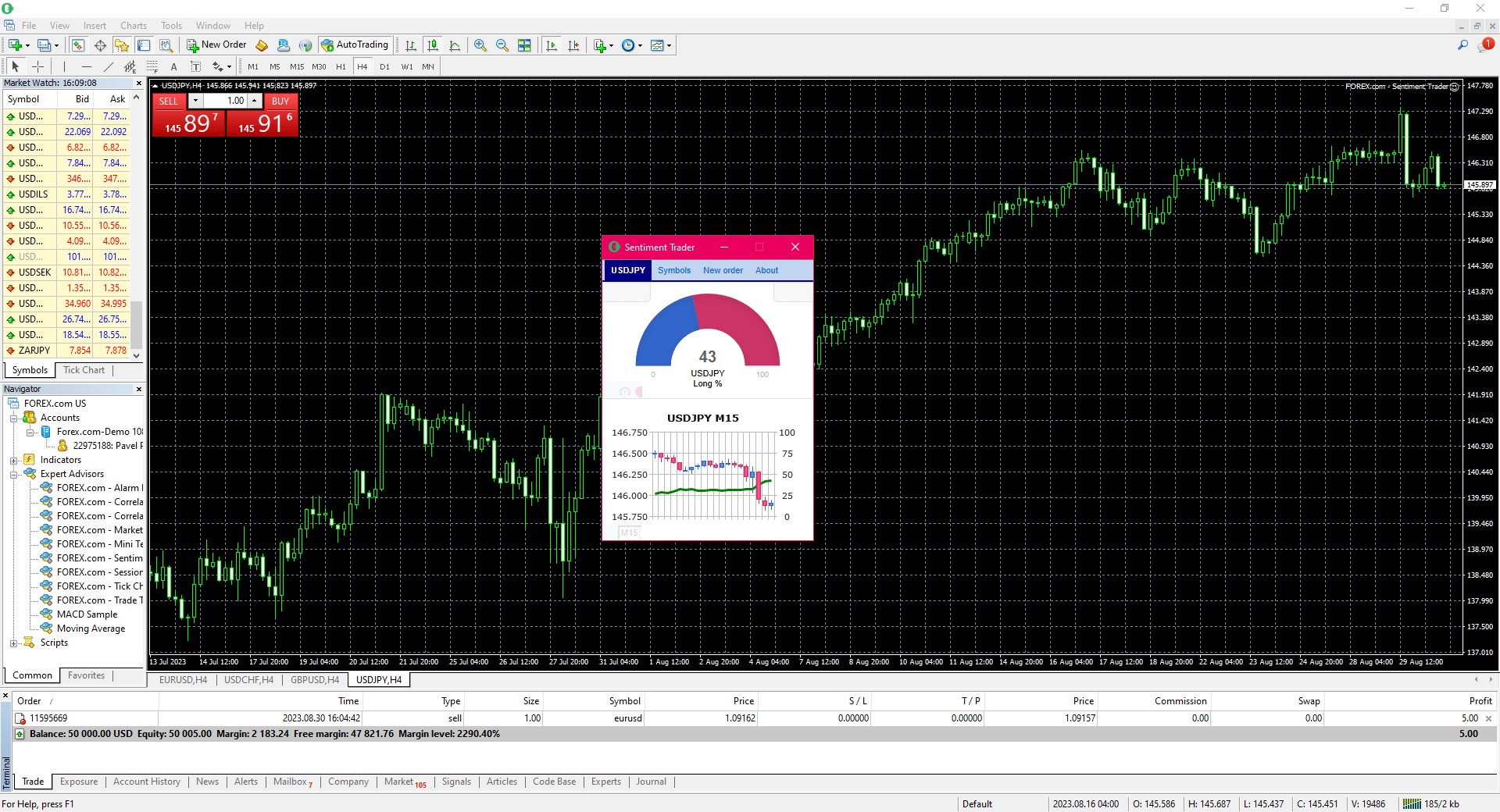
For example, the Sentiment Trader is an Expert Advisor (EA) tool available exclusively on MetaTrader charts that provides ratios of sentiment by both trader position and order volume. Learn more about the Sentiment Trader or keep reading to see it in action with a forex trading example.
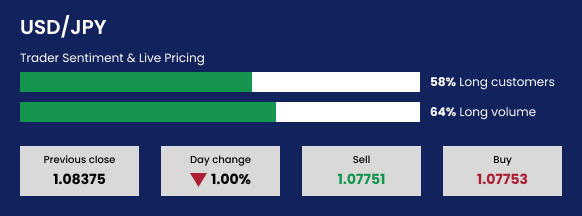
The Sentiment Trader displays a ratio of long and short orders for selected currency pairs along with other general information such as the previous day’s close and the current bid-ask spread. An example of the widget shown below displays both the percentage of long traders (customers) and the percentage of long trades. But the key for reading sentiment is that this indicator shows the ratio of long positions to short positions based on actual trades placed in a live market environment, so it is a direct read on retail sentiment as derived from the data at the time.
Please note that using sentiment data from a single broker or source means that you are working with a limited dataset. This data may not represent the broader market sentiment accurately, as it only reflects the sentiment of traders associated with that specific broker.
For example, data used by the Sentiment Analysis tool is provided by FXBlue, which is integrated into Meta Trader and other popular trading platforms. So, while the tool captures a large percentage of forex trades, it does not represent the entire market. Forex markets are vast and diverse, with participants from around the world, and a single source may not capture the sentiments of all market participants.
How to trade forex on market sentiment
Strong sentiment in either a long or short direction is generally seen as imbalance, and this can often be reads as a signal to trade in the opposite direction. That’s because sentiment trading reflects what a majority of retail traders are doing. If 80 or 90% of a market is already long, at some point in the future those traders will need to close their positions, which can mean more supply in the market as longs close.
This can also mean there is less money on the sideline that can come into buy which would push the price higher. Even a strong trend may face turbulence if the majority of the market is already long, and the reason is imbalance in sentiment.
When there is a large imbalance in trader positioning, market makers are often aware of that dynamic and this can provide a hindrance to the continuation of trends if a market is overweight on either the long or short side. This is also why sentiment is often looked at as a contrarian indicator in which traders will often look to go in the opposite direction of large imbalances.
Gain insight to market sentiment on MetaTrader with FOREX.com
To access the market sentiment tool, you need to first log in to MetaTrader using your FOREX.com account. Then, look for the Sentiment Trader tool among the Expert Advisors.
Once you’re online, you can use market sentiment to trade forex in these quick steps:
- Choose the market you want to trade
- Activate the Sentiment Trader tool among MetaTrader’s Expert Advisors
- Identify if there is an overarching trend by comparing the price action to market sentiment, then confirm trends with additional technical analysis
- Execute your trading strategy according to the trend
Market sentiment trading example
The Sentiment Trader tool is most useful in markets where strong long or short positioning is displayed, like GBP/JPY (short) and USD/CAD (long) in the module screenshot above. If 60% of customers are long in a market, that means 3 out of every 5 retail traders holding positions at that time are long, and this would suggest an imbalance on the long side of the pair.
Taking a contrarian look at that scenario would denote a bearish opinion, driven by the imbalance between longs and shorts. If the trader can then identify a down-trend in that market, the imbalance of long positioning could be alerting to a possible trend scenario that they can incorporate into their approach.
Of course, you should use additional indicators and market analysis to finalize entry and exit points for your trade, also setting stop-loss orders so you don’t become stuck in the majority with a losing position.
Market sentiment is a crucial element of forex trading, impacting price movements and trading decisions. While various tools and methods are available to gauge sentiment, traders should be aware of their advantages and limitations. A balanced approach that combines sentiment analysis with other forms of analysis and robust risk management is key to successful forex trading.
Related tags:


Open an account in minutes
Experience award-winning platforms with fast and secure execution, and enjoy tight spreads from 0.5 pts on FX and 0.3 pts on indices.
Economic calendar
Web Trader platform
Our sophisticated web-based platform is packed with features.
Related articles
AUD/USD Bulls Fight Back After Australian Jobs Shock
AUD/USD has been hit by another ugly Australian employment report, sending RBA rate hike expectations sharply lower. Yet the relationships driving the currency have shifted since quarter-end, and improving risk appetite could provide the fuel for a recovery.

Gold Price Short-term Outlook: XAU/USD Holds Critical Support as Breakout Nears 10 15 2026
Gold is consolidating after a steep selloff, with momentum divergence raising the stakes for the next move ahead of the Fed decision.


US Dollar Technical Outlook: DXY, Treasury Yields Retreat Despite Hot CPI 10 15 2026
The US Dollar is testing major support despite hotter inflation as Fed pushback cools yields and forces markets to reassess the path for tightening.
This report is intended for general circulation only. It should not be construed as a recommendation, or an offer (or solicitation of an offer) to buy or sell any financial products. The information provided does not take into account your specific investment objectives, financial situation or particular needs. Before you act on any recommendation that may be contained in this report, independent advice ought to be sought from a financial adviser regarding the suitability of the investment product, taking into account your specific investment objectives, financial situation or particular needs.
StoneX Financial Pte. Ltd., may distribute reports produced by its respective foreign entities or affiliates within the StoneX group of companies or third parties pursuant to an arrangement under Regulation 32C of the Financial Advisers Regulations. Where the report is distributed to a person in Singapore who is not an accredited investor, expert investor or an institutional investor (as defined in the Securities Futures Act), StoneX Financial Pte. Ltd. accepts legal responsibility to such persons for the contents of the report only to the extent required by law. Singapore recipients should contact StoneX Financial Pte. Ltd. at 6826 9988 for matters arising from, or in connection with the report.
In the case of all other recipients of this report, to the extent permitted by applicable laws and regulations neither StoneX Financial Pte. Ltd. nor its associated companies will be responsible or liable for any loss or damage incurred arising out of, or in connection with, any use of the information contained in this report and all such liability is hereby expressly disclaimed. No representation or warranty is made, express or implied, that the content of this report is complete or accurate.
StoneX Financial Pte. Ltd. is not under any obligation to update this report.
Trading CFDs carries a high level of risk that may not be suitable for some investors. Consider your investment objectives, level of experience, financial resources, risk appetite and other relevant circumstances carefully. The possibility exists that you could lose some or all of your investments, including your initial deposits. If in doubt, please seek independent expert advice. Visit www.forex.com/en-sg/terms-and-policies for the complete Risk Disclosure Statement.