


Japanese yen weekly outlook: BOJ intervention threat leaves USD/JPY on edge
For the first time in months, USD/JPY no longer looks like a straightforward buy-the-dip trade. Intervention risk, stretched positioning and arrival of a bearish technical signal have changed the complexion of the market.
Share this:

- BOJ intervention threat resurfaces
- Stretched yen positioning raises squeeze risk
- Fed speakers and FOMC minutes take centre stage
- Bearish technical signals challenge buy-the-dip mentality
Intervention or short squeeze?
Thursday's abrupt decline in USD/JPY reignited speculation that the Bank of Japan may have stepped into the market on behalf of Japan's Ministry of Finance. Whether that was the case remains unclear, but it's plausible the move reflected a combination of other factors, including a well-timed Reuters report suggesting Japanese authorities may be looking to catch speculators off guard, heavily stretched short yen positioning, thinning liquidity ahead of the US payrolls report and Independence Day holiday, and Federal Reserve Chair Kevin Warsh striking a slightly less hawkish tone only hours earlier.
Whatever the catalyst, the combination of stretched speculative positioning, bearish technical signals and lingering intervention risk has markets on edge heading into the week ahead.

Source: LSEG
Market positioning helps explain why. While futures positioning captures only a small part of the broader FX market, it provides a useful proxy for speculative sentiment. Right now, it points to short yen positioning bordering on extremes, reinforcing the risk that any catalyst capable of triggering a squeeze could generate an outsized market reaction.
While the risk of further intervention shouldn't be dismissed, the experience earlier this year suggests it may do little more than slow USD/JPY's advance. For any move lower to be sustained, it would still need to be accompanied by a meaningful shift in the underlying fundamentals encouraging investors to sell the yen.
Fed communication in focus
With intervention risk elevated, the focus this week shifts back to whether incoming data and central bank communication do anything to alter the underlying macro backdrop.

Source: TradingView
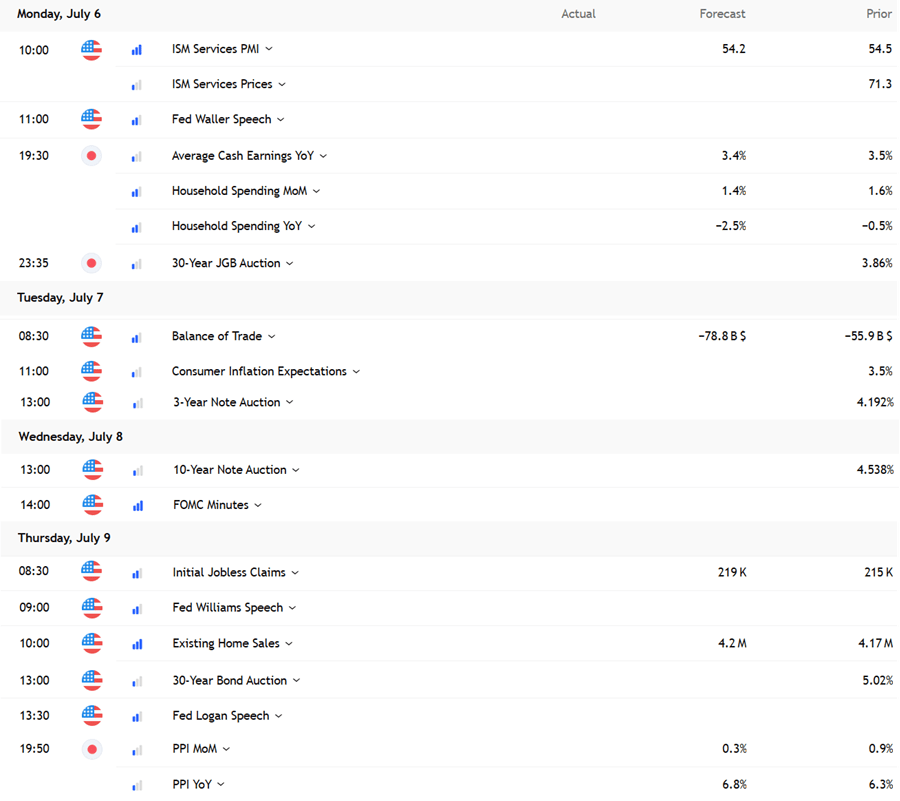
The US economic calendar is light. Monday's ISM services PMI will attract attention, particularly the prices paid component following the sharp slowdown seen in the equivalent manufacturing measure released last week. But as a sentiment survey, it may struggle to materially alter the broader outlook on its own.
Instead, the focus is likely to fall on remarks from Federal Reserve Governor Christopher Waller and New York Fed President John Williams. Both are widely viewed as influential voices within the FOMC, making any insights into how the Committee is thinking following the June employment report, recent declines in energy prices and Kevin Warsh's comments at Sintra worth watching closely.
While they're unlikely to provide definitive guidance, any clues on how the perceived centre of the Committee is assessing the evolving macro backdrop could carry far greater significance for USD/JPY than the second-tier data scheduled this week.
The June FOMC minutes also loom as a potential volatility event. Historically, the minutes have rarely generated a sustained market reaction, but this release may prove different given it relates to Kevin Warsh's first meeting as Fed Chair. Any clues on how policymakers are weighing inflation risks relative to labour market developments, and what they need to see before either tightening policy again or remaining on hold, will be eyed closely.
Source: TradingView (US EDT)
Testing the virtuous cycle
The Japanese calendar also carries event risk with Tuesday's wage and household spending reports providing another test of hawkish BOJ pricing. Real wage growth has finally turned positive in recent months and, to keep another rate hike in play later this year, you'd imagine that trend needs to continue. Household spending will be just as important given it accounts for more than half of Japan's economy and stronger consumption remains central to the BOJ's long-held goal of creating a self-sustaining cycle of stronger demand, faster wage growth and higher inflation.
Tuesday also brings a 30-year JGB auction worth watching after renewed selling pressure emerged at the ultra-long end of the curve last week. The bond market still appears to be signalling policy settings remain too loose. Unless the BOJ moves real policy rates towards positive territory, pressure is likely to remain on both the yen and the back end of the JGB curve.
Friday's producer price inflation report rounds out the week. Factory gate prices are still rising at an annual pace above 6%, reflecting the earlier jump in energy prices along with the pass-through from yen weakness. To keep another BOJ rate hike on the table this year, pipeline inflation pressures will likely need to remain firm. A sharp slowdown would naturally raise questions over whether the same lies ahead for consumer prices.
Technical picture begins to shift
Source: TradingView
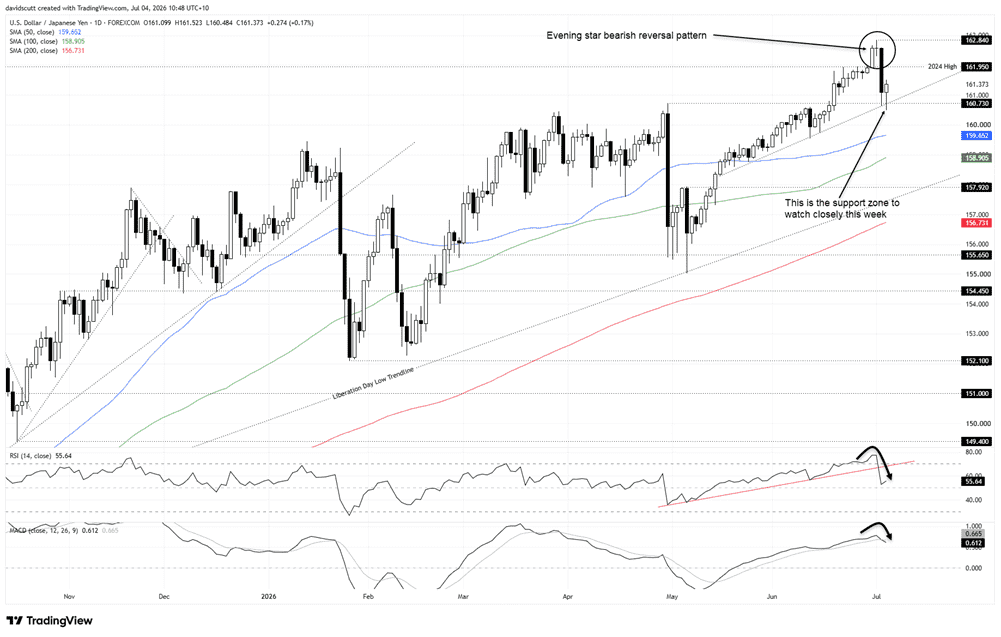
For the first time in months, the technical picture for USD/JPY is no longer overwhelmingly stacked in favour of the bulls. Thursday's completion of an evening star reversal pattern from the multi-decade high at 162.84 warns downside risks may be beginning to build. That view is reinforced by the momentum indicators. RSI (14) has broken the uptrend that's been in place since the latter part of April, although it remains above the neutral 50 level. MACD has also crossed beneath its signal line, but remains in positive territory. At the very least, both are warning that the strong upside momentum which had been in place for months has weakened sharply.
Despite those signals, the price continued to respect important technical levels late last week. The pair found support almost to the tick at 160.73, the former 2026 high set in late April, before rebounding on Thursday. Buyers stepped back in from the same area on Friday, with 160.73 also coinciding with the uptrend that's been in place since the middle of May. That leaves the area as the key downside level to watch this week. A break would shift the focus to the 50 and 100-day moving averages before exposing 157.92, the breakout level established in May following the previous intervention episode.
Should Friday's rebound extend, the 2024 high at 161.95 becomes the first topside level to watch before attention turns back to the multi-decade high at 162.84. The broader uptrend remains intact, but for the first time in months the technical picture is no longer screaming "buy the dip".


Open an account in minutes
Experience award-winning platforms with fast and secure execution, and enjoy tight spreads from 0.5 pts on FX and 0.3 pts on indices.
Economic calendar
Web Trader platform
Our sophisticated web-based platform is packed with features.
Related articles
USD/JPY weekly outlook: Quarter turn scrambles rates regime
USD/JPY’s tight relationship with front-end US rates broke down sharply last week, but quarter-turn flows and positioning suggest the disconnect may prove temporary.

USD/CAD forecast: rally could accelerate above June highs at 1.4250
USD/CAD recovered quickly after weaker US jobs data, keeping the bullish trend in focus. A move above the June highs could accelerate the rally as inflation keeps the Fed under pressure.


USD Sets Fresh Yearly High as EUR/USD Drops Dramatically, USD/JPY Stable
Well, it was a week of USD strength that wasn’t entirely pushed by USD/JPY, as a strong sell-off in EUR/USD has pushed the major pair to its most oversold state in a decade.

This report is intended for general circulation only. It should not be construed as a recommendation, or an offer (or solicitation of an offer) to buy or sell any financial products. The information provided does not take into account your specific investment objectives, financial situation or particular needs. Before you act on any recommendation that may be contained in this report, independent advice ought to be sought from a financial adviser regarding the suitability of the investment product, taking into account your specific investment objectives, financial situation or particular needs.
StoneX Financial Pte. Ltd., may distribute reports produced by its respective foreign entities or affiliates within the StoneX group of companies or third parties pursuant to an arrangement under Regulation 32C of the Financial Advisers Regulations. Where the report is distributed to a person in Singapore who is not an accredited investor, expert investor or an institutional investor (as defined in the Securities Futures Act), StoneX Financial Pte. Ltd. accepts legal responsibility to such persons for the contents of the report only to the extent required by law. Singapore recipients should contact StoneX Financial Pte. Ltd. at 6826 9988 for matters arising from, or in connection with the report.
In the case of all other recipients of this report, to the extent permitted by applicable laws and regulations neither StoneX Financial Pte. Ltd. nor its associated companies will be responsible or liable for any loss or damage incurred arising out of, or in connection with, any use of the information contained in this report and all such liability is hereby expressly disclaimed. No representation or warranty is made, express or implied, that the content of this report is complete or accurate.
StoneX Financial Pte. Ltd. is not under any obligation to update this report.
Trading CFDs carries a high level of risk that may not be suitable for some investors. Consider your investment objectives, level of experience, financial resources, risk appetite and other relevant circumstances carefully. The possibility exists that you could lose some or all of your investments, including your initial deposits. If in doubt, please seek independent expert advice. Visit www.forex.com/en-sg/terms-and-policies for the complete Risk Disclosure Statement.