



New Zealand Dollar Forecast: US rates recalibration leaves NZD/USD clinging to 200DMA
Rising US yields, surging Treasury volatility and a hawkish repricing in Fed expectations have combined to hammer NZD/USD in recent sessions. With weak domestic data also piling up, the Kiwi is losing support from both offshore and local drivers.
Share this:

- NZD/USD correlations with US rates volatility surged last week
- Treasury-led selloff leaves kiwi testing 200DMA support
- PSI and labour data point to ongoing domestic weakness
- Markets still aggressively priced for RBNZ rate hikes
Bond market volatility hammers kiwi
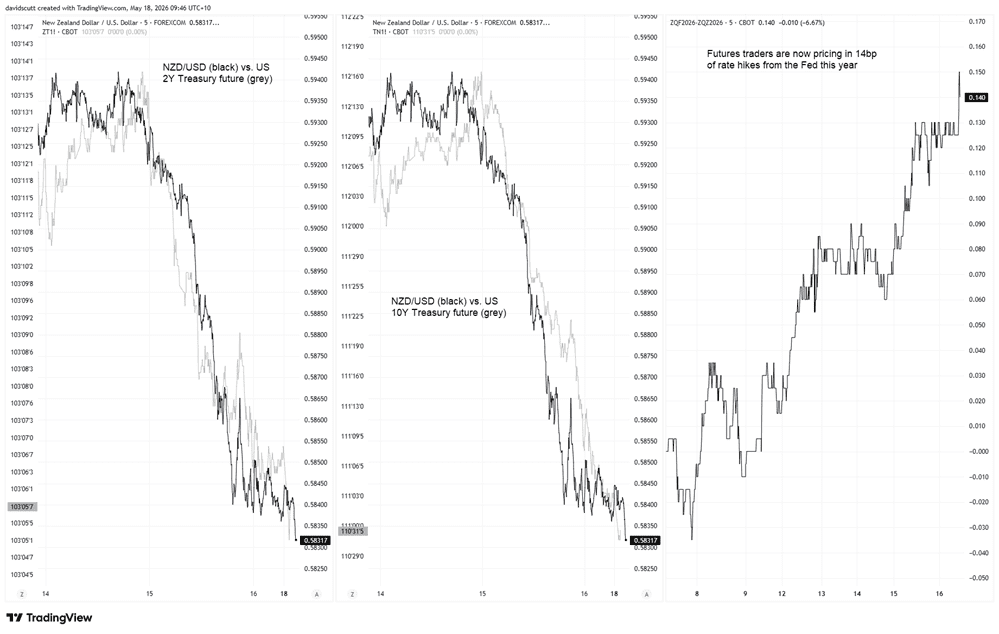
NZD/USD is increasingly behaving less like a traditional commodity currency and more like a direct expression of swings in US rates and implied Treasury volatility. That relationship intensified sharply over the past week, with correlations to Treasury futures and MOVE index strengthening materially across much of the US curve, as seen in the matrix below.

Source: TradingView
Five-day correlations between kiwi and US Treasury note futures are now sitting around 0.77 to 0.80. The inverse relationship with the MOVE index has strengthened to -0.91, the strongest reading across the monitored timeframes. Often described as the bond market’s version of the VIX, the MOVE index tracks implied 30-day volatility in US Treasury markets and now sits at its highest level since early April.
Source: TradingView
The move in Treasury futures coincided with another hawkish shift in Fed pricing. Futures markets are now pricing around 14 basis points of hikes from the Fed by year-end as traders respond to renewed inflation concerns linked to rising energy prices and developments in the Middle East.
200DMA becomes key battleground
Source: TradingView
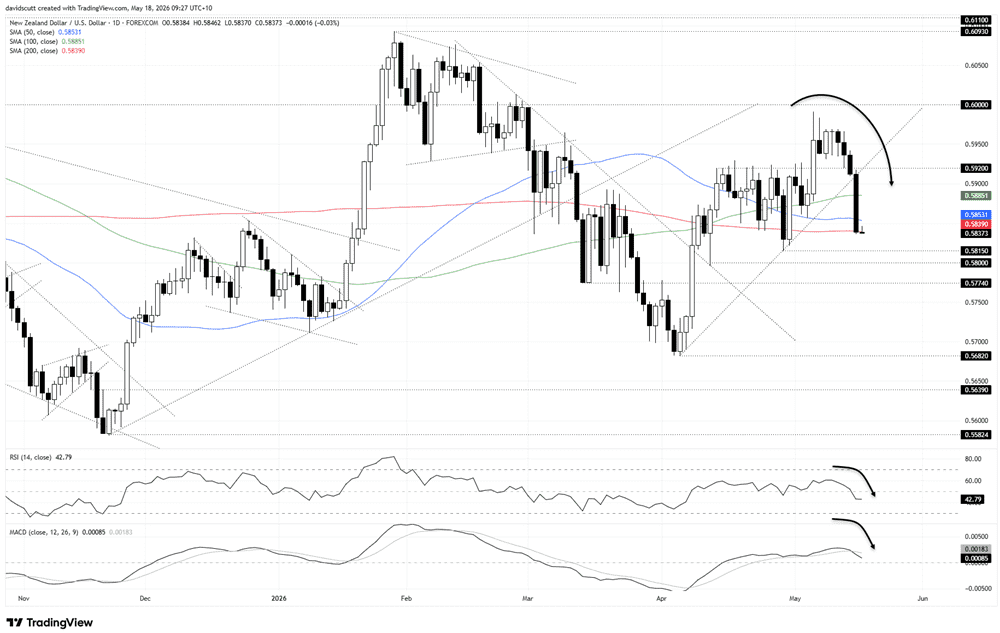
The slide in Treasury futures which saw underlying yields surge higher helped spark a violent breakdown in NZD/USD late last week, seeing the pair slice through uptrend support dating back to early April before running through the 100 and 50-day moving averages like they weren't even there.
It now opens the week teetering on the important 200-day moving average, a level that is often probed but far less frequently crossed on a sustainable basis. That puts the price action and closing level front-and-centre for anyone looking at the Kiwi right now.
Even with the violence of Friday's move, RSI (14) is not even close to entering oversold territory yet, sitting just beneath the neutral 50 level. MACD has also rolled over, crossing the signal line while remaining positive for now. Overall, it's more a cautionary message rather than an outright bearish one when it comes to directional risks, but on current trends it favours selling into strength rather than attempting to buy dips.
Beneath the 200-day moving average, we have a series of minor swing lows at .5815 and .5800 before more meaningful support emerges at .5774. If that were to buckle, there's little in the way of visible support until the April swing low at .5682.
Should bids around the 200DMA manage to keep the bears at bay, the 50-day moving average has been respected far more often than the 100 over recent months, making it the first meaningful level overhead to watch should we see a bounce. If the price can reclaim it, attention would then shift towards resistance at .5920.
Stagflation risks complicate the RBNZ outlook
While offshore developments are dominating NZD/USD price action right now, the domestic backdrop is hardly offering much support either.
The latest BNZ Performance of Services Index reinforced the picture of an economy still struggling to gain meaningful momentum. While the headline reading improved in April, it remained below the breakeven 50 level, indicating activity continues to contract. More concerningly, the employment component remained below 50 for a 29th consecutive month, reinforcing the message from the disappointing Q1 labour market report released earlier this month that labour market slack remains elevated.
Forward-looking details were hardly encouraging either. BNZ noted signs discretionary spending is weakening sharply, particularly across accommodation, cafes and restaurants, while combined services and manufacturing indicators point to little if any employment growth and an economy potentially stalling in Q2.

Source: Bloomberg
That soft domestic backdrop suggests markets may be getting a little ambitious with RBNZ pricing. Swaps are now fully priced for a hike in August with a second move around 90% priced by September, despite little evidence the labour market is tightening sufficiently to generate the kind of sustained second-round inflation pressures likely to genuinely worry the RBNZ.
While the RBNZ has only one mandate which is to keep inflation low and stable, without the threat of second-round effects, hiking aggressively in this environment risks exacerbating what already looks increasingly like a stagflationary backdrop, adding to the risk of another deep recession similar to that seen coming out of the pandemic.
Latest market news




Open an account in minutes
Experience award-winning platforms with fast and secure execution, and enjoy tight spreads from 0.5 pts on FX and 0.3 pts on indices.
Economic calendar
Web Trader platform
Our sophisticated web-based platform is packed with features.
Related articles
Gold Reclaims $4,000, Bulls Eye Reversal with Seasonality Tailwind
Gold futures rebound above $4,000 as falling US yields, improving sentiment and bullish seasonality raise hopes of a significant reversal.
GBP/USD, GBP/AUD: Sterling Rally Faces a BoE Reality Check
Sterling faces a reality check as the BoE prepares to hike rates. GBP/USD and GBP/AUD approach resistance, leaving bulls vulnerable to dovish guidance.
Swiss Franc Short-term Outlook: USD/CHF Selloff Nears Critical Support Ahead of NFP 11 4 2026
USD/CHF bears are closing in on critical trend support, with the next reaction likely to determine whether the October decline has further to run.

This report is intended for general circulation only. It should not be construed as a recommendation, or an offer (or solicitation of an offer) to buy or sell any financial products. The information provided does not take into account your specific investment objectives, financial situation or particular needs. Before you act on any recommendation that may be contained in this report, independent advice ought to be sought from a financial adviser regarding the suitability of the investment product, taking into account your specific investment objectives, financial situation or particular needs.
StoneX Financial Pte. Ltd., may distribute reports produced by its respective foreign entities or affiliates within the StoneX group of companies or third parties pursuant to an arrangement under Regulation 32C of the Financial Advisers Regulations. Where the report is distributed to a person in Singapore who is not an accredited investor, expert investor or an institutional investor (as defined in the Securities Futures Act), StoneX Financial Pte. Ltd. accepts legal responsibility to such persons for the contents of the report only to the extent required by law. Singapore recipients should contact StoneX Financial Pte. Ltd. at 6826 9988 for matters arising from, or in connection with the report.
In the case of all other recipients of this report, to the extent permitted by applicable laws and regulations neither StoneX Financial Pte. Ltd. nor its associated companies will be responsible or liable for any loss or damage incurred arising out of, or in connection with, any use of the information contained in this report and all such liability is hereby expressly disclaimed. No representation or warranty is made, express or implied, that the content of this report is complete or accurate.
StoneX Financial Pte. Ltd. is not under any obligation to update this report.
Trading CFDs carries a high level of risk that may not be suitable for some investors. Consider your investment objectives, level of experience, financial resources, risk appetite and other relevant circumstances carefully. The possibility exists that you could lose some or all of your investments, including your initial deposits. If in doubt, please seek independent expert advice. Visit www.forex.com/en-sg/terms-and-policies for the complete Risk Disclosure Statement.