



NFP Preview 1M jobs possible but wage growth still stubbornly straggles
Hopes are high heading into this week’s NFP Report, with potential to see over 1,000,000 net new jobs for the first time in eight months...
Share this:

Overview
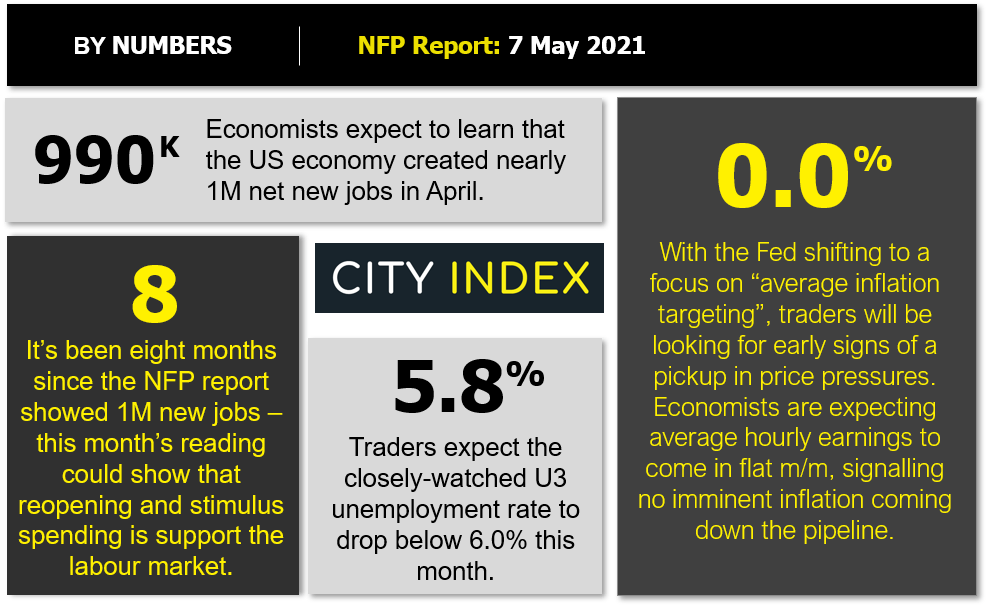
As we noted earlier this week, hopes are high heading into this week’s NFP Report, with potential to see over 1,000,000 net new jobs for the first time in eight months as the country gradually opens up amidst widespread vaccine distribution. In addition to the strong headline jobs reading, economists are also looking for the unemployment rate to tick down to 5.8% and average hourly earnings to come in flat month-over-month:
Source: StoneX
Are these expectations justified? We dive into the key leading indicators for Friday’s critical jobs report below!
NFP forecast
As regular readers know, we focus on four historically reliable leading indicators to help handicap each month’s NFP report:
- The ISM Non-Manufacturing PMI Employment component printed at 58.8, up a point and a half from last month’s 57.2 reading.
- The ISM Manufacturing PMI Employment component printed at 55.1, down more than 4% from last month’s 59.6 reading.
- The ADP Employment report came in at 742K net new jobs, an improvement over last month’s upwardly-revised 565K reading, though still below the 872K reading expected.
- Finally, the 4-week moving average of initial unemployment claims fell to 612K, down sharply from 719k last month.
As we’ve noted repeatedly over the last few months, traders should take any forward-looking economic estimates with a massive grain of salt given the truly unparalleled global economic disruption as a result of COVID-19’s spread. That said, weighing the data and our internal models, the leading indicators point to a slightly worse-than-expected reading from the April NFP report, with headline job growth potentially coming in somewhere in the 800k-900k range, albeit with a bigger band of uncertainty than ever given the current state of affairs.
Regardless, the month-to-month fluctuations in this report are notoriously difficult to predict, so we wouldn’t put too much stock into any forecasts (including ours). As always, the other aspects of the release, prominently including the closely-watched average hourly earnings figure, will likely be just as important as the headline figure itself.
Potential NFP market reaction
The US dollar gave back most of March’s gains through the month of April, with most major currencies gaining 200-300 pips against the world’s reserve currency last month. With the greenback getting off to a better start to the month of May, the NFP report could set the tone for the remainder of the month.
After the sharp selloff in April, the nascent US dollar rally could extend further if we see a strong US jobs report. In that scenario, readers may want to look at USD/JPY as a potential long candidate, with room for the pair to rally back toward previous highs in the mid-110.00s after retracing 38.2% of its Q1 rally last month.
On the other hand, a weaker-than-anticipated jobs report could create a sell opportunity in USD/CAD (pending the simultaneous release of the Canadian jobs report) if it can break below multi-year lows near 1.2250.
How to trade with City Index
Follow these easy steps to start trading with City Index today:
- Open a City Index account, or log-in if you’re already a customer.
- Search for the pair you want to trade in our award-winning platform.
- Choose your position and size, and your stop and limit levels.
- Place the trade.
Overview
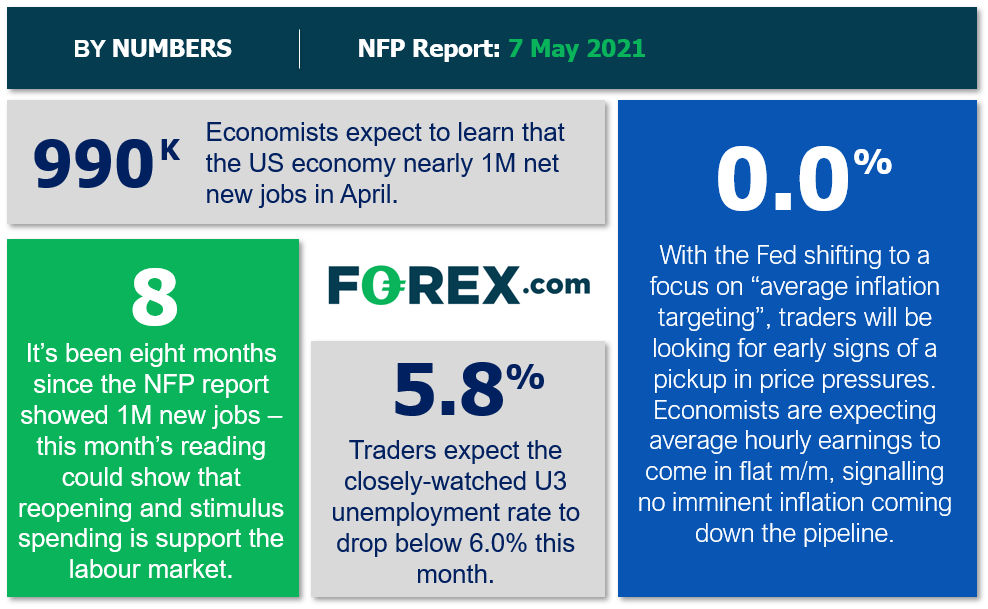
As we noted earlier this week, hopes are high heading into this week’s NFP Report, with potential to see over 1,000,000 net new jobs for the first time in eight months as the country gradually opens up amidst widespread vaccine distribution. In addition to the strong headline jobs reading, economists are also looking for the unemployment rate to tick down to 5.8% and average hourly earnings to come in flat month-over-month:
Source: StoneX
Are these expectations justified? We dive into the key leading indicators for Friday’s critical jobs report below!
NFP forecast
As regular readers know, we focus on four historically reliable leading indicators to help handicap each month’s NFP report:
- The ISM Non-Manufacturing PMI Employment component printed at 58.8, up a point and a half from last month’s 57.2 reading.
- The ISM Manufacturing PMI Employment component printed at 55.1, down more than 4% from last month’s 59.6 reading.
- The ADP Employment report came in at 742K net new jobs, an improvement over last month’s upwardly-revised 565K reading, though still below the 872K reading expected.
- Finally, the 4-week moving average of initial unemployment claims fell to 612K, down sharply from 719k last month.
As we’ve noted repeatedly over the last few months, traders should take any forward-looking economic estimates with a massive grain of salt given the truly unparalleled global economic disruption as a result of COVID-19’s spread. That said, weighing the data and our internal models, the leading indicators point to a slightly worse-than-expected reading from the April NFP report, with headline job growth potentially coming in somewhere in the 800k-900k range, albeit with a bigger band of uncertainty than ever given the current state of affairs.
Regardless, the month-to-month fluctuations in this report are notoriously difficult to predict, so we wouldn’t put too much stock into any forecasts (including ours). As always, the other aspects of the release, prominently including the closely-watched average hourly earnings figure, will likely be just as important as the headline figure itself.
Potential NFP market reaction
The US dollar gave back most of March’s gains through the month of April, with most major currencies gaining 200-300 pips against the world’s reserve currency last month. With the greenback getting off to a better start to the month of May, the NFP report could set the tone for the remainder of the month.
After the sharp selloff in April, the nascent US dollar rally could extend further if we see a strong US jobs report. In that scenario, readers may want to look at USD/JPY as a potential long candidate, with room for the pair to rally back toward previous highs in the mid-110.00s after retracing 38.2% of its Q1 rally last month.
On the other hand, a weaker-than-anticipated jobs report could create a sell opportunity in USD/CAD (pending the simultaneous release of the Canadian jobs report) if it can break below multi-year lows near 1.2250.
How to trade with FOREX.com
Follow these easy steps to start trading with FOREX.com today:
- Open a Forex.com account, or log-in if you’re already a customer.
- Search for the pair you want to trade in our award-winning platform.
- Choose your position and size, and your stop and limit levels.
- Place the trade.
Related tags:


Open an account in minutes
Experience award-winning platforms with fast and secure execution, and enjoy tight spreads from 0.5 pts on FX and 0.3 pts on indices.
Economic calendar
Web Trader platform
Our sophisticated web-based platform is packed with features.
Related articles
USD/CAD shooting star puts September surge on notice
USD/CAD has printed a clear bearish reversal pattern after an extraordinary September surge, but confirmation may depend heavily on how US Treasury yields react to Friday’s payrolls report.

USD/CHF Reverses as Swiss Franc Surges amid Bond Carnage
USD/CHF reverses from channel resistance as bond volatility surges and broad Swiss franc strength points to a possible carry-trade unwind.


USD/MXN Analysis: Is Super Peso Starting to Fade?
Over recent trading sessions, the Mexican peso has continued to show signs of weakness against the U.S. dollar. This can already be seen in USD/MXN, which has gained more than 1.7% over the last three sessions, highlighting sustained buying pressure in favor of the dollar in the short term.

This report is intended for general circulation only. It should not be construed as a recommendation, or an offer (or solicitation of an offer) to buy or sell any financial products. The information provided does not take into account your specific investment objectives, financial situation or particular needs. Before you act on any recommendation that may be contained in this report, independent advice ought to be sought from a financial adviser regarding the suitability of the investment product, taking into account your specific investment objectives, financial situation or particular needs.
StoneX Financial Pte. Ltd., may distribute reports produced by its respective foreign entities or affiliates within the StoneX group of companies or third parties pursuant to an arrangement under Regulation 32C of the Financial Advisers Regulations. Where the report is distributed to a person in Singapore who is not an accredited investor, expert investor or an institutional investor (as defined in the Securities Futures Act), StoneX Financial Pte. Ltd. accepts legal responsibility to such persons for the contents of the report only to the extent required by law. Singapore recipients should contact StoneX Financial Pte. Ltd. at 6826 9988 for matters arising from, or in connection with the report.
In the case of all other recipients of this report, to the extent permitted by applicable laws and regulations neither StoneX Financial Pte. Ltd. nor its associated companies will be responsible or liable for any loss or damage incurred arising out of, or in connection with, any use of the information contained in this report and all such liability is hereby expressly disclaimed. No representation or warranty is made, express or implied, that the content of this report is complete or accurate.
StoneX Financial Pte. Ltd. is not under any obligation to update this report.
Trading CFDs carries a high level of risk that may not be suitable for some investors. Consider your investment objectives, level of experience, financial resources, risk appetite and other relevant circumstances carefully. The possibility exists that you could lose some or all of your investments, including your initial deposits. If in doubt, please seek independent expert advice. Visit www.forex.com/en-sg/terms-and-policies for the complete Risk Disclosure Statement.