


NZD/USD Forecast: When Oil and Yields Align, the Kiwi Declines
Risk appetite has turned, oil has spiked and Fed pricing has shifted. NZD/USD has responded with a sharp technical break, leaving bulls clinging to trend support as U.S. data risk looms.
Share this:

- Oil surge and trimmed Fed cuts fuel broad dollar strength
- Correlations show risk appetite, not rates, driving flows
- 200DMA and November uptrend now pivotal support
- Break lower exposes the 0.5700 region
When Energy Risk Becomes Currency Risk
As a nation with a heavy dependence on fossil fuel imports, New Zealand sits among the major economic casualties from energy supply disruptions stemming from the lengthening conflict between Iran, the US and regional neighbours. And, as a small open economy closely tied to the performance of China, the world’s largest energy importer, it comes as little surprise the Kiwi dollar has been among the hardest hit G10 FX currencies so far this week. With a strengthening link to souring risk appetite, it’s been hammered, combining with bearish technical signals to spark a significant unwind from multi-month highs.
However, while headlines tied to the conflict are likely to remain the dominant driver of NZD/USD in the near term, major U.S. economic data is fast approaching, adding another layer of complexity and raising the risk of even greater volatility.
Risk Appetite Takes Control
Source: TradingView
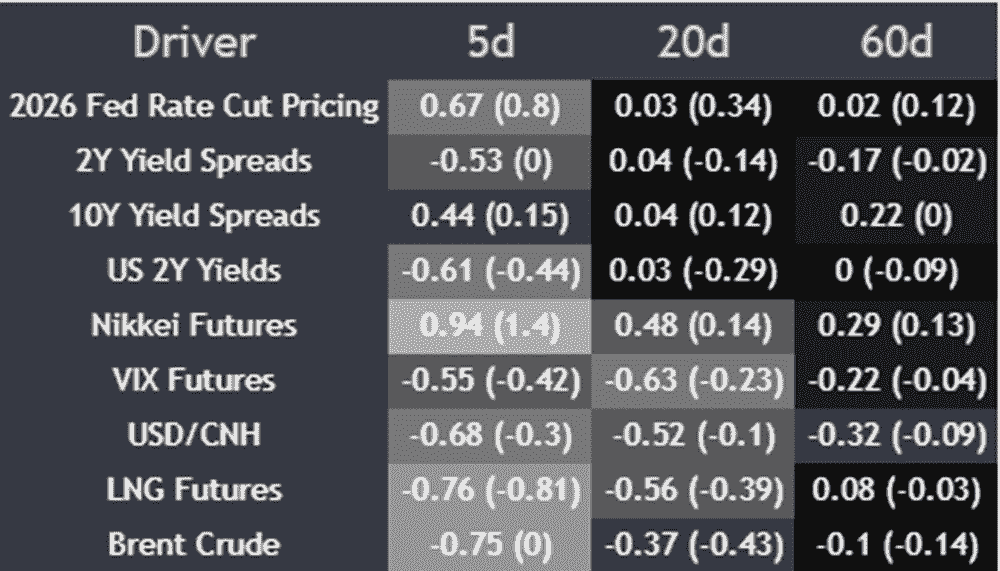
The correlation matrix above tells you everything you need to know about what’s been influencing the Kiwi in recent days. With a 0.94 positive relationship with Nikkei futures, used as a proxy for regional risk appetite given it often leads other Asian markets, it’s clear sentiment has been the dominant driver. That influence has even exceeded the impact of surging energy prices, reflected in the strengthening negative correlation with Brent and LNG futures over the past week, along with moves in rate differentials led primarily by U.S. Treasuries.
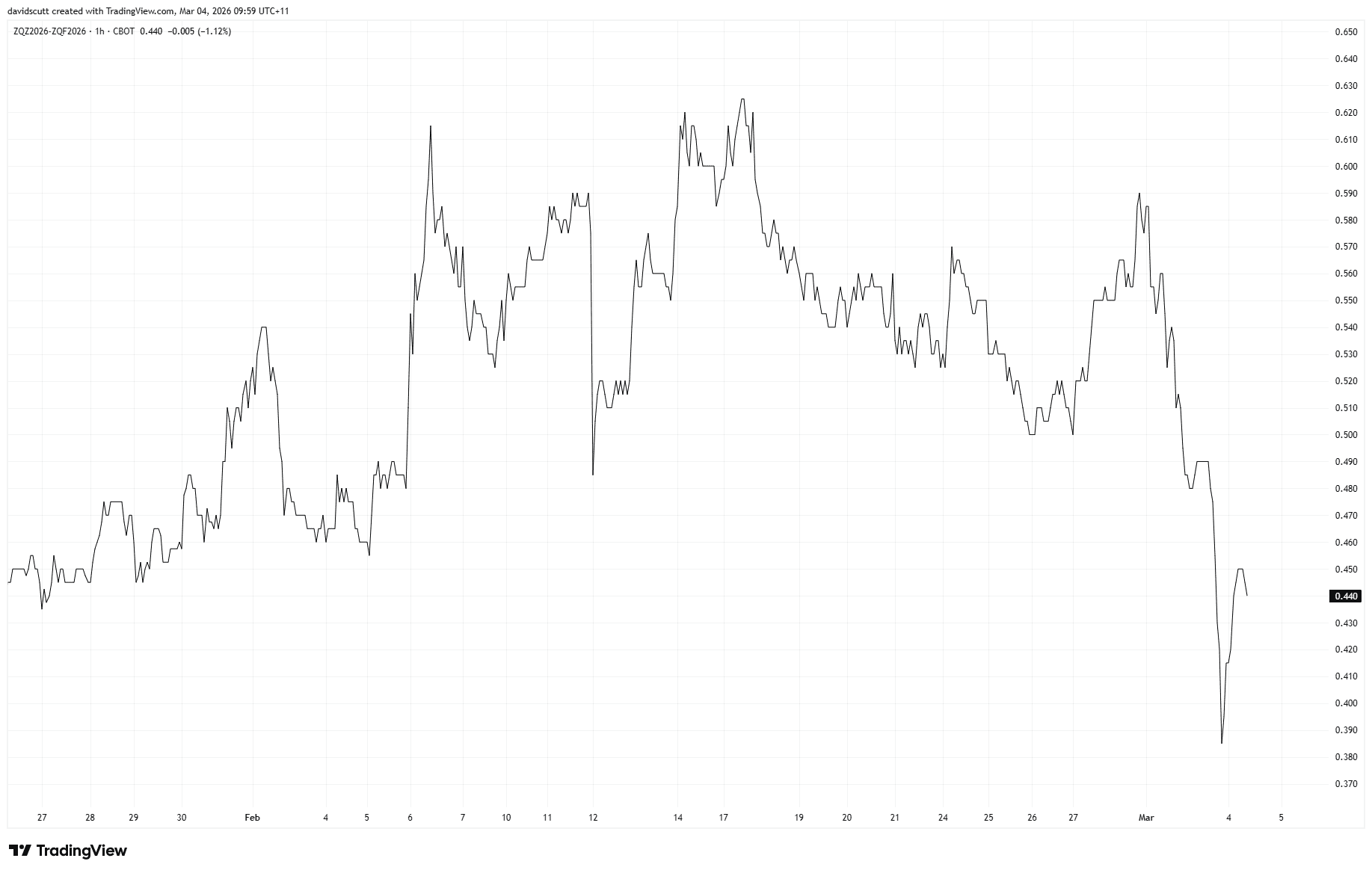
While the matrix shows only a modest relationship between NZD/USD and Fed rate cut pricing or short-dated yield differentials, rates have still leaned against the Kiwi at the margin. Fed funds futures now price just 44 basis points of easing this year, around 15bp less than at the start of the week. That shift, combined with the U.S. energy security advantage amid the Middle East escalation, has helped fuel broad dollar strength.
Source: TradingView
The Data Gauntlet Begins
But with key U.S. economic data now coming into view, the dollar move may not be linear. Concerns that surfaced late last week around private equity asset quality, bank exposure and potential AI-driven disruption risk shifting the focus back to U.S. growth and Fed expectations.
Source: TradingView
Monday’s ISM manufacturing report, which exceeded forecasts, helped to temporarily ease fears of a sharper slowdown. The focus now turns to whether that resilience extends beyond the factory sector.
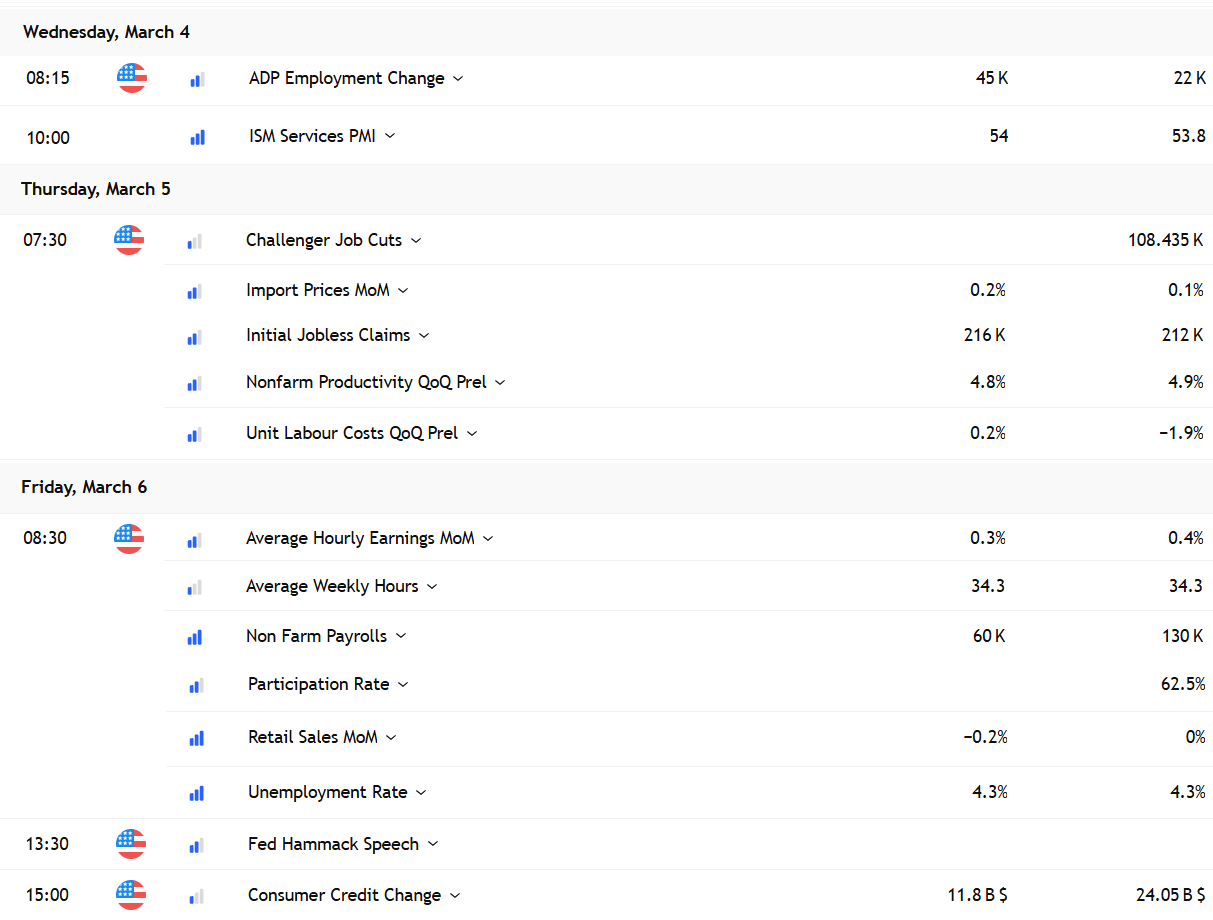
Today’s ADP report and ISM services PMI will take centre stage, with markets focused squarely on employment and new orders rather than price components. Any softening in hiring intentions would reinforce the bond market’s caution, particularly given concerns around AI-driven displacement of white-collar workers.
Challenger job cuts, productivity and unit labour cost data later in the week will provide further colour, before the real test arrives on Friday with non-farm payrolls and retail sales. In the current backdrop, solid data would likely steady risk appetite, while disappointment could quickly revive slowdown fears and reprice Fed expectations.
For the Kiwi, the outcome may be negative regardless of whether the data impresses or whiffs. Strong data could further widen the dollar’s yield advantage. Weak data, while normally supportive, risks triggering fresh weakness in riskier asset classes and an uptick in volatility, both traditional headwinds for the flightless bird. The market reaction may therefore prove more important than the data itself.
200DMA Becomes the Battleground
Source: TradingView
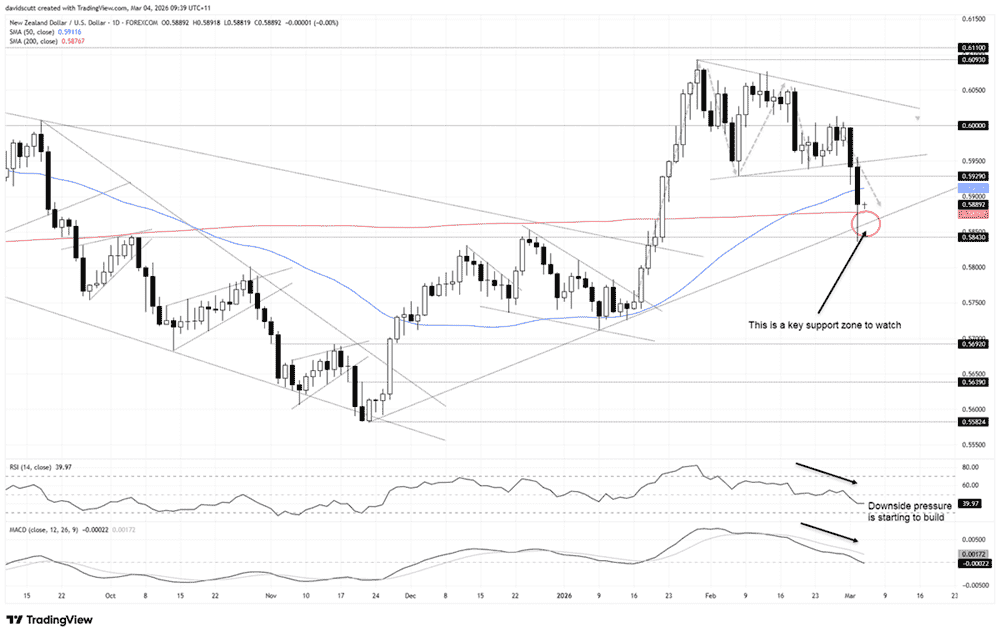
A few things stand out on the daily chart. After breaking to fresh multi-month highs in January, NZD/USD had been coiling within a bull pennant. Rather than extending the broader uptrend, we’ve seen a downside break, with the pair looking increasingly heavy since the RBNZ decision in mid-February.
The pair repeatedly struggled above 0.6000, and geopolitical headlines overwhelmed bulls who had been buying dips towards pennant support prior to the conflict. Tuesday’s breakdown has inflicted notable damage on the bullish case, although price managed to reclaim the 200-day moving average after briefly trading beneath it.
Importantly, it also bounced from the intersection of horizontal support at 0.5843 and the November 2025 uptrend, validating that trendline for now. The bulls haven’t been defeated, but directional risks look far more balanced than a month ago. RSI (14) had been carving lower highs before slipping below 50, while MACD has flipped negative after crossing below its signal line.
Downside pressure is therefore building, keeping a retest of the 200DMA and November uptrend in play. A clean break would undermine the broader bullish structure, tilting risks lower with little obvious technical support until around 0.5700.
If the 200DMA and uptrend hold, 0.5929 marks the origin of the breakdown and may now act as resistance. Former pennant support sits just above 0.5950, followed by the 0.6000 barrier.
Latest market news




Open an account in minutes
Experience award-winning platforms with fast and secure execution, and enjoy tight spreads from 0.5 pts on FX and 0.3 pts on indices.
Economic calendar
Web Trader platform
Our sophisticated web-based platform is packed with features.
Related articles
EUR/USD, USD/JPY Outlook: Oil, yields and an FX identity crisis
Crude oil is setting the tone across rates and FX, leaving EUR/USD vulnerable and USD/JPY caught between higher Treasury yields and the growing threat of intervention
AUD/USD Analysis: What's Next for the Australian Dollar After the RBA Decision?
Recent trading sessions have reflected a more neutral tone around the Australian dollar. This can be seen in AUD/USD price action, which has posted moves of roughly 0.2% over the last two sessions without establishing a clear direction. Much of this lack of momentum is linked to expectations surrounding the next policy moves from both the Reserve Bank of Australia (RBA) and the Federal Reserve.

Gold forecast: Rising yields become too hot for gold, but the outlook is far from bearish
Gold and silver prices took a plunge today, with the former down 3% and the latter falling some 5% by mid European session, before bouncing off their lows. The losses come after the metals remained largely supported until last week, despite the big dollar rally and surging bond yields as we have seen in recent weeks. But it simply got too much, and the metals succumbed to pressure today.

This report is intended for general circulation only. It should not be construed as a recommendation, or an offer (or solicitation of an offer) to buy or sell any financial products. The information provided does not take into account your specific investment objectives, financial situation or particular needs. Before you act on any recommendation that may be contained in this report, independent advice ought to be sought from a financial adviser regarding the suitability of the investment product, taking into account your specific investment objectives, financial situation or particular needs.
StoneX Financial Pte. Ltd., may distribute reports produced by its respective foreign entities or affiliates within the StoneX group of companies or third parties pursuant to an arrangement under Regulation 32C of the Financial Advisers Regulations. Where the report is distributed to a person in Singapore who is not an accredited investor, expert investor or an institutional investor (as defined in the Securities Futures Act), StoneX Financial Pte. Ltd. accepts legal responsibility to such persons for the contents of the report only to the extent required by law. Singapore recipients should contact StoneX Financial Pte. Ltd. at 6826 9988 for matters arising from, or in connection with the report.
In the case of all other recipients of this report, to the extent permitted by applicable laws and regulations neither StoneX Financial Pte. Ltd. nor its associated companies will be responsible or liable for any loss or damage incurred arising out of, or in connection with, any use of the information contained in this report and all such liability is hereby expressly disclaimed. No representation or warranty is made, express or implied, that the content of this report is complete or accurate.
StoneX Financial Pte. Ltd. is not under any obligation to update this report.
Trading CFDs carries a high level of risk that may not be suitable for some investors. Consider your investment objectives, level of experience, financial resources, risk appetite and other relevant circumstances carefully. The possibility exists that you could lose some or all of your investments, including your initial deposits. If in doubt, please seek independent expert advice. Visit www.forex.com/en-sg/terms-and-policies for the complete Risk Disclosure Statement.