



NZD/USD: US yield advantage keeps pressure on the Kiwi
NZD/USD has become unusually sensitive to relative front-end rates, with the US two-year yield advantage now near historically extreme levels.
Share this:

- US two-year yield advantage has rarely been this wide
- NZD/USD rate correlation hits 99.6th percentile since 2000
- Bearish four-hourly structure keeps downside breaks in focus
- Fed speak looms as key near-term directional catalyst
The RBNZ’s dovish hike earlier this month, coupled with a hawkish repricing of the US interest rate outlook, has delivered a hammer blow to NZD/USD, sending the pair to fresh multi-month lows last week.
I recently described USD/CAD as perhaps one of the best-trending major G10 FX pairs around. Looking at NZD/USD, you could make a similar argument.
Since the corrective bounce following the RBNZ’s meeting earlier this month ran out of steam, it’s been almost one-way traffic, extending a broader bearish trend that’s been in place since late August.
What makes this unwind especially interesting is that it appears to have been significantly influenced by shifts in the relative front-end interest rate outlook for New Zealand and the United States, likely explaining much of the price action seen over the past month.
And with NZD/USD now carving out what resembles a bearish continuation structure, the move may not be done yet.
Rate gap reaches rare territory
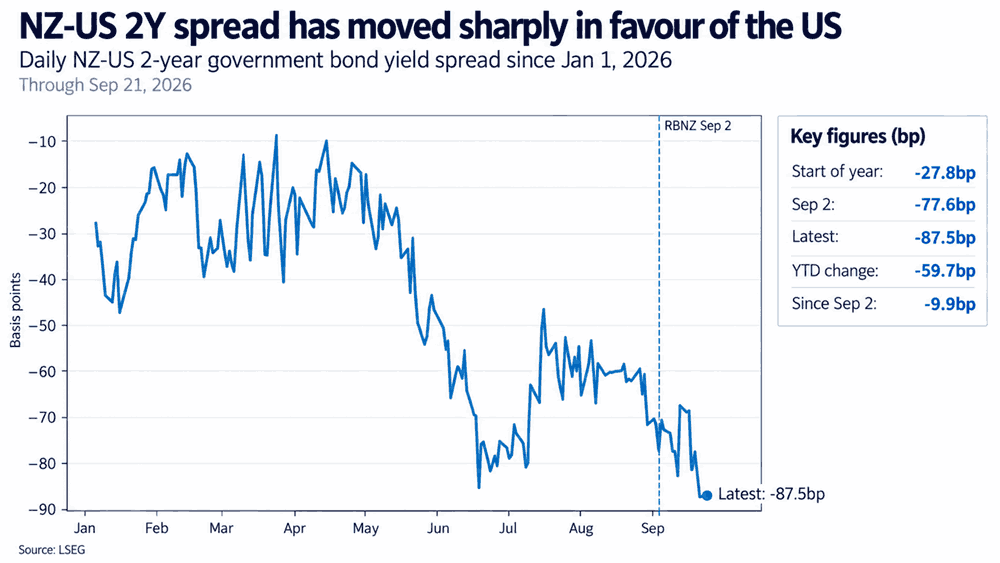
For a commodity currency that’s historically been closely aligned with risk appetite and the outlook for the global economy, the Kiwi’s had an almost unhealthy focus on relative rates this year, especially since the RBNZ’s September meeting, where it delivered a dovish hike, taking the overnight cash rate to 2.75%.
Source: LSEG
That’s helped drive a significant widening in the US two-year yield advantage over New Zealand, which has blown out to around 87.5 basis points. On a historical basis, that’s an unusually wide gap, sitting around the bottom 2% of observations since 2000.
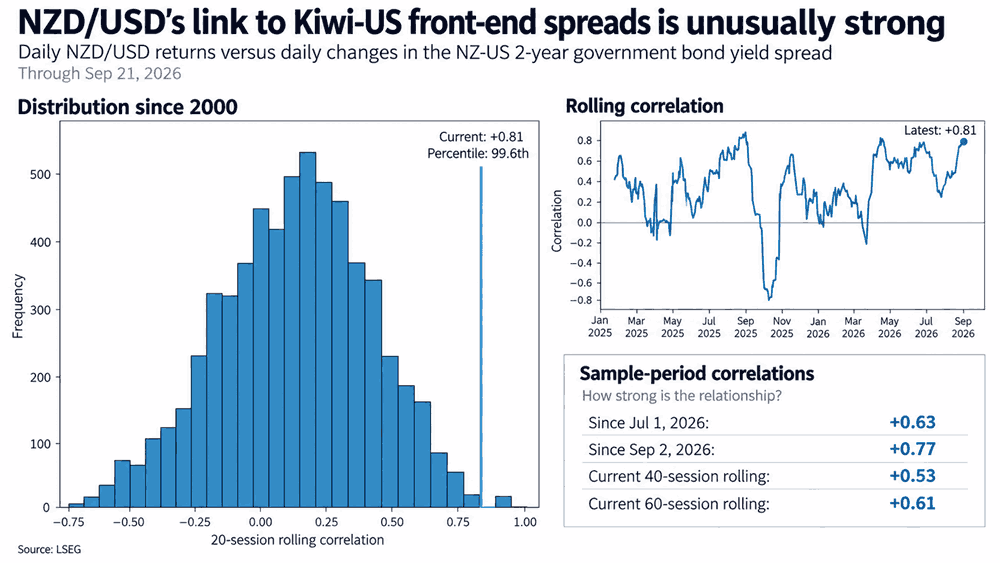
The relationship with NZD/USD has strengthened dramatically at the same time. The 20-session correlation between daily moves in the pair and daily changes in the NZ-US two-year spread has climbed to around +0.81, putting it near the 99.6th percentile of observations since 2000.
It’s not just a very short-term phenomenon either. The current 40-session correlation sits around +0.53, while the 60-session measure is around +0.61, suggesting that rather than risk appetite or commodity market movements, it’s been relative front-end rates that have been driving the bus for the Kiwi over recent months.
Source: LSEG
It also helps explain why the current bearish trend has been so persistent despite broader risk conditions remaining firm. Put bluntly, rather than being driven by a conventional risk-off shock, the downside pressure has largely come from the shifting rates outlook, with US yields helping to drive the dollar higher in response.
And with that yield advantage sitting near historically extreme levels, there’s little in the rates picture yet to suggest the pressure on NZD/USD has meaningfully eased, making relative front-end rates the focal point when assessing directional risk for the pair.
Bears wait for confirmation
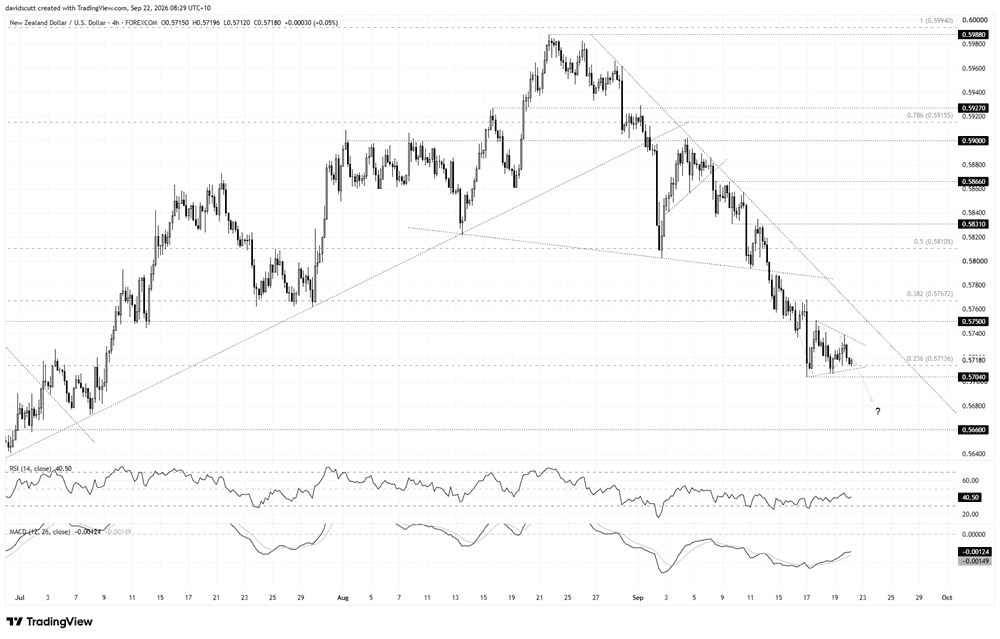
Turning to the technicals, and demonstrating the beautiful trending nature of the pair flagged in the introduction, NZD/USD finds itself coiling within something akin to a rising wedge structure on the four-hourly, having hit fresh multi-month lows last week.
Given the prevailing trend, selling into strength is still favoured, along with potential downside breaks. Of course, we haven’t seen a break of the structure as yet, so until that takes place, patience is warranted.
Source: TradingView
Levels to focus on in the near term are the 23.6% Fib retracement of the May to June bear move, along with 0.5704, the low hit on September 17. If we were to see a break of the lower side of the structure that extends beyond 0.5704, it would create a setup where shorts could be established beneath the level with a tight stop above for protection, initially targeting a retracement towards 0.5680, where the price bounced on a couple of occasions in early July.
Below that, 0.5660 is the next level of note, having acted as both resistance and support for periods in June this year. If that were to break, bears would likely be eyeing off a retest of the swing low set in June at 0.5627.
If we were to see a bounce in the pair in the near term, the upper end of the structure is the first level of note, along with 0.5750. The latter is a minor level that has acted as both support and resistance at times this year, reinforcing the need to wait for confirmation before setting bearish trades.
The message from the oscillators is one of gradually diminishing downside pressure. While RSI (14) and MACD continue to favour short setups over longs, both have been grinding higher over the past few days. Unless we were to see a fresh low print in RSI (14) and MACD curl back lower and cross beneath the signal line, delivering a bearish crossover, it’s another indicator pointing to the need for patience before looking to pounce.
Fed speak takes centre stage
There’s not a great deal on the economic calendar this week that screens as likely to move NZD/USD materially, which suggests Fed speak looms as the most likely catalyst to generate directional cues from a fundamental perspective.
We saw Chicago Fed President Austan Goolsbee out overnight delivering another hawkish message, suggesting persistent inflation pressures could warrant more hikes than the median one additional move signalled by the Fed in its latest dot plot at the September FOMC meeting.
But with markets already pricing another 75 basis points of hikes by the June meeting next year, you could argue the near-term risks around the Fed outlook are skewed towards a slightly less hawkish outcome.
That makes New York Fed President John Williams’ speech later Tuesday worth watching closely. Williams has often come across as a little more dovish than the consensus view on the committee, suggesting there may be grounds for a pop in NZD/USD should he continue down that path, despite voting for a hike last week.
Latest market news




Open an account in minutes
Experience award-winning platforms with fast and secure execution, and enjoy tight spreads from 0.5 pts on FX and 0.3 pts on indices.
Economic calendar
Web Trader platform
Our sophisticated web-based platform is packed with features.
Related articles
US CPI Preview: Follow the Fed and Look Past the Hot Headline
A 0.6% m/m reading in headline CPI, while scary at first glance, is already expected and presumably discounted into the current market prices. Instead, the “core” reading will be more impactful for the Fed and markets - see what it means for the US dollar!

Japanese Yen Short-term Outlook: USD/JPY Breakout Risk Builds Below 200-Day Average 10 13 2026
USD/JPY is trading in a narrow range beneath major resistance ahead of CPI, with the next breakout likely to set the near-term directional tone.

USD/CAD Forecast: Canadian Dollar Holds Firm as Markets Await U.S. CPI Data
The trading week continues to unfold and, for now, USD/CAD remains trapped in a relatively consistent phase of indecision. The Canadian dollar has managed to hold on to some of its recent strength, which can be seen in the pair's performance over the last two sessions, where it has declined by roughly 0.2%.

This report is intended for general circulation only. It should not be construed as a recommendation, or an offer (or solicitation of an offer) to buy or sell any financial products. The information provided does not take into account your specific investment objectives, financial situation or particular needs. Before you act on any recommendation that may be contained in this report, independent advice ought to be sought from a financial adviser regarding the suitability of the investment product, taking into account your specific investment objectives, financial situation or particular needs.
StoneX Financial Pte. Ltd., may distribute reports produced by its respective foreign entities or affiliates within the StoneX group of companies or third parties pursuant to an arrangement under Regulation 32C of the Financial Advisers Regulations. Where the report is distributed to a person in Singapore who is not an accredited investor, expert investor or an institutional investor (as defined in the Securities Futures Act), StoneX Financial Pte. Ltd. accepts legal responsibility to such persons for the contents of the report only to the extent required by law. Singapore recipients should contact StoneX Financial Pte. Ltd. at 6826 9988 for matters arising from, or in connection with the report.
In the case of all other recipients of this report, to the extent permitted by applicable laws and regulations neither StoneX Financial Pte. Ltd. nor its associated companies will be responsible or liable for any loss or damage incurred arising out of, or in connection with, any use of the information contained in this report and all such liability is hereby expressly disclaimed. No representation or warranty is made, express or implied, that the content of this report is complete or accurate.
StoneX Financial Pte. Ltd. is not under any obligation to update this report.
Trading CFDs carries a high level of risk that may not be suitable for some investors. Consider your investment objectives, level of experience, financial resources, risk appetite and other relevant circumstances carefully. The possibility exists that you could lose some or all of your investments, including your initial deposits. If in doubt, please seek independent expert advice. Visit www.forex.com/en-sg/terms-and-policies for the complete Risk Disclosure Statement.