





Swiss Franc vs Japanese Yen: Why CHF remains top dog in the safe haven stakes
CHF/JPY continues to grind higher despite short-term bouts of risk aversion, highlighting how the franc’s fundamentals—low debt levels and defensive traits—set it apart from the more volatile, positioning-sensitive yen.
Share this:

- Swiss government debt just 38% of GDP vs Japan above 250%
- Yen still behaves like a funding currency, not a haven
- CHF/JPY breaks higher after bullish channel breakout
- Momentum indicators suggest buying dips remains preferred strategy
Summary
CHF/JPY continues to trend higher as the franc reasserts its status as the go-to currency haven. While both the yen and franc attracted demand during April’s volatility, structural differences — particularly Japan’s role in carry trades and massive debt load — help explain why the Swissie keeps outperforming. The breakout on the daily suggests that trend may have further to run.
Not Every Safe Haven Created Equala
While traditional safe havens such as the Japanese yen and Swiss franc performed their job admirably in April as heightened levels of uncertainty caused volatility across markets to spike, when it comes to the title of being the undisputed safe haven of the FX world, there really is no contest: the Swissie is way out in front with daylight second.
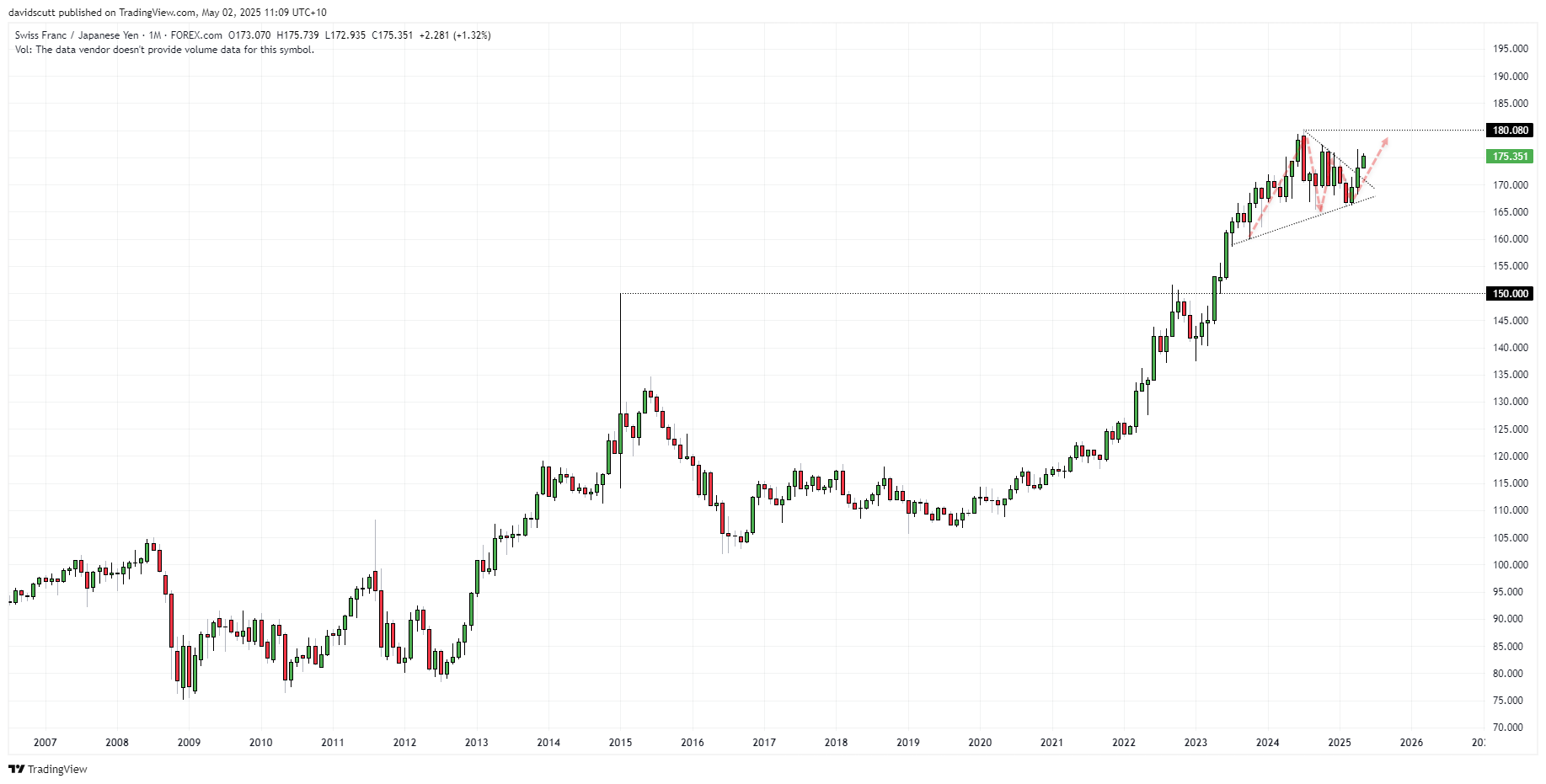
The monthly chart below underlines that point, with CHF/JPY rising from just above 75 during the GFC to more than 180 last year, an increase of 140% with a large chunk of that occurring since the pandemic. The bullish break of the triangle the pair had been coiling in since July suggests that increase may have further to run as we move towards the second half of 2025.
Source: TradingView
Explaining Franc Outperformance
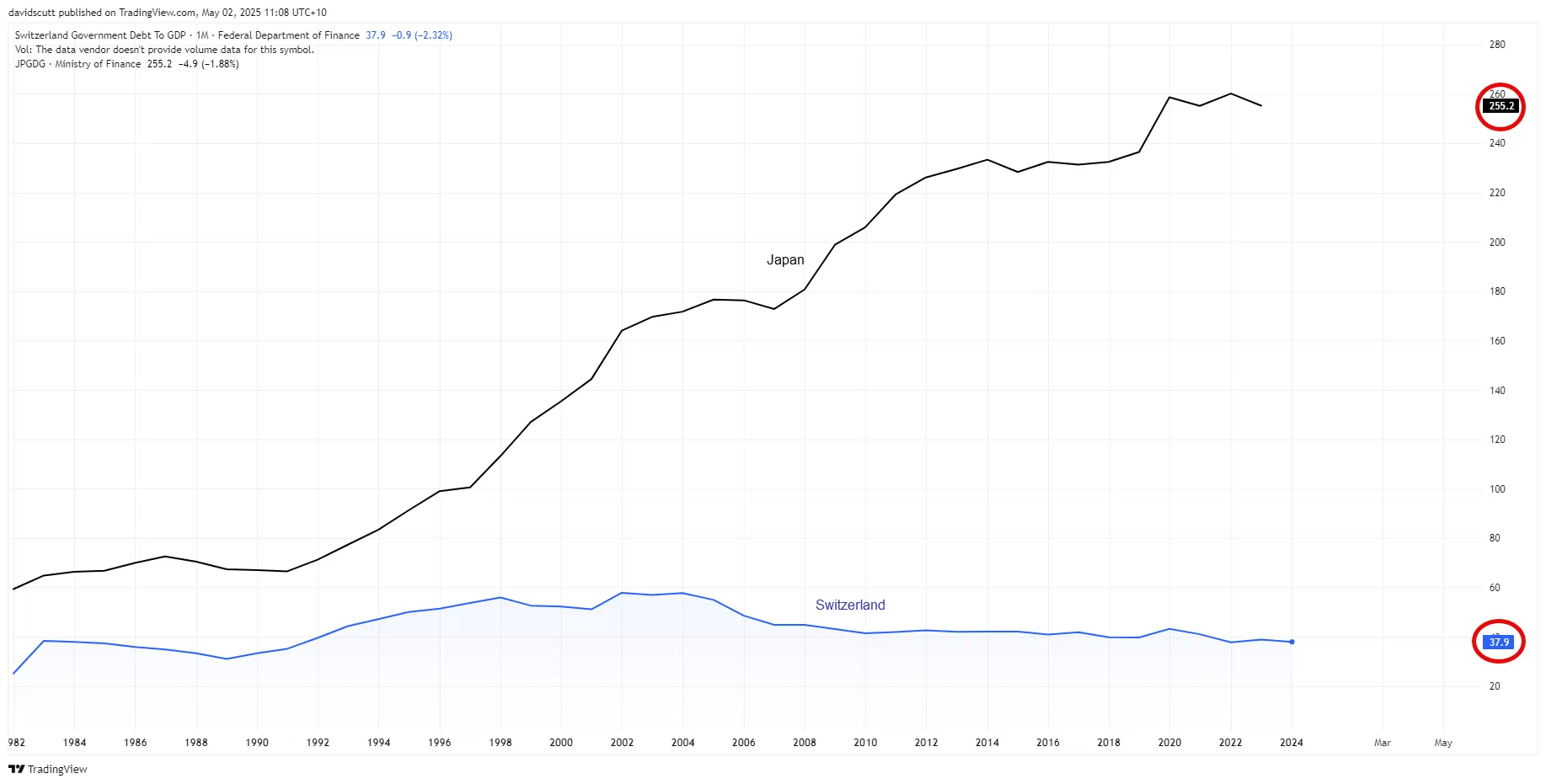
So why does the franc tend to outperform the yen over time despite both being considered safe haven currencies? A big reason is the stark contrast in government finances. As the chart below shows, Switzerland’s debt load sits just under 40% of GDP—among the lowest in the developed world—while Japan’s has surged to over 250%. That divergence undoubtedly feeds into broader market confidence: the franc is seen as a store of value.
Source: TradingView
In contrast, the yen behaves more like a release valve for risk appetite than a traditional haven. Even with the Bank of Japan (BOJ) embarking on monetary policy normalisation, it’s still one of the world’s most popular funding currencies for carry trades into higher yielding, often riskier asst classes. That positioning dynamic means it often weakens when markets are calm, then snaps higher when those trades are unwound, as we saw in April. It’s reactive, not defensive like the franc. For the yen to outperform, it would therefore likely require a prolonged period of market turmoil.
CHF/JPY Risks Biased Higher
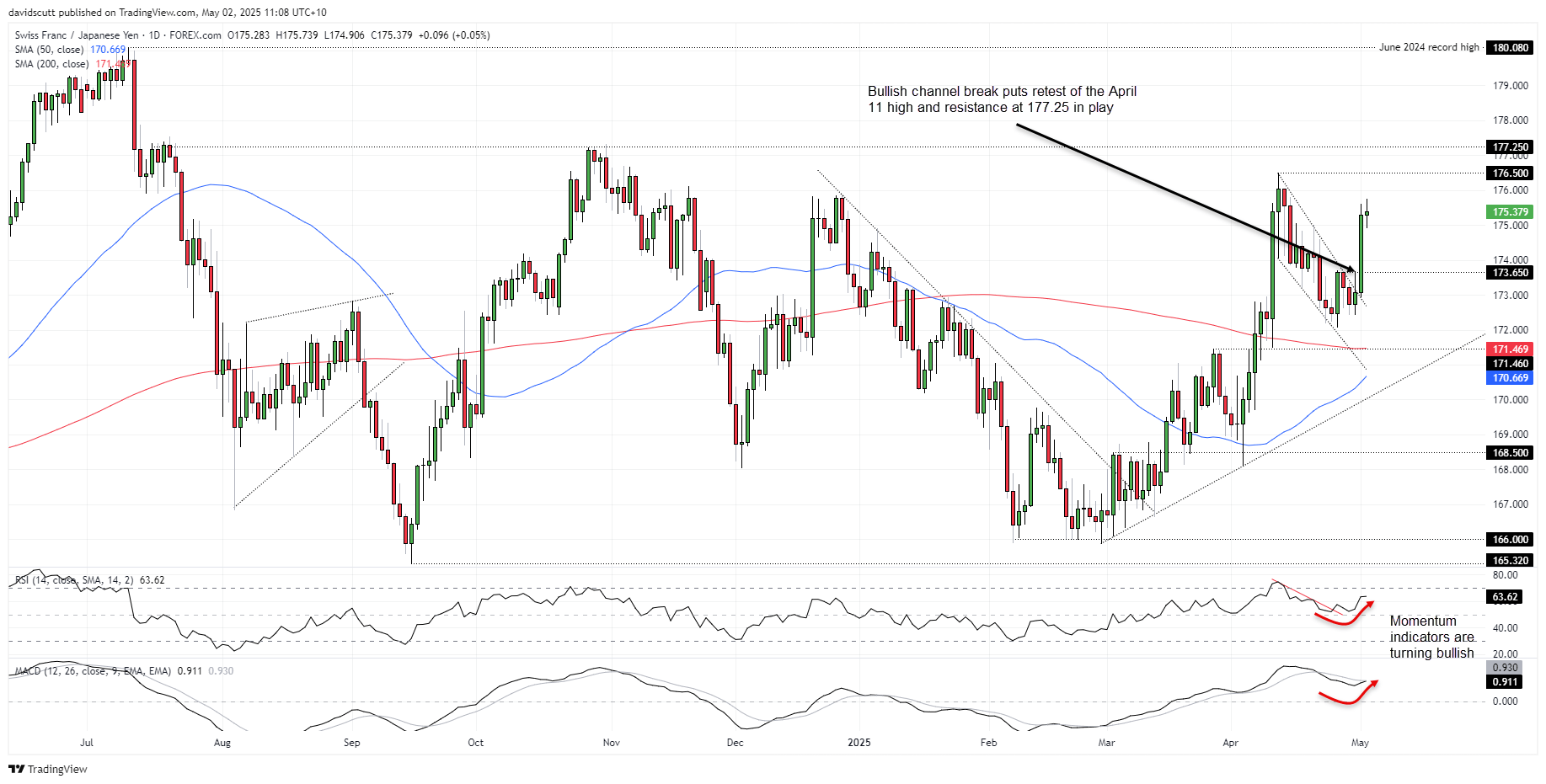
Zooming in, it therefore comes as no surprise that throughout the volatility seen this year, CHF/JPY keeps on trending higher as the yen drops and pops on abrupt changes in broader risk appetite.
Source: TradingView
Following a bullish breakout of the descending channel the pair had been trading in since the middle of April, risks for CHF/JPY look again to be skewing higher, especially with momentum indicators turning bullish. RSI (14) is trending higher while MACD is about to cross the signal line above 0. Combined, it favours buying dips over selling rips.
Topside levels of note include the April 11 swing high of 176.50 and resistance at 177.25. A break and close of the latter would increase the probability of a retest of the record high of 180.08 set in July last year. On the downside, 173.65, 172.10 and 171.46 are minor levels that could either act as bases for bullish setups or targets for bears, if the bullish breakout were to reverse.
-- Written by David Scutt
Follow David on Twitter @scutty
How to trade with City Index
You can trade with City Index by following these four easy steps:
- Open an account, or log in if you’re already a customer
• Open an account in the UK
• Open an account in Australia
• Open an account in Singapore
- Search for the market you want to trade in our award-winning platform
- Choose your position and size, and your stop and limit levels
- Place the trade
Related tags:


Open an account in minutes
Experience award-winning platforms with fast and secure execution, and enjoy tight spreads from 0.5 pts on FX and 0.3 pts on indices.
Economic calendar
Web Trader platform
Our sophisticated web-based platform is packed with features.
Related articles

US Dollar Bulls Hold Firm, but Euro Warns of Squeeze Risk | COT Report
US dollar bulls remain firmly positioned, but record euro shorts have failed to break EUR/USD support, raising the risk of a short-covering rally.


USD/CAD reversal risk builds as central bank showdown looms
USD/CAD has delivered a bullish reversal signal from established support, just as traders prepare for Fed and BoC decisions. Aggressive Canadian rate hike expectations and conflicting momentum signals make the coming session important.

Australian Dollar Outlook: AUD/USD Screams Sentiment Extreme Into Fed, CPI
AUD/USD rebounds despite record bearish futures positioning, with Australian Q3 CPI and the Fed meeting threatening to trigger another short squeeze.
This report is intended for general circulation only. It should not be construed as a recommendation, or an offer (or solicitation of an offer) to buy or sell any financial products. The information provided does not take into account your specific investment objectives, financial situation or particular needs. Before you act on any recommendation that may be contained in this report, independent advice ought to be sought from a financial adviser regarding the suitability of the investment product, taking into account your specific investment objectives, financial situation or particular needs.
StoneX Financial Pte. Ltd., may distribute reports produced by its respective foreign entities or affiliates within the StoneX group of companies or third parties pursuant to an arrangement under Regulation 32C of the Financial Advisers Regulations. Where the report is distributed to a person in Singapore who is not an accredited investor, expert investor or an institutional investor (as defined in the Securities Futures Act), StoneX Financial Pte. Ltd. accepts legal responsibility to such persons for the contents of the report only to the extent required by law. Singapore recipients should contact StoneX Financial Pte. Ltd. at 6826 9988 for matters arising from, or in connection with the report.
In the case of all other recipients of this report, to the extent permitted by applicable laws and regulations neither StoneX Financial Pte. Ltd. nor its associated companies will be responsible or liable for any loss or damage incurred arising out of, or in connection with, any use of the information contained in this report and all such liability is hereby expressly disclaimed. No representation or warranty is made, express or implied, that the content of this report is complete or accurate.
StoneX Financial Pte. Ltd. is not under any obligation to update this report.
Trading CFDs carries a high level of risk that may not be suitable for some investors. Consider your investment objectives, level of experience, financial resources, risk appetite and other relevant circumstances carefully. The possibility exists that you could lose some or all of your investments, including your initial deposits. If in doubt, please seek independent expert advice. Visit www.forex.com/en-sg/terms-and-policies for the complete Risk Disclosure Statement.