


USD/JPY Turns Lower as BOJ Hawk Echoes Bessent
USD/JPY has turned lower as the market starts taking seriously the risk of faster BOJ rate hikes, with Takata’s comments closely echoing those from US Treasury Secretary Scott Bessent over the weekend.
Share this:

- USD/JPY breaks its August uptrend after a bearish reversal
- BOJ member Takata flags consecutive hikes, echoing Bessent
- JGBs bear flatten as front-end yields surge
- US jobs data may decide whether the move sticks
USD/JPY has printed a bearish reversal candle on the four-hourly timeframe, followed by a break of the uptrend in place since August 20, with the move backed by a clear fundamental catalyst as BOJ officials continue to portray a far more hawkish outlook than what was seen earlier in the year.
BOJ Hawk Opens Door to Consecutive Hikes
Speaking in Sapporo earlier in the session, BOJ board member Takata suggested the pace of rate hikes should be assessed at every meeting, rather than assuming tightening will continue at the roughly twice-yearly pace seen so far. He also openly raised the possibility of consecutive hikes.
Such hawkish talk from Takata is hardly surprising given he has consistently dissented in favour of higher rates and has been the most hawkish member of the Board. What is more interesting is his willingness to openly discuss accelerating the pace of tightening, language that closely mirrors comments from US Treasury Secretary Scott Bessent over the weekend.
Speaking ahead of the G20 finance ministers meeting, Bessent expressed confidence that BOJ Governor Ueda would “do the right thing” on monetary policy and also openly entertained the prospect of the BOJ moving more aggressively with policy normalisation.
Coming so soon after his remarks, Takata’s comments will do nothing to diminish the view that the US Treasury Secretary is exerting strong influence over the direction of Japanese policy. That perception already has plenty of fuel after the coordinated FX intervention in late July, and the overlap in language around a faster pace of tightening will only bolster it.
Ueda Flags FX as an Upside Price Risk
Adding fuel to the fire, Ueda, speaking at the conclusion of the G20 finance ministers meeting in the United States earlier Wednesday, struck a relatively hawkish tone by his usual standards. While he didn’t commit to a September hike, he was clear the bank is focusing more on upside inflation risks and will take those risks into account when deliberating policy.
He also made explicit comments on the impact of the weaker yen, saying the BOJ is carefully watching FX moves as one risk factor to the price outlook and is scrutinising yen moves among the factors contributing to upside price risks.
That makes it clear the he is acknowledging the inflation risk posed by persistent yen weakness, especially when higher energy prices stemming from the conflict in the Middle East are already adding to imported price pressures.
JGB Curve Bear Flattens Sharply
Source: LSEG, FOREX.com
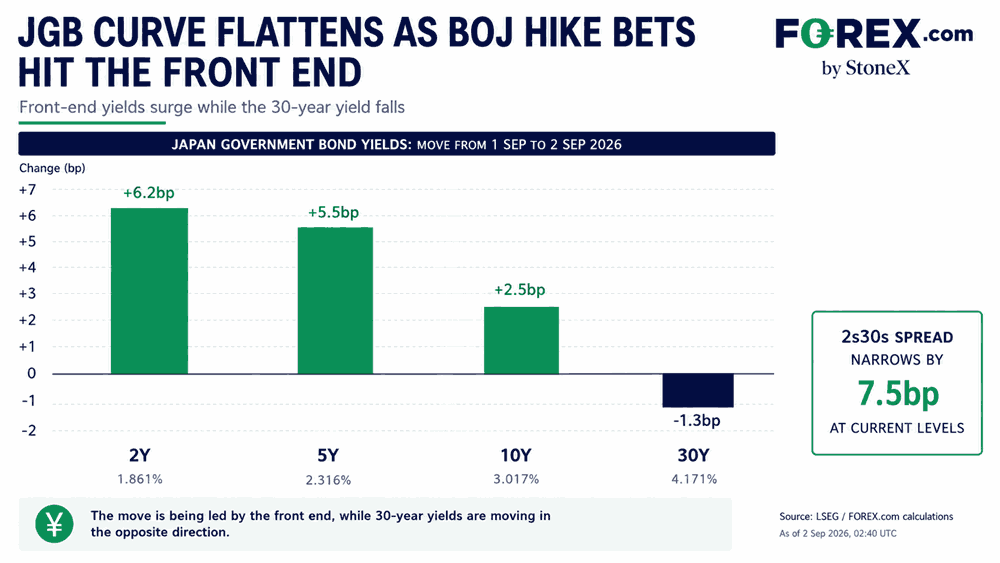
While it's far too early to tell whether they’ll have any lasting success, for once bond traders are paying attention to what’s being said. There has been a noticeable bear flattening of the JGB curve, with two-year yields up 6.2bp and five-year yields 5.5bp, while the move becomes progressively smaller further out. Ten-year yields are up only 2.5bp, while 30-year yields are actually down around 1.3bp.
At current levels, the 2s30s curve has flattened by roughly 7.5bp. That is a seriously rare move, sitting around the bottom 1% of daily changes seen since 2007. The rise in two-year yields is even more extreme, around the 99.8th percentile over the same period. The obvious caveat is that the session is nowhere near finished, so these numbers can still move around a lot before the close.
Even so, this is much closer to the kind of outcome Bessent and his Japanese counterpart Satsuki Katayama are trying to achieve: a stronger yen, less pressure on the long end of the JGB curve and, by extension, less additional pressure on longer-dated US Treasuries. At the same time, it points to a market that may be starting to believe the BOJ is prepared to act on inflation by lifting real policy rates out of negative territory.
What makes the reaction to these comments unusual relative to the prevailing status quo is that it has been driven by the Japanese side of the equation rather than the US interest rate outlook, which has been the dominant factor in recent months.
USD/JPY Breaks Trend Ahead of Jobs Data
Source: TradingView
While the latest hawkish remarks have had the effect of reversing earlier gains in USD/JPY, whether the move sticks will likely come down to the incoming flow of US data, starting with ADP private-sector employment later today before far chunkier releases arrive over the coming days, headlined by Friday’s August non-farm payrolls report.
As detailed in our week ahead note, the unemployment rate may prove more important than the payrolls figure itself, especially with the recent decline in labour force participation on track to become record-setting should we see another unchanged or lower reading for August.
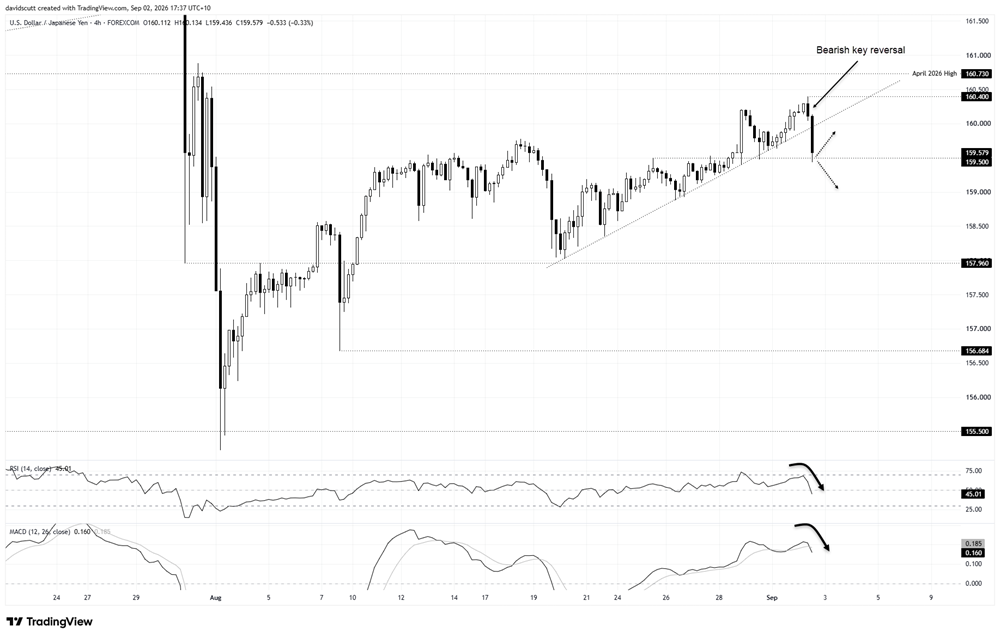
Looking at USD/JPY on the four-hourly chart, you can see the key reversal candle after the pair failed to sustain an early-session push higher, eventually culminating in a break of the August 20 uptrend. The move has since stalled around 159.50, a level that has acted as both support and resistance over the past week and is now the immediate focal point beneath where the pair trades.
The message from the oscillators is one of short-term shifting momentum, with RSI (14) flipping from near overbought territory to beneath the neutral 50 level, while MACD has staged a bearish crossover but remains in positive territory. Upside momentum that had been building has abruptly declined, with directional risk now arguably starting to skew to the downside into the European session. Beneath 159.50, the levels to watch are 159.00, where the pair was bid for a period last week, followed by the area between 158.00 and 157.96, where price has done a lot of work either side of since late July.
Overhead, 160.40 was the session high hit before the latest reversal, while 160.73 is the more important technical level above, marking the multi-decade high set in April this year, which has since flipped to act as both support and resistance.



Open an account in minutes
Experience award-winning platforms with fast and secure execution, and enjoy tight spreads from 0.5 pts on FX and 0.3 pts on indices.
Economic calendar
Web Trader platform
Our sophisticated web-based platform is packed with features.
Related articles
AUD/USD Bulls Fight Back After Australian Jobs Shock
AUD/USD has been hit by another ugly Australian employment report, sending RBA rate hike expectations sharply lower. Yet the relationships driving the currency have shifted since quarter-end, and improving risk appetite could provide the fuel for a recovery.

Gold Price Short-term Outlook: XAU/USD Holds Critical Support as Breakout Nears 10 15 2026
Gold is consolidating after a steep selloff, with momentum divergence raising the stakes for the next move ahead of the Fed decision.


USD/JPY Update: Can the Japanese Yen Sustain Its Recovery?
Short-term price action around the Japanese yen has started to show some relative improvement over recent sessions. This can be seen in the recent performance of USD/JPY, which has now recorded three consecutive daily declines in favor of the Japanese currency, resulting in a depreciation of roughly 0.35% over the period.

This report is intended for general circulation only. It should not be construed as a recommendation, or an offer (or solicitation of an offer) to buy or sell any financial products. The information provided does not take into account your specific investment objectives, financial situation or particular needs. Before you act on any recommendation that may be contained in this report, independent advice ought to be sought from a financial adviser regarding the suitability of the investment product, taking into account your specific investment objectives, financial situation or particular needs.
StoneX Financial Pte. Ltd., may distribute reports produced by its respective foreign entities or affiliates within the StoneX group of companies or third parties pursuant to an arrangement under Regulation 32C of the Financial Advisers Regulations. Where the report is distributed to a person in Singapore who is not an accredited investor, expert investor or an institutional investor (as defined in the Securities Futures Act), StoneX Financial Pte. Ltd. accepts legal responsibility to such persons for the contents of the report only to the extent required by law. Singapore recipients should contact StoneX Financial Pte. Ltd. at 6826 9988 for matters arising from, or in connection with the report.
In the case of all other recipients of this report, to the extent permitted by applicable laws and regulations neither StoneX Financial Pte. Ltd. nor its associated companies will be responsible or liable for any loss or damage incurred arising out of, or in connection with, any use of the information contained in this report and all such liability is hereby expressly disclaimed. No representation or warranty is made, express or implied, that the content of this report is complete or accurate.
StoneX Financial Pte. Ltd. is not under any obligation to update this report.
Trading CFDs carries a high level of risk that may not be suitable for some investors. Consider your investment objectives, level of experience, financial resources, risk appetite and other relevant circumstances carefully. The possibility exists that you could lose some or all of your investments, including your initial deposits. If in doubt, please seek independent expert advice. Visit www.forex.com/en-sg/terms-and-policies for the complete Risk Disclosure Statement.