


USD/JPY Weekly Outlook: Rally pressures Japan as yields surge ahead of Fed, BoJ
USD/JPY is climbing rapidly as markets unwind Fed rate cut expectations and test Japan’s tolerance for yen weakness. With Fed and BoJ decisions looming and intervention risks rising, policymakers are under pressure.
Share this:

- Iran conflict lifts energy prices, boosting US yields and the dollar
- USD/JPY rally sees rate differentials reassert as the dominant driver
- Yen slides as markets test Japan by selling both JGBs and the currency
- Fed and BoJ decisions loom with intervention risks rising
- Resistance at 160.23 and 161.95, support 159.45
Energy shock lifts yields, dollar
Escalating conflict in the Middle East continues to provide a powerful tailwind for the US dollar, delivering a positive terms of trade shock for the United States while simultaneously lifting global inflation risks.
With energy prices surging, markets have begun to unwind expectations for aggressive Federal Reserve rate cuts, pushing Treasury yields higher further out the curve. For the US, the combination of energy self-sufficiency, rising yields and renewed safe haven demand has proven a potent mix, helping drive the dollar index to its highest level since mid-2025.
The move has placed renewed pressure on currencies heavily exposed to higher energy import costs, with the yen among the most vulnerable. Japan remains heavily reliant on imported energy, meaning the surge in prices alongside a stronger dollar has accelerated the currency’s slide.
Those forces may remain firmly in play in the week ahead following US strikes on Iran’s Kharg Island, the country’s main oil export hub. While the attack targeted military assets rather than oil infrastructure, the escalation risks keeping energy markets on edge, reinforcing the inflation impulse already flowing through global markets.
Treasury Yields in control
After a period where traditional relationships struggled to hold, USD/JPY has once again fallen back into line with its most reliable driver: interest rate differentials.

Source: TradingView
As seen in the correlation matrix above, correlations between USD/JPY and US yields have strengthened sharply in recent days. Over the past five sessions, the correlation with US 10-year Treasury yields has surged to 0.90, indicating the two have been moving almost in lockstep. The relationship with the US-Japan 10-year yield spread has also strengthened, sitting at 0.74 over the same period.
Importantly, the latest move appears less about the direct impact of higher energy prices and more about what they imply for inflation and interest rates. As markets speculate over how long potential supply disruptions may last, the Treasury curve has shifted higher, particularly at the front end, as investors scale back expectations for Federal Reserve rate cuts.
That helps explain why USD/JPY’s strongest relationship currently sits with US yields rather than traditional risk drivers. Inflation concerns appear to be exerting greater influence than growth fears, helping to lift yields and reinforce dollar strength.
Japan’s vulnerability is also becoming more visible in the process. While Japanese government bond yields have also drifted higher recently, the move has done little to arrest the yen’s slide as Treasury yields have climbed at a faster pace. The result has been a widening in rate differentials, a backdrop that has historically favoured USD/JPY upside.
Japan feeling the heat: yen, JGBs slide
While US yields have been doing the heavy lifting behind USD/JPY’s latest push higher, developments in Japan tell a different story.
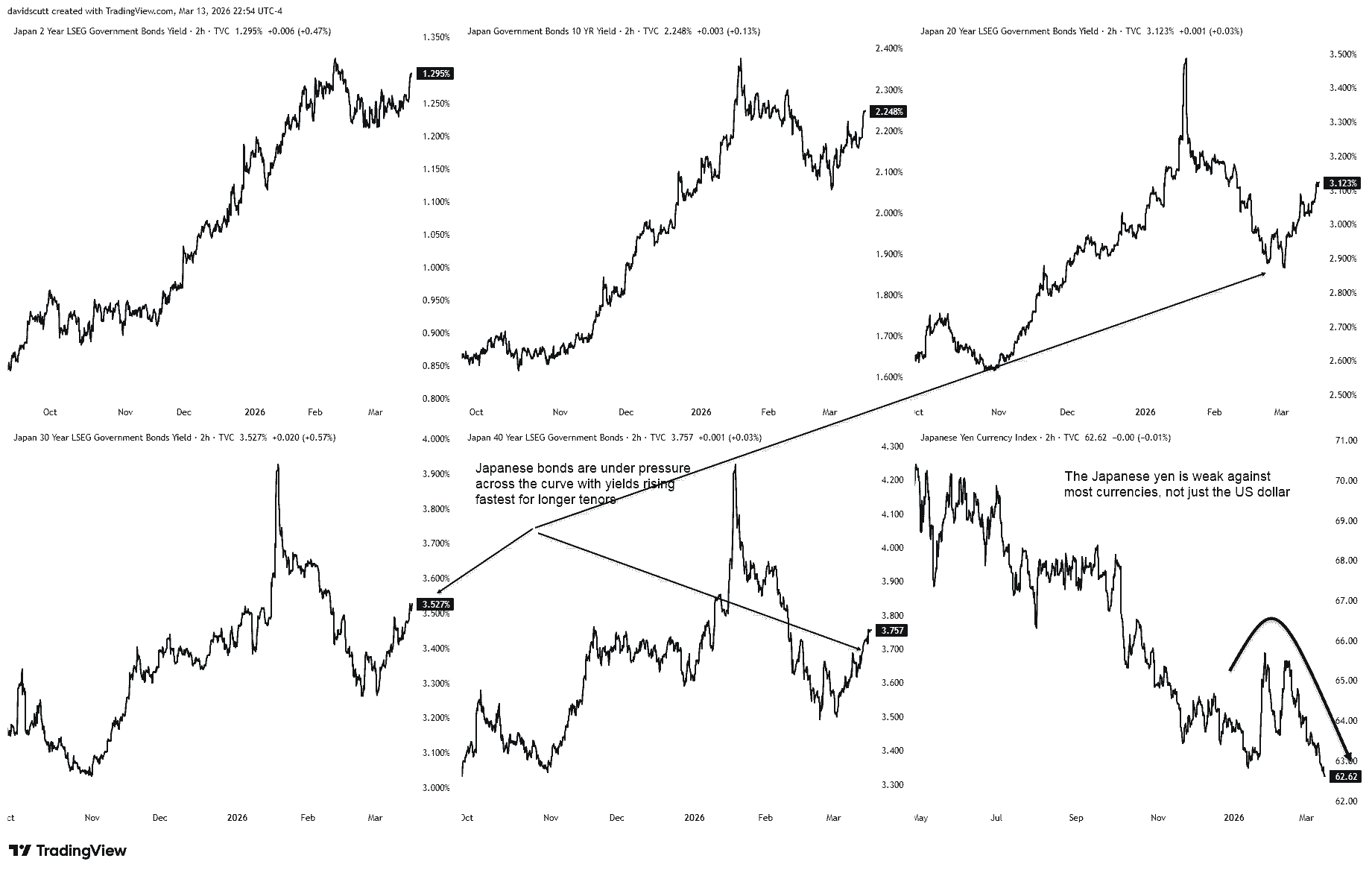
As seen in the chart below, the JGB curve has bear steepened in recent weeks, with yields rising across maturities from the front end to the ultra-long end. The move resembles the sell-off seen ahead of Japan’s election earlier this year, signalling markets are again pushing for higher policy rates.
Source: TradingView
At the same time, the yen continues to slide. The broader yen currency index, shown in the bottom right of the chart, has fallen even as domestic yields have moved higher, underscoring how little support rising JGB yields are currently providing the currency.
With energy prices surging and Japan heavily reliant on imports, investors are again questioning the country’s fiscal outlook. The result has been simultaneous pressure on both the yen and the JGB market.
In effect, the market appears to be testing policymakers by selling both. Realistically, if forced to choose, authorities are far more likely to prioritise stability in the bond market than the currency.
BoJ: watching for dissents
As its meeting this week will not include updated economic projections, attention will instead fall on Ueda’s press conference and the voting breakdown for clues on the policy outlook.
In January, only one board member dissented in favour of a rate hike. If that number increases, it may strengthen confidence the Bank is edging closer to tightening.
For now, markets see little chance of action immediately, with roughly a 10% probability of a hike priced for this meeting. Expectations instead centre on April as the next realistic opportunity for tightening, where markets currently assign around a 60% probability of a 25bp increase.
That probability has slipped in recent days as the Iran conflict escalated, potentially adding to the yen’s weakness and prompting renewed warnings from Finance Minister Satsuki Katayama that authorities stand ready to act against excessive currency moves.
However, intervention in the current environment may prove less effective. With dollar demand being driven more by safe-haven flows and rising energy prices than speculative positioning, any response may be limited to verbal warnings or rate checks rather than outright intervention, at least ahead of the BoJ meeting.
Fed meeting risks sideshow status
Against that backdrop, the Federal Reserve decision risks becoming something of a sideshow for USD/JPY this week unless policymakers deliver a genuine surprise.
Markets have already scaled back expectations for easing sharply. Just 22.5bp of cuts are now priced for 2026, with essentially zero probability assigned to rate reductions at either of the next two meetings. June currently carries only around a 22% chance of a move.

Source: TradingView
That shallow easing profile broadly aligns with the median dot from the December 2025 Summary of Economic Projections, which flagged just one rate cut in 2026. The same projections pencilled in only one additional cut in 2027, with the long-run median dot sitting at 3%, the estimated long-run neutral level.
Updated projections this week are likely to show a wide dispersion of views given the clear divide within the FOMC and the highly uncertain economic outlook. If there is a risk, it may be that enough policymakers see downside risks to the labour market to tilt the projections marginally more dovish than three months ago, even with the stronger inflation backdrop.
Such an outcome could wrongfoot markets after the recent repricing that has pared back rate cuts and may weigh modestly on the dollar. Much will depend on what the updated dots signal for 2026 and 2027, with longer-term projections largely conditional on where members see the appropriate level for rates.
Major surprises, however, appear unlikely. The statement, projections and Powell’s press conference will almost certainly emphasise the unusually high degree of uncertainty surrounding the outlook.
Curve nerves put auctions in focus
Source: TradingView
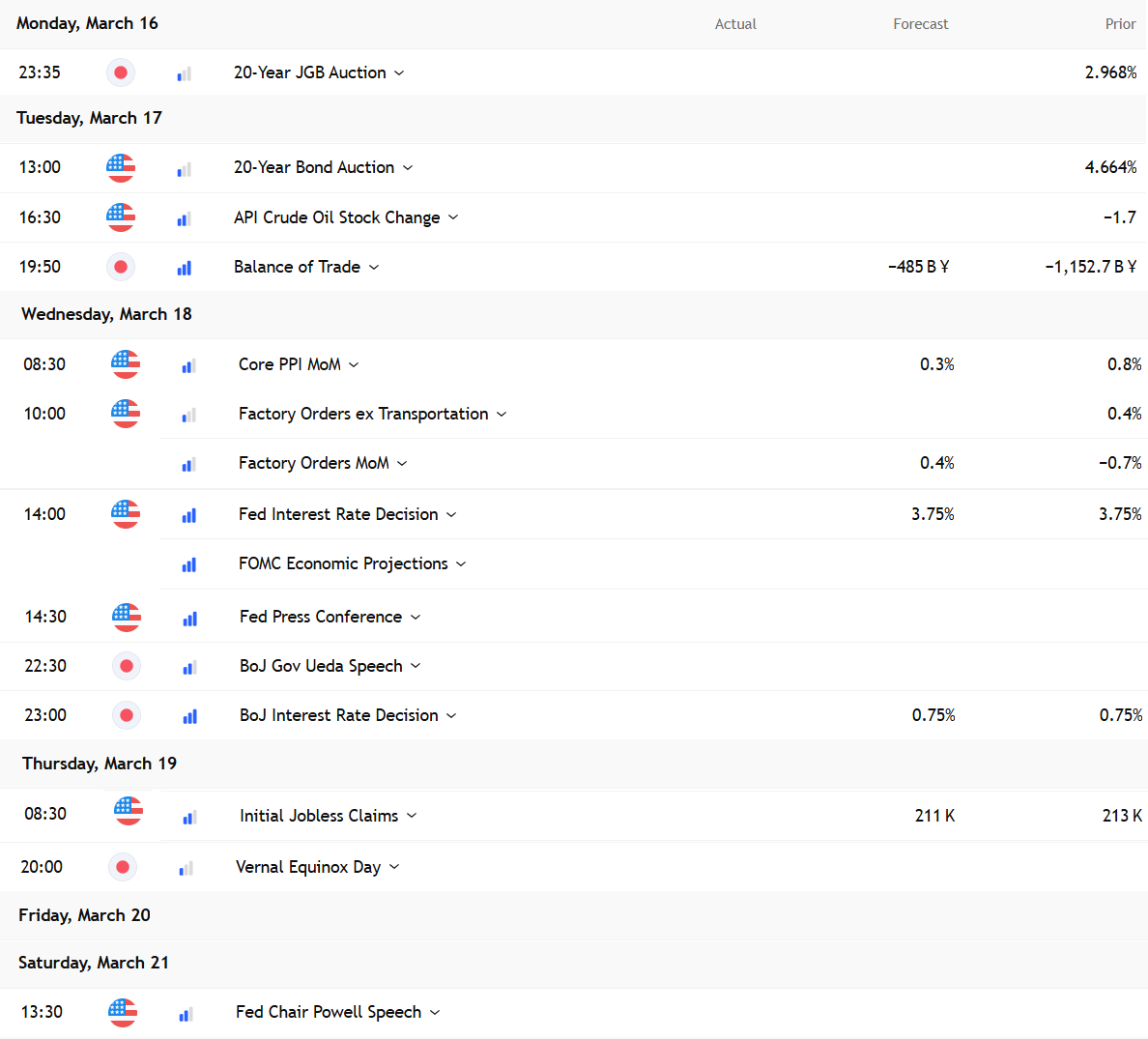
Outside of the Federal Reserve and Bank of Japan decisions, the economic calendar offers little that is likely to materially influence USD/JPY. As a result, the calendar below has been stripped back to include only events that may realistically impact the pair.
Chief among them are 20-year government bond auctions in both the United States and Japan following the recent weakness seen at the long end of the yield curve. With USD/JPY once again closely aligned with rate differentials, any surprise in demand at either auction has the potential to move yields and, by extension, the currency pair.
All times listed are US EDT.
Technicals scream bullish, officials may not
Source: TradingView
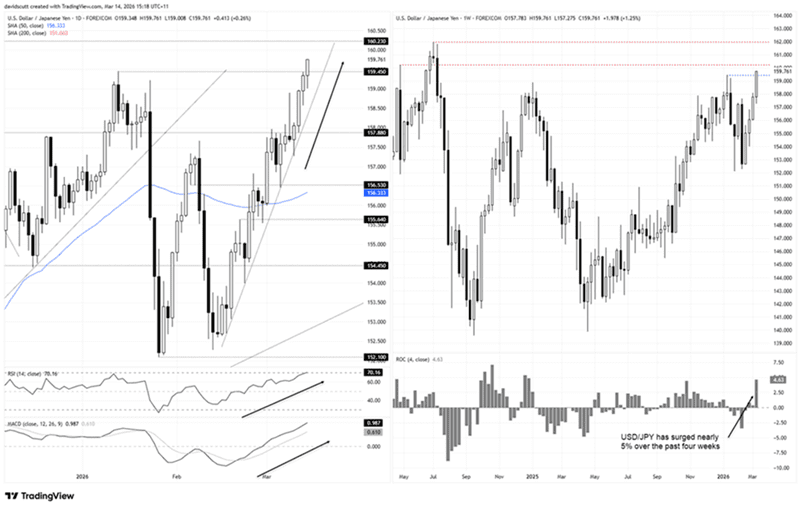
From a technical perspective, USD/JPY remains firmly biased to the upside, although geopolitical and intervention risks complicate the picture.
On the weekly chart on the right, the pair has delivered its strongest four-week advance since late 2024, rising 4.63% over the period. That type of one-sided move is typically the sort that draws the attention of Japan’s Ministry of Finance, particularly with the pair again approaching levels that previously prompted intervention. The red lines mark earlier episodes where the BoJ was instructed to step into the market, while the blue line highlights a US Treasury rate check earlier this year.
The daily chart on the left also points to continued bullish momentum. The price has broken above the early January highs and remains in a strong uptrend. RSI (14) and MACD are both trending higher without yet reaching extreme levels, while the 50 and 200-day moving averages have positive slopes.
Looking at levels, resistance sits at 160.23 and 161.95, both marking areas where authorities previously intervened. On the downside, the January high at 159.45 may now flip to support after Friday’s break. Beneath that, the 50-day moving average, 156.53 and 155.64 are levels to watch.


Open an account in minutes
Experience award-winning platforms with fast and secure execution, and enjoy tight spreads from 0.5 pts on FX and 0.3 pts on indices.
Economic calendar
Web Trader platform
Our sophisticated web-based platform is packed with features.
Related articles
USD/CAD shooting star puts September surge on notice
USD/CAD has printed a clear bearish reversal pattern after an extraordinary September surge, but confirmation may depend heavily on how US Treasury yields react to Friday’s payrolls report.

USD/CHF Reverses as Swiss Franc Surges amid Bond Carnage
USD/CHF reverses from channel resistance as bond volatility surges and broad Swiss franc strength points to a possible carry-trade unwind.


USD/MXN Analysis: Is Super Peso Starting to Fade?
Over recent trading sessions, the Mexican peso has continued to show signs of weakness against the U.S. dollar. This can already be seen in USD/MXN, which has gained more than 1.7% over the last three sessions, highlighting sustained buying pressure in favor of the dollar in the short term.

This report is intended for general circulation only. It should not be construed as a recommendation, or an offer (or solicitation of an offer) to buy or sell any financial products. The information provided does not take into account your specific investment objectives, financial situation or particular needs. Before you act on any recommendation that may be contained in this report, independent advice ought to be sought from a financial adviser regarding the suitability of the investment product, taking into account your specific investment objectives, financial situation or particular needs.
StoneX Financial Pte. Ltd., may distribute reports produced by its respective foreign entities or affiliates within the StoneX group of companies or third parties pursuant to an arrangement under Regulation 32C of the Financial Advisers Regulations. Where the report is distributed to a person in Singapore who is not an accredited investor, expert investor or an institutional investor (as defined in the Securities Futures Act), StoneX Financial Pte. Ltd. accepts legal responsibility to such persons for the contents of the report only to the extent required by law. Singapore recipients should contact StoneX Financial Pte. Ltd. at 6826 9988 for matters arising from, or in connection with the report.
In the case of all other recipients of this report, to the extent permitted by applicable laws and regulations neither StoneX Financial Pte. Ltd. nor its associated companies will be responsible or liable for any loss or damage incurred arising out of, or in connection with, any use of the information contained in this report and all such liability is hereby expressly disclaimed. No representation or warranty is made, express or implied, that the content of this report is complete or accurate.
StoneX Financial Pte. Ltd. is not under any obligation to update this report.
Trading CFDs carries a high level of risk that may not be suitable for some investors. Consider your investment objectives, level of experience, financial resources, risk appetite and other relevant circumstances carefully. The possibility exists that you could lose some or all of your investments, including your initial deposits. If in doubt, please seek independent expert advice. Visit www.forex.com/en-sg/terms-and-policies for the complete Risk Disclosure Statement.