



USD/JPY Outlook: Yen regains strength following recent BOJ comments
As the week progresses, USDJPY price action has started to show a notable decline in the short term, with the pair falling by approximately 0.7%, beginning to form a mild bearish bias on the chart.
Share this:

As the week progresses, USDJPY price action has started to show a notable decline in the short term, with the pair falling by approximately 0.7%, beginning to form a mild bearish bias on the chart. The selling pressure favoring the yen has been driven mainly by recent comments from the Bank of Japan, which have helped stabilize demand for the currency in the short term. If this dynamic persists, selling pressure could remain relevant in the coming sessions.


Bank of Japan comments
In recent sessions, the Bank of Japan has shown growing concern over the sustained weakness of the yen against currencies such as the U.S. dollar. The institution has highlighted that exchange rate movements are having a direct impact on inflation, as imports of energy and food have become significantly more expensive in recent months.
This factor has gained importance in the short term and may represent a risk to price stability in Japan’s economy. The central bank has even indicated that it does not rule out adjusting its policy if yen weakness persists, opening the door to a more restrictive stance and a potential shift in rate expectations through the remainder of 2026.
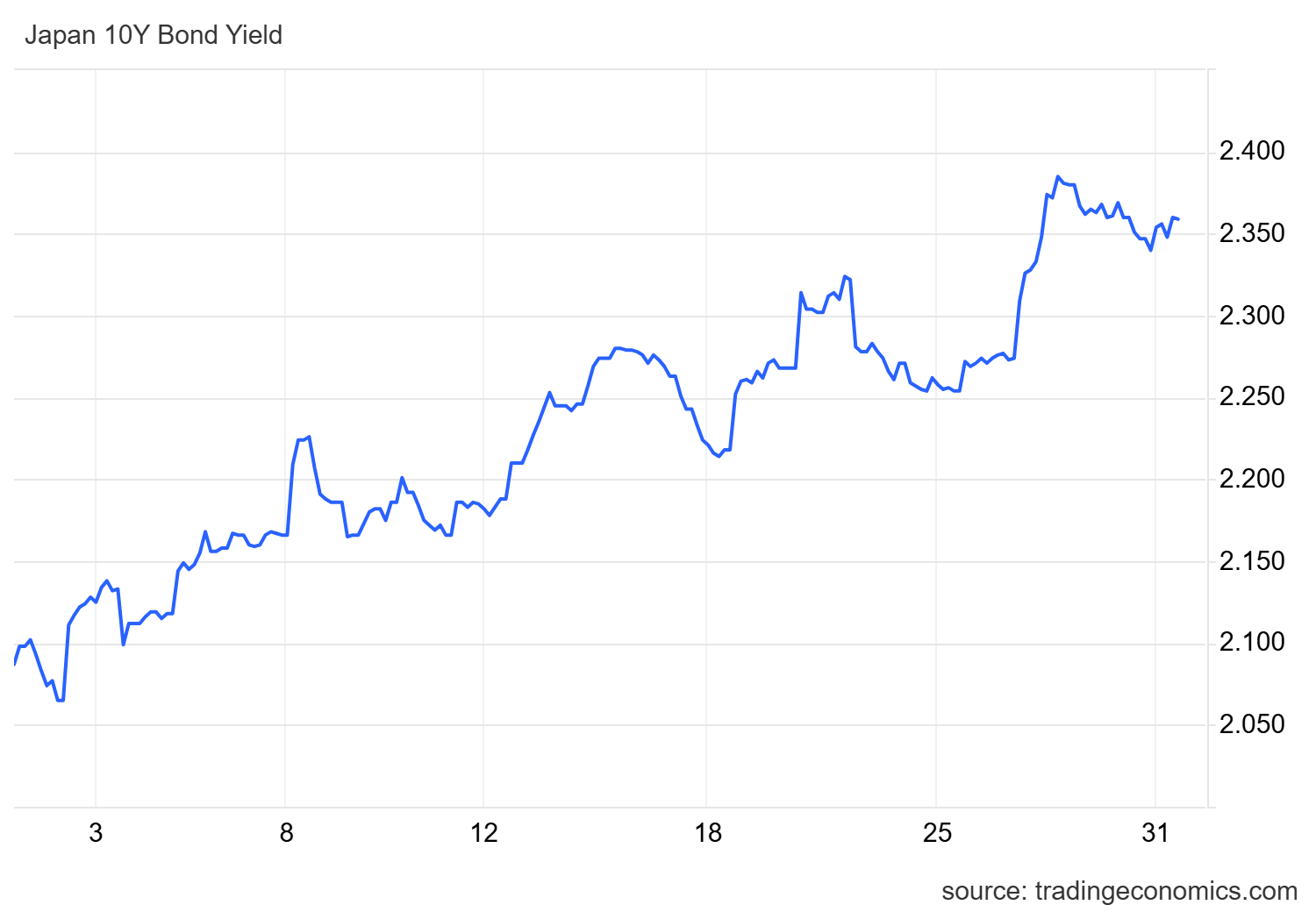
In this context, since the latest monetary policy decision, markets have begun to price in the possibility that Japan’s policy rate—currently at 0.75%—could rise in the coming months. This has supported a recovery in 10-year Japanese government bond yields, which now show a consistent upward trend and are trading near 2.35%.
Source: TradingEconomics
This development is particularly relevant, as rising bond yields could improve the attractiveness of Japan’s fixed income market and support a gradual recovery in yen demand in the short term.
Taking all of this into account, recent central bank comments appear to be contributing to a modest improvement in yen sentiment, and as expectations continue to point toward potentially higher rates, this could maintain downward pressure on USDJPY in the coming sessions.
Can the dollar remain a threat?
It is important to note that the strength of the U.S. dollar has been one of the main factors weighing on yen confidence in recent weeks, as the dollar continues to be perceived as a safe-haven currency amid the ongoing conflict in the Middle East.
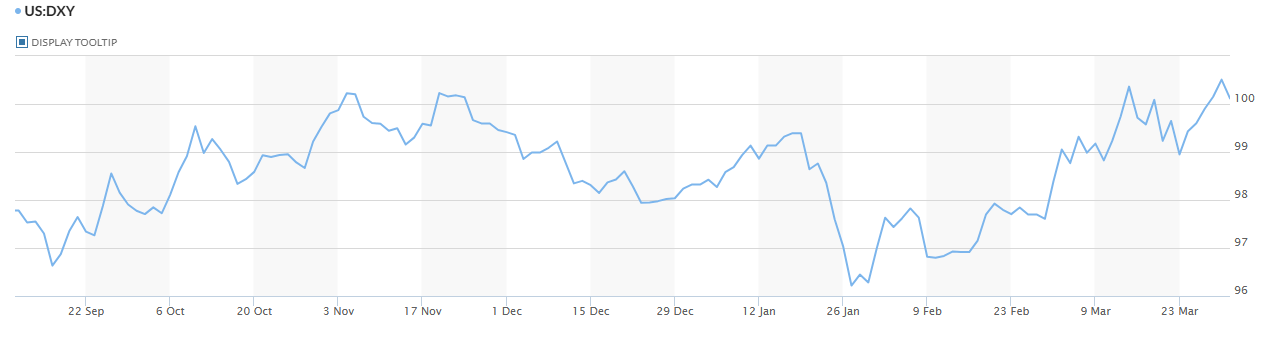
However, the DXY index, which measures the dollar’s strength against its major peers, has started to show signs of stabilization, holding around the 100 level in the short term. This may be allowing currencies such as the yen to regain some ground in recent sessions.
Source: MarketWatch
That said, this stabilization in the DXY does not eliminate the broader bullish bias that has been in place in recent weeks. If the dollar regains strength, it could once again limit the yen’s recovery and lead to a more pronounced indecision phase in USDJPY in the short term.
USD/JPY Technical Outlook
Source: StoneX, Tradingview
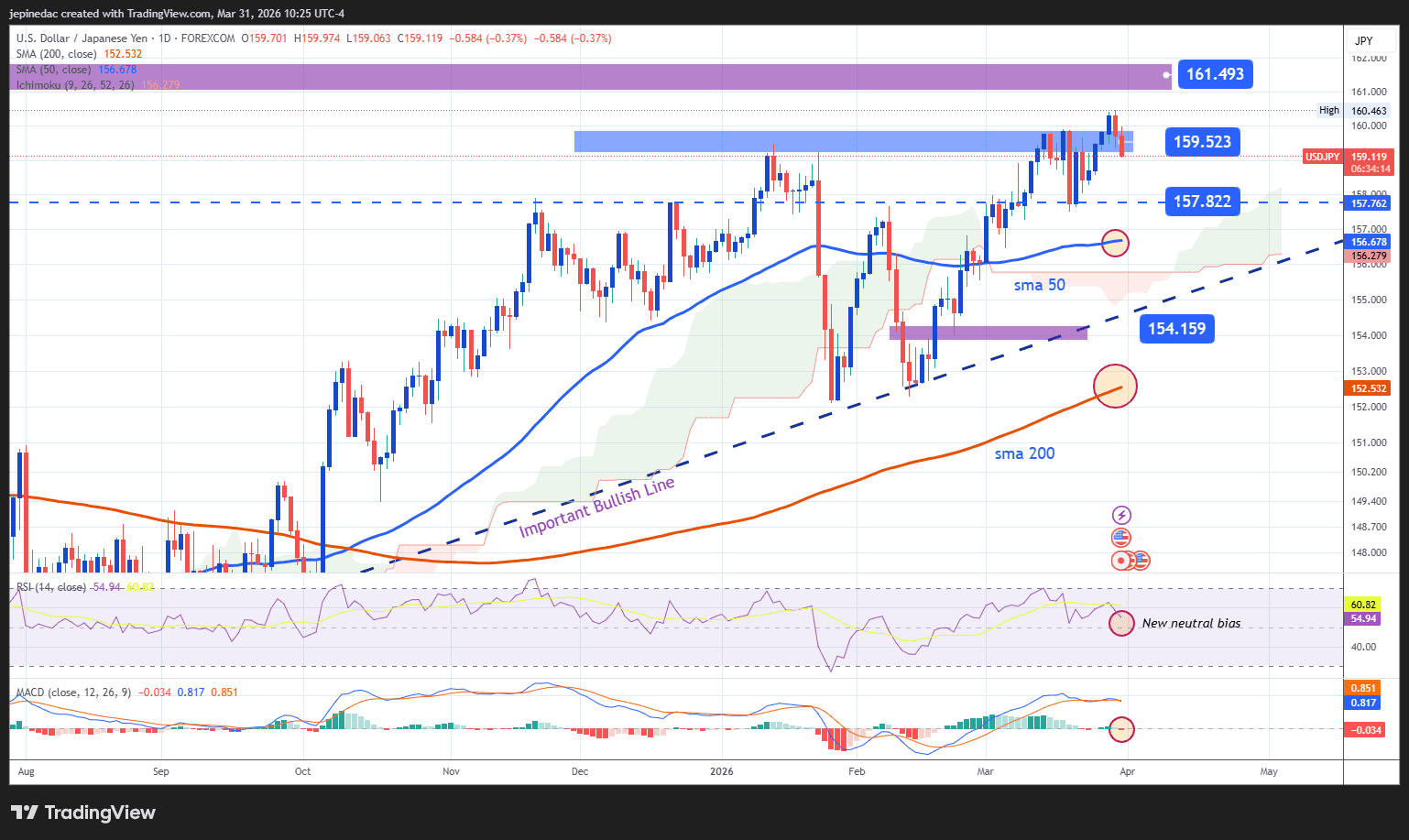
- The broader uptrend remains dominant: For several months, USDJPY has maintained a long-term upward trendline, which continues to be the most relevant technical structure on the chart. So far, the recent bearish correction has not been strong enough to threaten this formation, meaning the broader bias remains bullish. However, as price begins to stabilize, a phase of consolidation may develop, potentially leading to further short-term corrective moves within the broader uptrend.
- RSI: The RSI has been trending lower and is now near the 50 level, reflecting a balance between buying and selling pressure over the last 14 sessions. This suggests that the market may enter a more defined phase of indecision in the short term.
- MACD: A similar picture is seen in the MACD, with the histogram hovering around the zero line, indicating neutral momentum in short-term moving averages. If this dynamic persists, it could reinforce an indecisive price environment.
Key levels:
- 161.493 – Key resistance: A level corresponding to highs not seen since 2024, acting as the main upside barrier in the short term. A move toward this area could confirm a stronger bullish bias and support the continuation of the broader uptrend.
- 159.523 – Near-term barrier: A key neutrality zone in the short term. Sustained price action around this level could reinforce indecision or lead to the formation of a sideways range.
- 157.822 – Key support: A level aligned with recent lows. Moves toward this area could reinforce a short-term bearish bias and give more relevance to corrective price action.
Written by Julian Pineda, CFA, CMT – Market Analyst
Follow him on: @julianpineda25
Related tags:
Latest market news




Open an account in minutes
Experience award-winning platforms with fast and secure execution, and enjoy tight spreads from 0.5 pts on FX and 0.3 pts on indices.
Economic calendar
Web Trader platform
Our sophisticated web-based platform is packed with features.
Related articles
USD/CHF Feels the Weight of US Midterms, USD/CAD Clings to Support
US midterms threaten fresh dollar volatility as USD/CHF tests technical support and USD/CAD clings to 1.3940 ahead of election results.

US Dollar, GBP/USD, USD/CAD, USD/CHF, Gold Weekly Technical Outlook 11 2 2026
Sr. Technical Strategist Michael Boutros highlights the levels that matter on the USD Majors, commodities, and equity indices charts this week.

US Midterm Forecast: The Key Risks for Traders to Watch Through the US Elections
Prediction markets are pricing in nearly 75% odds of a Democratic sweep in this week’s US midterm elections, a development that would result in a split from the single party Republican rule of the past two years - what will it mean for markets?

This report is intended for general circulation only. It should not be construed as a recommendation, or an offer (or solicitation of an offer) to buy or sell any financial products. The information provided does not take into account your specific investment objectives, financial situation or particular needs. Before you act on any recommendation that may be contained in this report, independent advice ought to be sought from a financial adviser regarding the suitability of the investment product, taking into account your specific investment objectives, financial situation or particular needs.
StoneX Financial Pte. Ltd., may distribute reports produced by its respective foreign entities or affiliates within the StoneX group of companies or third parties pursuant to an arrangement under Regulation 32C of the Financial Advisers Regulations. Where the report is distributed to a person in Singapore who is not an accredited investor, expert investor or an institutional investor (as defined in the Securities Futures Act), StoneX Financial Pte. Ltd. accepts legal responsibility to such persons for the contents of the report only to the extent required by law. Singapore recipients should contact StoneX Financial Pte. Ltd. at 6826 9988 for matters arising from, or in connection with the report.
In the case of all other recipients of this report, to the extent permitted by applicable laws and regulations neither StoneX Financial Pte. Ltd. nor its associated companies will be responsible or liable for any loss or damage incurred arising out of, or in connection with, any use of the information contained in this report and all such liability is hereby expressly disclaimed. No representation or warranty is made, express or implied, that the content of this report is complete or accurate.
StoneX Financial Pte. Ltd. is not under any obligation to update this report.
Trading CFDs carries a high level of risk that may not be suitable for some investors. Consider your investment objectives, level of experience, financial resources, risk appetite and other relevant circumstances carefully. The possibility exists that you could lose some or all of your investments, including your initial deposits. If in doubt, please seek independent expert advice. Visit www.forex.com/en-sg/terms-and-policies for the complete Risk Disclosure Statement.