



Markets pricing in central bank rate increases over the next year
Traders should watch the change in expectations of interest rates vs current rates.
Share this:

As inflation continues to rise around the globe, central banks are trying to combat rising prices by ending their respective asset purchase programs and by increasing interest rates. Most of the major central banks have ended their Quantitative Easing programs, with the exception of the ECB and the BOJ (however the ECB is expected to end it very soon). That leaves raising interest rates as the primary tool for combating inflation.
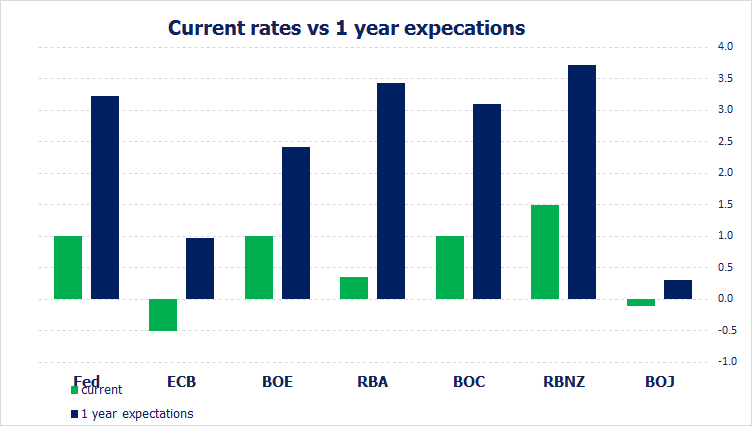
The chart below shows where some of the major central banks currently have interest rates and where the markets expect them to be in one year.
Source: Stone X
The ECB is the farthest behind in terms of raising rates at -0.50. However, markets expect rates to be near 1.0% in 1-year. With inflation in the Eurozone pushing 7.5% YoY, ECB members, including ECB President Christine Lagarde, have been on the wires the past few weeks discussing the possibility of hiking rates as soon as July.
The Bank of Japan also has ultra-low rates at -0.10, however markets only expect to see rates in Japan rise to 0.3% in 1-years’ time. This is primarily due to the deflationary pressures that Japan has been facing. Indeed, as part of the BOJ’s central bank QE, it continues to buy ETFs in the market and pegs the 10-year yield at 0.25%. If yields rise to that level, the central bank will step in and buy JGBs to keep yields low.
The Fed currently has the Fed Funds rate at 1.0%. However, markets are anticipating that the Fed will raise rates to 3.22% in 1 year. With inflation near 40-year highs at 8.3% YoY, several Fed members have suggested that it they may have to raise rates above what the Fed considers neutral, roughly 2.5%, in order to bring inflation down. It should be noted that the Fed targets 2% inflation, so there is a long way to go before inflation reaches the Fed’s target level.
The BOE currently has rates set at 1.0%. Markets see rates rising to “only” 2.41% in 1-year. Although inflation in the UK is high, as with other countries, the MPC is taking a more cautious approach. The BOE knows it must raise rates to combat inflation, however at the same time the central bank is concerned about the effect inflation and rising interest rates will have on household incomes and growth. Indeed, March’s GDP reading was -0.1%, suggesting that the BOE may be on to something!
The BOC, RBA, and RBNZ are in similar situations. Everyone is facing high inflation but is also concerned about slowing growth. If one throws the recent lockdowns in China into the mix, there is even more of a chance of a global slowdown.
Traders should watch the change in expectations of rates vs current rates. Since foreign exchange rates are affected by the difference between 2 countries interest rates, having an idea of where interest rates may be headed can be one tool investors can use to help determine where fx rates may be going next!
As inflation continues to rise around the globe, central banks are trying to combat rising prices by ending their respective asset purchase programs and by increasing interest rates. Most of the major central banks have ended their Quantitative Easing programs, with the exception of the ECB and the BOJ (however the ECB is expected to end it very soon). That leaves raising interest rates as the primary tool for combating inflation.
The chart below shows where some of the major central banks currently have interest rates and where the markets expect them to be in one year.
Source: Stone X
The ECB is the farthest behind in terms of raising rates at -0.50. However, markets expect rates to be near 1.0% in 1-year. With inflation in the Eurozone pushing 7.5% YoY, ECB members, including ECB President Christine Lagarde, have been on the wires the past few weeks discussing the possibility of hiking rates as soon as July.
Everything you need to know about the ECB
The Bank of Japan also has ultra-low rates at -0.10, however markets only expect to see rates in Japan rise to 0.3% in 1-years’ time. This is primarily due to the deflationary pressures that Japan has been facing. Indeed, as part of the BOJ’s central bank QE, it continues to buy ETFs in the market and pegs the 10-year yield at 0.25%. If yields rise to that level, the central bank will step in and buy JGBs to keep yields low.
Everything you need to know about the BOJ
The Fed currently has the Fed Funds rate at 1.0%. However, markets are anticipating that the Fed will raise rates to 3.22% in 1 year. With inflation near 40-year highs at 8.3% YoY, several Fed members have suggested that it they may have to raise rates above what the Fed considers neutral, roughly 2.5%, in order to bring inflation down. It should be noted that the Fed targets 2% inflation, so there is a long way to go before inflation reaches the Fed’s target level.
Everything you need to know about the Federal Reserve
The BOE currently has rates set at 1.0%. Markets see rates rising to “only” 2.41% in 1-year. Although inflation in the UK is high, as with other countries, the MPC is taking a more cautious approach. The BOE knows it must raise rates to combat inflation, however at the same time the central bank is concerned about the effect inflation and rising interest rates will have on household incomes and growth. Indeed, March’s GDP reading was -0.1%, suggesting that the BOE may be on to something!
Everything you need to know about the BOE
The BOC, RBA, and RBNZ are in similar situations. Everyone is facing high inflation but is also concerned about slowing growth. If one throws the recent lockdowns in China into the mix, there is even more of a chance of a global slowdown.
Traders should watch the change in expectations of rates vs current rates. Since foreign exchange rates are affected by the difference between 2 countries interest rates, having an idea of where interest rates may be headed can be one tool investors can use to help determine where fx rates may be going next!
Learn more about forex trading opportunities.
Related tags:


Open an account in minutes
Experience award-winning platforms with fast and secure execution.
Economic calendar
Web Trader platform
Our sophisticated web-based platform is packed with features.
Related articles
China's steel slump leaves iron ore bulls under the pump
Iron ore has broken major support, threatening a return to the lows of 2022 as mounting evidence of weakness in China's steel sector reinforces the bearish outlook.

NZD/USD Forecast: Kiwi faces historic breakdown as RBNZ survey looms
NZD/USD is teetering above support that held through the pandemic and Liberation Day turmoil. With RBNZ hawks repeatedly disappointed, today's inflation expectations survey could open the door to a slide towards the GFC lows.

USD/JPY, AUD/JPY: Central Bank Divergence Creates Two-Way Risk
USD/JPY eyes a breakout above 160, while AUD/JPY faces further losses as Fed, RBA and BoJ interest rate expectations diverge.

StoneX Financial Ltd (trading as "FOREX.com") is an execution-only service provider. This material, whether or not it states any opinions, is for general information purposes only and it does not take into account your personal circumstances or objectives. This material has been prepared using the thoughts and opinions of the author and these may change. However, FOREX.com does not plan to provide further updates to any material once published and it is not under any obligation to keep this material up to date.
This material is short term in nature and may only relate to facts and circumstances existing at a specific time or day. Nothing in this material is (or should be considered to be) financial, investment, legal, tax or other advice and no reliance should be placed on it. No opinion given in this material constitutes a recommendation by FOREX.com or the author that any particular investment, security, transaction or investment strategy is suitable for any specific person.
The material has not been prepared in accordance with legal requirements designed to promote the independence of investment research. Although FOREX.com is not specifically prevented from dealing before providing this material, FOREX.com does not seek to take advantage of the material prior to its dissemination. This material is not intended for distribution to, or use by, any person in any country or jurisdiction where such distribution or use would be contrary to local law or regulation. For further details see our full non-independent research disclaimer and quarterly summary.