


China A50: upside risks for earnings grow as stimulus ramps up
Comprising huge financial and property firms, China's A50 may benefit from the rapid rollout of stimulus measures.
Share this:

Chinese policymakers continue to roll out measures to boost economic activity, suggesting risks for corporate earnings risks may be skewing to the upside given the level of pessimism that already exists.
Upside risks building for Chinese stocks?
Latest media reports suggest China’s state-backed banks are preparing to cut interest rates for existing lending and deposit customers, adding to an increasingly lengthy list of measures designed to reboot confidence and encourage increased spending and investment. Cuts to wholesale funding costs, lower mortgage rates for new applicants, reducing stamp duty fees on stock market transactions and slowing the pace of new IPO listings are just some of the announcements seen over the past fortnight, adding to the sense of urgency to turning the flagging economy around.
While still not the stimulus “bazooka” many investors are waiting for, the greater the number of smaller policy measures, the greater the aggregate risk it may deliver meaningful benefits to corporate earnings and upside for Chinese stocks.
China A50 may benefit from latest support measures
Should the latest speculation on deposit and lending rates prove accurate, China’s A50 will be a market traders should be monitoring closely. Laden with massive financial and property-related names, any potential boost to lending volumes without hammering bank net interest margins any further makes it a prime candidate to benefit from a meaningful turnaround in investor sentiment.
China A50 remains rangebound for now
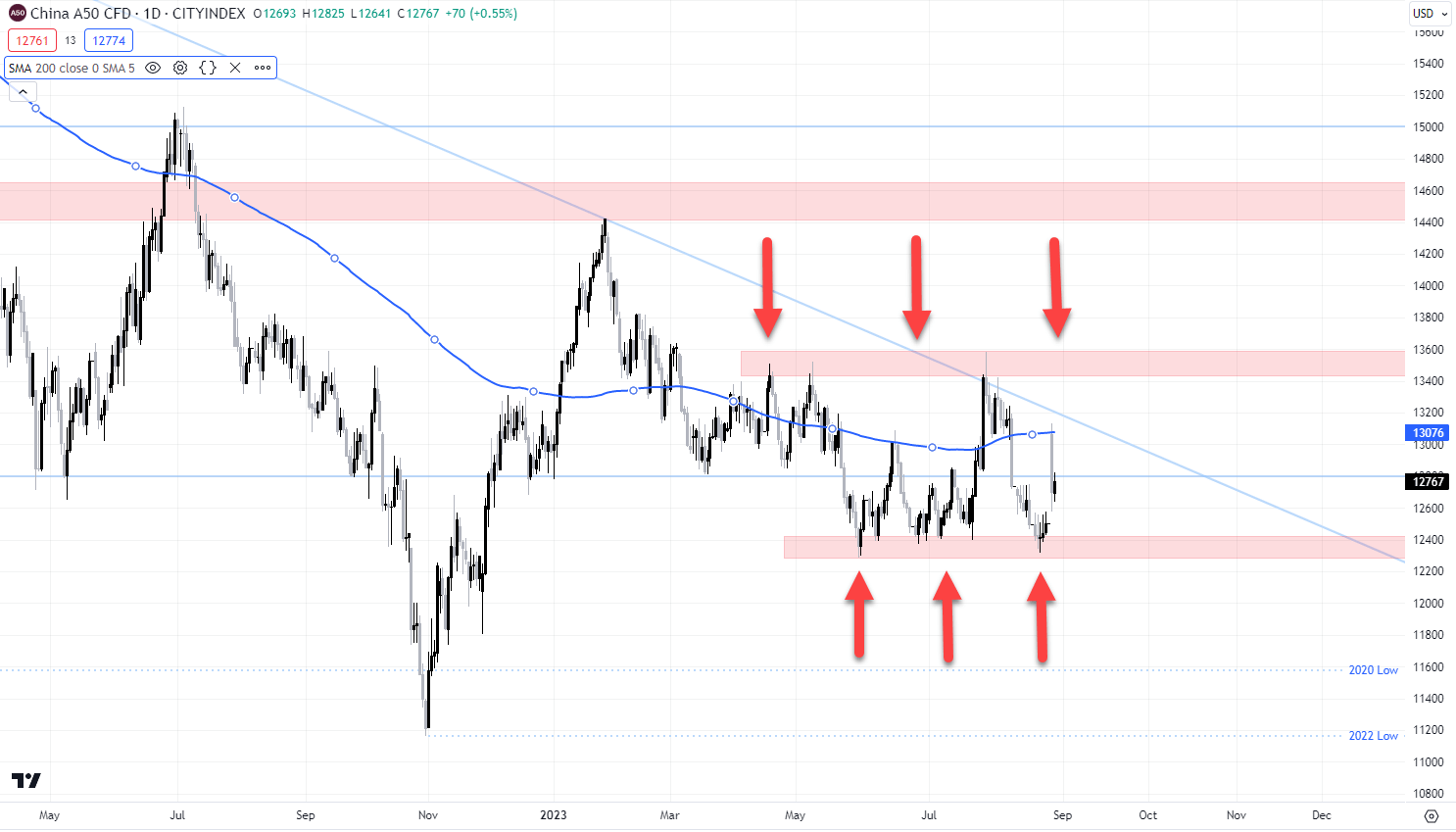
For all the bearish headlines and sentiment, China’s A50 has been rangebound for the past three months, meandering either side of two decent support and resistance zones starting around 12,400 and 13,400 respectively. There’s no imminent threat of the prevailing range being broken in the near-term, although risks may be skewing towards an upside test given the rapid rollout of supportive policy measures seen in recent days.
Source: Trading View. StoneX.
The A50 ran into sellers at the 200-day SMA at 13,076 earlier this week, failing to sustain the bounce seen following the reduction on stamp duty on stock trades announced over the weekend. That’s something to watch. 12,800 – a level it has done a lot of work either side in the past – is another given that’s where Tuesday’s rally stalled. Should they be overcome, the downtrend from the start of 2022 is the next topside level to watch around 13,200 before we get to the bottom of the resistance zone at 13,400.
On the downside, the demand zone starting at 12,400 has repelled numerous attempts to push the index lower since the end of May.
-- Written by David Scutt
Follow David on Twitter @scutty
How to trade with City Index
You can trade with City Index by following these four easy steps:
- Open an account, or log in if you’re already a customer
• Open an account in the UK
• Open an account in Australia
• Open an account in Singapore
- Search for the market you want to trade in our award-winning platform
- Choose your position and size, and your stop and limit levels
- Place the trade
Latest market news




Open an account in minutes
Experience award-winning platforms with fast and secure execution.
Economic calendar
Web Trader platform
Our sophisticated web-based platform is packed with features.
Related articles

Nasdaq 100 Forecast: Anthropic Weighs on NDX Sentiment
As November approaches its end, weakening confidence around major equity benchmarks such as the Nasdaq 100 remains an important theme in financial markets. The index continues to face significant short-term weakness and, over the last two trading sessions alone, has fallen nearly 6.0%, highlighting a bearish bias that has not been this evident for several months.


ASX 200 On Track for Worst Week in Four Years, Raising Bear Market Fears
The ASX 200 faces its worst week in four years as falling commodities, China's economic weakness and broad-based selling threaten a deeper correction.


Brazil Elections: Is Investor Confidence Beginning to Fade?
One of the most relevant events for emerging markets in recent sessions has been the outcome of Brazil’s presidential election. Following Lula da Silva’s victory in the second round, investor sentiment began to deteriorate noticeably. This can be observed in both the iShares MSCI Brazil ETF and the VanEck Brazil Small-Cap ETF, two important benchmarks for tracking the Brazilian equity market, both of which have posted declines of more than 15% at the start of the week.
StoneX Financial Ltd (trading as "FOREX.com") is an execution-only service provider. This material, whether or not it states any opinions, is for general information purposes only and it does not take into account your personal circumstances or objectives. This material has been prepared using the thoughts and opinions of the author and these may change. However, FOREX.com does not plan to provide further updates to any material once published and it is not under any obligation to keep this material up to date.
This material is short term in nature and may only relate to facts and circumstances existing at a specific time or day. Nothing in this material is (or should be considered to be) financial, investment, legal, tax or other advice and no reliance should be placed on it. No opinion given in this material constitutes a recommendation by FOREX.com or the author that any particular investment, security, transaction or investment strategy is suitable for any specific person.
The material has not been prepared in accordance with legal requirements designed to promote the independence of investment research. Although FOREX.com is not specifically prevented from dealing before providing this material, FOREX.com does not seek to take advantage of the material prior to its dissemination. This material is not intended for distribution to, or use by, any person in any country or jurisdiction where such distribution or use would be contrary to local law or regulation. For further details see our full non-independent research disclaimer and quarterly summary.