



Crude oil stabilises post OPEC but pressure remains
Share this:

Oil market participants have now had a few days to digest the decision from the OPEC+ to cut crude supply by 1.2 million barrels per day. Both major oil contracts are below the levels they were trading prior to the announcement, with Brent around $60 and WTI $51 per barrel. Investors were clearly unimpressed by that decision, although they weren’t too disappointed either given that some oil ministers had talked up the prospects of a no-cut in the days leading up to the OPEC+ meeting, while US President Donald Trump was also applying pressure on Saudi not to cut. Additional doubts were raised after the decision to reduce output was made on Friday, when the OPEC refused to specify which country would cut how much – effectively asking the market to trust them. Crucially, though, oil prices haven’t extended their fails (yet). Russia had previously indicated it would be happy with oil prices around $60, which is exactly where Brent is holding right now. What’s more, the OPEC’s aim was to “stabilise” the oil markets, which they have done so – for now. Trump, meanwhile, has stayed quiet about the production cut, suggesting he’s also content with what was a smaller-than-expected reduction. The key questions now are: will the OPEC+ comply with these output targets and will oil prices stop falling further?
Our long-term outlook remains negative but worst of selling probably behind us
While I am doubtful on both the above points, I do, however, think we may have seen the worst of the sell-off and doubt prices will go back down to $30s again. After all, demand from China remains strong. The world’s second largest economy and oil consumer imported a record 10.4 million barrels of crude oil per day in November. Chinese refineries were happy to take advantage of downbeat prices to build up their stocks. However, as the saying in the financial markets go that past performance is not indicative of future results, just because China imported a record amount of oil in November, doesn’t necessarily mean they will do the same in December or January. In fact, with recent falls in the Chinese yuan, you’d think demand would be impacted negatively for dollar-denominated crude oil – and not just from China, but India and Turkey too, among other places. On the supply side, US oil production growth continues relentlessly and will probably continue for the foreseeable future to offset any supply-side adjustments from the OPEC+ group. So, as before, when prices were trading around $84, we maintain our long-term negative view on the oil market. However, as indicated above, prices may go up in the short-term in light of the not-here-nor-there production cuts from the OPEC+ group. Ultimately, we think any short-term gains would be limited and the highs hit in October may not be reached again any time soon.
WTI still holding below trend line
From a shorter-term technical perspective, while the consolidation above the $50 hurdle means WTI has stopped falling, so far we haven’t seen any clear bullish signals. Indeed, the two-month-old bearish trend line remains intact and this has capped the gains since OPEC+ announcement. As a minimum, we would like to see this trend line break before entertaining the bullish scenario. Ideally, the bulls would want the old high at $54.50 to break to confirm a short-term reversal in the trend. But if $50 gives way on a daily closing basis then WTI could head towards the Fibonacci levels shown on the chart, with the long-term 61.8% retracement at $45.35 being the most important of such levels.
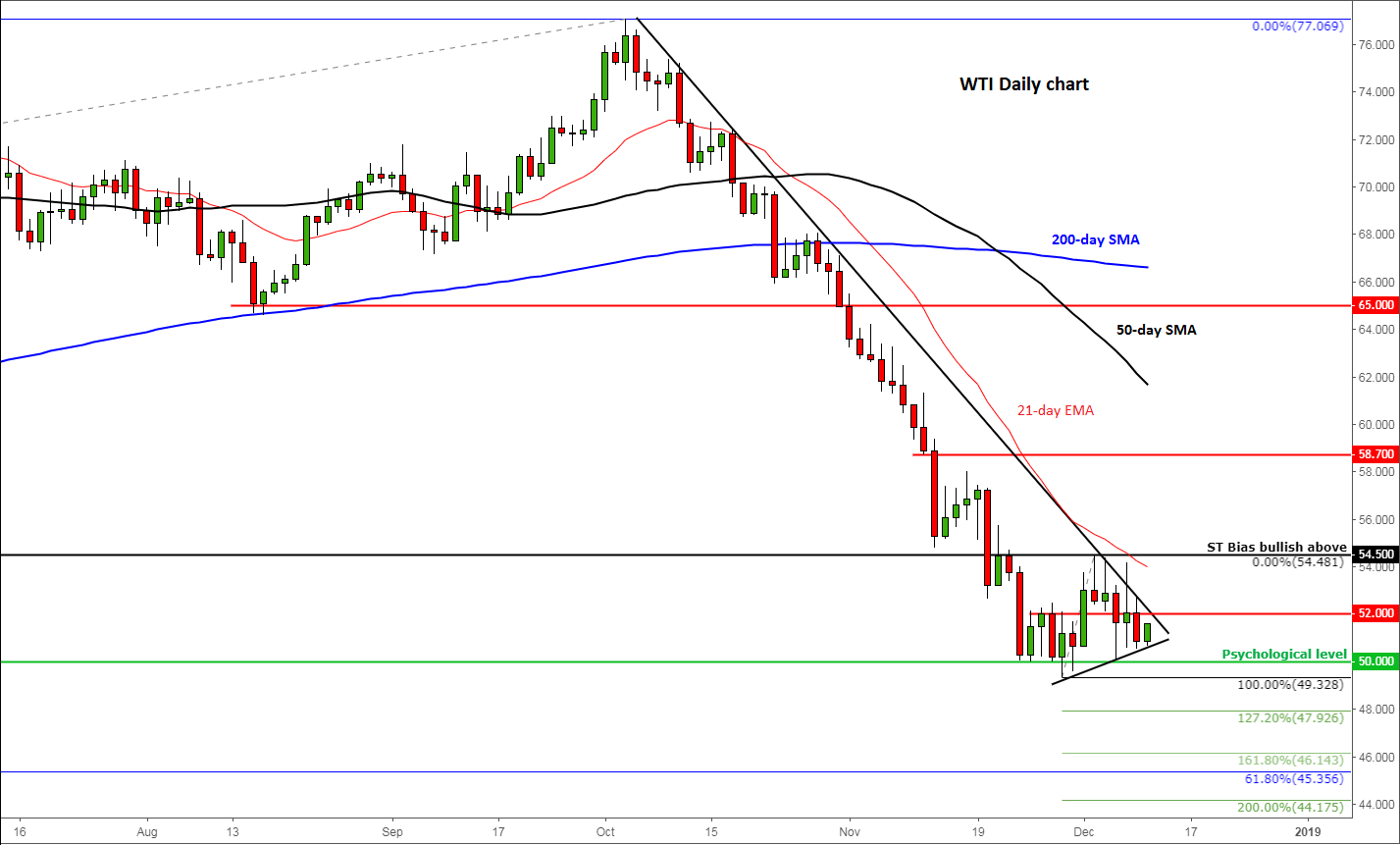
Source: TradingView and FOREX.com. Please note, this product is not available to US clients.




Open an account in minutes
Experience award-winning platforms with fast and secure execution.
Economic calendar
Web Trader platform
Our sophisticated web-based platform is packed with features.
Related articles

Nasdaq 100 Forecast: NDX falls ahead of Nvidia’s earnings & Anthropic’s debut this week
U.S. stocks are heading for a weaker open amid a challenging macro backdrop and with AI-linked stocks once again under pressure ahead of Nvidia's results later this week. Attention is also turning to Anthropic's highly anticipated IPO.


Crude Oil Weekly Outlook: Geopolitics vs Oversupply Risks
Crude Oil Weekly Outlook: The IEA has flagged the risk of an oil supply surplus since the Iran war began. Yet WTI and Brent have held onto bullish rebounds from key support near 84 and 89, respectively, as geopolitical risks persist.

S&P 500 forecast: SPX struggles for direction ahead of PPI data
U.S. stocks are struggling for direction on Friday as investors continue to weigh up the fallout from Nvidia’s leadership change, rising Treasury yields and the upcoming U.S. producer price inflation data.
StoneX Financial Ltd (trading as "FOREX.com") is an execution-only service provider. This material, whether or not it states any opinions, is for general information purposes only and it does not take into account your personal circumstances or objectives. This material has been prepared using the thoughts and opinions of the author and these may change. However, FOREX.com does not plan to provide further updates to any material once published and it is not under any obligation to keep this material up to date.
This material is short term in nature and may only relate to facts and circumstances existing at a specific time or day. Nothing in this material is (or should be considered to be) financial, investment, legal, tax or other advice and no reliance should be placed on it. No opinion given in this material constitutes a recommendation by FOREX.com or the author that any particular investment, security, transaction or investment strategy is suitable for any specific person.
The material has not been prepared in accordance with legal requirements designed to promote the independence of investment research. Although FOREX.com is not specifically prevented from dealing before providing this material, FOREX.com does not seek to take advantage of the material prior to its dissemination. This material is not intended for distribution to, or use by, any person in any country or jurisdiction where such distribution or use would be contrary to local law or regulation. For further details see our full non-independent research disclaimer and quarterly summary.