



ECB Minutes and Christine Lagarde’s dovishness send EUR/GBP lower
Recent and projected near-term inflation is driven by temporary factors that are expected to ease over the course of 2022
Share this:

Minutes released from the December ECB meeting confirmed the dovishness that some ECB members have been touting for the last few days: recent and projected near-term inflation is driven by temporary factors that are expected to ease over the course of 2022. As recent as Thursday, Christine Lagarde echoed these comments, thus showing that even with EU CPI at 5% she still remains dovish. Lagarde continued by saying that the ECB has “every reason not to react as quickly” as the Fed. Similar comments were made this week by the ECB’s Villeroy, who said that inflation should fall back under 2% by year end.
Recall from the December ECB meeting that although the ECB is ending its Pandemic Emergency Purchase Program (PEPP) in March, it will still buy bonds under the Asset Purchase Program (APP) at a pace of EUR40 billion in Q2 and EUR30 billion in Q3, before returning to the current EUR20 billion maintenance level. Members also said that they see inflation above their 2% target for most of 2022, and only see 1.8% inflation for 2023 and 2024.
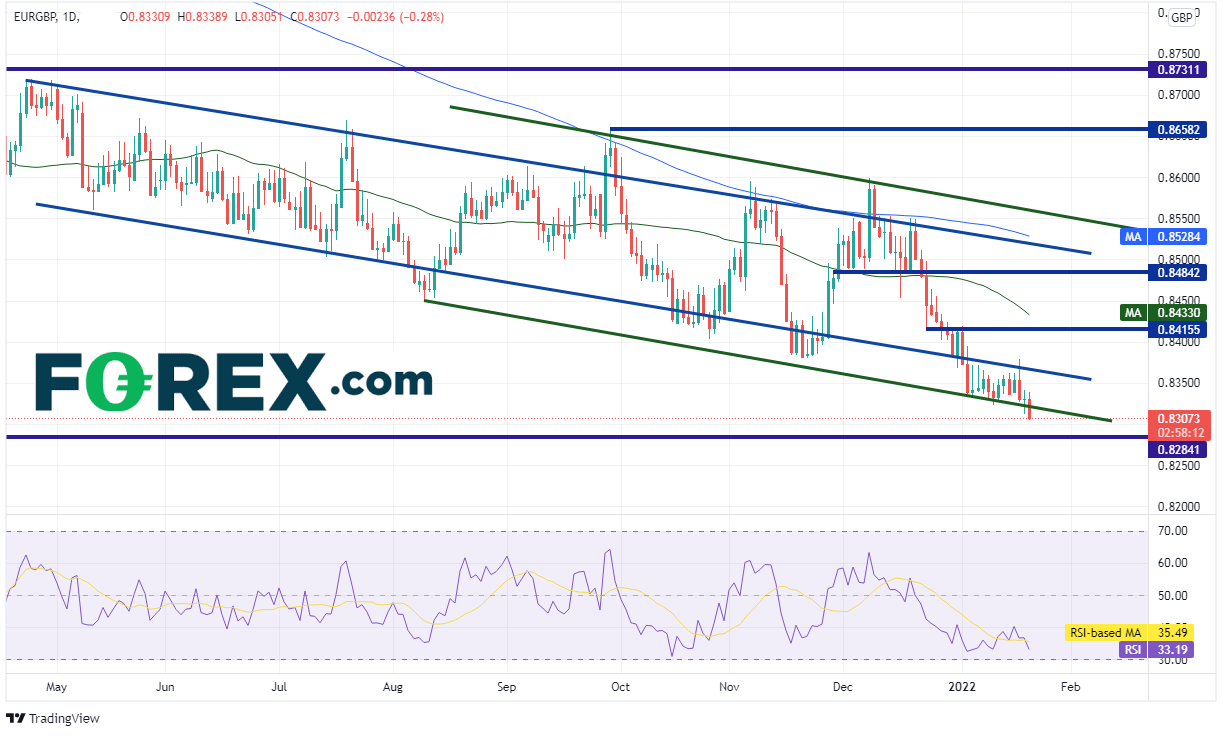
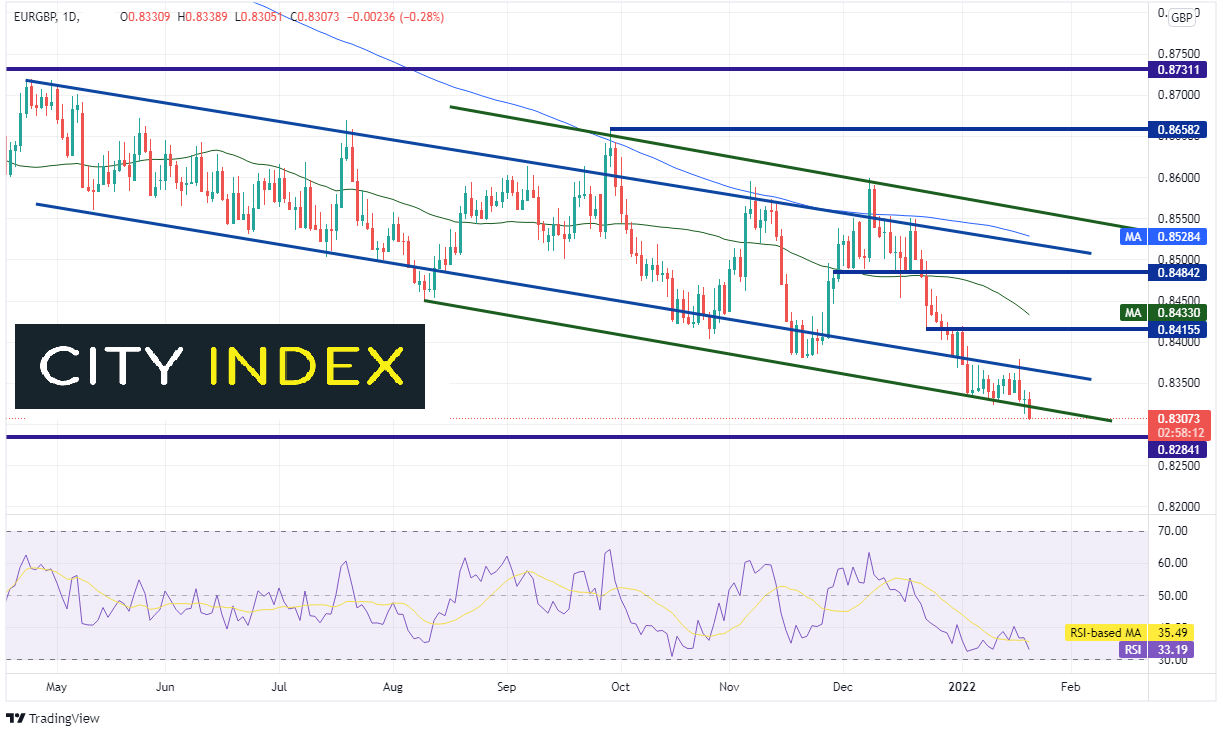
What does this mean for the Euro vs a currency, such as the Pound, whose central bank is raising rates? Typically it means that the Euro will go lower. Indeed, EUR/GBP has been in a long-term downward sloping channel since April 2021. However in August 2021, the pair became more volatile and began trading on either side of the channel, thus creating an even wider channel (green). On Thursday, after Christine Lagarde’s comments and the ECB minutes, EUR/GBP broke out of the larger channel to its lowest level since February 2020!
Source: Tradingview, Stone X
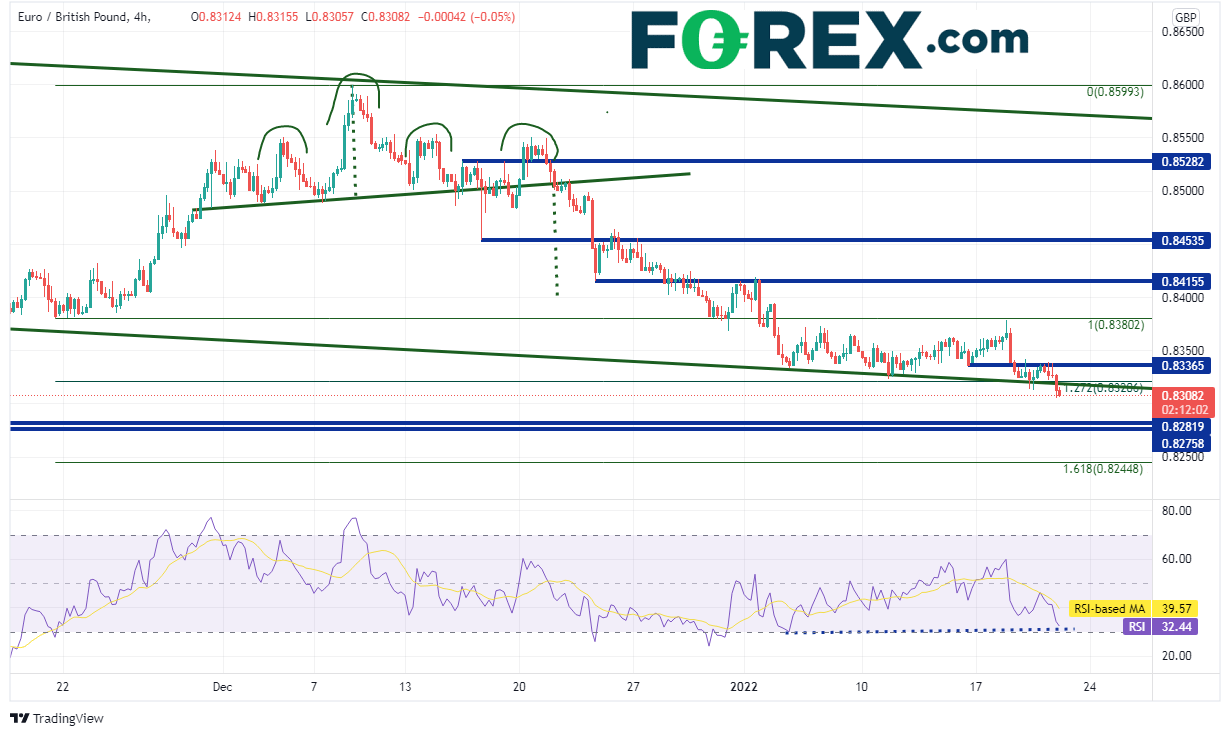
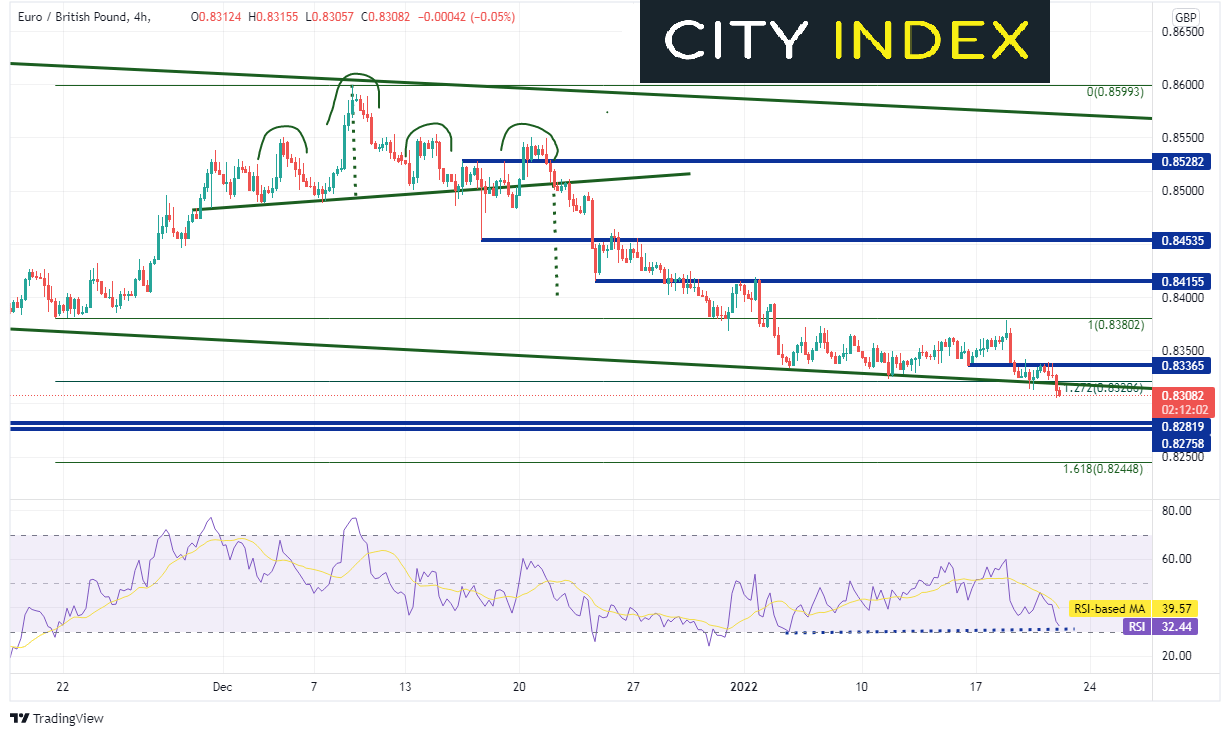
On a 240-minute chart, we can see that price has not only broken below the bottom trendline of the channel, but also below the 127.2% Fibonacci extension from the lows of November 19th 2021 to the highs of December 8th 2021, near 0.8321. First support is at a confluence of the February 2020 lows and the December 2019 lows near 0.8282 and 0.8276 respectively. Below that is the 161.8% Fibonacci extension of the previously mentioned timeframe near 0.8244. However, notice that the RSI is diverging with price, an indication EUR/GBP may be ready to bounce. Horizontal resistance is at 0.8336, then the previous support level at 0.8380. Above there, once again previous support is resistance at 0.8416.
Source: Tradingview, Stone X
While the ECB remains dovish, the BOE is hawkish. Markets have fully priced in a rate hike for the February 3rd meeting. If this dynamic continues, there could be more downside for EUR/GBP in the near-term.
Minutes released from the December ECB meeting confirmed the dovishness that some ECB members have been touting for the last few days: recent and projected near-term inflation is driven by temporary factors that are expected to ease over the course of 2022. As recent as Thursday, Christine Lagarde echoed these comments, thus showing that even with EU CPI at 5% she still remains dovish. Lagarde continued by saying that the ECB has “every reason not to react as quickly” as the Fed. Similar comments were made this week by the ECB’s Villeroy, who said that inflation should fall back under 2% by year end.
Forecasting 2022 inflation: Transitory no more?
Recall from the December ECB meeting that although the ECB is ending its Pandemic Emergency Purchase Program (PEPP) in March, it will still buy bonds under the Asset Purchase Program (APP) at a pace of EUR40 billion in Q2 and EUR30 billion in Q3, before returning to the current EUR20 billion maintenance level. Members also said that they see inflation above their 2% target for most of 2022, and only see 1.8% inflation for 2023 and 2024.
Central Banks: Liftoff in Focus?
What does this mean for the Euro vs a currency, such as the Pound, whose central bank is raising rates? Typically it means that the Euro will go lower. Indeed, EUR/GBP has been in a long-term downward sloping channel since April 2021. However in August 2021, the pair became more volatile and began trading on either side of the channel, thus creating an even wider channel (green). On Thursday, after Christine Lagarde’s comments and the ECB minutes, EUR/GBP broke out of the larger channel to its lowest level since February 2020!
Source: Tradingview, Stone X
Trade EUR/GBP now: Login or Open a new account!
• Open an account in the UK
• Open an account in Australia
• Open an account in Singapore
On a 240-minute chart, we can see that price has not only broken below the bottom trendline of the channel, but also below the 127.2% Fibonacci extension from the lows of November 19th 2021 to the highs of December 8th 2021, near 0.8321. First support is at a confluence of the February 2020 lows and the December 2019 lows near 0.8282 and 0.8276 respectively. Below that is the 161.8% Fibonacci extension of the previously mentioned timeframe near 0.8244. However, notice that the RSI is diverging with price, an indication EUR/GBP may be ready to bounce. Horizontal resistance is at 0.8336, then the previous support level at 0.8380. Above there, once again previous support is resistance at 0.8416.
Source: Tradingview, Stone X
While the ECB remains dovish, the BOE is hawkish. Markets have fully priced in a rate hike for the February 3rd meeting. If this dynamic continues, there could be more downside for EUR/GBP in the near-term.
Learn more about forex trading opportunities.
Related tags:


Open an account in minutes
Experience award-winning platforms with fast and secure execution.
Economic calendar
Web Trader platform
Our sophisticated web-based platform is packed with features.
Related articles
China's steel slump leaves iron ore bulls under the pump
Iron ore has broken major support, threatening a return to the lows of 2022 as mounting evidence of weakness in China's steel sector reinforces the bearish outlook.

NZD/USD Forecast: Kiwi faces historic breakdown as RBNZ survey looms
NZD/USD is teetering above support that held through the pandemic and Liberation Day turmoil. With RBNZ hawks repeatedly disappointed, today's inflation expectations survey could open the door to a slide towards the GFC lows.

USD/JPY, AUD/JPY: Central Bank Divergence Creates Two-Way Risk
USD/JPY eyes a breakout above 160, while AUD/JPY faces further losses as Fed, RBA and BoJ interest rate expectations diverge.

StoneX Financial Ltd (trading as "FOREX.com") is an execution-only service provider. This material, whether or not it states any opinions, is for general information purposes only and it does not take into account your personal circumstances or objectives. This material has been prepared using the thoughts and opinions of the author and these may change. However, FOREX.com does not plan to provide further updates to any material once published and it is not under any obligation to keep this material up to date.
This material is short term in nature and may only relate to facts and circumstances existing at a specific time or day. Nothing in this material is (or should be considered to be) financial, investment, legal, tax or other advice and no reliance should be placed on it. No opinion given in this material constitutes a recommendation by FOREX.com or the author that any particular investment, security, transaction or investment strategy is suitable for any specific person.
The material has not been prepared in accordance with legal requirements designed to promote the independence of investment research. Although FOREX.com is not specifically prevented from dealing before providing this material, FOREX.com does not seek to take advantage of the material prior to its dissemination. This material is not intended for distribution to, or use by, any person in any country or jurisdiction where such distribution or use would be contrary to local law or regulation. For further details see our full non-independent research disclaimer and quarterly summary.