





ECB Preview Christine Lagarde will have to kick the can down the tightrope
The goal of this meeting will likely be to bide time
Share this:

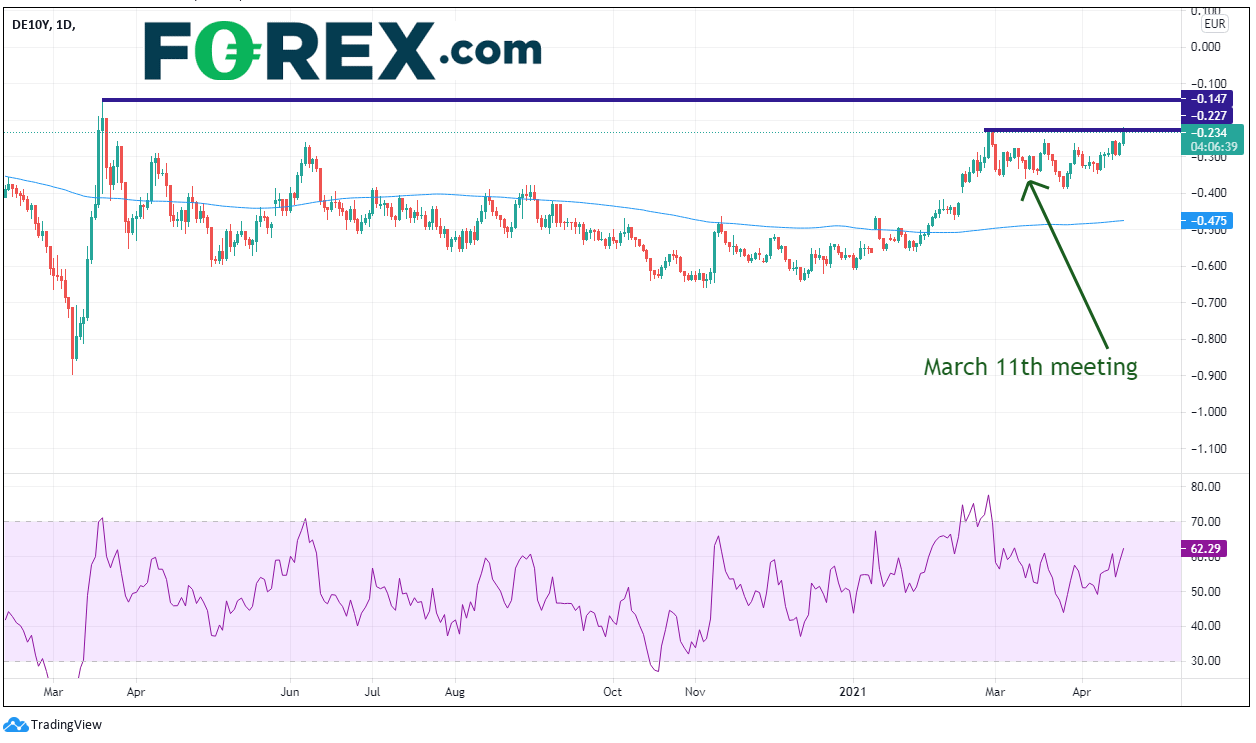
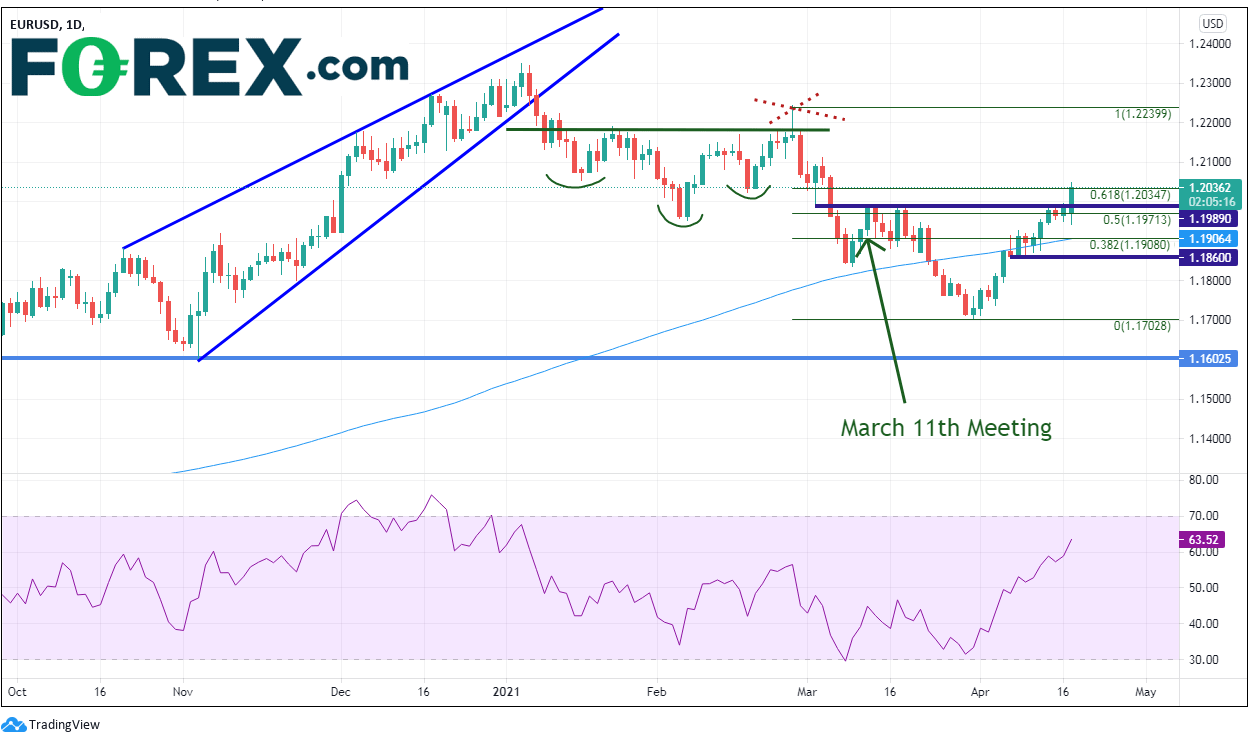
The ECB last met on March 11th. At that time, EUR/USD was trading near 1.1950 and German Bund yields were trading near-0.35. The outlook was bright, maybe too bright, as forecasts were revised for growth and inflation. Many countries were under restrictions and lockdowns at the time, and all eyes were on the increase in yields, with some suggesting that the value of the Euro was too high as well. The conclusion at the March 11th meeting was that the ECB would increase the pace of their bond purchases under the Pandemic Emergency Purchase Program (PEPP), which did lower yields and the Euro, but only for a short time.
German Bunds
Source: Tradingview, City Index
Three days before the April 22nd ECB meeting, EUR/USD is trading above 1.2000 and the Bunds are trading near -0.235, both higher than March 11th. The vaccine rollout continues to be slow, with some countries pausing the AstraZeneca and Johnson and Johnson vaccines due to possible blood clotting. Many economic indicators in Europe are still weak, sans manufacturing data. Expectations are for the ECB to leave interest rates unchanged and maintain the current duration of the bond buying program (PEPP). However, how will Christine Lagarde navigate between a stronger Euro and stronger yields, and a current poor environment regarding the coronavirus and economic data?
EUR/USD
Source: Tradingview, City Index
Christine Lagarde will have to talk down yields and the Euro. Many countries are set to end lockdowns within a few weeks. Vaccines are moving slowly, though the pace is expected to increase. This may be why traders are selling bonds (resulting in rising yields) and buying EUR/USD now. Although she will discuss the light at the end of the tunnel and how bright the future looks, this is years away. She will likely talk about how inflation will increase in the near term “due to temporary factors”. She must temper any hopes that the ECB may begin tapering anytime soon. Under the PEPP program, the ECB has 1.85 trillion Euros to use to buy bonds, at their discretion (unlike the Fed who is committed to buying $40 billion/month in MBS and $80 billion/month in government bonds). At the March 11th meeting, the ECB said they would increase the pace of their bond purchases, which they did. With higher yields and a higher Euro, will they increase the pace of bond purchases again or maintain it at current levels?
Everything you need to know about the ECB
Whatever the ECB and Christine Lagarde say and do, they must be convincing enough to try and keep yields and the Euro “low” until the next ECB meeting on June 10th (when they will have new projections). However, they always have “all tools available” and can act inter-meeting if necessary. The goal of this meeting will likely be to bide time until the ECB can see how quickly countries can reopen and how efficiently vaccines can be distributed.
Learn more about forex trading opportunities.
The ECB last met on March 11th. At that time, EUR/USD was trading near 1.1950 and German Bund yields were trading near-0.35. The outlook was bright, maybe too bright, as forecasts were revised for growth and inflation. Many countries were under restrictions and lockdowns at the time, and all eyes were on the increase in yields, with some suggesting that the value of the Euro was too high as well. The conclusion at the March 11th meeting was that the ECB would increase the pace of their bond purchases under the Pandemic Emergency Purchase Program (PEPP), which did lower yields and the Euro, but only for a short time.
German Bunds
Source: Tradingview, FOREX.com
Three days before the April 22nd ECB meeting, EUR/USD is trading above 1.2000 and the Bunds are trading near -0.235, both higher than March 11th. The vaccine rollout continues to be slow, with some countries pausing the AstraZeneca and Johnson and Johnson vaccines due to possible blood clotting. Many economic indicators in Europe are still weak, sans manufacturing data. Expectations are for the ECB to leave interest rates unchanged and maintain the current duration of the bond buying program (PEPP). However, how will Christine Lagarde navigate between a stronger Euro and stronger yields, and a current poor environment regarding the coronavirus and economic data?
EUR/USD
Source: Tradingview, FOREX.com
Christine Lagarde will have to talk down yields and the Euro. Many countries are set to end lockdowns within a few weeks. Vaccines are moving slowly, though the pace is expected to increase. This may be why traders are selling bonds (resulting in rising yields) and buying EUR/USD now. Although she will discuss the light at the end of the tunnel and how bright the future looks, this is years away. She will likely talk about how inflation will increase in the near term “due to temporary factors”. She must temper any hopes that the ECB may begin tapering anytime soon. Under the PEPP program, the ECB has 1.85 trillion Euros to use to buy bonds, at their discretion (unlike the Fed who is committed to buying $40 billion/month in MBS and $80 billion/month in government bonds). At the March 11th meeting, the ECB said they would increase the pace of their bond purchases, which they did. With higher yields and a higher Euro, will they increase the pace of bond purchases again or maintain it at current levels?
Everything you need to know about the ECB
Whatever the ECB and Christine Lagarde say and do, they must be convincing enough to try and keep yields and the Euro “low” until the next ECB meeting on June 10th (when they will have new projections). However, they always have “all tools available” and can act inter-meeting if necessary. The goal of this meeting will likely be to bide time until the ECB can see how quickly countries can reopen and how efficiently vaccines can be distributed.
Learn more about forex trading opportunities.



Open an account in minutes
Experience award-winning platforms with fast and secure execution.
Economic calendar
Web Trader platform
Our sophisticated web-based platform is packed with features.
Related articles
US Dollar Breakout Has History on Its Side
The US dollar is breaking higher as financial conditions tighten at a historically rapid pace. Both history and the charts suggest the rally may have further to run.
GBP/USD, GBP/JPY, GBP/AUD: Sterling Eyes UK Inflation Catalyst
Sterling faces a pivotal UK inflation test as traders weigh BoE tightening, Fed minutes and Australian employment data across GBP/USD, GBP/JPY and GBP/AUD.


USD/MXN Forecast: Is Super Peso Making a Comeback?
The latest trading sessions have once again highlighted the strength of the Mexican peso. The currency has managed to regain a consistent appreciation trend in the short term, even despite the renewed strength displayed by the U.S. dollar in recent sessions.

StoneX Financial Ltd (trading as "FOREX.com") is an execution-only service provider. This material, whether or not it states any opinions, is for general information purposes only and it does not take into account your personal circumstances or objectives. This material has been prepared using the thoughts and opinions of the author and these may change. However, FOREX.com does not plan to provide further updates to any material once published and it is not under any obligation to keep this material up to date.
This material is short term in nature and may only relate to facts and circumstances existing at a specific time or day. Nothing in this material is (or should be considered to be) financial, investment, legal, tax or other advice and no reliance should be placed on it. No opinion given in this material constitutes a recommendation by FOREX.com or the author that any particular investment, security, transaction or investment strategy is suitable for any specific person.
The material has not been prepared in accordance with legal requirements designed to promote the independence of investment research. Although FOREX.com is not specifically prevented from dealing before providing this material, FOREX.com does not seek to take advantage of the material prior to its dissemination. This material is not intended for distribution to, or use by, any person in any country or jurisdiction where such distribution or use would be contrary to local law or regulation. For further details see our full non-independent research disclaimer and quarterly summary.