



EUR/USD Analysis: What’s Next for the Euro in the Coming Week?
As the trading week comes to an end, EUR/USD has posted a gain of more than 0.3% during the final session, with the euro showing a modest recovery in strength in the short term. However, when looking at the average of recent sessions, price action continues to reflect a consistent phase of neutrality.
Share this:

As the trading week comes to an end, EUR/USD has posted a gain of more than 0.3% during the final session, with the euro showing a modest recovery in strength in the short term. However, when looking at the average of recent sessions, price action continues to reflect a consistent phase of neutrality.
This behavior may be linked to market expectations ahead of upcoming central bank decisions, which could begin to reshape the outlook for EUR/USD as participants continue to assess the direction of monetary policy in both economies.

Central bank week ahead
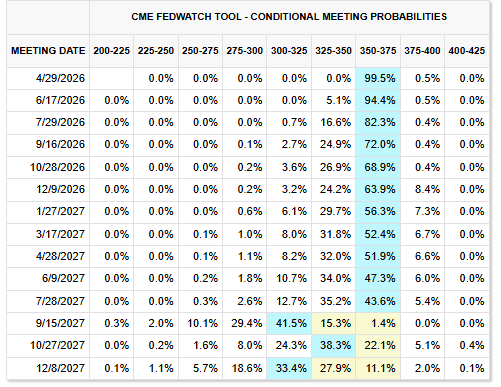
Next week will be key, with the Federal Reserve set to announce its interest rate decision on April 29, followed by the European Central Bank on April 30. In this context, expectations for the Fed continue to point toward a pause in rate changes, with a probability close to 99.5% that rates will remain at 3.75%.
Additionally, the market continues to project that this stance could remain in place for an extended period, even stretching toward 2027, reinforcing a view of policy stability in the United States.
Source: CMEGROUP
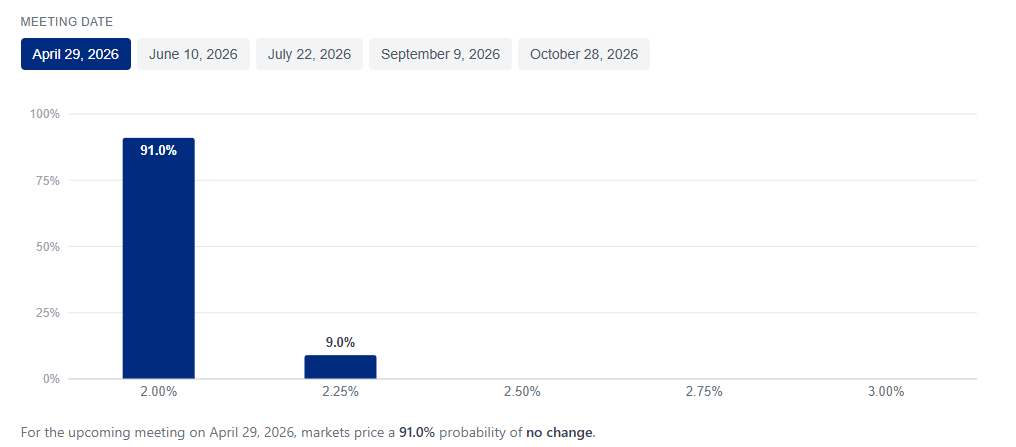
In the case of the European Central Bank, expectations are similar in the short term, with a roughly 91% probability that the deposit rate will remain unchanged at 2.00%. However, there are growing probabilities of potential rate increases toward the 2.25% level, introducing an important factor to monitor.
Source: ECBWATCH
This setup is relevant, as the interest rate differential between the two economies has been a key factor limiting the euro’s strength against the dollar. With U.S. rates at 3.75% and Europe at 2.00%, USD-denominated assets continue to be perceived as more attractive, reducing demand for the euro over the longer term.
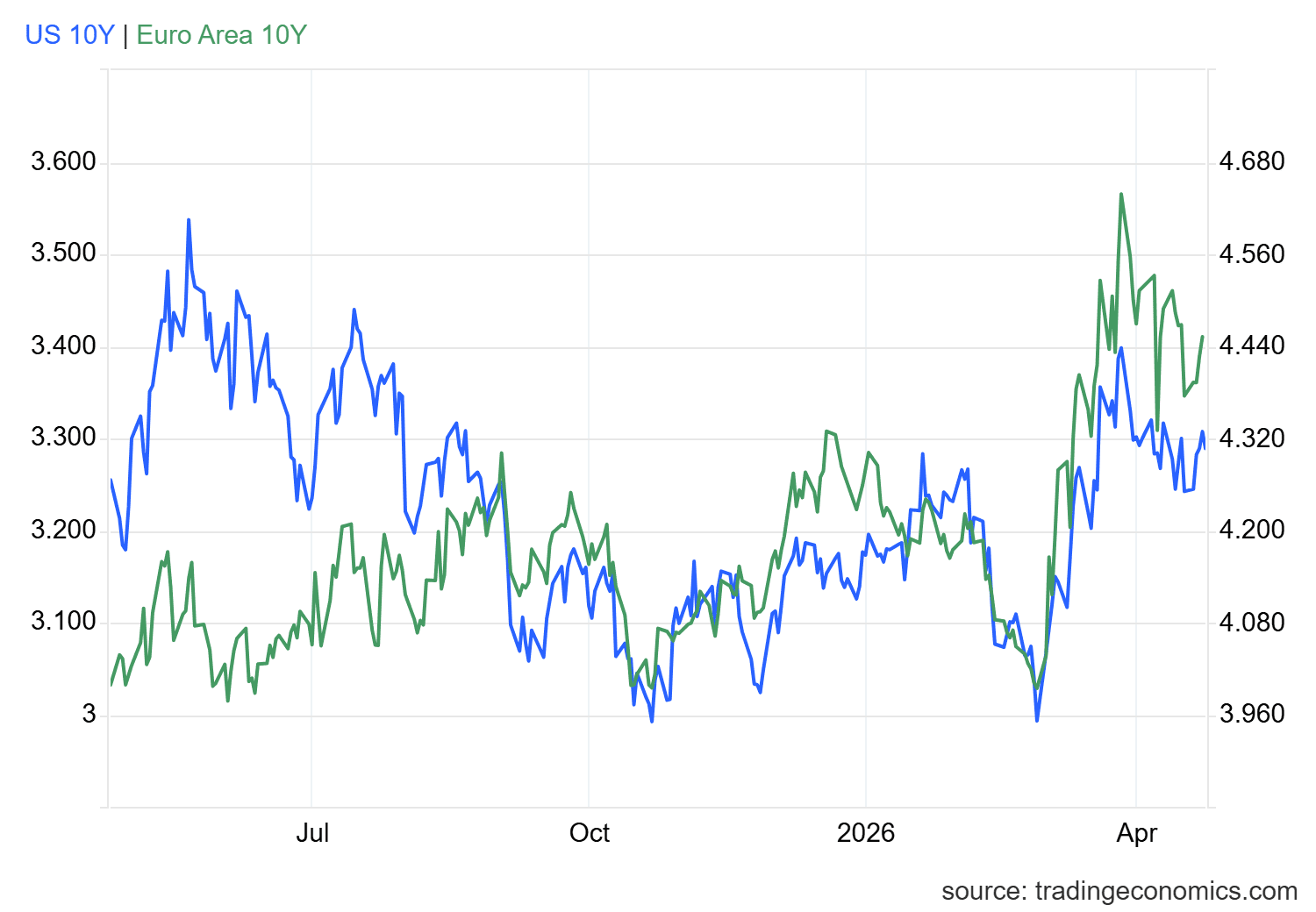
This differential is also reflected in the bond market. U.S. 10-year Treasury yields remain around 4.3%, while in Europe, yields are closer to 3.4%, despite recent increases. This gap continues to favor the dollar, maintaining stronger capital flows toward USD assets.
Source: TradingEconomics
With all of this in mind, the upcoming central bank decisions will be crucial. While the Fed is expected to hold its current stance, attention will shift to the ECB, where any signal of a more restrictive monetary policy could narrow the rate differential and reduce the dollar’s relative appeal. In that scenario, buying pressure in EUR/USD could begin to regain relevance in the coming weeks.
Technical outlook for EUR/USD
Source: StoneX, Tradingview
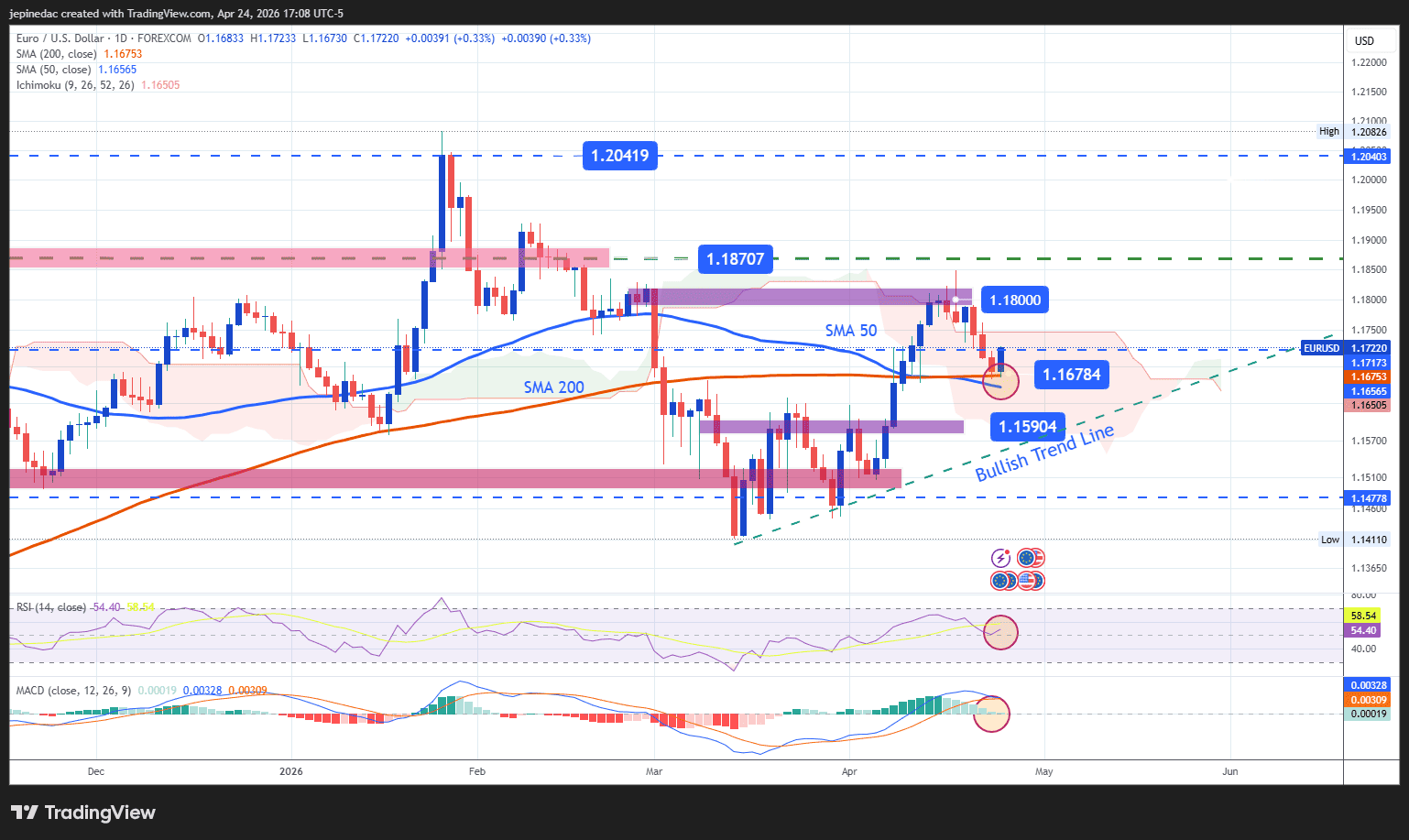
- Uptrend remains relevant: Since mid-March, EUR/USD has been forming higher lows, allowing for the development of a potential short-term upward trendline. As long as no aggressive downside corrections emerge, this structure could consolidate as the dominant pattern in the coming weeks.
- RSI: The RSI indicator continues to oscillate around the 50 level, suggesting a balance between bullish and bearish momentum. This behavior indicates that indecision remains dominant in price action. As the RSI continues to hover around this level, this phase of indecision is likely to persist in the short term.
- MACD: A similar pattern can be observed in the MACD, where the histogram remains close to the zero level, suggesting that short-term moving average strength is in neutral territory. This reinforces the idea of a consistent neutral phase that may remain relevant in the coming sessions.
Key levels:
- 1.18000 – Key resistance: A key psychological level. Sustained moves above this zone could support a more dominant bullish bias and potentially lead to the consolidation of a stronger uptrend in the coming sessions.
- 1.16784 – Near-term barrier: A neutral zone aligned with the 50 and 200-period moving averages, making it one of the most relevant levels to monitor in the short term. Price action around this level could reinforce a sideways phase and further market indecision.
- 1.15904 – Key support: A level positioned below the moving averages, acting as a relevant retracement zone. Moves toward this area could put the current bullish structure at risk and trigger a more consistent bearish bias in the coming weeks.
Written by Julian Pineda, CFA, CMT – Market Analyst
Follow him on: @julianpineda25
Latest market news




Open an account in minutes
Experience award-winning platforms with fast and secure execution.
Economic calendar
Web Trader platform
Our sophisticated web-based platform is packed with features.
Related articles

US dollar outlook: DXY finds fresh support as risk aversion deepens
The dollar is finding fresh support as risk aversion drives investors out of emerging-market and commodity currencies. With tariff threats mounting and today's PCE data in focus, the 104.53 high and 104.60 resistance are back in play.


AUD/USD Outlook: Hot Inflation No Match for Global Risk Aversion
With inflation pressures broadening and the labour market deteriorating, the RBA faces an unenviable task. But for AUD/USD traders, developments offshore may matter far more right now.


NZD/USD Outlook: Reversal Signals Emerge as AI Trade Falters
Kiwi prints a reversal signal comes as cracks appear in the US economic exceptionalism story. An orderly rotation away from AI could provide favourable conditions for a rebound, but another brutal risk-off episode may have the opposite effect.
StoneX Financial Ltd (trading as "FOREX.com") is an execution-only service provider. This material, whether or not it states any opinions, is for general information purposes only and it does not take into account your personal circumstances or objectives. This material has been prepared using the thoughts and opinions of the author and these may change. However, FOREX.com does not plan to provide further updates to any material once published and it is not under any obligation to keep this material up to date.
This material is short term in nature and may only relate to facts and circumstances existing at a specific time or day. Nothing in this material is (or should be considered to be) financial, investment, legal, tax or other advice and no reliance should be placed on it. No opinion given in this material constitutes a recommendation by FOREX.com or the author that any particular investment, security, transaction or investment strategy is suitable for any specific person.
The material has not been prepared in accordance with legal requirements designed to promote the independence of investment research. Although FOREX.com is not specifically prevented from dealing before providing this material, FOREX.com does not seek to take advantage of the material prior to its dissemination. This material is not intended for distribution to, or use by, any person in any country or jurisdiction where such distribution or use would be contrary to local law or regulation. For further details see our full non-independent research disclaimer and quarterly summary.