





HSBC Lloyds Full Year Results Preview
Both HSBC and Lloyds are due to report with both banks facing different challenges
Share this:

Britain two largest banks, HSBC and Lloyds reveal their full year results this week. Here’s what to expect:
When - Tuesday 18th February before the opening bell
HSBC warned in October’s Q3 results that conditions have worsened. Investors will be bracing themselves restructuring news, paying particular attention to the outlook and waiting for news as to whether interim Chief Executive Noel Quin will be confirmed as CEO.
HSBC Results Restructuring & Outlook in Focus
When - Tuesday 18th February before the opening bell
- Pre-tax profit of $20 billion (£15.3 million) 2019 vs $19.9 billion 2018
HSBC warned in October’s Q3 results that conditions have worsened. Investors will be bracing themselves restructuring news, paying particular attention to the outlook and waiting for news as to whether interim Chief Executive Noel Quin will be confirmed as CEO.
Restructuring
Back in August the bank removed chief executive John Flint and had plans to continue slashing jobs across all levels. 1 in 20 jobs are expected to go as part of the restructuring and remodeling programme, to address structural inefficiencies and organizational complexity. 10,000 job losses are expected to be announced alongside results. Many of the job cuts will come from global banking and markets division and commercial and retail banking business.
The restructuring is expected to result in a reduction of the bank’s geographical spread. As Asia accounts for 49% revenue and 90% profits in 2018, Noel Quinn will drive efforts to boost revenues, pulling out of some low returning markets such as Greece, Oman and Turkey.
HSBC is at a key stage in this programme and acknowledges that there is still room for improvement. Return on Equity target of 11% in 2020 is not expected to be reached. A cost saving target of $6 billion by 2022 has already been announced.
Outlook
Given HSBC’s heavy exposure to Hong Kong where the bank has faced many headwinds, a lot of focus will be on the outlook for the bank. Last year there was the trade war at the start of the year, followed by months of protests and unrest in Hong Kong and now the whole region is affected by Covid-19 which is adding to uncertainty.
Share price
HSBC share price has performed a strong V-shaped recovery, bouncing off a low of 550p in early February. It now trades above its 50, 100 and 200 sma. Immediate resistance can be seen at 600p (13 Feb high). Support is seen in the region of 580p (200 & 100 sma).
Lloyds - Low Bar, Outlook Matters
When - Thursday 20th February before market open.
Low expectations
Lloyds offers the most liquid exposure to UK macroeconomics. The performance of the UK economy is inextricably linked to the performance of Lloyds. Given the UK’s sluggish growth, low interest rate environment, combined with Brexit uncertainty, 2019 was a tough year for the UK economy.
Expectations for Lloyd’s full year 2019 are pretty low. Back in September the bank halted its own share buyback, whilst Q3 profits plummeted owing to £1.8 billion of extra provisions for PPI compensation. Underlying profits were down as total income and net interest margins squeezed, so much so that the NIM outlook for the full year was reduced to 2.88% down from 2.9%.
Adding to the bank’s woes, Lloyds also performed poorly in the BoE stress tests, further reducing its capabilities for cash returns above and beyond the dividend.
The future of Lloyds Chief executive Antonio Horta-Osorio will also be in focus after he faced criticism over his pay. He is expected to see a cut from 2018’s £6.3 million package. Executive remuneration is expected to be overhauled and succession plans stepped up.
Outlook
Given the low expectations investors are likely to pay closer attention to forward guidance.
The broad expectation is for Lloyds to deliver a middling performance in 2020. The fact that the Boris bounce was short lived in the Lloyds share price shows there are still plenty of concerns surrounding the banks ability to perform well in what promises to be another year of Brexit uncertainty weighing on the UK economy.
That said the unexpected resignation of Sajid Javid and replacement by Rishi Sunak last week has boosted the prospect of an expansionary fiscal policy. This could take the pressure off the Bank of England to cut interest rates, offering some respite for Lloyds.
Levels to watch
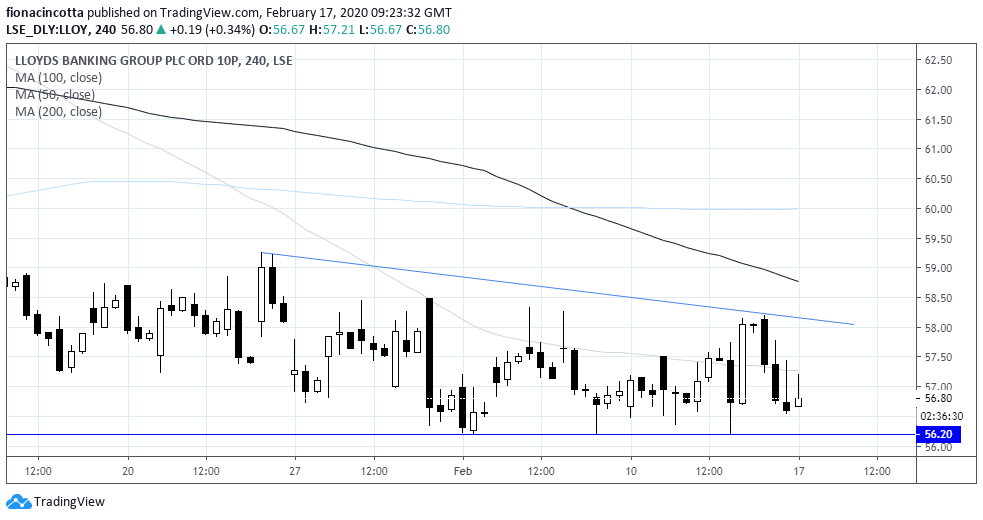
Lloyds has been trending lower. It trades below its 50, 100 and 200 sma. Immediate support can be seen at 56.20p, trend line resistance is seen around 58p.
Britain's two largest banks, HSBC and Lloyds reveal their full year results this week. Here’s what to expect:
HSBC Results Restructuring & Outlook in Focus
When - Tuesday 18th February before the opening bell
- Pre-tax profit of $20 billion (£15.3 million) 2019 vs $19.9 billion 2018
HSBC warned in October’s Q3 results that conditions have worsened. Investors will be bracing themselves restructuring news, paying particular attention to the outlook and waiting for news as to whether interim Chief Executive Noel Quinn will be confirmed as CEO.
Restructuring
Back in August the bank removed chief executive John Flint and had plans to continue slashing jobs across all levels. 1 in 20 jobs are expected to go as part of the restructuring and remodeling programme, to address structural inefficiencies and organizational complexity. 10,000 job losses are expected to be announced alongside results. Many of the job cuts will come from global banking and markets division and commercial and retail banking business.
The restructuring is expected to result in a reduction of the bank’s geographical spread. As Asia accounts for 49% revenue and 90% profits in 2018, Noel Quinn will drive efforts to boost revenues, pulling out of some low returning markets such as Greece, Oman and Turkey.
HSBC is at a key stage in this programme and acknowledges that there is still room for improvement. Return on Equity target of 11% in 2020 is not expected to be reached. A cost saving target of $6 billion by 2022 has already been announced.
Outlook
Given HSBC’s heavy exposure to Hong Kong where the bank has faced many headwinds, a lot of focus will be on the outlook for the bank. Last year there was the trade war at the start of the year, followed by months of protests and unrest in Hong Kong and now the whole region is affected by Covid-19 which is adding to uncertainty.
Share price
HSBC share price has performed a strong V-shaped recovery, bouncing off a low of 550p in early February. It now trades above its 50, 100 and 200 sma. Immediate resistance can be seen at 600p (13 Feb high). Support is seen in the region of 580p (200 & 100 sma).
Lloyds - Low Bar, Outlook Matters
When - Thursday 20th February before market open.
Pre-tax profits -25% to £4.47 billion in 2019
Low expectations
Lloyds offers the most liquid exposure to UK macroeconomics. The performance of the UK economy is inextricably linked to the performance of Lloyds. Given the UK’s sluggish growth, low interest rate environment, combined with Brexit uncertainty, 2019 was a tough year for the UK economy.
Expectations for Lloyd’s full year 2019 are pretty low. Back in September the bank halted its own share buyback, whilst Q3 profits plummeted owing to £1.8 billion of extra provisions for PPI compensation. Underlying profits were down as total income and net interest margins squeezed, so much so that the NIM outlook for the full year was reduced to 2.88% down from 2.9%.
Adding to the bank’s woes, Lloyds also performed poorly in the BoE stress tests, further reducing its capabilities for cash returns above and beyond the dividend.
The future of Lloyds Chief executive Antonio Horta-Osorio will also be in focus after he faced criticism over his pay. He is expected to see a cut from 2018’s £6.3 million package. Executive remuneration is expected to be overhauled and succession plans stepped up.
Outlook
Given the low expectations investors are likely to pay closer attention to forward guidance.
The broad expectation is for Lloyds to deliver a middling performance in 2020. The fact that the Boris bounce was short lived in the Lloyds share price shows there are still plenty of concerns surrounding the banks ability to perform well in what promises to be another year of Brexit uncertainty weighing on the UK economy.
That said the unexpected resignation of Sajid Javid and replacement by Rishi Sunak last week has boosted the prospect of an expansionary fiscal policy. This could take the pressure off the Bank of England to cut interest rates, offering some respite for Lloyds.
Levels to watch
Lloyds has been trending lower. It trades below its 50, 100 and 200 sma. Immediate support can be seen at 56.20p, trend line resistance is seen around 58p.
Latest market news




Open an account in minutes
Experience award-winning platforms with fast and secure execution.
Economic calendar
Web Trader platform
Our sophisticated web-based platform is packed with features.
Related articles

SK Hynix IPO: Everything You Need to Know About SK Hynix
Learn everything you need to know about the SK Hynix IPO, including its Nasdaq listing, valuation, financials, ownership, competitors and investment risks.


Nasdaq 100 Outlook: Broadcom Extends Slide, Palantir Reversal Signal
Nasdaq 100 slides as AI funding fears bite, with Broadcom extending losses and Palantir flashing a potential reversal at resistance.


ASX 200 Market Wrap: Big Four Bounce, FMG Surges, CSL Lags
ASX 200 posts its best day in three months as big four banks rebound, FMG breaks higher and CSL continues to lag the market.
StoneX Financial Ltd (trading as "FOREX.com") is an execution-only service provider. This material, whether or not it states any opinions, is for general information purposes only and it does not take into account your personal circumstances or objectives. This material has been prepared using the thoughts and opinions of the author and these may change. However, FOREX.com does not plan to provide further updates to any material once published and it is not under any obligation to keep this material up to date.
This material is short term in nature and may only relate to facts and circumstances existing at a specific time or day. Nothing in this material is (or should be considered to be) financial, investment, legal, tax or other advice and no reliance should be placed on it. No opinion given in this material constitutes a recommendation by FOREX.com or the author that any particular investment, security, transaction or investment strategy is suitable for any specific person.
The material has not been prepared in accordance with legal requirements designed to promote the independence of investment research. Although FOREX.com is not specifically prevented from dealing before providing this material, FOREX.com does not seek to take advantage of the material prior to its dissemination. This material is not intended for distribution to, or use by, any person in any country or jurisdiction where such distribution or use would be contrary to local law or regulation. For further details see our full non-independent research disclaimer and quarterly summary.