


New Zealand Dollar Forecast: Weak Labour Market Signals Risk for NZD/USD
New Zealand’s unemployment rate edged up to 5.2%, beating market expectations but softer details highlight growing slack and limited wage pressures.
Share this:

- New Zealand unemployment up to 5.2%, matching RBNZ forecasts
- Employment, participation drop
- Underutilisation rises to 12.8%, youth unemployment steady
- NZD firms slightly, but mid‑2% cash rate still a risk
NZD/USD Outlook Summary
New Zealand’s Q2 jobs report showed further signs of labour market weakness, even as the unemployment rate marginally undershot market expectations. Falling employment, softer participation, rising underutilisation and elevated youth unemployment point to a weak backdrop that should keep wage pressures contained. The Kiwi firmed slightly on the headline unemployment beat, but with swaps still treating 2.75% as a floor for the cash rate, we see scope for deeper cuts should these trends persist. That may limit upside for NZD/USD over the medium to longer term.
Q2 Jobs Report: Soft Underlying Detail
New Zealand’s Q2 employment data delivered another soft set of underlying details despite the headline unemployment rate coming in slightly better than markets expected. Seasonally adjusted unemployment rose to 5.2% from 5.1% in Q1, matching the RBNZ’s forecast but below the 5.3% rate expected by markets.
Employment fell 0.1% versus the RBNZ’s projected 0.2% rise, while participation eased to 70.5%, undershooting the bank’s 70.8% forecast. Weaker participation helped limit the rise in unemployment but points to ongoing softness in labour market conditions. The employment rate fell to 66.8%, down from 67.1% in Q1 and three-tenths below what the RBNZ anticipated.
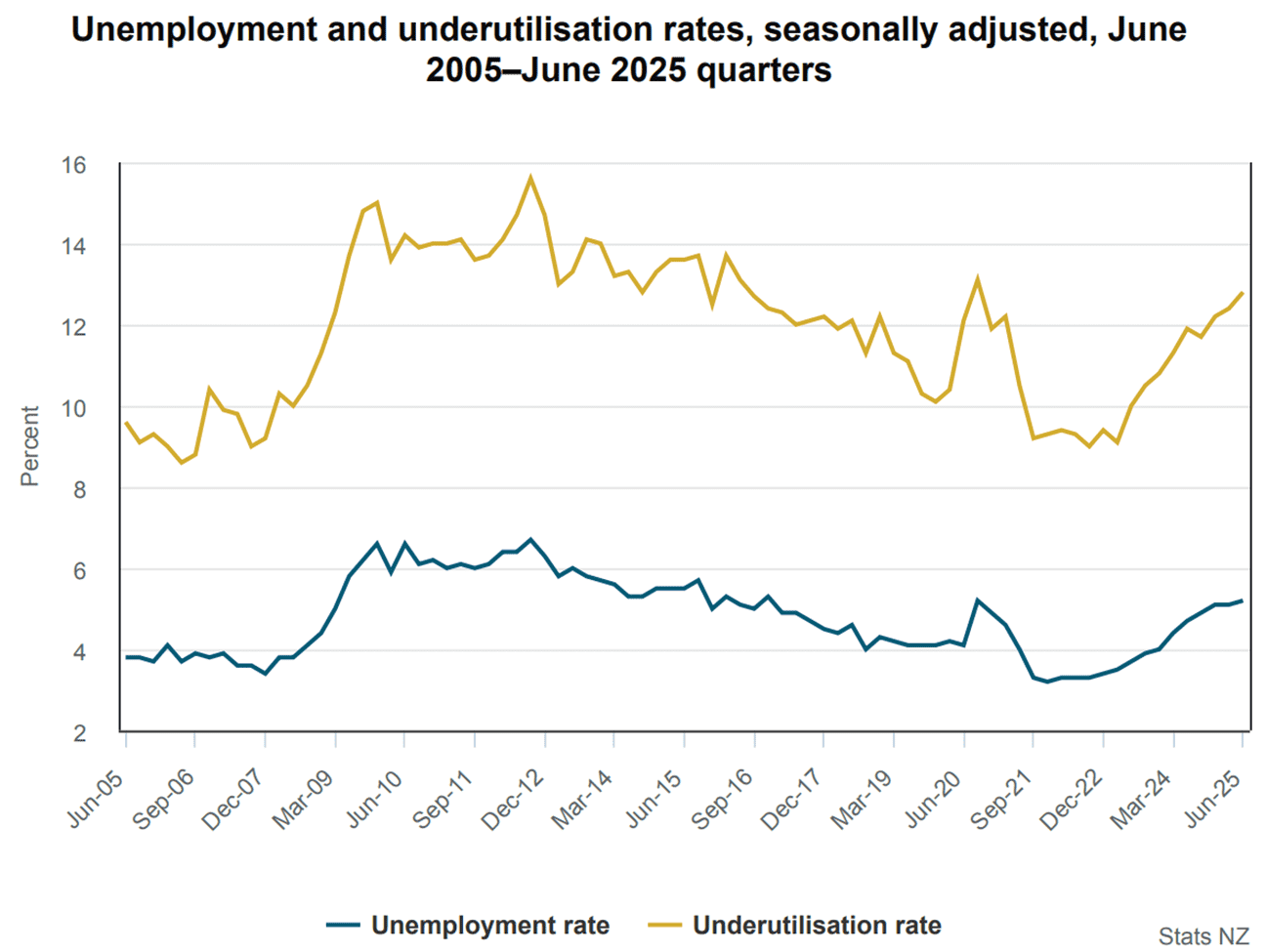
Source: StatsNZ
Despite lower participation, labour market slack continued to build with underutilisation climbing to 12.8% from 12.4% in Q1. This figure combines both unemployed and underemployed workers, along with potential labour market participants.
Youth unemployment remained elevated, holding at 12.9%. This underlines how the most responsive parts of the labour market continue to feel the pressure from weaker economic growth.
Private sector wages excluding bonuses rose 2.2% from a year earlier, a touch below the 2.3% pace expected, reinforcing that wage pressures remain contained. Despite the marginal beat on the headline unemployment rate, the details signal a labour market that is loosening further, limiting the risk of a renewed pickup in domestic-driven inflation.
Markets Favour 2.75% RBNZ Cash Rate Floor
Despite the soft underlying detail, traders are focusing on the small undershoot in unemployment relative to expectations, helping the Kiwi to strengthen against the USD. There has been little movement in swaps markets with traders continuing to favour 2.75% as the floor for the RBNZ cash rate this cycle.
Given trends in underutilisation and wage growth, and with a sizeable proportion of the working-age population not even participating in the labour market, that comes across as too optimistic in our book. To get the private sector firing, policy settings need to be stimulatory, not neutral, pointing to the potential for the cash rate to be reduced to the mid-2s or lower. That’s the risk we continue to see.
NZD/USD Technical Analysis
Looking at NZD/USD, the pair trades towards the lower end of the post-Liberation Day range established in May, recording a series of lower highs and lower lows over the past month since a brief foray above .6100 in early July.

Source: TradingView
While RSI (14) sits below 50 with MACD continuing to push lower in negative territory, having crossed the signal line from above in late July—two momentum signals that favour playing the Kiwi from the short side—with known support at .5850 and the key 200-day moving average just below, it’s difficult to get too bearish right now unless there’s a clean downside break of both levels. Zooming out, the pair may be in the process of forming a falling wedge, providing another warning that downside may be hard won over the medium to longer term.
For now, buyers have been nibbling away on dips beneath .5900, likely noting the bullish price action seen on deeper probes below the level earlier in the year. For those contemplating countertrend longs, positions could be established around .5900 with a stop order beneath for protection. Depending on the desired risk-reward, this could extend down to beneath the 200-day moving average.
.5940 is a minor resistance level above, providing an early test for bulls. If it’s cleared, .6000 and the 50-day moving average loom as a potential target. Wedge resistance, .6050 and .6110 are other possibilities if the Kiwi really gets a wriggle on.
On the downside, .5883 was the low set on Tuesday, making that an initial level of note. Below, wedge support, .5850 and the 200-day moving average are the key levels to watch. If the latter is broken cleanly, there’s little visible support until the long-running downtrend established in January 2021.
Related tags:


Open an account in minutes
Experience award-winning platforms with fast and secure execution.
Economic calendar
Web Trader platform
Our sophisticated web-based platform is packed with features.
Related articles
China's steel slump leaves iron ore bulls under the pump
Iron ore has broken major support, threatening a return to the lows of 2022 as mounting evidence of weakness in China's steel sector reinforces the bearish outlook.

NZD/USD Forecast: Kiwi faces historic breakdown as RBNZ survey looms
NZD/USD is teetering above support that held through the pandemic and Liberation Day turmoil. With RBNZ hawks repeatedly disappointed, today's inflation expectations survey could open the door to a slide towards the GFC lows.

USD/JPY, AUD/JPY: Central Bank Divergence Creates Two-Way Risk
USD/JPY eyes a breakout above 160, while AUD/JPY faces further losses as Fed, RBA and BoJ interest rate expectations diverge.

StoneX Financial Ltd (trading as "FOREX.com") is an execution-only service provider. This material, whether or not it states any opinions, is for general information purposes only and it does not take into account your personal circumstances or objectives. This material has been prepared using the thoughts and opinions of the author and these may change. However, FOREX.com does not plan to provide further updates to any material once published and it is not under any obligation to keep this material up to date.
This material is short term in nature and may only relate to facts and circumstances existing at a specific time or day. Nothing in this material is (or should be considered to be) financial, investment, legal, tax or other advice and no reliance should be placed on it. No opinion given in this material constitutes a recommendation by FOREX.com or the author that any particular investment, security, transaction or investment strategy is suitable for any specific person.
The material has not been prepared in accordance with legal requirements designed to promote the independence of investment research. Although FOREX.com is not specifically prevented from dealing before providing this material, FOREX.com does not seek to take advantage of the material prior to its dissemination. This material is not intended for distribution to, or use by, any person in any country or jurisdiction where such distribution or use would be contrary to local law or regulation. For further details see our full non-independent research disclaimer and quarterly summary.