



Rising yields could undermine stocks and reignite EM currency crisis
The biggest story in the markets right now is that benchmark government bonds are getting absolutely hammered, lifting yields across the developed economies.
Share this:

The biggest story in the markets right now is that benchmark government bonds are getting absolutely hammered, lifting yields across the developed economies. In essence, it is the unwinding of the massive bond buying programmes from major central banks, led by the US where the Federal Reserve is already on a hiking cycle. But we are also seeing bonds fall and yields rise in Europe, with German 10-year bund, for example, hitting its best level since May. In the UK, Gilts are on the rise too and the 10-year has now reached 1.531, its highest level since May 22.
Clearly market participants are growing optimistic about the health of the global economy and therefore expect monetary conditions to tighten further. The ECB has already started to taper its bond buying programme and plans to end it in December, before raising interest rates at some point in 2019 - probably after the summer. In the UK, the Bank of England has already raised rates from the post financial crisis record lows and is expected to tighten its belt further in the upcoming months, especially if there is a breakthrough in Brexit stablemate. Elsewhere, the Bank of Canada is set to hike rates again at its next meeting owing to improving conditions there and after they reached a new trade deal with the US and Mexico.
The rally in bond yields, if sustained, could have major implications on financial markets going forward. It was during all those years post the financial crisis when they were falling which led to investors flocking to the higher-yielding stock markets in the first place. Now that bond yields are rising, this is eroding the attractiveness of equities on a relative basis. Thus, we could see funds flowing out of equities, leading to a correction for major global indices.
In the US, the three major indices - S&P 500, Dow Jones and Nasdaq - have all been trading near record highs this week. However, the small-cap index, the Russel 2000, has been going the opposite direction. In part, the divergence could be due to the rising yields and the dollar, making the large caps more attractive as they make a bulk of their earnings abroad. So when the earnings are converted back to the dollars, their results will appear better than would otherwise be the case. Also, higher yields are seen as being positive for banking stocks. But this can’t go on for too long, and once sentiment turns negative, even the large caps, including banks, could drop. With the latest reporting season set to start next week, things could get really interesting for stocks.
Meanwhile the rising yields in developed economies could potentially re-ignite the emerging market currency crisis. This is an additional risk factor for equities that needs to be taken into account.
But so far the US stock markets in particular have been very resilient to rising yields. It could be that investors are warming to signs of improving economy and they therefore think this is positive for company profits. Even so, valuations are extremely stretched in the US and a so correction may be looming anyway.
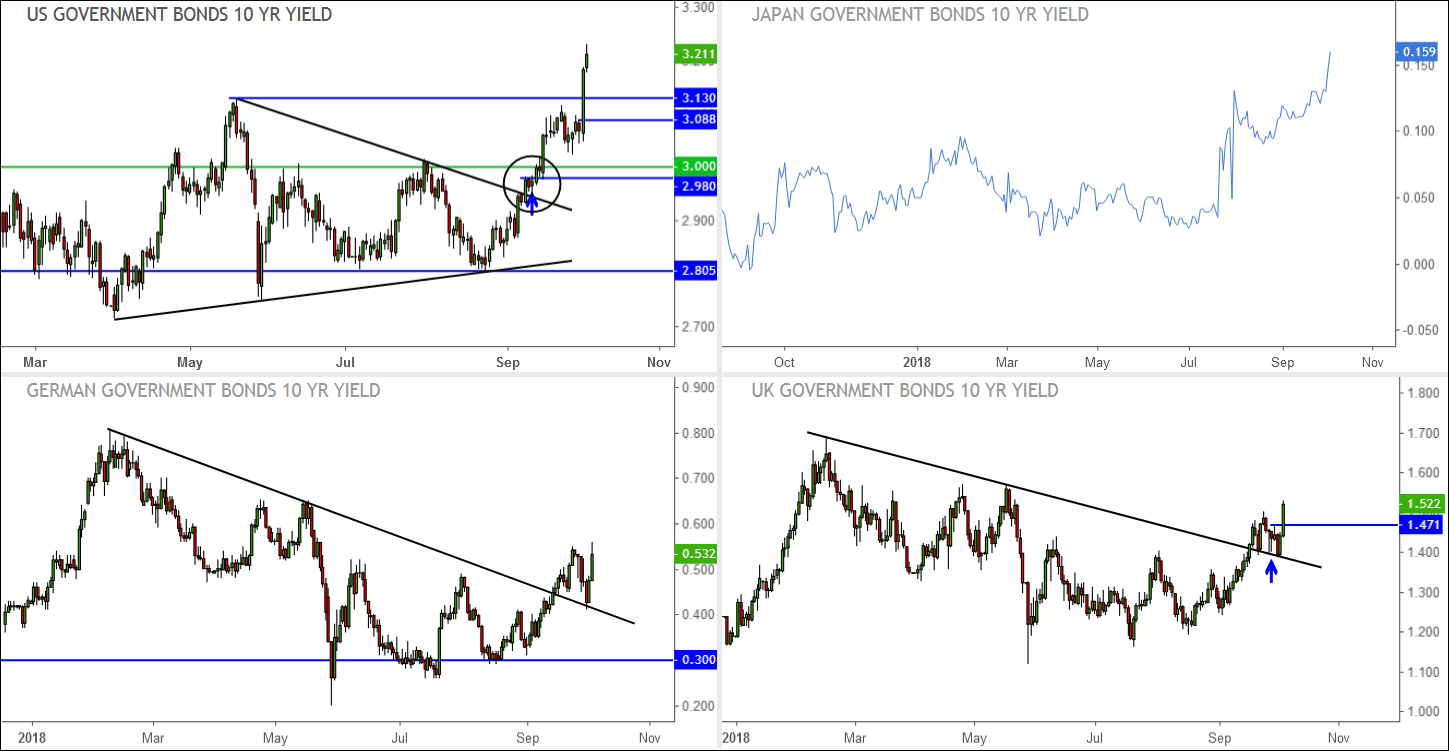
Source: TradingView.com and FOREX.com. Please note, this product is not available to US clients



Open an account in minutes
Experience award-winning platforms with fast and secure execution.
Economic calendar
Web Trader platform
Our sophisticated web-based platform is packed with features.
Related articles
US Dollar Breakout Has History on Its Side
The US dollar is breaking higher as financial conditions tighten at a historically rapid pace. Both history and the charts suggest the rally may have further to run.

GBP/USD, GBP/JPY, GBP/AUD: Sterling Eyes UK Inflation Catalyst
Sterling faces a pivotal UK inflation test as traders weigh BoE tightening, Fed minutes and Australian employment data across GBP/USD, GBP/JPY and GBP/AUD.


USD/MXN Forecast: Is Super Peso Making a Comeback?
The latest trading sessions have once again highlighted the strength of the Mexican peso. The currency has managed to regain a consistent appreciation trend in the short term, even despite the renewed strength displayed by the U.S. dollar in recent sessions.

StoneX Financial Ltd (trading as "FOREX.com") is an execution-only service provider. This material, whether or not it states any opinions, is for general information purposes only and it does not take into account your personal circumstances or objectives. This material has been prepared using the thoughts and opinions of the author and these may change. However, FOREX.com does not plan to provide further updates to any material once published and it is not under any obligation to keep this material up to date.
This material is short term in nature and may only relate to facts and circumstances existing at a specific time or day. Nothing in this material is (or should be considered to be) financial, investment, legal, tax or other advice and no reliance should be placed on it. No opinion given in this material constitutes a recommendation by FOREX.com or the author that any particular investment, security, transaction or investment strategy is suitable for any specific person.
The material has not been prepared in accordance with legal requirements designed to promote the independence of investment research. Although FOREX.com is not specifically prevented from dealing before providing this material, FOREX.com does not seek to take advantage of the material prior to its dissemination. This material is not intended for distribution to, or use by, any person in any country or jurisdiction where such distribution or use would be contrary to local law or regulation. For further details see our full non-independent research disclaimer and quarterly summary.