


Swiss Franc Forecast: Bullish USD/CHF and EUR/CHF setups face inflation hurdle
The franc’s underperformance has extended into August, with USD/CHF and EUR/CHF finding support ahead of a key U.S. inflation print that could set the tone for the next move.
Share this:

- CHF has lagged since early July
- Higher U.S. yields and calmer geopolitics cut haven demand
- USD/CHF and EUR/CHF maintain bullish setups
- U.S. CPI to dictate near-term direction
Swiss Franc Outlook Summary
The Swiss franc remains on the defensive heading into Tuesday’s U.S. inflation report. Strong correlations with U.S. rates, Fed policy expectations, and equity market volatility suggest the franc’s next move will hinge on the CPI outcome, making price action the key guide.
Rare CHF Underperformance
The Swiss franc has endured a rare period of underperformance over the past month, not only against the U.S. dollar but other majors like the euro and Japanese yen. Higher U.S. Treasury yields started the move, bottoming in unison with the U.S. dollar on July 1, before a combination of a calmer geopolitical backdrop and avoidance of a worst-case scenario for U.S. tariff policy sapped the franc of its safe-haven demand.

Source: TradingView
The question now is whether the franc’s underperformance is merely a corrective move or the start of a longer-lasting reversal. Initial thoughts lean towards the former given the structural shift towards the franc going back decades.
But in the near term, Tuesday’s U.S. inflation report looms as a key moment for USD/CHF given how strong its correlation has been with U.S. rates markets over the past week, with coefficient scores above 0.9 against U.S. two and 10-year yields. The same applies for Fed rate cut pricing out to June 2026, along with 10-year yield spreads between the U.S. and Switzerland. With a strong inverse correlation to VIX futures over the same period, USD/CHF is trading exactly like the yield-driven haven play it’s renowned for.

Source: TradingView
U.S. Inflation Key to Next Move
When it comes to the U.S. inflation report, there’s little to say other than that a monthly print of 0.4% or more for the core reading would likely deliver USD/CHF upside, prompting traders to pare expectations for how many interest rate cuts the Fed will deliver this cycle, likely pushing Treasury yields higher further out the curve. The opposite is likely to be true for a figure of 0.3% or less, helping bolster confidence that the impact of higher import tariffs may be temporary.
A core reading between 0.3% and 0.4% comes across as a more nuanced outcome for USD/CHF, likely requiring a deeper investigation to determine the underlying message. I’ve said it before and will say it again—while the focus will be on goods prices given the tariff impact, the largest share of the inflation basket measures services prices, which provide insights into domestic demand conditions. That’s what markets reacted violently to following the July payrolls report at the start of August, so those areas are arguably more important than tariff impacts on goods.
Where the price action in the franc may get interesting is against crosses like the euro and Japanese yen. As noted in a franc piece last week, recent evidence suggests those names tend to be more sensitive to shifts in Fed rate cut pricing, meaning franc volatility may be relatively muted compared with those currencies if we see a major data deviation from consensus. That’s something to keep in mind for those seeking to avoid trading direct USD pairs around the release.
USD/CHF Grinds Higher
Source: TradingView
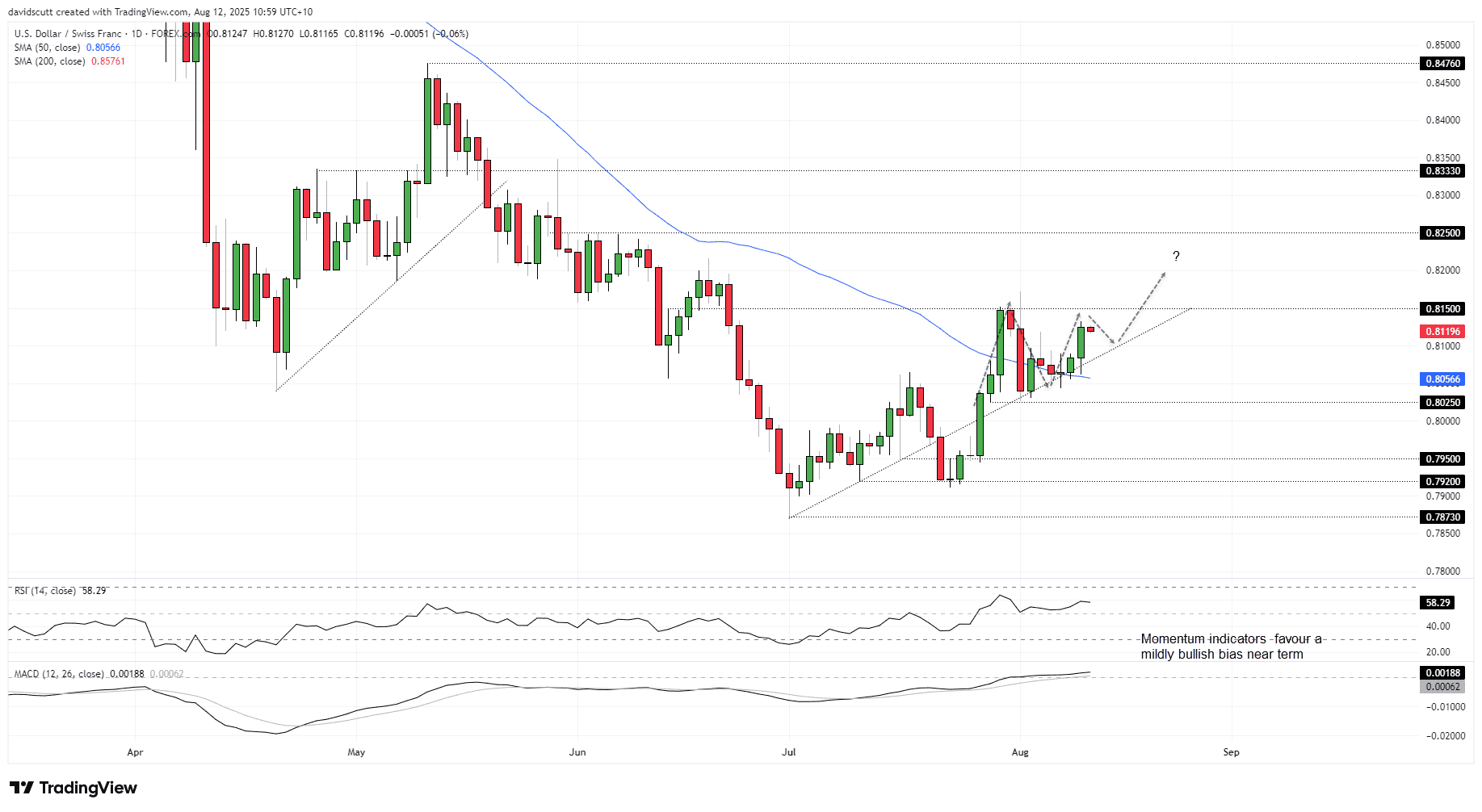
USD/CHF continues to grind higher after bottoming in July, finding support in recent days from the confluence of the 50-day moving average with the uptrend running from the recent lows. Sitting in what resembles an ascending triangle, upside is favoured in the near term, putting a potential retest of horizontal resistance at 0.8150 in play. RSI (14) and MACD are also providing mildly bullish momentum signals that favour an upside bias.
If USD/CHF were to close above 0.8150 resistance, 0.8200 and 0.8250 capped bullish advances during periods in June, making them immediately relevant for anyone contemplating bullish setups. Beyond that, 0.8333 may prove to be a tougher test for longs given price action around the level earlier in the year.
Should USD/CHF break the July uptrend/50DMA, the bullish bias would be invalidated.
EUR/CHF Trades at Multi-Month Highs

Source: TradingView
EUR/CHF has seen a solid bounce since the U.S. July nonfarm payrolls report, taking out both the 50- and 200-day moving averages along with several horizontal resistance levels, closing at the highest level since April on Monday.
0.9429 should be on the radar for traders, providing a level that could be used for both bullish and bearish setups depending on whether Monday’s move sticks. Momentum indicators favour a bullish bias, although price action should take precedence on a day with event risk such as this.
If the break holds, longs could be established above 0.9429 with a stop beneath for protection, targeting an extension of the bullish move back towards former support at 0.8500. If the break proves to be false, the setup could be flipped, with 0.9400, the 200-day moving average, and 0.9363/50-day moving average levels of note on the downside.
CHF/JPY Uptrend Hits Roadblock
Source: TradingView
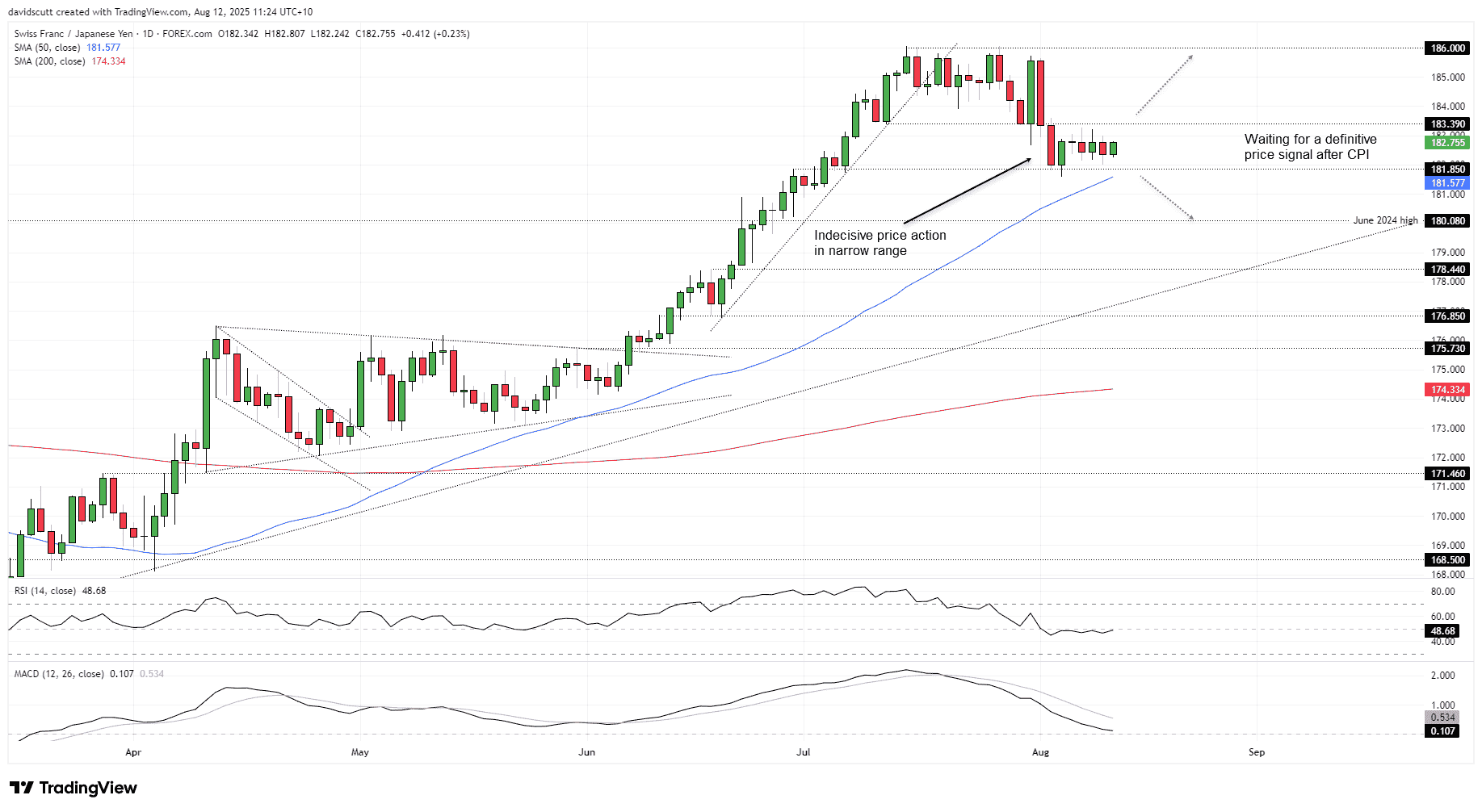
The broader bullish trend in CHF/JPY has stalled for now, with the pair reversing from strong resistance at 186.00 before finding support at 181.85 over the past week. The string of dojis on the daily timeframe between 181.85 and 183.39 paints a picture of indecision. With no firm signal from momentum indicators, this is one on the watchlist until we see a definitive price move.
183.39 and 186.00 are topside levels of note, with 181.85, the 50-day moving average, 180.08, 178.44, and 176.85 the ones to watch on the downside.
Related tags:


Open an account in minutes
Experience award-winning platforms with fast and secure execution.
Economic calendar
Web Trader platform
Our sophisticated web-based platform is packed with features.
Related articles
China's steel slump leaves iron ore bulls under the pump
Iron ore has broken major support, threatening a return to the lows of 2022 as mounting evidence of weakness in China's steel sector reinforces the bearish outlook.

NZD/USD Forecast: Kiwi faces historic breakdown as RBNZ survey looms
NZD/USD is teetering above support that held through the pandemic and Liberation Day turmoil. With RBNZ hawks repeatedly disappointed, today's inflation expectations survey could open the door to a slide towards the GFC lows.

USD/JPY, AUD/JPY: Central Bank Divergence Creates Two-Way Risk
USD/JPY eyes a breakout above 160, while AUD/JPY faces further losses as Fed, RBA and BoJ interest rate expectations diverge.

StoneX Financial Ltd (trading as "FOREX.com") is an execution-only service provider. This material, whether or not it states any opinions, is for general information purposes only and it does not take into account your personal circumstances or objectives. This material has been prepared using the thoughts and opinions of the author and these may change. However, FOREX.com does not plan to provide further updates to any material once published and it is not under any obligation to keep this material up to date.
This material is short term in nature and may only relate to facts and circumstances existing at a specific time or day. Nothing in this material is (or should be considered to be) financial, investment, legal, tax or other advice and no reliance should be placed on it. No opinion given in this material constitutes a recommendation by FOREX.com or the author that any particular investment, security, transaction or investment strategy is suitable for any specific person.
The material has not been prepared in accordance with legal requirements designed to promote the independence of investment research. Although FOREX.com is not specifically prevented from dealing before providing this material, FOREX.com does not seek to take advantage of the material prior to its dissemination. This material is not intended for distribution to, or use by, any person in any country or jurisdiction where such distribution or use would be contrary to local law or regulation. For further details see our full non-independent research disclaimer and quarterly summary.