



US Dollar Outlook: Peak War Uncertainty Weighs on USD, USD/CHF Eyes Breakdown
US dollar weakens as risk appetite improves, with correlations tight and USD/CHF offering a clearer bearish setup near key support.
Share this:

The US dollar is showing signs of fatigue as markets increasingly price in peak geopolitical risk. With correlations across FX majors tightening and equities pushing higher, traders appear to be shifting back towards a risk-on mindset. That leaves the dollar vulnerable, particularly if tensions in the Middle East begin to ease.
Technically, the US dollar index is testing key support levels after breaking below its 200-day EMA, while USD/CHF offers one of the clearest bearish setups among major pairs.
View related analysis:
View related analysis:
US Dollar Weakens as Risk Appetite Returns, USD/CHF Near Breakdown
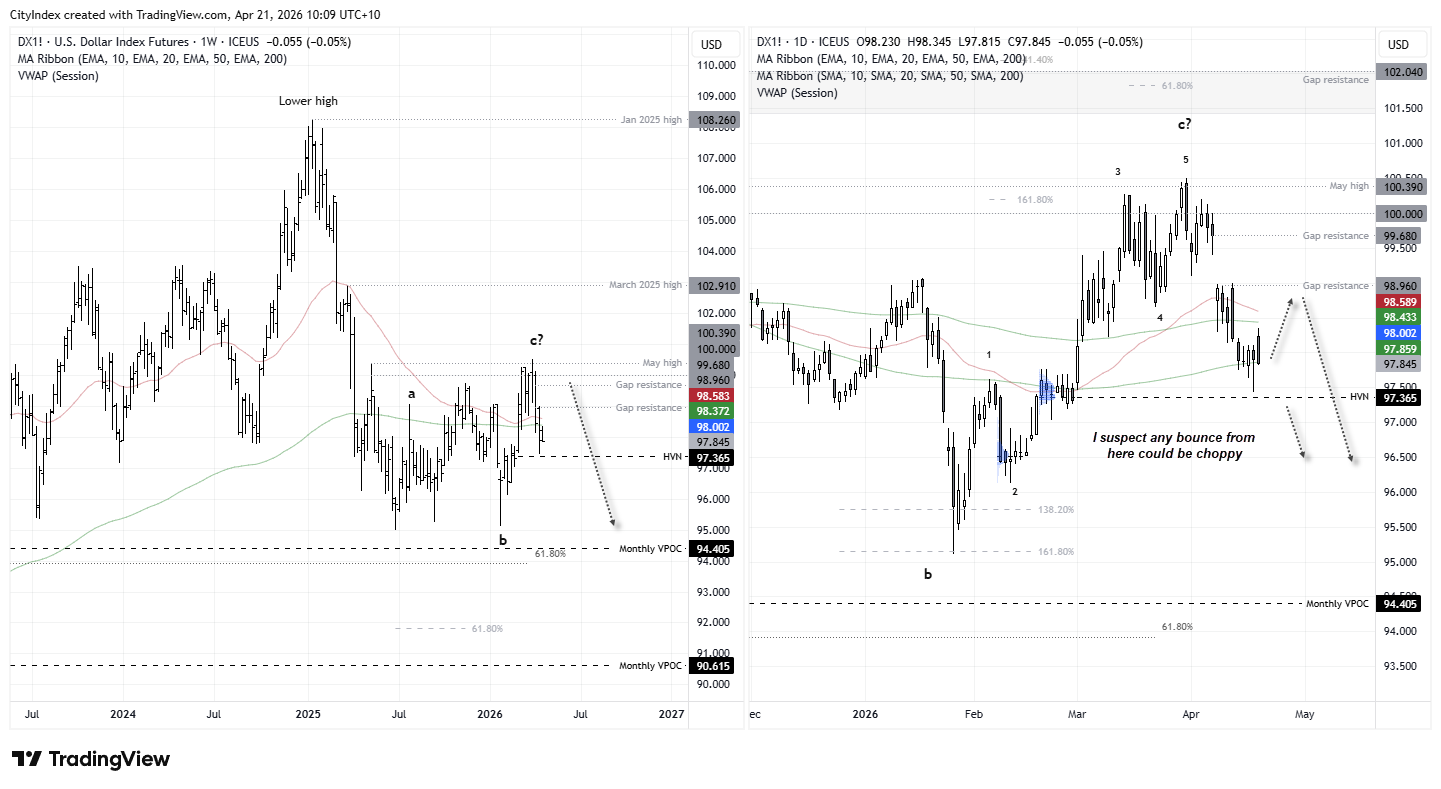
Traders continue to bet that we’ve seen peak uncertainty around the war in the Middle East, helping push Wall Street indices to fresh highs. That supports my view that the US dollar index formed an important top on March 31, and that any rebounds from recent losses are likely corrective in nature—offering opportunities for bears to fade.
US Dollar: Corrective Bounce or Breakdown Below 97.36?
The US dollar index daily chart shows bearish momentum has returned below the 200-day EMA, with prices now probing the 200-day SMA. This suggests any bounce is unlikely to be clean or impulsive. The key question is whether we see a grinding, corrective rally towards the 98.96 gap resistance to form a prominent swing high, or a break below the 97.36 high-volume node (HVN).
The latter scenario likely requires some resolution to the conflict. Until then, support may continue to hold and any upside could remain choppy. Either way, I suspect we’ve already seen the end of the larger wave C and 5-wave impulsive move, leaving the path of least resistance skewed to the downside over time.
Source: ICE, TradingView
US Dollar Correlation Matrix
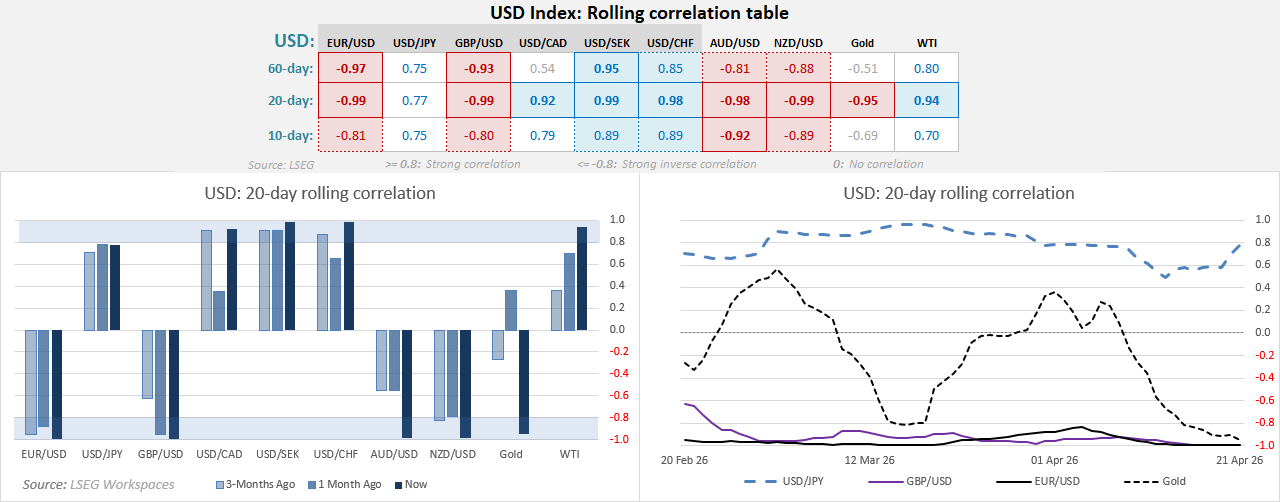
The correlation table compares the relationship between the US dollar index and major FX pairs, alongside gold and WTI crude oil. Correlations remain broadly strong across all three timeframes, reinforcing the USD’s dominant macro influence.
- However, the Japanese yen stands out as an outlier, with correlations around 0.75 across the 10–60 day windows—slightly weaker than typical levels, suggesting a more nuanced driver set (likely tied to yield differentials and Bank of Japan expectations).
- The Australian dollar currently shows the strongest inverse correlation over the past two weeks, with AUD/USD at -0.92, closely followed by NZD/USD at -0.89. This highlights how tightly antipodean currencies are tracking broader USD sentiment.
- Gold and crude oil correlations have softened over the past 10 days, which suggests geopolitical risk premia may be fading. This aligns with broader “risk-on” behaviour seen across equity markets.
- Notably, EUR/USD, GBP/USD and NZD/USD show near-perfect inverse correlations of around -0.99 over the past 20 days, underscoring how dominant USD flows have been in driving G10 FX.
- The Swiss franc also maintains consistently strong positive correlation via USD/CHF across all timeframes, reinforcing its role as a liquid counterweight to USD moves.
Ultimately, when correlations are this tight, it’s less about cross-currency stories and more about getting the USD right.
Source: LSEG


FX Majors Mixed as USD Weakness Persists, CAD Leads Gains
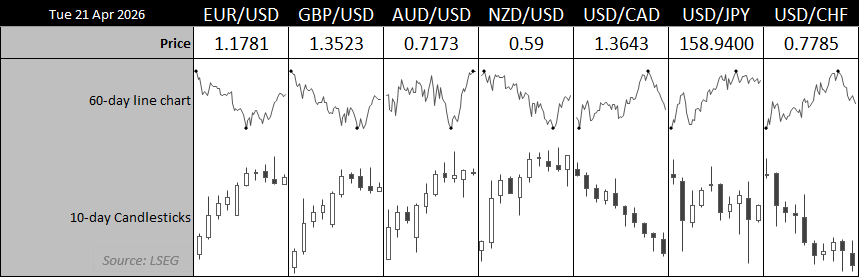
Looking across FX majors on the daily charts shows the Canadian dollar has been the strongest performer over the past two weeks.
- USD/CAD has fallen for nine of the past ten sessions. While clearly bearish, the lack of consolidation or retracement suggests it may be better suited to intraday setups rather than fresh swing trades.
- NZD/USD is carving out a potential swing low after New Zealand inflation surprised to the upside, increasing the likelihood of further RBNZ tightening.
- AUD/USD printed what could be interpreted as either a bullish hammer or hanging man on Monday. However, after a strong rally and Friday’s shooting star reversal, NZD/USD appears the more attractive bullish setup, with AUD/USD likely to remain choppy.
- EUR/USD is in a similar position to AUD/USD—extended after a strong move and now showing signs of hesitation near recent highs.
- GBP/USD is pulling back more gently and may offer a slight edge for bulls relative to EUR/USD.
Overall, USD/CHF continues to offer the clearest price action for a near-term bearish USD setup.
Source: LSEG


USD/CHF Technical Analysis: US Dollar vs Swiss Franc
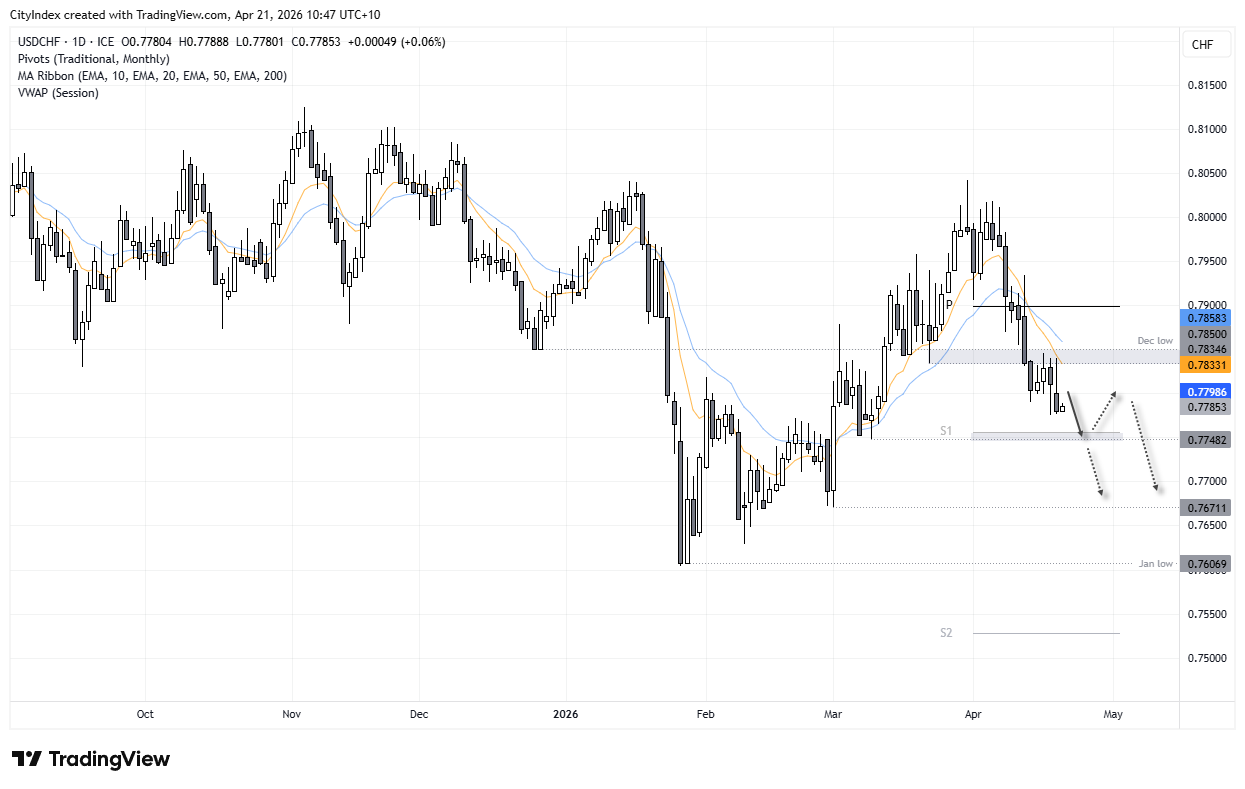
While correlations between FX majors and the US dollar index remain tight overall, price action in the Swiss franc appears cleaner for USD bears.
The USD/CHF daily chart shows the downtrend began on March 31, with a shooting star marking a false break above 0.80. A bearish engulfing candle on April 13 then drove prices below the monthly pivot point—a level yet to be retested. Since then, USD/CHF has printed a lower high and is now hovering just beneath the cycle lows.
Bears may look to fade rallies towards the December low (0.7850), anticipating a move towards the monthly S1 near the 0.7748 swing low. A break below there brings 0.77 and 0.7671 into focus, which would likely coincide with a broader USD selloff—potentially driven by easing geopolitical tensions in the Middle East.
Source: NYMEX, TradingView
View the full economic calendar
View the full economic calendar
-- Written by Matt Simpson
Follow Matt on Twitter @cLeverEdge
How to trade with City Index
You can trade with City Index by following these four easy steps:
- Open an account, or log in if you’re already a customer
• Open an account in the UK
• Open an account in Australia
• Open an account in Singapore
- Search for the market you want to trade in our award-winning platform
- Choose your position and size, and your stop and limit levels
- Place the trade
Related tags:


Open an account in minutes
Experience award-winning platforms with fast and secure execution.
Economic calendar
Web Trader platform
Our sophisticated web-based platform is packed with features.
Related articles
China's steel slump leaves iron ore bulls under the pump
Iron ore has broken major support, threatening a return to the lows of 2022 as mounting evidence of weakness in China's steel sector reinforces the bearish outlook.

NZD/USD Forecast: Kiwi faces historic breakdown as RBNZ survey looms
NZD/USD is teetering above support that held through the pandemic and Liberation Day turmoil. With RBNZ hawks repeatedly disappointed, today's inflation expectations survey could open the door to a slide towards the GFC lows.

USD/JPY, AUD/JPY: Central Bank Divergence Creates Two-Way Risk
USD/JPY eyes a breakout above 160, while AUD/JPY faces further losses as Fed, RBA and BoJ interest rate expectations diverge.
StoneX Financial Ltd (trading as "FOREX.com") is an execution-only service provider. This material, whether or not it states any opinions, is for general information purposes only and it does not take into account your personal circumstances or objectives. This material has been prepared using the thoughts and opinions of the author and these may change. However, FOREX.com does not plan to provide further updates to any material once published and it is not under any obligation to keep this material up to date.
This material is short term in nature and may only relate to facts and circumstances existing at a specific time or day. Nothing in this material is (or should be considered to be) financial, investment, legal, tax or other advice and no reliance should be placed on it. No opinion given in this material constitutes a recommendation by FOREX.com or the author that any particular investment, security, transaction or investment strategy is suitable for any specific person.
The material has not been prepared in accordance with legal requirements designed to promote the independence of investment research. Although FOREX.com is not specifically prevented from dealing before providing this material, FOREX.com does not seek to take advantage of the material prior to its dissemination. This material is not intended for distribution to, or use by, any person in any country or jurisdiction where such distribution or use would be contrary to local law or regulation. For further details see our full non-independent research disclaimer and quarterly summary.