



Why USDJPY Could See a Big Breakout Around Mondays LDP Election
On Monday 14 September, the LDP is expected to hold its leadership election three days before the National Diet will elect a new Prime Minister.
Share this:

As if 2020 wasn’t already tumultuous enough, Shinzō Abe, Japan’s longest-serving Prime Minister, unexpectedly resigned on 28 August, citing health issues. Abe will remain in office until a successor is chosen by the country’s ruling Liberal Democratic Party (LDP).
On Monday 14 September, the LDP is expected to hold its leadership election three days before the National Diet will elect a new Prime Minister. Though Abe refused to endorse a preferred successor, Chief Cabinet Secretary Yoshihide Suga is the clear frontrunner and has reportedly solidified his support within the LDP; former Defense Minister Shigeru Ishiba and ex-Foreign Minister Fumio Kishida will also vie for the election. The winner of the election will serve out the rest of Abe’s term, through September 2021.
If Suga secures the election, he has pledged to continue the former PM’s “Abenomics” economic policy, anchored by monetary easing from the Bank of Japan, fiscal stimulus through government spending, and structural reforms. In recent interviews, Suga has also cited deregulation as a key policy goal. While continuity in economic policies should benefit Japanese businesses, there is a risk that Suga could dissolve parliament and call a snap election to solidify his support, which could introduce an extended period of uncertainty and volatility for Japanese assets, including the yen.
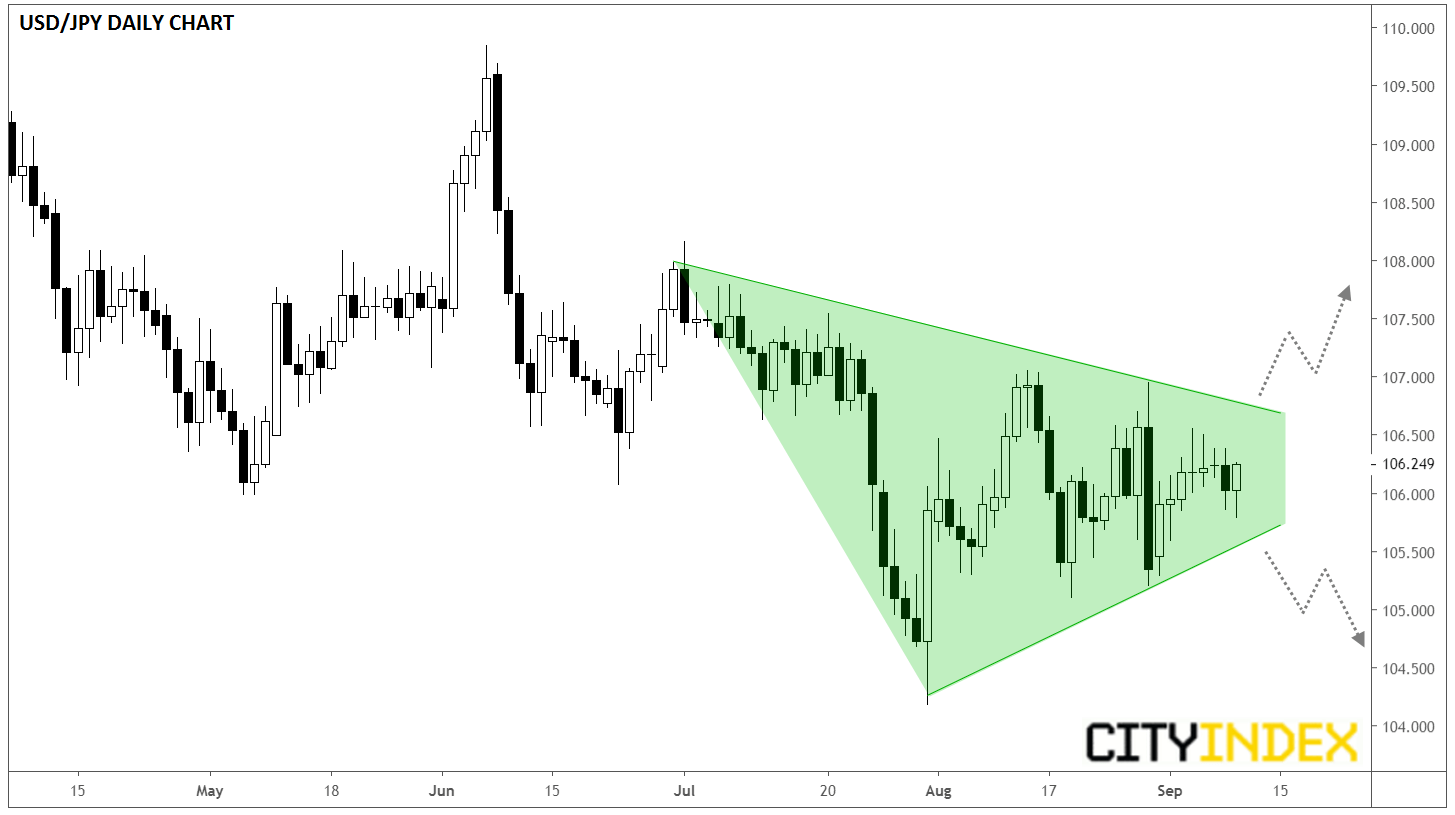
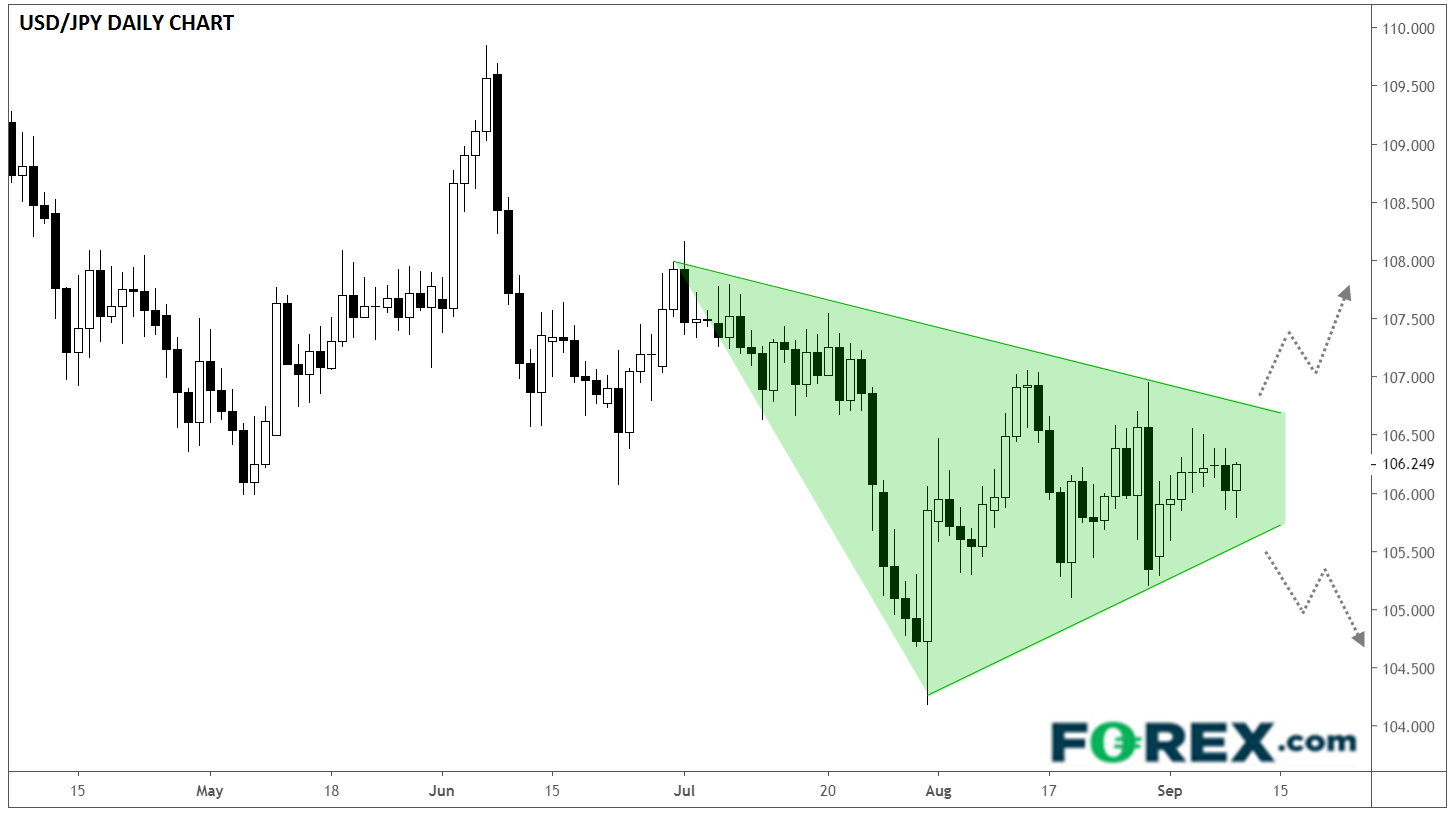
Speaking of the yen, Japan’s currency surprisingly saw notable strength against the US dollar on the day Abe announced his resignation, though USD/JPY has since retraced most of that move. Taking a step back, USD/JPY sits near the middle of a “symmetrical triangle” pattern created by a series of lower highs and higher lows in price. For the uninitiated, this pattern is similar to a person compressing a coiled spring: as the range continues to contract, energy builds up within the spring. When one of the pressure points is eventually removed, the spring will explode in that direction.
It’s notoriously difficult to predict the direction of a symmetrical triangle breakout in advance, but markets tend to see large moves following a breakout in either direction. Accordingly, readers may want to wait for a potential breakout around the election and then hop aboard the new trend on any pullbacks. To the topside, USD/JPY could rally up to 108.00, whereas a downside break could target the late July lows near 104.00.
Source: TradingView, GAIN Capital
Related tags:
Latest market news




Open an account in minutes
Experience award-winning platforms with fast and secure execution.
Economic calendar
Web Trader platform
Our sophisticated web-based platform is packed with features.
Related articles
USD/MXN Forecast: Is Super Peso Making a Comeback?
The latest trading sessions have once again highlighted the strength of the Mexican peso. The currency has managed to regain a consistent appreciation trend in the short term, even despite the renewed strength displayed by the U.S. dollar in recent sessions.
EUR/USD outlook: euro back above 1.1000 as dollar rally loses steam
EUR/USD has recovered back above 1.1000 after a brief break lower, a sign the dollar's inflation-driven rally may be losing momentum. With a December Fed hike largely priced in and oil a potential tailwind for the euro, the risks are starting to tilt to the upside.

USD/CAD Forecast: Canadian Dollar Remains Under Pressure After Inflation Data
As the end of 2026 draws closer, one of the most notable themes in the currency market remains the weakness of the Canadian dollar against its U.S. counterpart. Over the past five trading sessions alone, USD/CAD has gained nearly 0.8%, highlighting the consistent strength that the U.S. dollar has continued to display.
StoneX Financial Ltd (trading as "FOREX.com") is an execution-only service provider. This material, whether or not it states any opinions, is for general information purposes only and it does not take into account your personal circumstances or objectives. This material has been prepared using the thoughts and opinions of the author and these may change. However, FOREX.com does not plan to provide further updates to any material once published and it is not under any obligation to keep this material up to date.
This material is short term in nature and may only relate to facts and circumstances existing at a specific time or day. Nothing in this material is (or should be considered to be) financial, investment, legal, tax or other advice and no reliance should be placed on it. No opinion given in this material constitutes a recommendation by FOREX.com or the author that any particular investment, security, transaction or investment strategy is suitable for any specific person.
The material has not been prepared in accordance with legal requirements designed to promote the independence of investment research. Although FOREX.com is not specifically prevented from dealing before providing this material, FOREX.com does not seek to take advantage of the material prior to its dissemination. This material is not intended for distribution to, or use by, any person in any country or jurisdiction where such distribution or use would be contrary to local law or regulation. For further details see our full non-independent research disclaimer and quarterly summary.