



Will Easing Trade Tensions and More Supportive Central Banks Boost FTSE to 7460
After jumping higher in early trade, the FTSE has manged to hold onto its gains.
Share this:

US stock markets opened deep in the red and we haven’t seen any signs of a comeback just yet. The risks remain skewed to the downside, as selling momentum is rapidly growing. The S&P 500 forecast remains bearish, as things stand.
Before discussing why markets are falling, let’s take a look at the charts of the S&P 500.
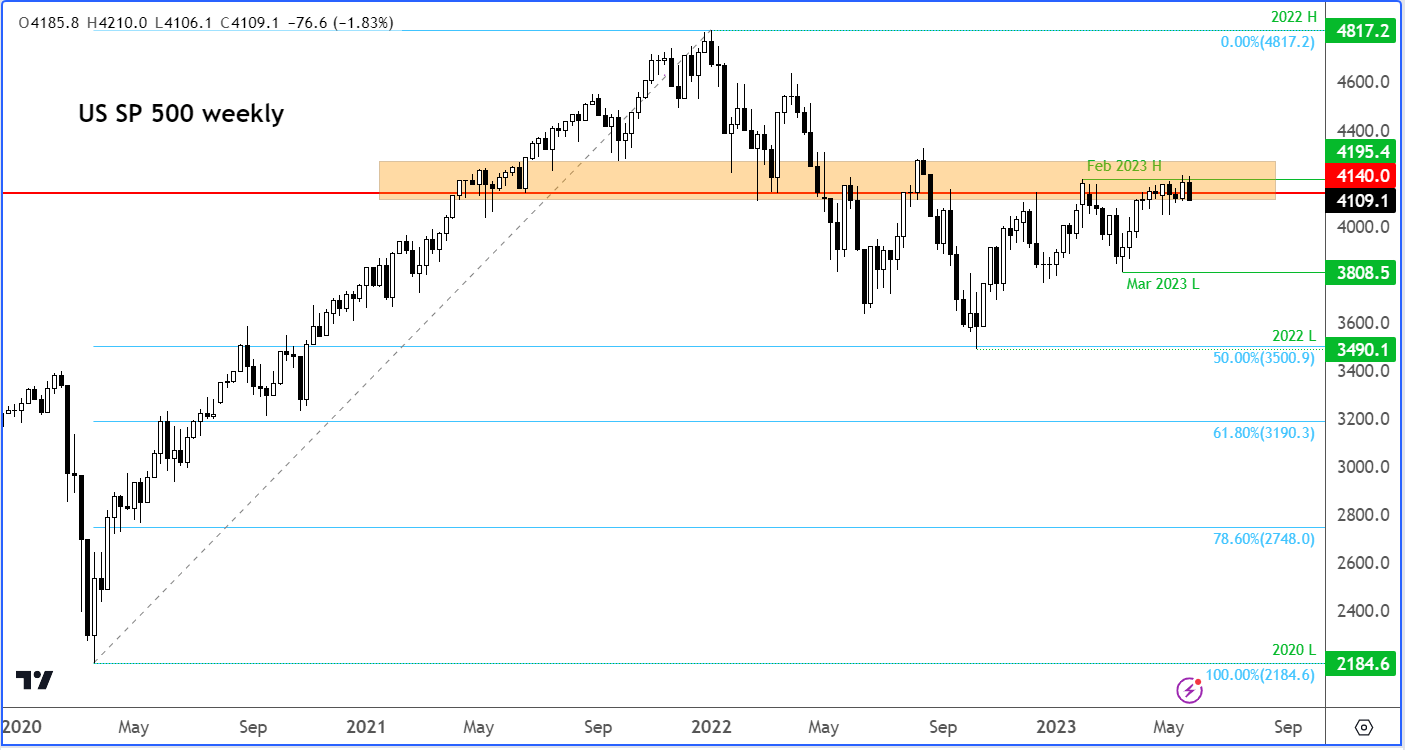
Here, the weekly shows the index is turning lower from a key long-term inflection point circa 4140, a level which was previously support and resistance on several occasions. A decisive break below last week’s low would be a significant technical development.
Source: TradingView.com
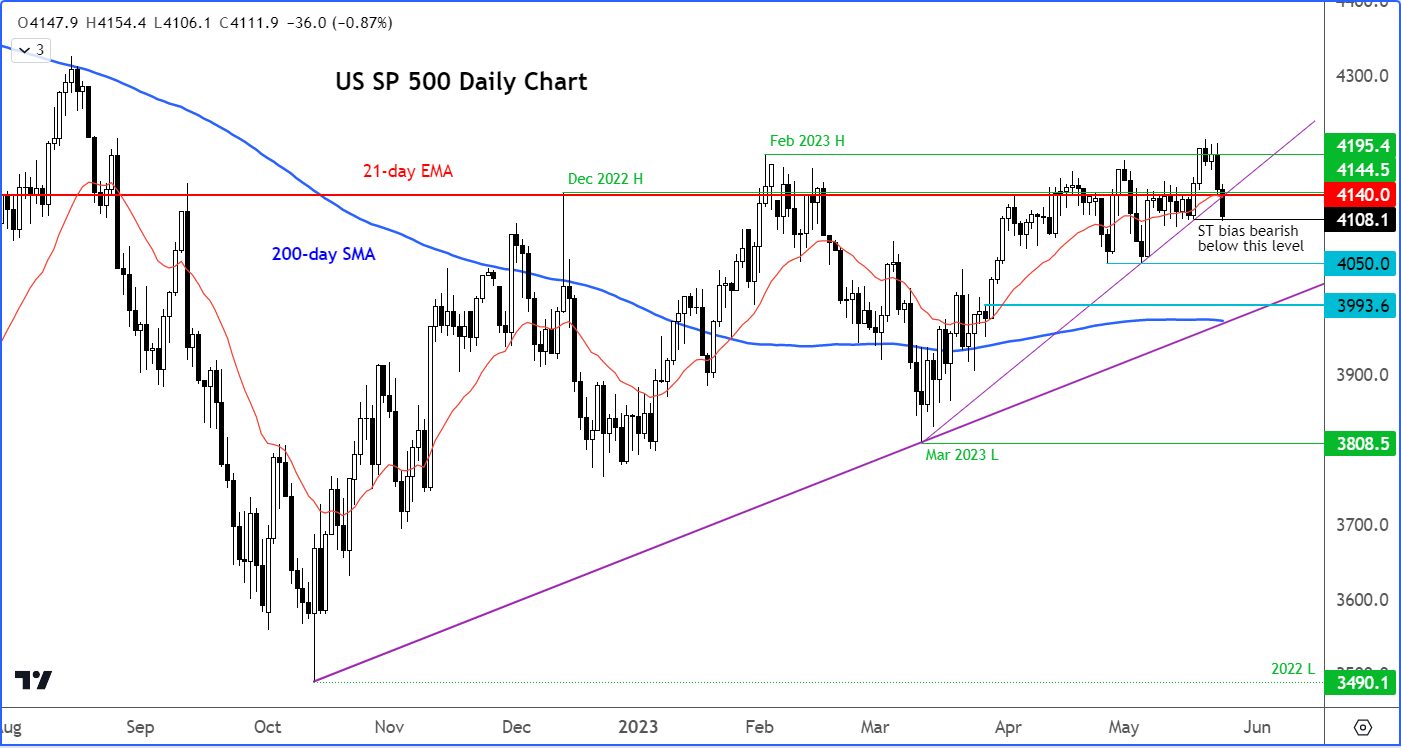
The daily chart of the S&P shows the index has already broken below a short-term bullish trend line and 21-day exponential moving average. A close below 4108 would create a short-term lower low. If that happens, then watch out below! In that case, a move down to 4050 would become highly likely, with the subsequent target being around 3990ish where the 200-day average meets the longer-term trend line.
Source: TradingView.com
For the bulls, well there’s nothing to cheer right now and the best course of action for them is to sit on their hands and await a bullish reversal. It could be a long wait. A move above 4140 would be an ideal outcome for the bulls, as things stand.
Why are stocks falling?
Today’s losses come hot on the heels of a sharp sell-off on Tuesday, which carried on overnight in index futures along with Asian and European markets. Investors are awaiting the FOMC’s last meeting minutes, due to be released shortly. However, this is unlikely to be a catalyst behind a potential market recovery, as the focus remains firmly fixated on the US debt limit situation. A sell-off in the markets was always going to be needed to put pressure on the two sides to make a compromise. Negotiators are still far apart on key issues. They must act quickly to avert a default – and to stop the market turmoil. But have they left it all too late?
It is not just stocks. Sentiment towards nearly all risk assets has turned negative quite abruptly this week. Concerns are on the rise about the health of the Chinese and European economies and fears about the US debt ceiling. You also have a Fed still keen to tighten its policy further, while inflation in some parts of the world continues to remain very high, causing all sorts of problems and hurting the pockets of consumers. For example, the UK CPI eased less than expected to a still very high 8.7% in April. Businesses are not doing very well either, especially in the manufacturing sector, as we found out on Tuesday with those weak PMI numbers.
Stocks in Europe and China, copper and cryptos all sink
Earlier today we saw a sharp drop in shares of Europe’s top luxury brands, including Herms, LVMH and Kering, among others. This came on the back of a fresh drop in Chinese shares to a new low for the year. The selling meant the German DAX had now relinquished the entire sharp gains from last week in the space of just three days. Copper, too, hit a new low for the year, hurt by concerns about demand from China, the world’s top importers of base metals (and many other commodities).
Commodity dollars lead drop in FX
The risk off sentiment also filtered through the FX markets, causing commodity dollars to sink. Overnight the RBNZ hiked interest rate by 25 basis points, but the central bank also indicated that it is done with hiking, and this cause the NZD to drop sharply as traders priced out further rate hikes. The kiwi also took a hit because of the risk off trade weighing on all commodity dollars.
However, it wasn’t just ComDolls that struggled against the greenback. The pound and euro also fell, albeit the losses were contained. This morning saw inflation data come in stronger from the UK but this failed to provide any meaningful support for the GBP/USD, with the cable turning lower shortly after to drop to a new low on the week.
-- Written by Fawad Razaqzada, Market Analyst
Follow Fawad on Twitter @Trader_F_R
How to trade with City Index
You can trade with City Index by following these four easy steps:
- Open an account, or log in if you’re already a customer
• Open an account in the UK
• Open an account in Australia
• Open an account in Singapore
- Search for the company you want to trade in our award-winning platform
- Choose your position and size, and your stop and limit levels
- Place the trade
Latest market news




Open an account in minutes
Experience award-winning platforms with fast and secure execution.
Economic calendar
Web Trader platform
Our sophisticated web-based platform is packed with features.
Related articles

Nikkei swings harder than Nasdaq as AI fears deepen
Nikkei 225 volatility is running well ahead of Nasdaq 100, with the index construction and Japan's heavy exposure to AI manufacturing potentially explaining the difference.

S&P 500, Nasdaq 100 Claw Back But NVDA Cloud Looms Overhead
Last week was green for both the Nasdaq and S&P 500 but given the sell-off that led into that bounce there’s still a very real question as to whether bears still have a statement to make. And the NVDA situation presents a very real threat.


Nasdaq 100 forecast: Nvidia troubles put AI recovery into question
The recovery for major indices this week has helped repair much of the technical damage inflicted by last week’s sell-off, but the latest developments with Nvidia suggest investors are not quite ready to put the underlying risks behind them. The Nasdaq 100 led other US index futures lower overnight, with falls of around 0.8%.

StoneX Financial Ltd (trading as "FOREX.com") is an execution-only service provider. This material, whether or not it states any opinions, is for general information purposes only and it does not take into account your personal circumstances or objectives. This material has been prepared using the thoughts and opinions of the author and these may change. However, FOREX.com does not plan to provide further updates to any material once published and it is not under any obligation to keep this material up to date.
This material is short term in nature and may only relate to facts and circumstances existing at a specific time or day. Nothing in this material is (or should be considered to be) financial, investment, legal, tax or other advice and no reliance should be placed on it. No opinion given in this material constitutes a recommendation by FOREX.com or the author that any particular investment, security, transaction or investment strategy is suitable for any specific person.
The material has not been prepared in accordance with legal requirements designed to promote the independence of investment research. Although FOREX.com is not specifically prevented from dealing before providing this material, FOREX.com does not seek to take advantage of the material prior to its dissemination. This material is not intended for distribution to, or use by, any person in any country or jurisdiction where such distribution or use would be contrary to local law or regulation. For further details see our full non-independent research disclaimer and quarterly summary.