



Are US deposits safe? Don’t bank on it Nasdaq bulls
US treasury secretary Janet Yellen has arguably stolen the show from the FOMC meeting, thanks to her comments on banking deposits which saw Wall Street slide into the close.
Share this:

- Risk of bank runs to be assessed on a case-by-base basis
- But what if depositors get spooked and do a bank run anyway?
- What does this mean for APAC banks?
- Nasdaq 100 daily chart
When the Fed, US Treasury and FDIC (Federal Deposit Insurance Committee) issued a joint statement last week to guarantee all deposits under $250k, it was taken as a sign that regulators were ready to step in at all costs to restore confidence in the US banking system. That assumption has been challenged.
Risk of bank runs to be assessed on a case-by-base basis
When asked whether congressional approval was require to insure all US deposits, US Treasury Secretary Yellen said she has neither considered nor discussed “blanket insurance” and that bank risks were reviews on a case by case basis.
“I have not considered or discussed anything having to do with blanket insurance or guarantees of deposits”, Janet Yellen to congress on March 22nd
According to Yellen, a bank would need to be at risk of a “contagious bank run” to be deemed a “systematic risk” which would then permit the FDIC to protect all depositors, “and that would be a case-by-case determination”. Having the likes of the US Treasury assess a bank’s risk of a bank run is all well and good on the face of it, but there’s a problem.
But what if depositors get spooked and do a bank run anyway?
Depositors (like investors) are more likely to act on impulse if they get a whiff of concern and try to pull their funds anyway – regardless of what the US Treasury thinks. Redeem funds first, ask questions later.
Put it this way. If you’re walking past your local bank and see a queue go around the corner, are you likely to simply walk on or ask a couple of questions and join that queue?
Perhaps there are no more skeletons in the US financial closet, but we’re back to the phase where people are looking for the next bogey man. Ultimately, a key pillar of support for bullish sentiment is back in doubt and that was evident in price action on US markets, which also had to content with Jerome Powell also reminding markets that the Fed are here to “fight inflation”.
- SPDR S&P Regional Banking ETF -5.7%
- Nasdaq Bank index -4.7%
- S&P 500 -1.6%
- Nasdaq -1.4%
What does this mean for APAC banks?
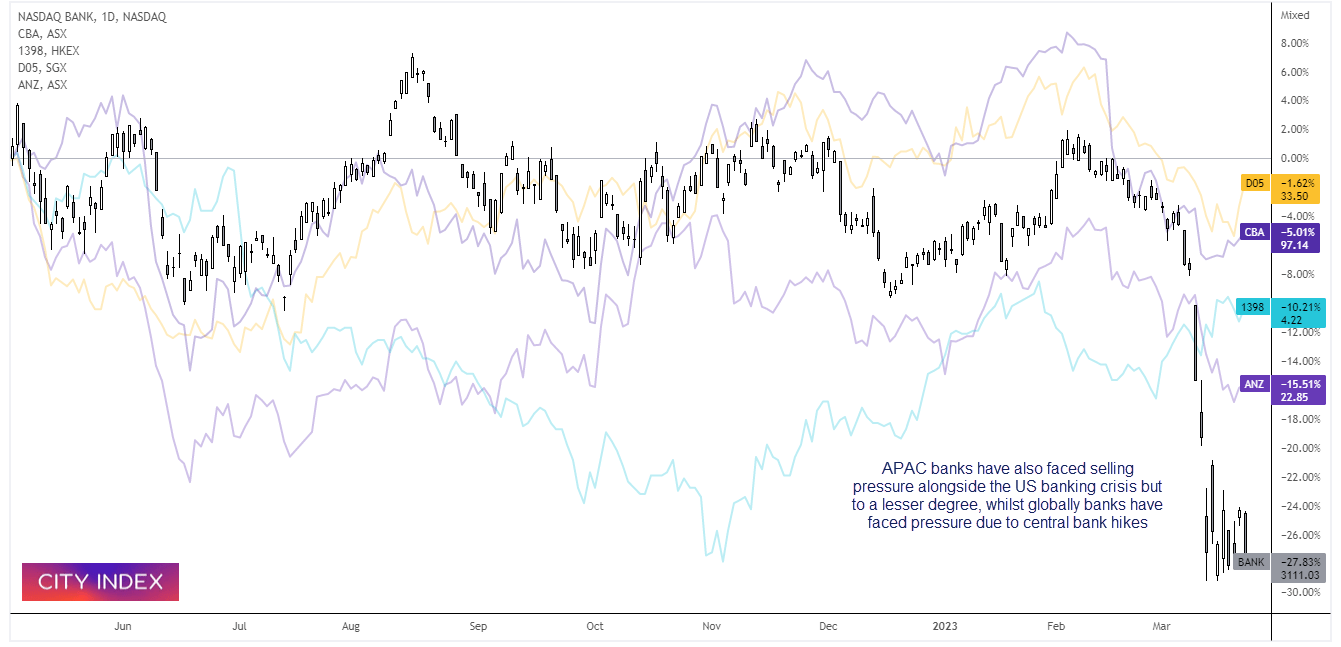
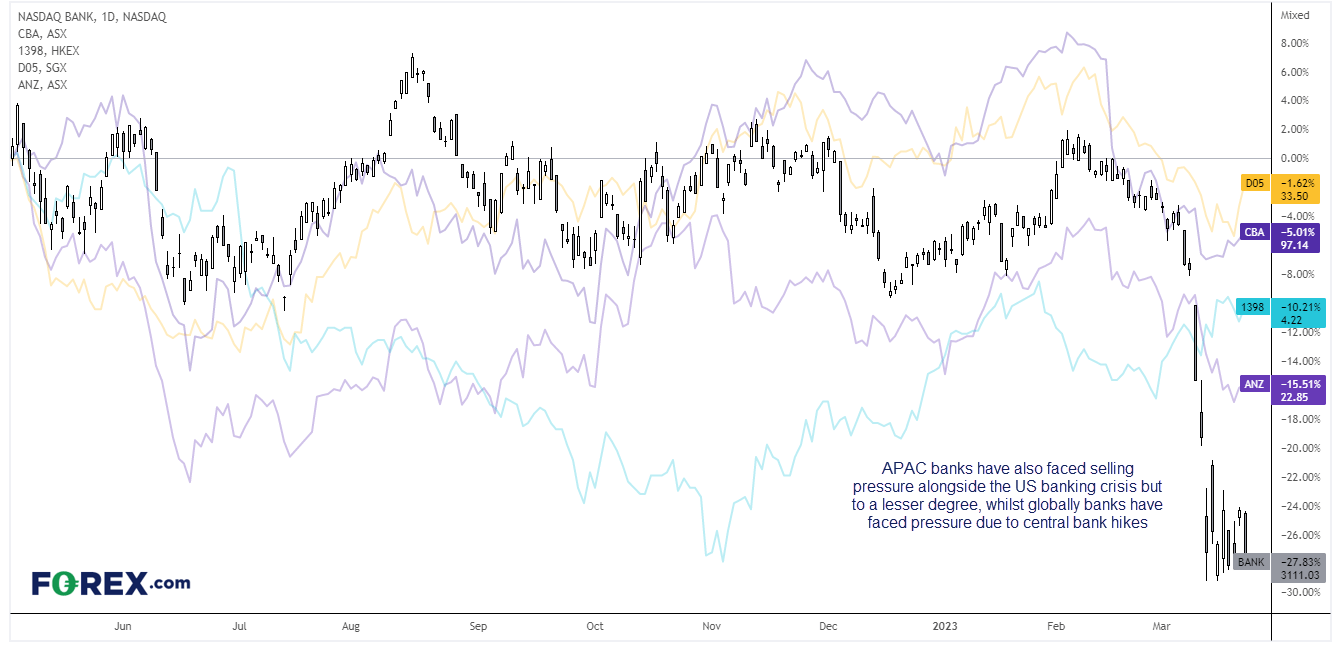
Global financial markets are clearly interlinked, so it is understandable that fears of a financial meltdown in the US will have repercussions cross the APAC region. Yet so far, we have only seen medium-sized US banks fail who regulations are less stringent. So we do not believe we have seen a ‘Lehman moment’ with SVB or Signature bank’s failing, even if it has clearly weighed on sentiment globally. Moreover, global bank stocks were already facing selling pressure ahead of the recent rout as central banks have continued to hike rates during a high inflation / lower growth environment.
For comparison, the Nasdaq banking index is down -27.8% y/y compare with Australia’s ANZ and CBA banks (-15.5% and -5% respectively), whilst China’s ICBC bank is down -10.2% and Singapore’s DBS bank down just -1.6% over the same period.
Overall, concerns of a bank run are less apparent across the APAC region, even if such headlines change sentiment over the near-term. We therefore prefer to stick with US markets to play the banking crisis theme.
Nasdaq 100 daily chart:
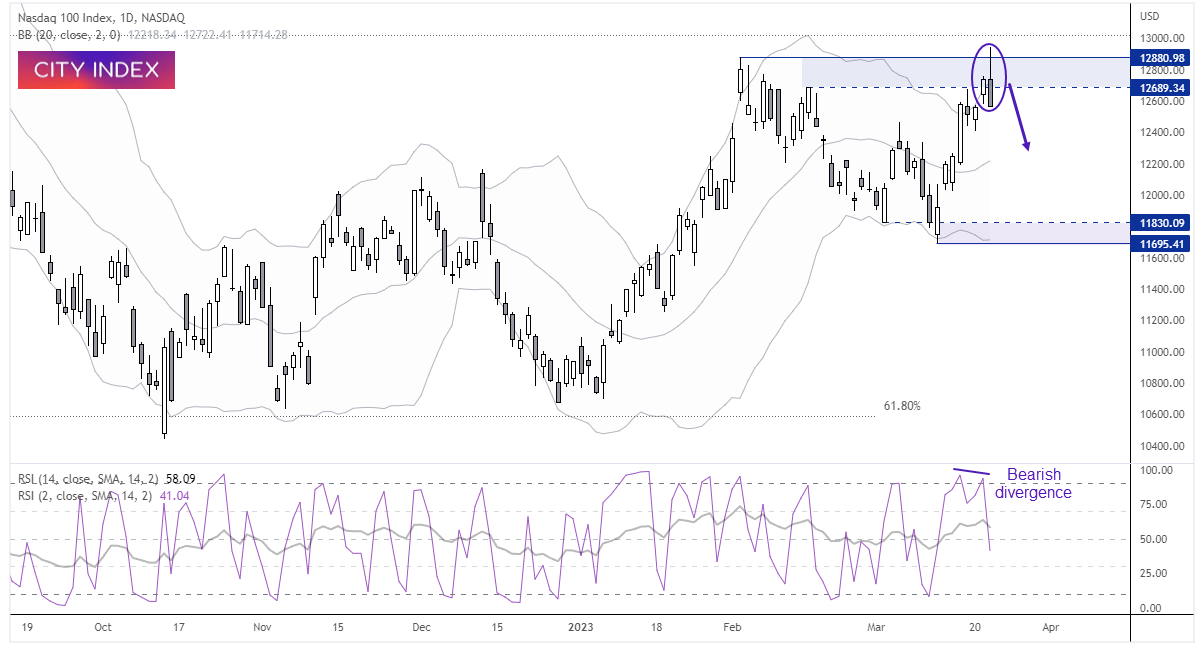
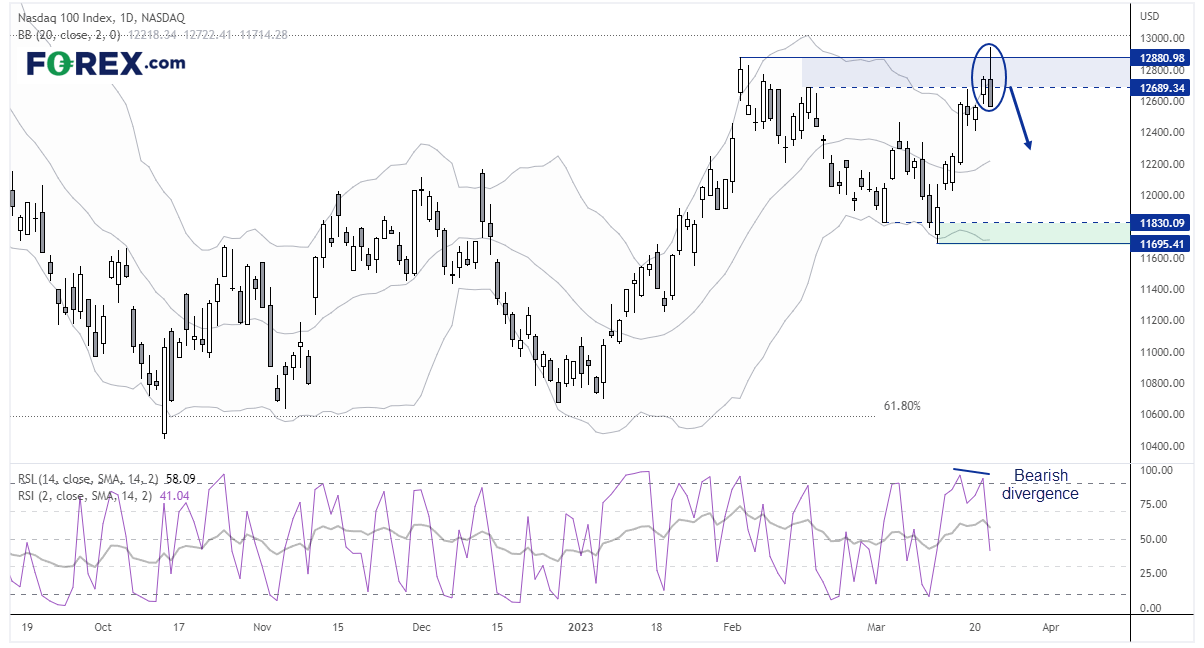
The Nasdaq’s recent rally stalled just shy of our 13k target before reversing sharply lower. This has left in its wake a bearish engulfing / outside day and false break of the prior cycle high. Moreover, a two-bar reversal formed at the upper Bollinger band and a bearish divergence has formed on the RSI (2). Given the Fed dispelled hopes of cuts this year, vowed to keep fighting inflation and Yellen has removed a pillar of support for US deposit holders, we suspect the Nasdaq is set for some mean reversion from its highs and may remain within the 12,700 – 13,000 range.
The bias remains bearish below 13,000 (although yesterday’s high can also be used to fine-tune risk management) and an initial target is the 20-day MA around 12,200, which is the centre of the Bollinger band.
-- Written by Matt Simpson
Follow Matt on Twitter @cLeverEdge
How to trade with City Index
You can trade with City Index by following these four easy steps:
- Open an account, or log in if you’re already a customer
• Open an account in the UK
• Open an account in Australia
• Open an account in Singapore
- Search for the market you want to trade in our award-winning platform
- Choose your position and size, and your stop and limit levels
- Place the trade
Latest market news



The complete CFD trading experience
Award-winning platforms, competitive spreads, low commissions and dedicated support.
We live and breathe the markets and are dedicated to helping traders realise their ambitions as we continue to set the industry bar.
Economic calendar
Web Trader platform
Our sophisticated web-based platform is packed with features.
Related articles
Australian Dollar Short-term Outlook: AUD/USD 3% Plunge Puts Multi-Month Range at Risk 11 6 2026
A sharp equity-led selloff has driven AUD/USD toward critical June-low support, with strong NFP data adding pressure ahead of next week’s U.S. CPI.

Nasdaq 100 forecast: Tech stocks rebound but AI concerns linger
The Nasdaq 100 rebound has run into former support as fears over AI regulation and spending linger. Fawad Razaqzada explains why he maintains a cautious forecast and where the key levels sit.

Dollar forecast: NFP provides dollar, already supported amid tech sell-off, additional boost
The US dollar has found some mild amid the tech rout in recent days, most visibly against risk sensitive and commodity dollars. Today, we have so far seen a bit of a recovery in global indices from their overnight lows. Investors will be watching the markets to see whether fresh losses will be on the again once Wall Street gets going. Ahead of that, we have just seen the release of the October US non-farm payrolls report – and it was much stronger at 165K than expected.
StoneX Europe Ltd may make third party material available on this website which may contain information included but not limited to the conditions of financial markets. The material is for information purposes only and does not contain, and should not be construed as containing, investment advice and/or investment recommendation and/or an investment research and/or an offer of or solicitation for any transactions in financial instruments; any decision to enter into a specific transaction shall be made by the client following an assessment by him/her of their situation.
StoneX Europe Ltd makes no representation or warranty and assumes no liability as to the accuracy or completeness of the information provided, nor any loss arising from any investment based on a recommendation, forecast or other information supplied. You should always seek independent advice as to your suitability to speculate in any related markets and your ability to assume the associated risks, if you are at all unsure. We are not under any obligation to update any such material. Any opinion made may be personal to the author and may not reflect the opinion of StoneX Europe Ltd.