







AUD/USD Analysis: Eyes on China and the yuan Amid Trump’s 104% Tariff
All eyes are on how China responds to Trump’s 104% tariff. With the numbers already becoming meaningless, the Australian dollar could get dragged a lot lower with a yuan devaluation, with AUD/CHF leading the bearish stampede amid Swiss franc strength.
Share this:

All eyes are on how China responds to Trump’s 104% tariff. With the numbers already becoming meaningless, the Australian dollar could get dragged a lot lower with a yuan devaluation, with AUD/CHF leading the bearish stampede amid Swiss franc strength.
Any hopes of a ‘Turnaround Tuesday’ were dashed when President Trump announced a 104% tariff on Chinese goods, citing China’s failure to remove its 34% retaliatory tariff on US exports. The triple-digit levy is set to take effect from midnight Wednesday, alongside new tariffs of up to 50% on goods from all other countries. The administration has shifted focus to continued negotiations with other trading partners. All eyes are now on China, which on Tuesday vowed to “fight to the end.” Their response today will be telling.
There comes a point when the numbers lose meaning and defeat the aggressor’s purpose. If China responds with a 200% tariff, and the US counters with 500%, China’s exports might nosedive—but the US would be left with a gaping hole in its supply chain. That shortfall would drive up prices and strain importers scrambling for alternatives. The real question becomes: how high will prices go, and for how long? The answer could be: worse than COVID.
Assuming China skips the pointless route of throwing large numbers back at the US, they could go straight to currency devaluation.
View related analysis:
- AUD/USD weekly outlook: Bears Eye Sustainable Move to the 50s Amid Tariff Turmoil
- 2025 could be one heck of a ride if bearish AUD/JPY clues are correct
- Traders Placed Bets Against VIX and Swiss Franc Ahead of Tariffs: COT Report
- CHF Beats Yen for Safety as Tariffs Take Second Quarter to the Slaughter
- If Consumers Don’t Consume, a Recession Could be Presumed
All eyes on China’s yuan fix today
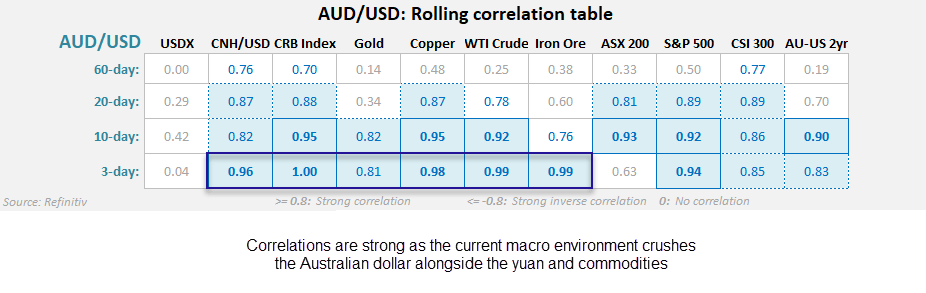
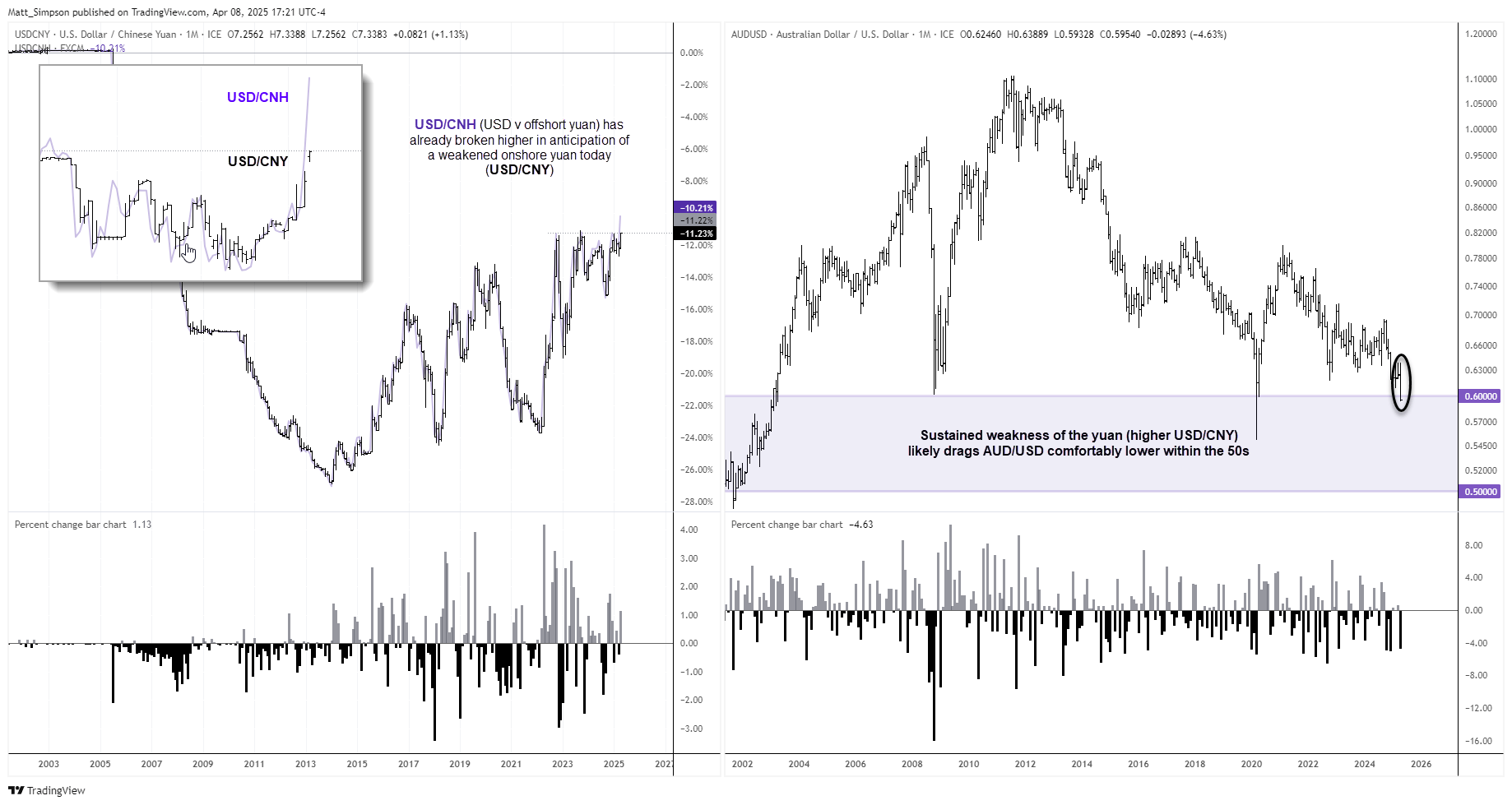
Traders are already betting on a devaluation of China’s currency by shorting the offshore yuan (CNH), pushing USD/CNH up 1.2% to a record high on Tuesday. USD/CNH shares a tight correlation with AUD/USD, which has now slipped further into the 50–60 cent range—a level typically associated with financial and economic crises.
Put simply, a sustained move higher in USD/CNY spells trouble for the Australian dollar and the RBA. It effectively imports inflation—the very thing the RBA has been trying to contain post-COVID. The central bank may soon face a tough choice: intervene to support the currency, or risk worsening inflation by cutting rates to support growth.
Australian dollar analysis: A bearish cash cow?
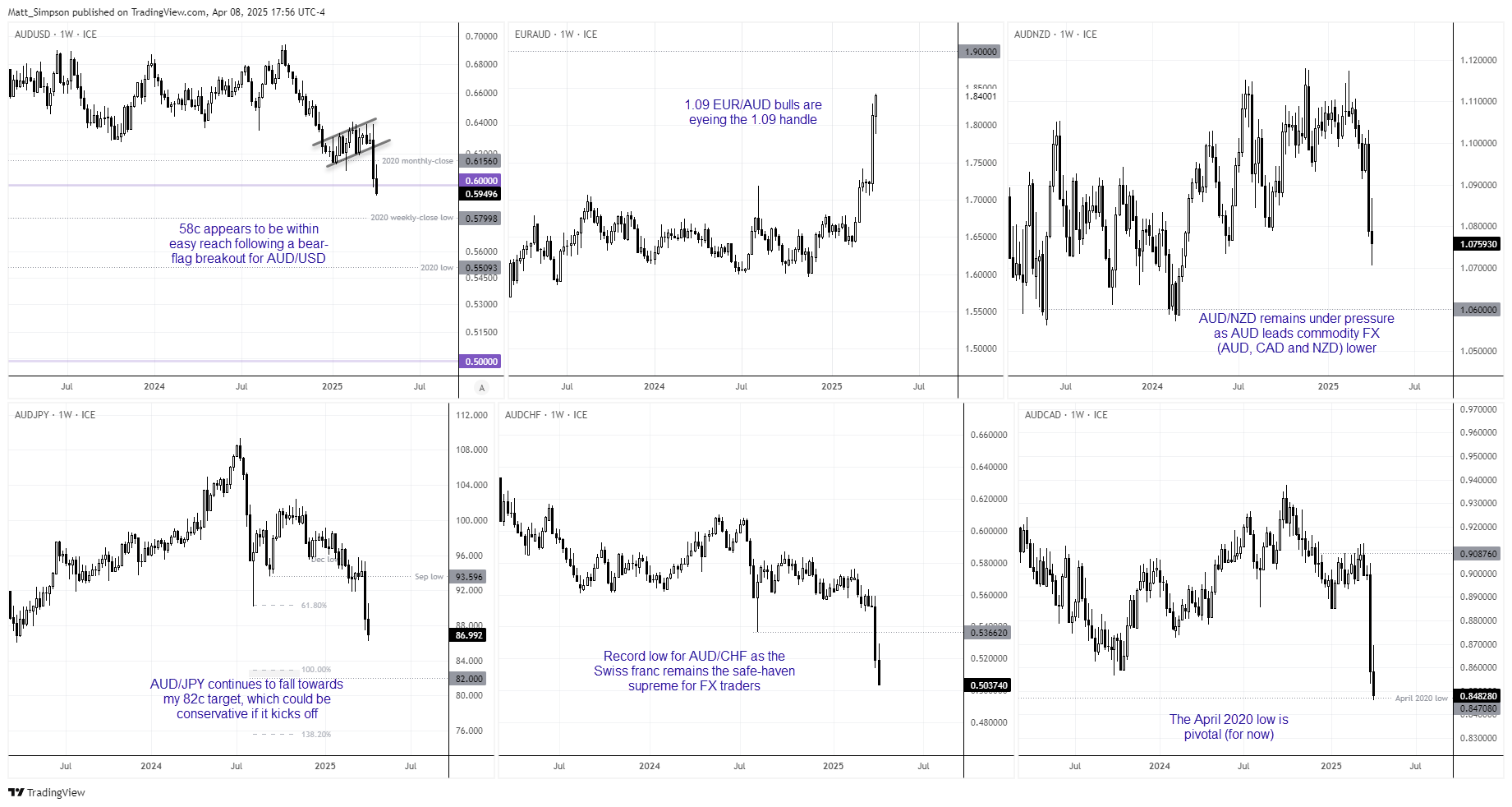
- AUD/USD is testing Monday’s low and sits just a day’s range away from 59c (by recent standards), with the 2020 weekly close low (~58c) looking increasingly attractive to bears.
- EUR/AUD is probing Monday’s high, on the verge of setting a fresh 5-year high, with 1.59 now firmly in focus for euro bulls.
- AUD/NZD continues to buckle under its own weight, with AUD/USD leading the move lower in the commodity FX space compared to NZD/USD and CAD/USD. 1.06 anyone?
- AUD/JPY is continuing toward my 82 target, which could prove conservative if yuan depreciation deepens in the coming weeks.
- AUD/CHF has hit a fresh record low, with the Swiss franc remaining the go-to safety play amid Trump’s escalating trade war.
- AUD/CAD sliced through my bearish 87 target with ease and now trades at a 5-year low, as the Australian dollar feels more heat from a weakening yuan than the Canadian dollar has from Trump’s tariffs. It clings to the April 2020 low, which seems like a pivotal level over the near term.
Implied volatility is elevated
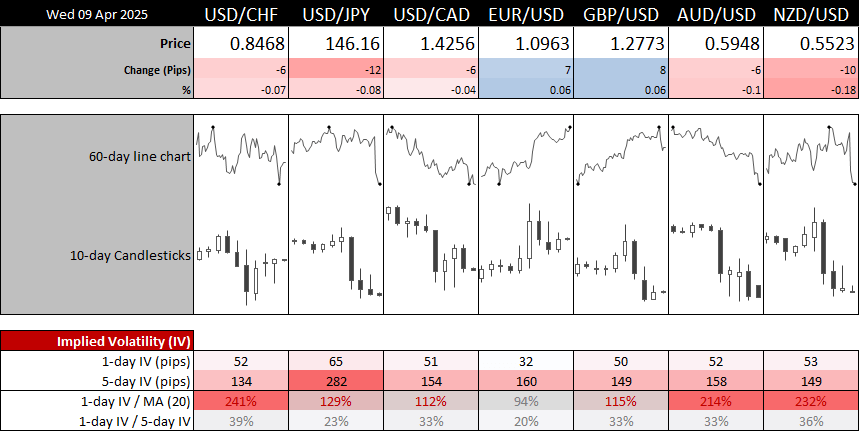
Perhaps not too surprisingly, the 1-day implied volatility band has more than doubled for AUD/USD and the closely intertwined NZD/USD. This provides a potential move of 52 pips in either direction (104 total) spanning the 0.5899 – 0.6603 area. Note that the Swiss franc is also expected to have higher levels of volatility, with the 1-day IV for USD/CHF rising to 241% of its 20-day average (52 pips up or down, or 104 total).
Economic events in focus (AEDT)
- 11:15 – PBOC announces the yuan fix
- 11:30 – Australian building approvals
- 12:00 – RBNZ interest rate decision
- 15:00 – Japanese household confidence
- 16:00 – Japanese machine tool orders
- 02:30 – FOMC member Barkin speaks
- 03:00 – US 10-year treasury auction
- 04:00 – FOMC meeting minutes
-- Written by Matt Simpson
Follow Matt on Twitter @cLeverEdge
How to trade with City Index
You can trade with City Index by following these four easy steps:
- Open an account, or log in if you’re already a customer
• Open an account in the UK
• Open an account in Australia
• Open an account in Singapore
- Search for the market you want to trade in our award-winning platform
- Choose your position and size, and your stop and limit levels
- Place the trade
Latest market news




The complete CFD trading experience
Award-winning platforms, competitive spreads, low commissions and dedicated support.
We live and breathe the markets and are dedicated to helping traders realise their ambitions as we continue to set the industry bar.
Economic calendar
Web Trader platform
Our sophisticated web-based platform is packed with features.
Related articles
USD/CAD reversal risk builds as central bank showdown looms
USD/CAD has delivered a bullish reversal signal from established support, just as traders prepare for Fed and BoC decisions. Aggressive Canadian rate hike expectations and conflicting momentum signals make the coming session important.
EUR/USD weekly outlook: FOMC and ECB to set the tone
The current backdrop is modestly bearish. On Friday, the EUR/USD closed modestly lower, down for the third consecutive day. The pair also posted a weekly decline after staging a modest recovery attempt in the previous week. Out of the past 8 weeks, the EUR/USD has fallen on 6 occasions. There is not much supporting factors for the single currency right now. So, the upside remains capped.


USD/JPY Forecast: Is Rising Japanese Inflation Supporting the Yen?
As the trading week comes to an end, one of the most relevant developments in the FX market has been the renewed strength of the Japanese yen. This can be seen in the recent performance of USD/JPY, which has fallen nearly 1.0% over the last two trading sessions, highlighting a meaningful recovery in the Japanese currency against the U.S. dollar.

StoneX Europe Ltd may make third party material available on this website which may contain information included but not limited to the conditions of financial markets. The material is for information purposes only and does not contain, and should not be construed as containing, investment advice and/or investment recommendation and/or an investment research and/or an offer of or solicitation for any transactions in financial instruments; any decision to enter into a specific transaction shall be made by the client following an assessment by him/her of their situation.
StoneX Europe Ltd makes no representation or warranty and assumes no liability as to the accuracy or completeness of the information provided, nor any loss arising from any investment based on a recommendation, forecast or other information supplied. You should always seek independent advice as to your suitability to speculate in any related markets and your ability to assume the associated risks, if you are at all unsure. We are not under any obligation to update any such material. Any opinion made may be personal to the author and may not reflect the opinion of StoneX Europe Ltd.