




Currency Pair of the Week EURCAD
Watch closely for comments from both the BOC and the ECB
Share this:

EUR/CAD could be a volatile pair this week. With both the Bank of Canada (BOC) and the European Central Bank (ECB) interest rate decisions this week, an unexpected outcome could significantly move the pair.
The BOC is meeting on Wednesday and is likely to leave rates unchanged at 0.25% and asset purchases unchanged at CAD $5 billion per week. However, there is talk that the central bank may begin looking at yield curve control to help regulate interest rates, as the US Federal Reserve had considered. Employment has been improving since the height of the coronavirus, with the unemployment rate falling from a high of 13.7% in May to 10.2% in August (released this past Friday). However, at the same time, the inflation rate has been hovering near 0%. In addition, the price of the Canadian Dollar also is greatly affected by the price of Crude Oil. Last week, light crude oil futures fell nearly 7.5%. If the selloff in oil continues, the Canadian Dollar may sell off as well.
The ECB is meeting on Thursday and is also likely to leave rates unchanged at 0.0% and asset purchases unchanged at 1.35 trillion Euros. However, the recovery hasn’t been as kind to Europe as it has been to some other areas. The number of new coronavirus cases have fluctuated over the last 6 months. The same can be said for Europe’s economic data. And although the month over month inflation rate has turned negative, policy makers have expressed concerns about the strength of the Euro, which traded above 1.2000 vs the US Dollar last week. Christine Lagarde may try and talk down the value of the Euro on Thursday.
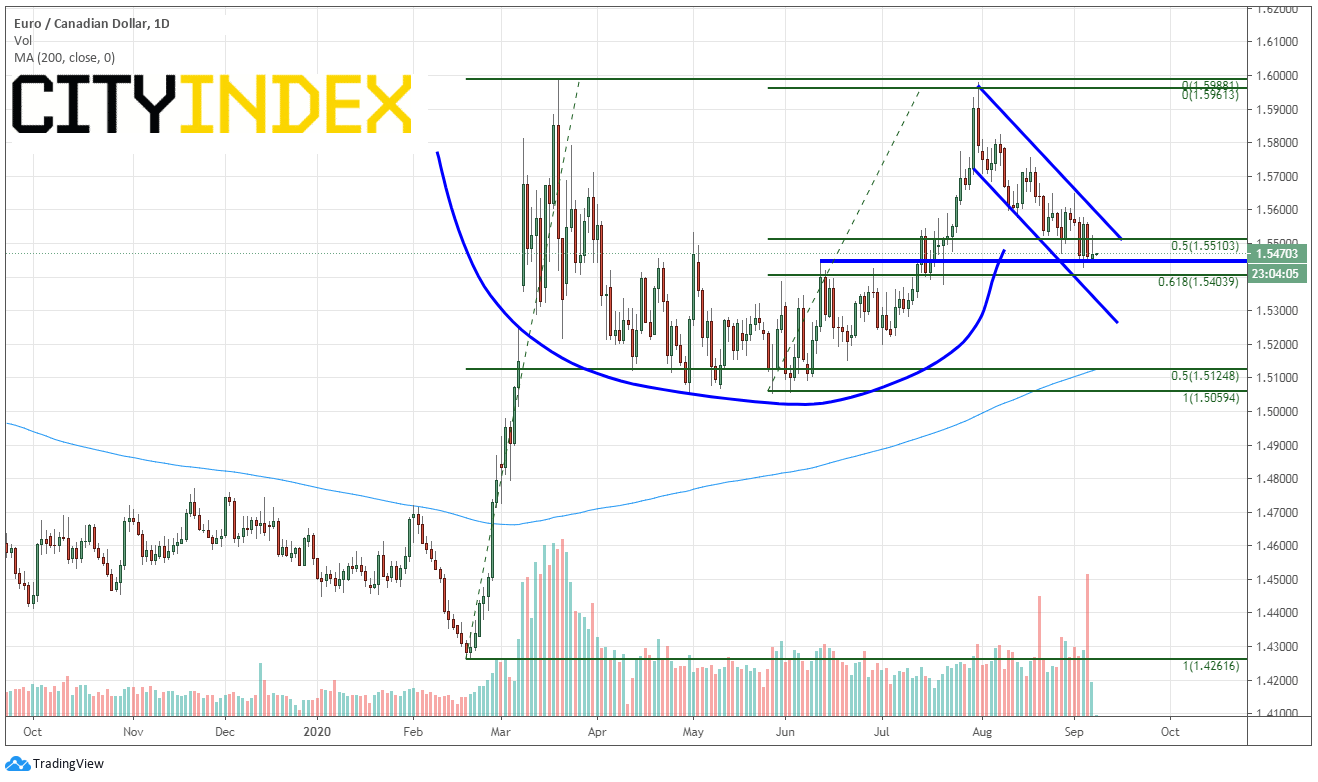
EUR/CAD has been in a cup-and-handle formation since February 20th on a daily timeframe. The pair moved to a high of 1.5991 on March 9th, before pulling back to just below the 50% retracement of the same timeframe. The EUR/CAD made a run at the previous highs on July 31st (to complete the “cup”) and has pulled back in a downward sloping channel to horizontal support near 1.5468 (the “handle”). This level is also between the 61.8% retracement level from the June 1st lows to the July 31st high. A break of this level would negate the cup-and-handle pattern, however it may not negate the downward sloping channel.
Source: City Index, Tradingview.com
On a 240-minute timeframe, the 1.5400 level in EUR/CAD (which is also the previously mentioned 61.8% Fibonacci retracement level) is key support. Below there is the bottom trendline of the channel near 1.5325. Resistance on the top side is at the top channel line near 1.5575, then the September 1st highs near 1.5650.
Source: City Index, Tradingview.com
Watch closely for comments from both the BOC and the ECB, which could significantly move this pair. Comments, plus a larger move in oil, could see EUR/CAD quickly trading outside the “handle”.
EUR/CAD could be a volatile pair this week. With both the Bank of Canada (BOC) and the European Central Bank (ECB) interest rate decisions this week, an unexpected outcome could significantly move the pair.
The BOC is meeting on Wednesday and is likely to leave rates unchanged at 0.25% and asset purchases unchanged at CAD $5 billion per week. However, there is talk that the central bank may begin looking at yield curve control to help regulate interest rates, as the US Federal Reserve had considered. Employment has been improving since the height of the coronavirus, with the unemployment rate falling from a high of 13.7% in May to 10.2% in August (released this past Friday). However, at the same time, the inflation rate has been hovering near 0%. In addition, the price of the Canadian Dollar also is greatly affected by the price of Crude Oil. Last week, light crude oil futures fell nearly 7.5%. If the selloff in oil continues, the Canadian Dollar may sell off as well.
The ECB is meeting on Thursday and is also likely to leave rates unchanged at 0.0% and asset purchases unchanged at 1.35 trillion Euros. However, the recovery hasn’t been as kind to Europe as it has been to some other areas. The number of new coronavirus cases have fluctuated over the last 6 months. The same can be said for Europe’s economic data. And although the month over month inflation rate has turned negative, policy makers have expressed concerns about the strength of the Euro, which traded above 1.2000 vs the US Dollar last week. Christine Lagarde may try and talk down the value of the Euro on Thursday.
EUR/CAD has been in a cup-and-handle formation since February 20th on a daily timeframe. The pair moved to a high of 1.5991 on March 9th, before pulling back to just below the 50% retracement of the same timeframe. The EUR/CAD made a run at the previous highs on July 31st (to complete the “cup”) and has pulled back in a downward sloping channel to horizontal support near 1.5468 (the “handle”). This level is also between the 61.8% retracement level from the June 1st lows to the July 31st high. A break of this level would negate the cup-and-handle pattern, however it may not negate the downward sloping channel.
Source: FOREX.com, Tradingview.com
On a 240-minute timeframe, the 1.5400 level in EUR/CAD (which is also the previously mentioned 61.8% Fibonacci retracement level) is key support. Below there is the bottom trendline of the channel near 1.5325. Resistance on the top side is at the top channel line near 1.5575, then the September 1st highs near 1.5650.
Source: Forex.com, Tradingview.com
Watch closely for comments from both the BOC and the ECB, which could significantly move this pair. Comments, plus a larger move in oil, could see EUR/CAD quickly trading outside the “handle”.
Related tags:
Latest market news




The complete CFD trading experience
Award-winning platforms, competitive spreads, low commissions and dedicated support.
We live and breathe the markets and are dedicated to helping traders realise their ambitions as we continue to set the industry bar.
Economic calendar
Web Trader platform
Our sophisticated web-based platform is packed with features.
Related articles
EUR/USD Forecast: Euro Struggles to Find Support Even After U.S. PCE Data
The euro continues to face a challenging environment in the short term. The currency has struggled to regain ground against a U.S. dollar that remains firmly supported, a dynamic reflected in EUR/USD, which has now recorded three consecutive losing sessions and a decline of roughly 0.6%.


AUD/USD forecast: Currency Pair of the Week | September 28, 2026
The week has started with stocks, gold, silver and bitcoin all falling, as crude oil rebounded and bond yields pushed further higher. Trump refusing to agree to Tehran’s proposal to re-open the Strait of Hormuz has left the markets disappointed. Still, reports that mediators are expected to hold talks with the two sides on an amended version of the 7-day proposal that Iran presented, keeps hopes alive that we may see some progress.


USD/CAD and USD/MXN Q4 2026 Outlook: Will the U.S. Dollar Dominate North America Again?
The final stretch of 2026 is approaching, and North America's major currencies have begun to show a shift in the strength dynamics seen earlier in the year. New expectations of a more aggressive monetary policy stance, particularly in the United States, could be significantly reshaping the outlook for the region. At the same time, this backdrop, combined with potential trade tensions across North America, may become one of the most important drivers of currency performance in the months ahead.
StoneX Europe Ltd may make third party material available on this website which may contain information included but not limited to the conditions of financial markets. The material is for information purposes only and does not contain, and should not be construed as containing, investment advice and/or investment recommendation and/or an investment research and/or an offer of or solicitation for any transactions in financial instruments; any decision to enter into a specific transaction shall be made by the client following an assessment by him/her of their situation.
StoneX Europe Ltd makes no representation or warranty and assumes no liability as to the accuracy or completeness of the information provided, nor any loss arising from any investment based on a recommendation, forecast or other information supplied. You should always seek independent advice as to your suitability to speculate in any related markets and your ability to assume the associated risks, if you are at all unsure. We are not under any obligation to update any such material. Any opinion made may be personal to the author and may not reflect the opinion of StoneX Europe Ltd.