



DAX forecast: Downside risks increased on re-escalation of US-Iran war
The markets should not ignore the economic impact of the closer of Strait of Hormuz, and failed peace talks at the weekend. Energy prices are going to remain elevated the longer this drags on, and this is particular bad news for European markets reliant on energy imports.
Share this:

Following the overnight gap-down, the major global indices managed to bounce off their lows, and in some cases quite impressively so. US markets even managed to turn positive momentarily as European indices clawed back further loss on the back of a NYP report that Iranian officials are studying abandoning uranium enrichment as a US condition for ending the war. This is not confirmed but markets sold oil and bought stocks as if the war was ending right away. We have seen this sort of price action in recent times, but one should be careful not to jump into any conclusions. The collapsed talks at the weekend, and Trump’s decision to escalate the situation again by announcing a blockade of their own of Iranian ports has gone into effect, which means there is a risk we could see a prolonged war. Against this backdrop, we maintain a cautious to slightly negative DAX forecast.
Prolonged Strait of Hormuz closure undermines DAX forecast
The markets should not ignore the economic impact of the closer of Strait of Hormuz, and failed peace talks at the weekend. Energy prices are going to remain elevated the longer this drags on, and this is particular bad news for European markets reliant on energy imports.
Iran’s effective shutdown has already driven energy prices higher. The US blockade is adding further upward pressure, while increasing the risk of escalation — particularly Iranian strikes on Gulf energy infrastructure.
The longer this drags on, the more economic and political pressure builds on Washington and its allies, strengthening Tehran’s hand. Removing roughly one fifth of global energy supply is no minor disruption.
Until now, the impact of this was masked by oil and gas already in transit. That cushion is now fading, and the real effects are beginning to bite. Petrol prices are just the start. Jet fuel shortages threaten air travel and Europe’s summer tourism season. Fertiliser shortages will push food prices higher.
Trump appears to be betting that economic strain on Iran will force it back down. That may prove optimistic. If the blockade fails, the US faces difficult choices. Even reopening the strait militarily would not guarantee safe passage. It would take only limited Iranian attacks to keep shipping risky — and effectively uninsurable.
So, it looks like the situation is unlikely to be resolved quickly. The economic fallout is only just beginning unfortunately. This should keep the DAX forecast cautious in the days and week ahead, unless we see one of the sides blinks and a major de-escalation follows.
Technical DAX forecast
The technical picture for the DAX shows the market trading within a wide range. The index is currently stuck between the 21-day exponential and the 200-day simple moving averages, which suggests there’s no clear trend or directional bias. In other words, this remains a level-to-level market. That makes sense given the ongoing uncertainty surrounding the Middle East situation.
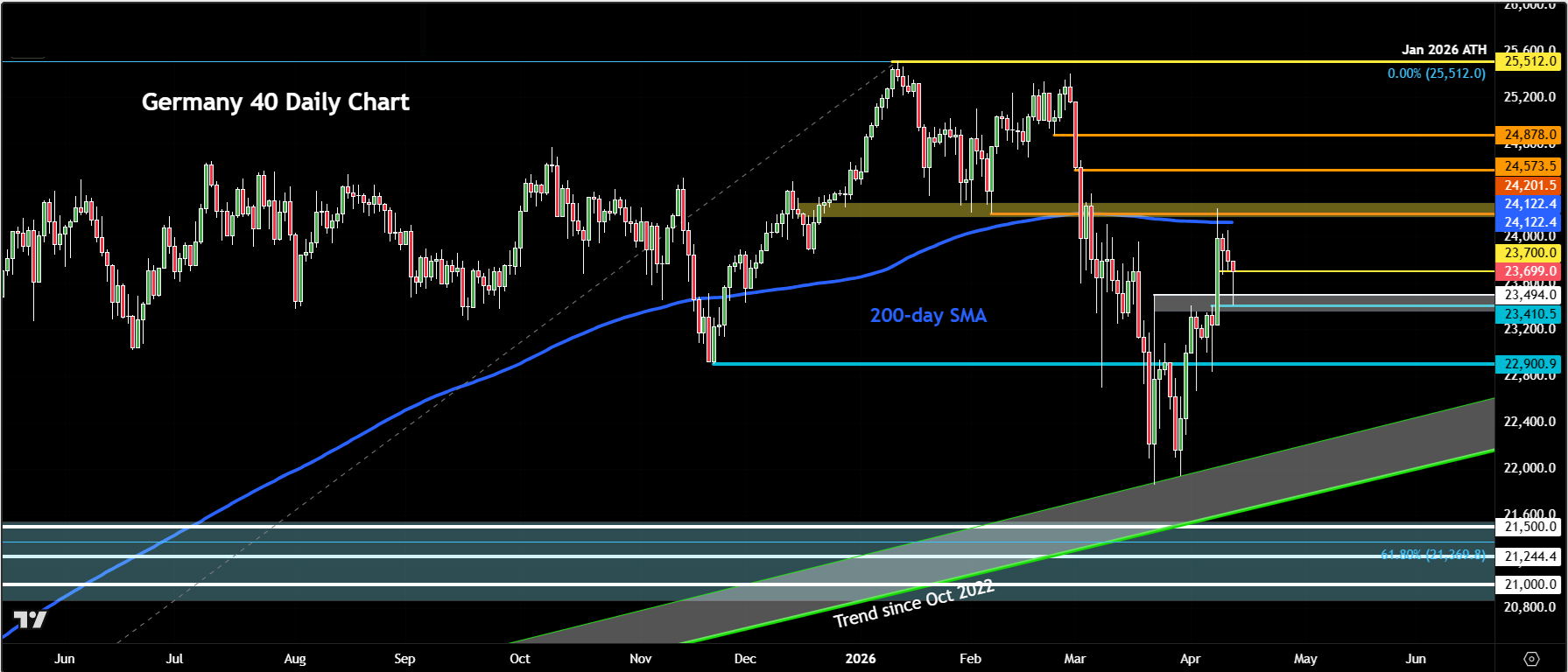
A couple of key levels to watch: 23,400 stands out as a major area. This was previously a strong resistance zone during the height of the Middle East conflict. It was broken during a sharp rally last Wednesday, and we’ve since retested it from above. So far, it’s holding.
Going forward, 23,400 is a critical level. A clean break below it could open the door for a move down towards 23,200 and 23,100, which are the next areas of support. Below that, 22,900 comes into focus — a very important level, as it marks the low from November 2025 and was reclaimed recently.
Make no mistake, 22,900 is the line in the sand. If the index breaks below this zone in the coming days, it would suggest a more bearish shift in market sentiment. However, if we continue to hold above it, there’s still a case that the market may have already formed a low during this period of geopolitical tension.
On the upside, resistance sits around 23,700, followed by the 24,000 level. Beyond that, the 200-day moving average at 24,125 is the next potential resistance zone.
So, there are clear levels on both sides of the market. This is a typical range environment — trade level to level and move on to the next opportunity.

-- Written by Fawad Razaqzada, Market Analyst
Follow Fawad on Twitter @Trader_F_R
Latest market news




The complete CFD trading experience
Award-winning platforms, competitive spreads, low commissions and dedicated support.
We live and breathe the markets and are dedicated to helping traders realise their ambitions as we continue to set the industry bar.
Economic calendar
Web Trader platform
Our sophisticated web-based platform is packed with features.
Related articles
Magnificent Seven Earnings Preview: Is the AI Boom Facing Its Biggest Test Yet?
After a wobble in the broader AI trade, the Magnificent Seven" stocks are reporting earnings in the coming week - see the key themes and Nasdaq 100 levels to watch!

Nasdaq 100 forecast: Tech stocks not out of woods yet
US index futures pushed higher in the first half of Friday’s session, taking cues from a strong performance from European equities. Both European and US equity futures extending yesterday’s impressive recovery after the sharp sell-off earlier in the week. But the lingering concerns around the AI investment cycle remain, while bond markets were easing lower again, lifting yields.

DAX Rebounds, but 25,600 Remains the Level to Hold
The DAX continues to recover from last week's sell-off, supported by easing energy concerns and improving short-term momentum. While buyers have regained control of the four-hour trend, the index is now approaching a critical resistance zone between 25,450 and 25,600. A decisive break higher would strengthen the bullish case and open the door toward 25,800, while failure at resistance could quickly revive downside pressure.

StoneX Europe Ltd may make third party material available on this website which may contain information included but not limited to the conditions of financial markets. The material is for information purposes only and does not contain, and should not be construed as containing, investment advice and/or investment recommendation and/or an investment research and/or an offer of or solicitation for any transactions in financial instruments; any decision to enter into a specific transaction shall be made by the client following an assessment by him/her of their situation.
StoneX Europe Ltd makes no representation or warranty and assumes no liability as to the accuracy or completeness of the information provided, nor any loss arising from any investment based on a recommendation, forecast or other information supplied. You should always seek independent advice as to your suitability to speculate in any related markets and your ability to assume the associated risks, if you are at all unsure. We are not under any obligation to update any such material. Any opinion made may be personal to the author and may not reflect the opinion of StoneX Europe Ltd.