



Magnificent Seven Earnings Preview: Is the AI Boom Facing Its Biggest Test Yet?
After a wobble in the broader AI trade, the Magnificent Seven" stocks are reporting earnings in the coming week - see the key themes and Nasdaq 100 levels to watch!
Share this:

Nasdaq 100 Key Points
- Ahead of the Magnificent 7’s earnings reports, AI infrastructure financing and profitability are under increasing scrutiny.
- Cloud growth, agentic AI, custom chips and digital advertising remain key themes.
- Strong earnings and guidance will be critical to sustaining the Nasdaq 100's bullish outlook.
Magnificent Seven Earnings Preview – MSFT, AAPL, GOOGL, AMZN, NVDA, META, TSLA
The Magnificent Seven enter another earnings season with a complicated backdrop. Broadly speaking, AI investment continues to drive extraordinary revenue growth, but investors are becoming less comfortable with the enormous investments required to sustain it.
The latest concerns have emerged in credit markets, where rising borrowing costs and questions about heavily indebted AI infrastructure providers have contributed to renewed selling pressure in technology stocks. Recent weakness in companies such as CoreWeave (CRWV) and Nebius (NBIS) highlights the risks of financing datacenter construction on the assumption that demand will remain exceptionally strong for years.
Nevertheless, underlying growth remains difficult to ignore. Last quarter, Microsoft Azure revenue grew 43%, Amazon Web Services expanded 37%, and Google Cloud surged 82% year-over-year. Nvidia's revenue more than doubled, reaching $96.2 billion, with little indication of slowing demand for advanced computing infrastructure.
These competing forces create an important test for the Nasdaq 100. Investors will be looking for evidence that the AI investment cycle remains financially sustainable while assessing emerging opportunities in agentic AI, custom silicon and consumer applications.
Magnificent Seven Stock Performance Year-to-Date – Daily Chart
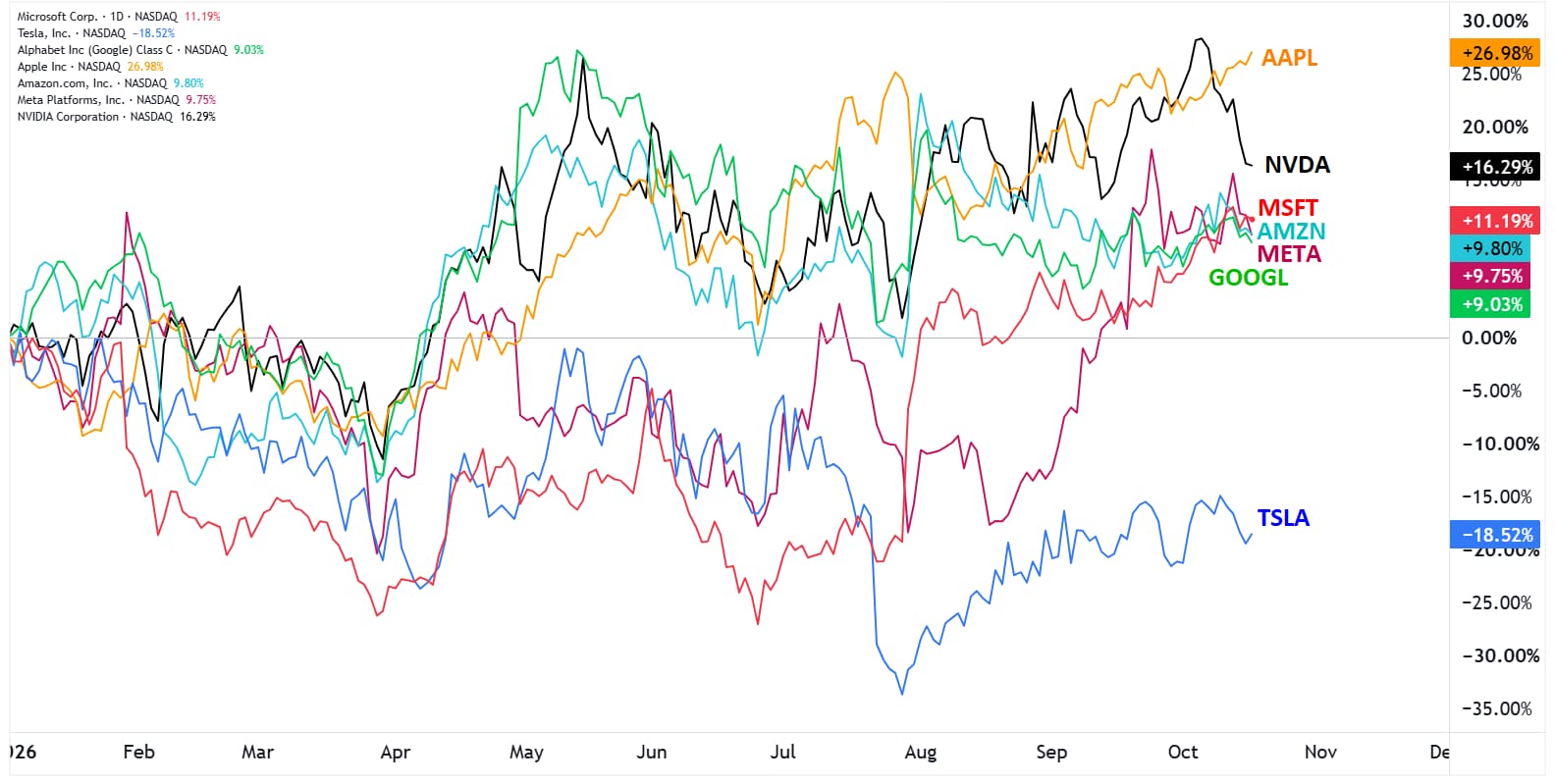
Source: TradingView, StoneX
Magnificent Seven Earnings Cheat Sheet
|
Company |
Report Date |
Key Focus |
|
Meta (META) |
October 21 |
Muse, advertising, AI spending |
|
Tesla (TSLA) |
October 21 |
Auto margins, robotaxi, Optimus |
|
Microsoft (MSFT) |
October 28 |
Azure, Copilot, cloud margins |
|
Alphabet (GOOGL) |
October 28* |
Cloud, TPUs, Search |
|
Amazon (AMZN) |
October 29 |
AWS, free cash flow, AI chips |
|
Apple (AAPL) |
November 2 |
iPhone 18, AI, holiday guidance |
|
Nvidia (NVDA) |
November 18* |
Rubin, margins, AI demand |
Estimated dates, subject to company confirmation.
AI Infrastructure: When Debt Markets Start Asking Questions
The biggest development this quarter is growing concern about how the AI infrastructure boom is being financed. While Microsoft, Amazon, Alphabet and Meta have substantial cash flows to support their investments, the wider ecosystem of specialized cloud providers and datacenter developers increasingly relies on borrowing.
Reports suggest roughly one-third of AI-related capital expenditure is now debt-financed. Nvidia-backed CoreWeave has come under particular pressure, with concerns about its roughly $50 billion debt burden raising questions about the sustainability of infrastructure spending.
Even the largest technology companies face growing scrutiny. Despite AWS revenue accelerating to 37% growth last quarter, Amazon's trailing 12-month free cash flow turned negative at $7.6 billion, while Meta generated just $784 million in quarterly free cash flow while spending more than $31 billion on capital expenditures.
Investors will be listening closely for 2027 spending projections, cash flow trends and evidence that these investments can generate attractive returns. Strong revenue growth may no longer be sufficient if it comes with an increasingly expensive financing burden.
Agentic AI: The Search for the Next Breakthrough Product
While infrastructure spending remains controversial, recent developments suggest AI may be moving closer to generating meaningful revenue beyond traditional cloud services.
For readers who haven’t had a chance to try it yet, Meta's September launch of Muse represents a key development: The personal AI agent can perform tasks such as researching purchases, organizing schedules and booking travel. Early adoption has been encouraging, helping fuel renewed enthusiasm for Meta's longer-term AI opportunities.
Unlike conventional chatbots, agents can perform actions on behalf of users, potentially creating new opportunities in subscriptions, commerce and advertising. However, running these systems requires substantial computing resources, making monetization particularly important.
Microsoft, Alphabet and Amazon are pursuing similar opportunities through Copilot, Gemini and AWS services, raising a key question: Are customers are willing to pay for increasingly sophisticated AI capabilities?
Cloud Computing and the Growing Threat to Nvidia's Dominance
Cloud computing remains one of technology's strongest growth areas, but competition to supply the chips powering that expansion is intensifying.
Alphabet's latest results were particularly impressive, with Google Cloud revenue surging 82% to $24.8 billion. Its proprietary Tensor Processing Units (TPUs) are becoming an increasingly important part of that business, offering an alternative to Nvidia's GPUs for certain AI workloads.
Amazon is following a similar strategy with Trainium processors, designed to reduce computing costs and give the company greater control over its infrastructure.
For Nvidia, the competitive threat remains manageable. Its latest datacenter revenue increased 117% to $89 billion, while management guided to approximately $108 billion in total quarterly revenue. The next-generation Vera Rubin platform offers another potential growth catalyst.
Nevertheless, custom chips could gradually capture a larger share of AI inference workloads, where cost efficiency is especially important. Nvidia's outlook will be scrutinized for signs that demand remains strong enough to accommodate both rising competition and continued growth.
Apple: A New iPhone Cycle and a New CEO
Apple faces a different set of challenges. Its latest quarterly revenue increased 16% to $109.4 billion, but attention has shifted toward the iPhone 18 launch and the upcoming holiday shopping season.
Initial demand signals have been mixed. Early sales in China reportedly exceeded last year's comparable launch, but subsequent reports suggested Apple had reduced component orders for some models amid softer demand elsewhere.
The company is also navigating its first earnings season under new CEO John Ternus, who succeeded Tim Cook in September. Apple's latest devices place greater emphasis on Siri AI and Apple Intelligence, potentially strengthening its ecosystem without requiring hyperscaler-level infrastructure spending.
With the new iPhones launching late in the September quarter, holiday guidance will likely matter more than reported results. Investors will also focus on China demand, margins and rising component costs.
Tesla: Deliveries Improve, but Profitability Remains Key
Tesla remains somewhat separate from the broader AI infrastructure narrative, with its investment case increasingly tied to autonomous driving, robotics and energy storage alongside automotive sales.
The company delivered 486,532 vehicles during the third quarter, exceeding analyst expectations of approximately 462,000. Energy storage deployments also remained strong at 13.7 GWh.
However, better deliveries do not guarantee stronger profitability amid persistent EV competition and pricing pressure. Automotive margins will be important, while updates on robotaxi deployment and Optimus development could continue to drive the stock's longer-term valuation.
Earnings Quality: Look Beyond Headline EPS
One thing that traders struggle with is anchoring solely to heavily to top-line EPS and revenue figures, and that issue could be potentially notable this quarter.
Alphabet and Amazon reported unusually large investment gains last quarter, including approximately $98 billion for Alphabet and more than $53 billion in other income for Amazon, primarily related to its Anthropic investment.
These gains can dramatically inflate earnings without reflecting comparable improvements in core operations. Investors may therefore place greater emphasis on operating income, segment margins and free cash flow when evaluating results.
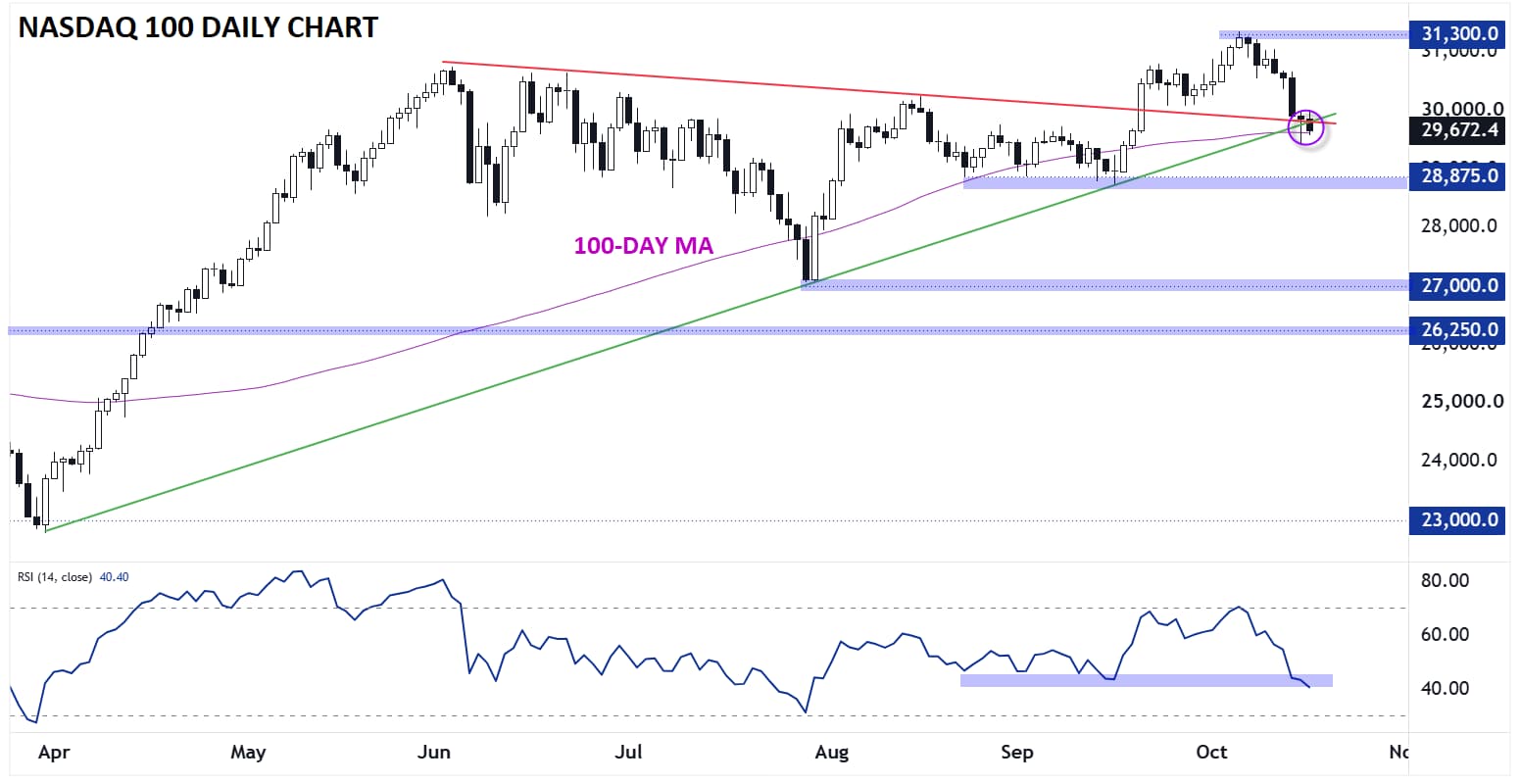
Nasdaq 100 Technical Analysis – NDX Daily Chart
Source: TradingView, StoneX
When it comes to a high-level view of the Magnificent Seven’s earnings, the Nasdaq 100 is the chart to watch. The Nasdaq 100 sports a nearly 40% to these seven stocks, and that concentration rises further including closely-related firms like SpaceX (SPCX) and Oracle (ORCL).
From a technical perspective, the Nasdaq 100 is showing weakness heading into the kickoff of major tech earnings. As the chart above shows, NDX is testing a confluence of support levels from a bullish trend line, a broken bearish trend line, and the rising 100-day MA all near the 29,700 level. A series of strong, high-quality earnings reports could see the index bounce from this clear support level and potentially retest the record highs above 31,000 over the next month.
On the other hand, lower-quality earnings or any signs of a pullback in AI investment could push the index below this key support zone, opening the door for a deeper retracement toward the August/September lows near 28,875 or the late July lows around 27,000 in short order.
Much like the technology itself, the AI trade is engulfing more and more of the sentiment of broader markets, making this earnings season arguably the most significant one yet for traders of all stripes.
-- Written by Matt Weller, Global Head of Research
Check out Matt’s Daily Market Update videos on YouTube and be sure to follow Matt on Twitter: @MWellerFX
Related tags:


The complete CFD trading experience
Award-winning platforms, competitive spreads, low commissions and dedicated support.
We live and breathe the markets and are dedicated to helping traders realise their ambitions as we continue to set the industry bar.
Economic calendar
Web Trader platform
Our sophisticated web-based platform is packed with features.
Related articles

Magnificent Seven Earnings Preview: Is the AI Boom Facing Its Biggest Test Yet?
After a wobble in the broader AI trade, the Magnificent Seven" stocks are reporting earnings in the coming week - see the key themes and Nasdaq 100 levels to watch!

Nasdaq 100 forecast: Tech stocks not out of woods yet
US index futures pushed higher in the first half of Friday’s session, taking cues from a strong performance from European equities. Both European and US equity futures extending yesterday’s impressive recovery after the sharp sell-off earlier in the week. But the lingering concerns around the AI investment cycle remain, while bond markets were easing lower again, lifting yields.


ASX 200 Outlook: A Rates Trade Disguised as a Stock Market?
Australian bond futures have exhibited a far stronger relationship with the ASX 200 than Wall Street over recent months. Now both markets are displaying remarkably similar price structures.

StoneX Europe Ltd may make third party material available on this website which may contain information included but not limited to the conditions of financial markets. The material is for information purposes only and does not contain, and should not be construed as containing, investment advice and/or investment recommendation and/or an investment research and/or an offer of or solicitation for any transactions in financial instruments; any decision to enter into a specific transaction shall be made by the client following an assessment by him/her of their situation.
StoneX Europe Ltd makes no representation or warranty and assumes no liability as to the accuracy or completeness of the information provided, nor any loss arising from any investment based on a recommendation, forecast or other information supplied. You should always seek independent advice as to your suitability to speculate in any related markets and your ability to assume the associated risks, if you are at all unsure. We are not under any obligation to update any such material. Any opinion made may be personal to the author and may not reflect the opinion of StoneX Europe Ltd.