



Dow Jones Forecast: The DJIA Attempts to Recover Amid Expectations of an Interest Rate Cut
Over the last two trading sessions, the Dow Jones Index has gained nearly 1.3%, opening the week with a moderately bullish bias. This rebound follows comments from several Federal Reserve officials suggesting the possibility of an interest rate cut in December’s policy meeting.
Share this:

Over the last two trading sessions, the Dow Jones Index has gained nearly 1.3%, opening the week with a moderately bullish bias. This rebound follows comments from several Federal Reserve officials suggesting the possibility of an interest rate cut in December’s policy meeting. For now, this has supported buying pressure in the short term. As new confirmations emerge indicating that the Fed may be considering a more consistent rate reduction, a sustained demand for equities could continue to support the index in the coming sessions.


Could Lower Rates Be Coming by Year-End?
At the end of last week, John Williams, President of the Federal Reserve Bank of New York, stated that monetary policy is currently moderately restrictive and that there is room for adjustment in the short term, possibly in favor of lower interest rates. Williams noted that the unemployment rate, which remains above 4%, continues to be a concern, suggesting that the central bank may need to act to prevent a further slowdown in employment. He also mentioned that inflation continues to moderate, making an overly restrictive stance unnecessary.
While other Fed members have emphasized that inflation is not yet fully under control and have avoided explicitly endorsing a rate cut, Williams’s recent comments were welcomed by the market, boosting expectations for lower rates. According to CME Group, the probability of a 25-basis-point (0.25%) rate cut at the December 10 meeting stands at 77.7%, while for January 28 it is 61.8%, suggesting that the current benchmark rate of 4.00% could be reduced to 3.75% within the next two months.
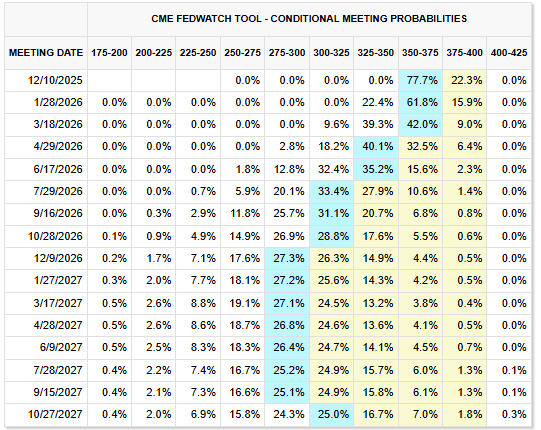
Source: CMEGROUP
Lower interest rates could provide relief to the equity market, as they would result in lower borrowing costs and make consumption and investment more accessible in the U.S. economy. This could lead to greater corporate income stability and a more positive outlook for the Dow Jones in the short term.
This positive sentiment is already reflected in the Top 5 index components, with Goldman Sachs up 0.58%, Caterpillar up 0.44%, Microsoft gaining 0.27%, American Express rising 0.42%, and Home Depot up 0.19% at the start of the week. The major index constituents are maintaining steady buying momentum, reflecting an increase in short-term confidence.
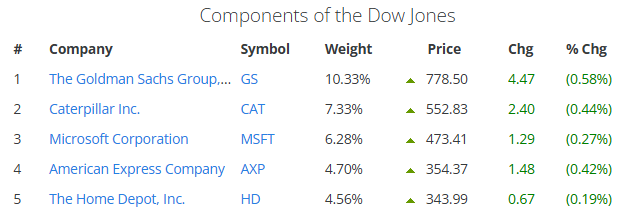
Source: Slickcharts
Thus, the shift in Federal Reserve rate-cut expectations appears to be acting as a key catalyst for renewed confidence in the Dow Jones. If the outlook for a more flexible monetary policy persists, buying pressure could remain strong in the coming sessions.
Long-Term Perspective
Despite the recent rebound in short-term confidence, the long-term outlook remains uncertain. According to the AAII Investor Sentiment Survey, market sentiment currently shows 32.6% bullish, 23.9% neutral, and 43.6% bearish expectations regarding equity market performance over the next six months. This indicates that pessimism continues to dominate among long-term investors.
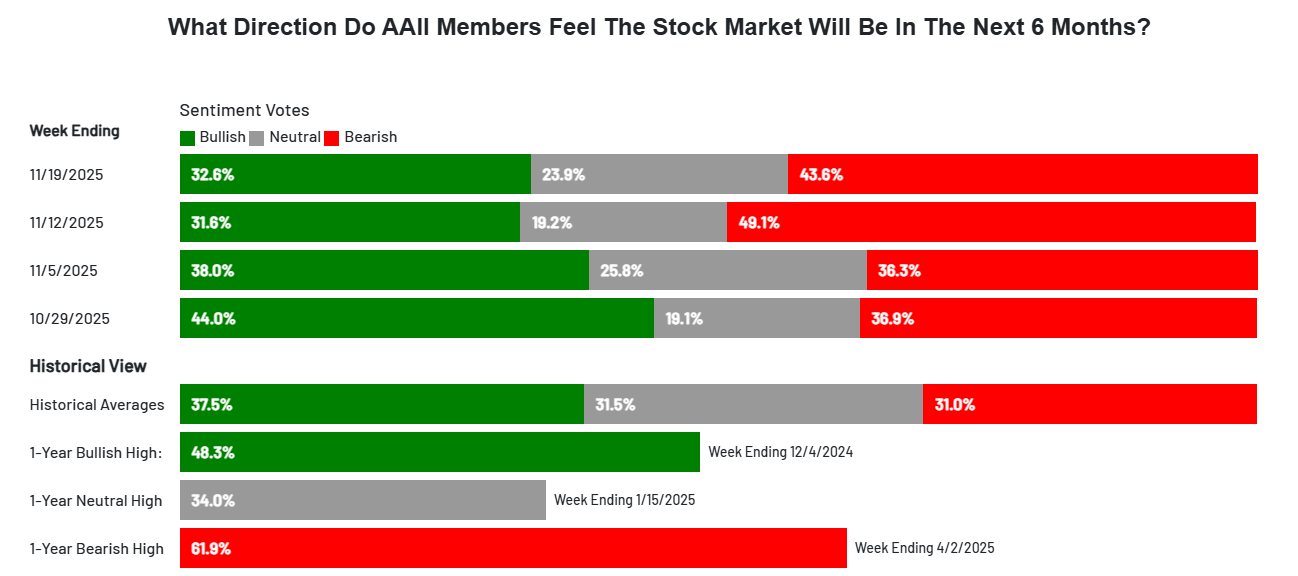
Source: AAII
Without structural catalysts to sustain equity demand, confidence may remain cautious. Although there is optimism in the short term, it could fade quickly if negative sentiment persists. In this scenario, a lack of structural confidence could limit steady demand for indices such as the Dow Jones, potentially triggering stronger selling pressure in the coming months.
Dow Jones Technical Outlook
Source: StoneX, Tradingview
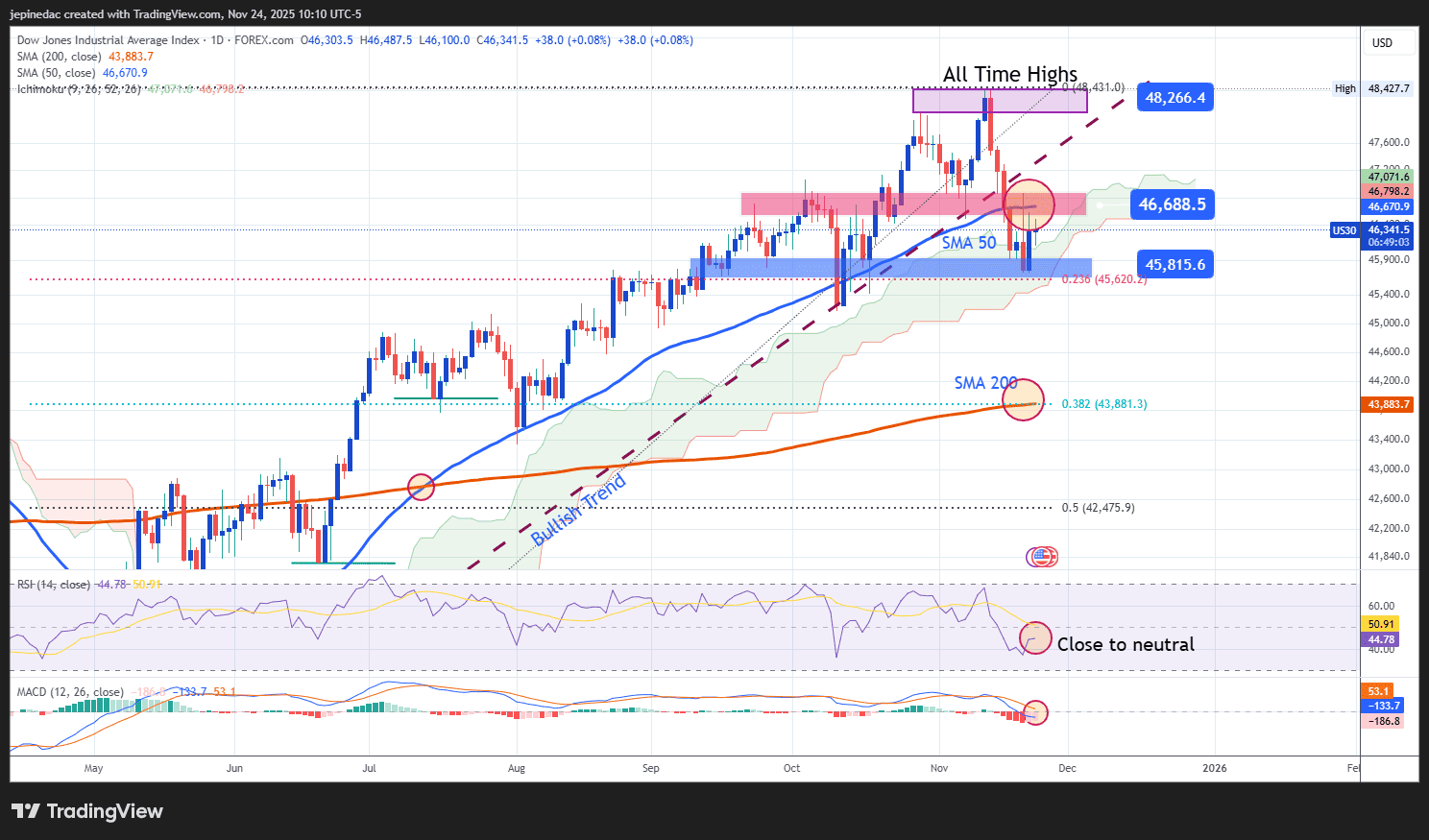
- Uptrend Yet to Reestablish: In recent sessions, Dow Jones downward movements have broken the bullish trendline that had held since early April 2025. Although the index has shown some short-term recovery, buying momentum remains insufficient to restore the broader uptrend that dominated most of the year. If the price fails to break above the 50-period moving average, a sideways range could develop, maintaining indecisive behavior in the short term.
- RSI: The RSI indicator shows a neutral slope, with oscillations near the 50 level, indicating an equilibrium between buying and selling pressure over the past 14 sessions. As long as this behavior persists, price indecision is likely to continue in the near term.
- MACD: The MACD histogram remains below the zero line, reflecting structural weakness in short-term moving averages. If this pattern continues, it could reinforce the current neutrality or even trigger new selling pressure in the coming weeks.
Key Levels to Watch:
- 48,266 points – Major Resistance: Represents the index’s all-time high and the most important bullish barrier in the short term. A move above this level could revive a dominant bullish bias and reactivate the uptrend line that prevailed during the second half of 2025.
- 46,688 points – Nearby Barrier: Aligns with a recent retracement zone around the 50-period simple moving average. If the price consolidates around this level, market indecision may increase, forming a short-term sideways range.
- 45,815 points – Key Support: Marks a recent low area, coinciding with the 23.6% Fibonacci retracement level. A break below this zone could trigger a new downward trendline, strengthening selling pressure in the short term.
Written by Julian Pineda, CFA, CMT – Market Analyst
Follow him on: @julianpineda25
Related tags:
Latest market news




The complete CFD trading experience
Award-winning platforms, competitive spreads, low commissions and dedicated support.
We live and breathe the markets and are dedicated to helping traders realise their ambitions as we continue to set the industry bar.
Economic calendar
Web Trader platform
Our sophisticated web-based platform is packed with features.
Related articles

Dow Jones Forecast: DJIA cautious as oil jumps & earnings loom
U.S. stocks are subdued on Monday as investors weigh oil prices and geopolitical developments, while looking cautiously ahead to Q3 bank earnings and inflation data later in the week.


Indices weekly outlook: Can the DAX rebound turn into a reversal?
Global indices managed to bounce back towards the end of the week as risk mood improved following Thursday’s drop in bond yields and a slight decline in oil prices. But by late Friday afternoon, oil prices had made back most of Thursday’s drop and the bond markets remained under some pressure as European bourses closed for trading.
Dow Jones Forecast: DJIA rises as Oil slips and Treasury yields pause
U.S. stocks are rising on Friday as oil prices ease on signs of reduced Middle East supply risks, although the telecom sector remains under pressure following SpaceX’s acquisition deal.
StoneX Europe Ltd may make third party material available on this website which may contain information included but not limited to the conditions of financial markets. The material is for information purposes only and does not contain, and should not be construed as containing, investment advice and/or investment recommendation and/or an investment research and/or an offer of or solicitation for any transactions in financial instruments; any decision to enter into a specific transaction shall be made by the client following an assessment by him/her of their situation.
StoneX Europe Ltd makes no representation or warranty and assumes no liability as to the accuracy or completeness of the information provided, nor any loss arising from any investment based on a recommendation, forecast or other information supplied. You should always seek independent advice as to your suitability to speculate in any related markets and your ability to assume the associated risks, if you are at all unsure. We are not under any obligation to update any such material. Any opinion made may be personal to the author and may not reflect the opinion of StoneX Europe Ltd.