





Economic Data Will Get Worse Dont Wait for it to Get Better
Markets and risk appetite WILL improve before the underlying infection, death, or economic data does.
Share this:

Markets have recovered slightly off the peak pessimism of this morning, but even the bounce from “sheer, unadulterated panic” levels to mere “violently risk averse” prices may not hold for long in the current environment. Major indices have erased Friday’s rally entirely to hit new multi-year lows, yields on the benchmark 10-year treasury bond have been stuck below 1.00% for the past week, and the safe haven currencies (JPY, CHF, and US dollar) are leading the relative strength charts year-to-date, while growth-sensitive currencies like the Australian and New Zealand dollars have fallen sharply:
Source: Finviz
So why are have markets become so volatile, despite economic data holding up relatively well so far?
Well, at the risk of stating the obvious for some readers, it’s critical to remember that the markets are forward-looking. Traders can’t afford to wait for retail sales to fall, unemployment to rise, and economic growth to grind to a halt to sell risk assets. The market is constantly pricing in its best estimate of the future state of affairs in real time.
What does that mean in practice when it comes to coronavirus?
- It means that we WILL see infection and the associated death figures rise.
- It means that we WILL see more extreme efforts to limit the spread of COVID-19.
- It means that we WILL see some almost unbelievably bad economic figures in the coming weeks (think sub-40 PMIs, 1-2 million in initial unemployment claims, etc).
And that will all be highly unsettling, to put it lightly. It’s worth doing your best to prepare for things to get better before they get worse, on both a societal and economic level.
But the fact that markets are forward-looking also has a silver lining: it means that markets and risk appetite WILL improve before the underlying infection, death, or economic data does. This is the fundamental nature of markets. By aggregating the opinions of millions of smart individuals around the globe and incentivizing them to be as accurate as possible, markets can provide one of the most accurate ways to “predict” the future, even if they are imperfect. That’s the reason that the Chinese stock market is one of the best performing indices across the globe year to date.
If you wait for infection and economic data to improve, you’ll miss the majority (if not all) of the recovery.
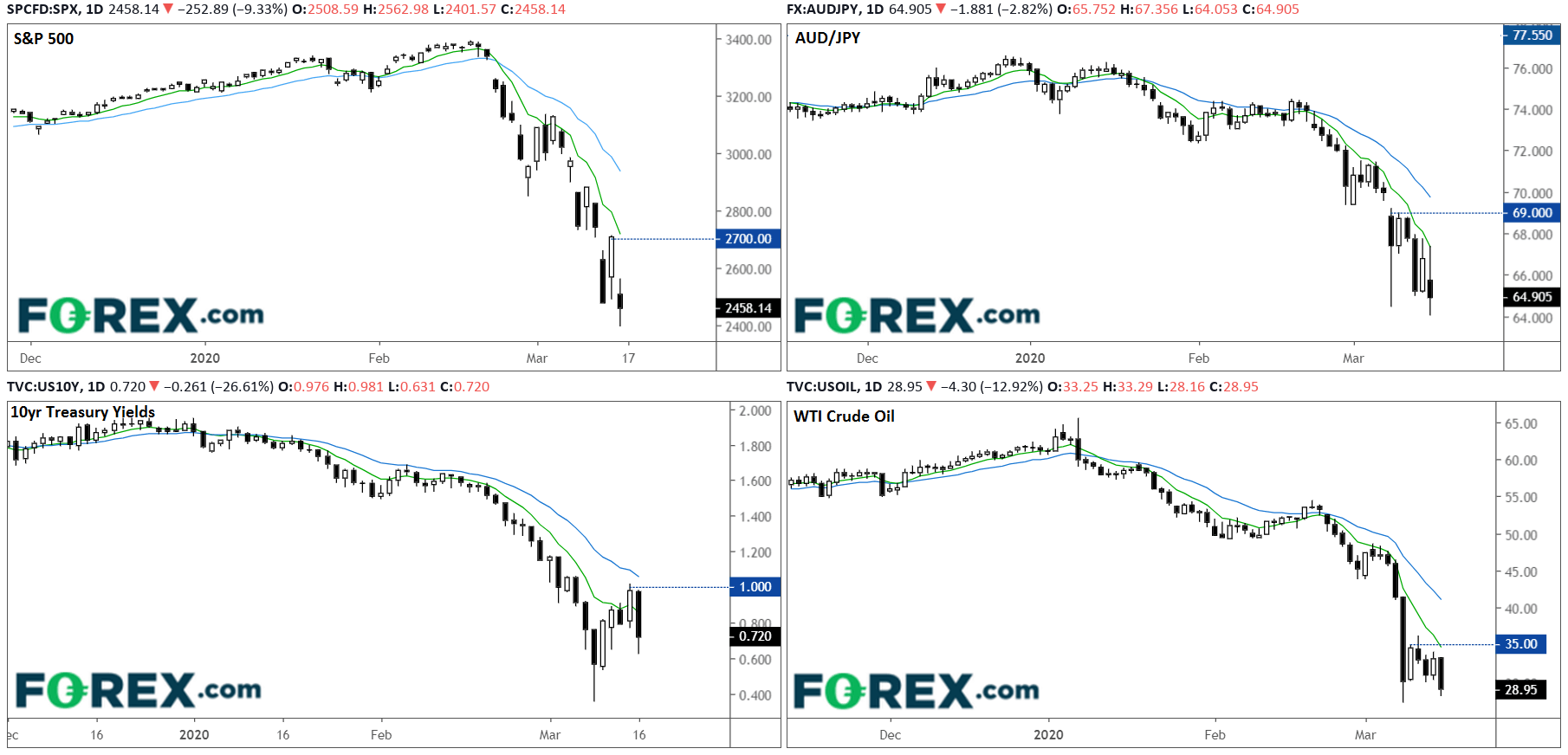
As far as actionable information, we’d encourage readers to take their cues from the broader market. Keying in on the major markets, some short-term signs that could signal a shift back toward a more risk-on environment (or at least stabilization) include the following:
- A recovery to regain 2700 in the S&P 500
- AUD/JPY, the quintessential risk-on/safe haven pairing, to break back above 69.00
- A move above 1.00% in the 10-year treasury yield
- Oil prices (WTI) recovering above 35.00
Source: TradingView, GAIN Capital
Astute observers will note that these levels roughly correspond to the 21-day EMA for each instrument. Obviously, these initial levels will evolve if we see another big leg lower in the coming weeks. If we do fall further, then we’ll check back and update these areas, as well as equivalent levels in other markets.
“If you can keep your head when all about you
Are losing theirs and blaming it on you…
If you can force your heart and nerve and sinew
To serve your turn long after they are gone…
Yours is the Earth and everything that’s in it”
- Rudyard Kipling
Markets have recovered slightly off the peak pessimism of this morning, but even the bounce from “sheer, unadulterated panic” levels to mere “violently risk averse” prices may not hold for long in the current environment. Major indices have erased Friday’s rally entirely to hit new multi-year lows, yields on the benchmark 10-year treasury bond have been stuck below 1.00% for the past week, and the safe haven currencies (JPY, CHF, and US dollar) are leading the relative strength charts year-to-date, while growth-sensitive currencies like the Australian and New Zealand dollars have fallen sharply:
Source: Finviz
So why are have markets become so volatile, despite economic data holding up relatively well so far?
Well, at the risk of stating the obvious for some readers, it’s critical to remember that the markets are forward-looking. Traders can’t afford to wait for retail sales to fall, unemployment to rise, and economic growth to grind to a halt to sell risk assets. The market is constantly pricing in its best estimate of the future state of affairs in real time.
What does that mean in practice when it comes to coronavirus?
- It means that we WILL see infection and the associated death figures rise.
- It means that we WILL see more extreme efforts to limit the spread of COVID-19.
- It means that we WILL see some almost unbelievably bad economic figures in the coming weeks (think sub-40 PMIs, 1-2 million in initial unemployment claims, etc).
And that will all be highly unsettling, to put it lightly. It’s worth doing your best to prepare for things to get better before they get worse, on both a societal and economic level.
But the fact that markets are forward-looking also has a silver lining: it means that markets and risk appetite WILL improve before the underlying infection, death, or economic data does. This is the fundamental nature of markets. By aggregating the opinions of millions of smart individuals around the globe and incentivizing them to be as accurate as possible, markets can provide one of the most accurate ways to “predict” the future, even if they are imperfect. That’s the reason that the Chinese stock market is one of the best performing indices across the globe year to date.
If you wait for infection and economic data to improve, you’ll miss the majority (if not all) of the recovery.
As far as actionable information, we’d encourage readers to take their cues from the broader market. Keying in on the major markets, some short-term signs that could signal a shift back toward a more risk-on environment (or at least stabilization) include the following:
- A recovery to regain 2700 in the S&P 500
- AUD/JPY, the quintessential risk-on/safe haven pairing, to break back above 69.00
- A move above 1.00% in the 10-year treasury yield
- Oil prices (WTI) recovering above 35.00
Source: TradingView, GAIN Capital
Astute observers will note that these levels roughly correspond to the 21-day EMA for each instrument. Obviously, these initial levels will evolve if we see another big leg lower in the coming weeks. If we do fall further, then we’ll check back and update these areas, as well as equivalent levels in other markets.
“If you can keep your head when all about you
Are losing theirs and blaming it on you…
If you can force your heart and nerve and sinew
To serve your turn long after they are gone…
Yours is the Earth and everything that’s in it”
- Rudyard Kipling
Latest market news




The complete CFD trading experience
Award-winning platforms, competitive spreads, low commissions and dedicated support.
We live and breathe the markets and are dedicated to helping traders realise their ambitions as we continue to set the industry bar.
Economic calendar
Web Trader platform
Our sophisticated web-based platform is packed with features.
Related articles
RBA delivers 25bp hike, Bullock now the main event
The RBA delivered the expected 25bp hike, but Bullock’s press conference now looms as the bigger volatility risk for AUD/USD and the ASX 200.
EUR/USD, USD/JPY Outlook: Oil, yields and an FX identity crisis
Crude oil is setting the tone across rates and FX, leaving EUR/USD vulnerable and USD/JPY caught between higher Treasury yields and the growing threat of intervention
AUD/USD Analysis: What's Next for the Australian Dollar After the RBA Decision?
Recent trading sessions have reflected a more neutral tone around the Australian dollar. This can be seen in AUD/USD price action, which has posted moves of roughly 0.2% over the last two sessions without establishing a clear direction. Much of this lack of momentum is linked to expectations surrounding the next policy moves from both the Reserve Bank of Australia (RBA) and the Federal Reserve.

StoneX Europe Ltd may make third party material available on this website which may contain information included but not limited to the conditions of financial markets. The material is for information purposes only and does not contain, and should not be construed as containing, investment advice and/or investment recommendation and/or an investment research and/or an offer of or solicitation for any transactions in financial instruments; any decision to enter into a specific transaction shall be made by the client following an assessment by him/her of their situation.
StoneX Europe Ltd makes no representation or warranty and assumes no liability as to the accuracy or completeness of the information provided, nor any loss arising from any investment based on a recommendation, forecast or other information supplied. You should always seek independent advice as to your suitability to speculate in any related markets and your ability to assume the associated risks, if you are at all unsure. We are not under any obligation to update any such material. Any opinion made may be personal to the author and may not reflect the opinion of StoneX Europe Ltd.