



EUR/USD forecast: Currency Pair of the Week, September 22, 2025
The EUR/USD forecast partly hinges on PMIs and US inflation data this week, following last week's Fed-induced volatility. It remains to be seen whether the dollar recovery has any legs. There will be a lot of focus on speeches from Fed officials this week with the FOMC now resuming its easing cycle.
Share this:

- EUR/USD forecast partly hinges on PMIs and US inflation data this week
- Germany’s PMIs could keep the euro supported if numbers improve
- Fed’s core PCE release on Friday remains the key driver for dollar momentum
Following last week’s rate cut by the Fed, we saw the US dollar regain its poise somewhat, ending on a high on Friday. However, it remains to be seen whether the dollar recovery has any legs. There will be a lot of focus on speeches from Fed officials this week with the FOMC now resuming its easing cycle. Currencies where the central bank has ended or is nearing the end of its easing cycle should outperform the greenback. Chief among them is the euro, with the ECB practically done with rate cuts this year. This should keep the EUR/USD forecast in the bullish territory.

Will the dollar selling resume?
Plenty of Federal Reserve voices are lined up this week, likely giving us a clearer picture of how the FOMC is leaning after Powell’s notably cautious tone last week. With the Dot Plot pencilling in two further cuts this year, I can’t see much reason for the dollar to find fresh support – one can, in fact, argue that it is already looking a touch pricey in the short run.
The real question for investors is whether Powell’s hesitation over more aggressive easing is echoed by the wider committee. Today, we’ve got comments expected from hawkish-leaning Hammack, Musalem and Barkin, while Williams should bring the more dovish perspective. Stephen Miran, who backed a 50bp cut last week, will also be speaking. Then tomorrow, Powell himself takes the stage again with an outlook speech that could carry real weight.
What else to watch out for this week?
This week promises to be pivotal for the EUR/USD forecast, with a packed economic calendar likely to drive sharp moves in currency markets. Traders will be eyeing global PMIs, the Swiss National Bank’s (SNB) policy announcement, Fedspeak (see above) and the Fed’s preferred inflation measure, the core PCE price index. Each of these events has the potential to shift expectations for monetary policy across major economies, setting the stage for volatility in EUR/USD.
- Global PMIs to provide a snapshot of Eurozone economic health
The latest Purchasing Managers’ Index (PMI) figures are due on Tuesday. These are forward-looking indicators that often provide an early read on economic conditions, sometimes proving more market-moving than hard data. For the eurozone, Germany’s PMI readings will be closely scrutinized, as any signs of stabilization or improvement could support the euro. Conversely, weak figures may reinforce concerns over slowing growth.
In the US, the focus will be on employment components, which could reinforce fears of a cooling labour market. Should PMIs disappoint, the dollar may resume its recent slide, opening the door for a EUR/USD rebound. Meanwhile, in the UK, stronger prices paid could highlight inflation concerns, a development that indirectly could weigh on the dollar by dampening expectations for further BoE cuts.
- Core PCE inflation
The highlight of the week will undoubtedly be Friday’s release of the US core PCE index, the Fed’s preferred inflation gauge. The Fed recently cut rates as expected and signalled two more cuts by year-end, but Powell’s warning that “there are no risk-free paths” underscores the delicate balance policymakers are trying to strike.
Tariffs remain a wildcard, with risks of reigniting inflationary pressures. If Friday’s PCE data surprises to the upside, inflation concerns could quickly return to the spotlight, boosting the dollar. On the other hand, a softer reading may reinforce dovish expectations and weigh on the greenback, supporting EUR/USD. The University of Michigan’s Consumer Inflation Expectations survey will add another layer of insight for traders parsing Fed policy direction.
Technical analysis: EUR/USD forecast remains tilted to upside
The trend is bullish on the EUR/USD and with rates now testing support here around 1.1700-1.1750 area, I wasn’t surprised to see a recovery today. But can it now climb above 1.1780 and push higher from there. Well, I continue to expect the pair to head to 1.20 in the coming days/weeks. But we need to see support levels being defended for the bulls to remain in control. So far, there is no evidence of a market top yet.
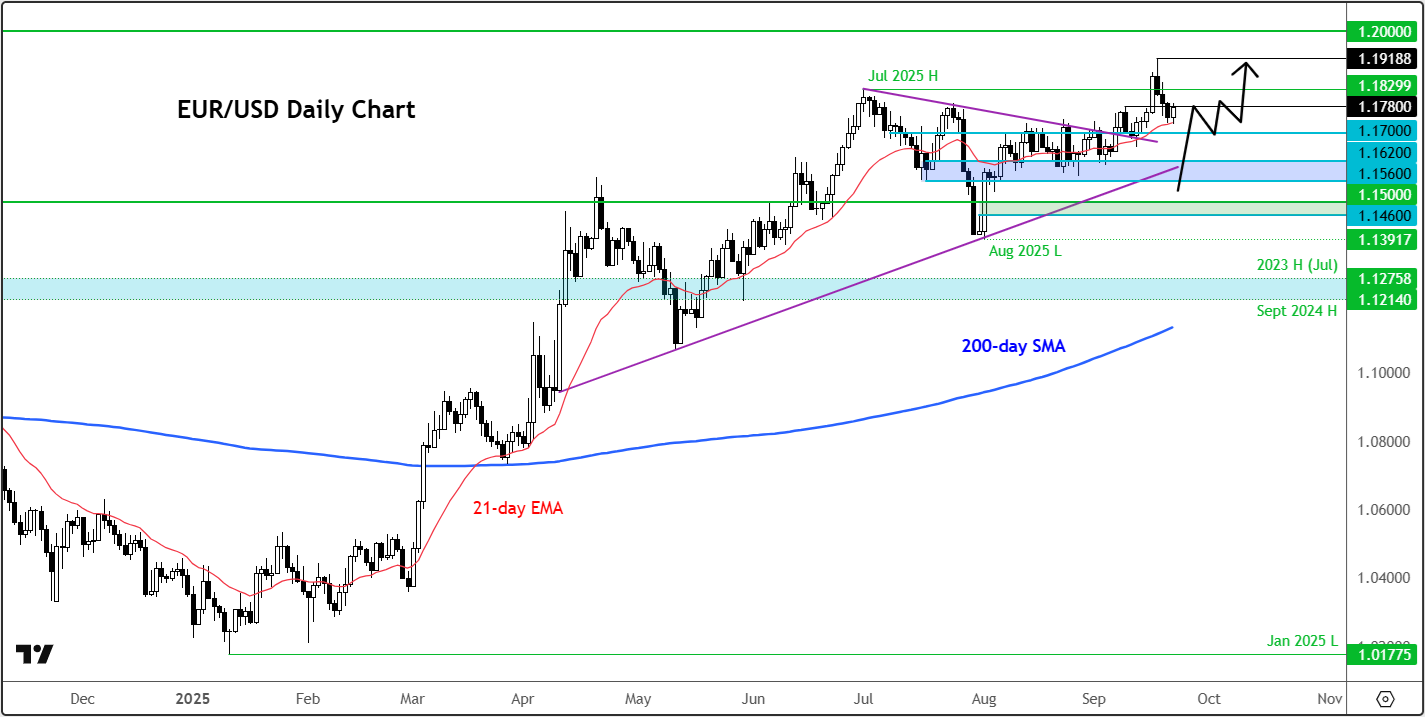
So, the EUR/USD forecast this week revolves around a tug-of-war between weak growth signals in Europe and shifting inflation dynamics in the US. While Germany’s PMIs could provide the euro with near-term support, the real driver will be Friday’s US. inflation data. For traders, that means keeping one eye firmly on the Fed and another on Europe’s growth pulse.
-- Written by Fawad Razaqzada, Market Analyst
Follow Fawad on Twitter @Trader_F_R
Related tags:

The complete CFD trading experience
Award-winning platforms, competitive spreads, low commissions and dedicated support.
We live and breathe the markets and are dedicated to helping traders realise their ambitions as we continue to set the industry bar.
Economic calendar
Web Trader platform
Our sophisticated web-based platform is packed with features.
Related articles

USD/JPY weekly outlook: Quarter turn scrambles rates regime
USD/JPY’s tight relationship with front-end US rates broke down sharply last week, but quarter-turn flows and positioning suggest the disconnect may prove temporary.


USD/CAD forecast: rally could accelerate above June highs at 1.4250
USD/CAD recovered quickly after weaker US jobs data, keeping the bullish trend in focus. A move above the June highs could accelerate the rally as inflation keeps the Fed under pressure.

USD Sets Fresh Yearly High as EUR/USD Drops Dramatically, USD/JPY Stable
Well, it was a week of USD strength that wasn’t entirely pushed by USD/JPY, as a strong sell-off in EUR/USD has pushed the major pair to its most oversold state in a decade.

StoneX Europe Ltd may make third party material available on this website which may contain information included but not limited to the conditions of financial markets. The material is for information purposes only and does not contain, and should not be construed as containing, investment advice and/or investment recommendation and/or an investment research and/or an offer of or solicitation for any transactions in financial instruments; any decision to enter into a specific transaction shall be made by the client following an assessment by him/her of their situation.
StoneX Europe Ltd makes no representation or warranty and assumes no liability as to the accuracy or completeness of the information provided, nor any loss arising from any investment based on a recommendation, forecast or other information supplied. You should always seek independent advice as to your suitability to speculate in any related markets and your ability to assume the associated risks, if you are at all unsure. We are not under any obligation to update any such material. Any opinion made may be personal to the author and may not reflect the opinion of StoneX Europe Ltd.