



EUR/USD forecast: FOREX Friday | July 17, 2026
Although this week’s softer US inflation readings briefly encouraged hopes that the Fed may not have to tightening after all, the renewed rise in oil prices has complicated that narrative and prompted investors to reassess the outlook. As such, they have found it difficult to justify shorting higher-yielding currencies or buying low or zero yielding assets. This narrative is unlikely to change much until there is genuine breakthrough in the tension between the US and Iran.
Share this:

The EUR/USD forecast remains biased to the downside as geopolitical tensions in the Middle East continue to underpin demand for both crude oil and the US dollar. Although this week’s softer US inflation readings briefly encouraged hopes that the Fed may not have to tightening after all, the renewed rise in oil prices has complicated that narrative and prompted investors to reassess the outlook. As such, they have found it difficult to justify shorting higher-yielding currencies or buying low or zero yielding assets. This narrative is unlikely to change much until there is genuine breakthrough in the tension between the US and Iran.
Dollar remains on front-foot as oil risk clouds inflation outlook
This week we had some weak inflation numbers from the US, and that caused only temporary weakness in US dollar. Both consumer and producer inflation surprised on the downside, reinforcing the view that underlying price pressures are gradually easing. Under normal circumstances, that would have weighed on the greenback more meaningfully. Instead, markets have been reluctant to fully embrace that view as crude oil prices continue to climb amid escalating tensions between the United States and Iran.
Higher energy prices raise the risk that inflation proves more persistent later in the year, potentially delaying any shift towards easier monetary policy. While investors still expect inflation to moderate over the medium term, the near-term backdrop has become considerably less favourable for dollar bears. I continue to believe that a stronger dollar is the more likely outcome in so far as the near-term is concerned, assuming geopolitical risks do not fade abruptly, and energy prices retreat. That makes the near-term EUR/USD forecast slightly bearish.
Fed policymakers remain reluctant to soften their stance
Despite encouraging inflation data, Federal Reserve officials have made little effort to signal an imminent policy pivot. Chair Kevin Warsh and Governor Chris Waller both reiterated that one or two favourable inflation reports are insufficient evidence that price stability has been restored. With crude oil prices moving sharply higher, policymakers will be wary of declaring victory too early. Energy costs rising means the Fed is unlikely to abandon its cautious approach until it sees sustained evidence that inflation is returning towards target. Markets continue to price in one rate increase before year-end. Should expectations shift towards a more aggressive policy path, the dollar could extend its recent gains while risk assets may struggle to maintain their resilience.
ECB meeting could provide the next catalyst
For the euro, attention now turns to next week’s European Central Bank meeting. Although policymakers are widely expected to leave interest rates unchanged, rising energy prices have injected a degree of uncertainty into the outlook. The ECB faces an uncomfortable balancing act. On one hand, inflation has continued to moderate across much of the eurozone. On the other, higher oil prices threaten to revive inflationary pressures while simultaneously weighing on economic growth, raising the spectre of stagflation.
Some policymakers may therefore argue for maintaining a hawkish bias to preserve the ECB’s inflation-fighting credibility. Investors will be paying close attention to President Lagarde’s guidance for clues on whether policymakers are becoming more concerned about renewed energy-driven inflation.
Beyond the ECB, next week’s flash PMI surveys will offer a timely snapshot of business activity across the major economies and could shape expectations for both European growth and the direction of the euro over the coming weeks.
Technical EUR/USD forecast: Key levels to watch
The EUR/USD managed to find support from the support trend of its flag pattern near the 1.1380 area earlier this week. That led to a bounce to test resistance and the bearish trend line around 1.1475/80 zone. From there, we have since seen renewed weakness. As a result, the EUR/USD continues to remain inside its bear flag pattern, and below the bearish trend line. While momentum is clearly lacking, the overall technical bias is one that leans slightly on the bearish side of things. The onus is on the bulls to show up and change that trend. Until that happens, the near-term EUR/USD forecast from a technical analysis point of view remains to the downside.
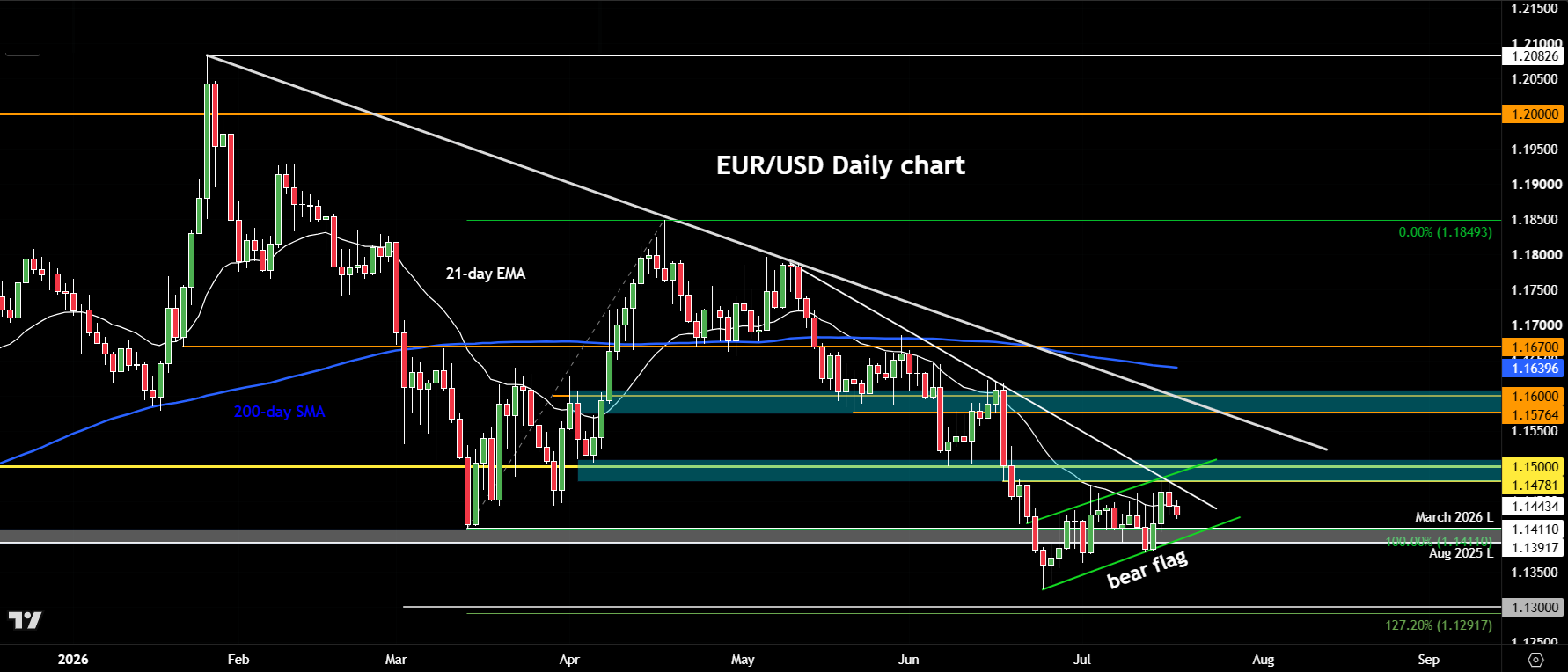
Should the EUR/USD break below the bear flag, then the next target would be the 1.1300 handle. Conversely, a break above the short-term bearish trend could expose the 1.1500 handle for a retest with the next resistance not seen until 1.1575 – 1.1600 area.

-- Written by Fawad Razaqzada, Market Analyst
Follow Fawad on Twitter @Trader_F_R


The complete CFD trading experience
Award-winning platforms, competitive spreads, low commissions and dedicated support.
We live and breathe the markets and are dedicated to helping traders realise their ambitions as we continue to set the industry bar.
Economic calendar
Web Trader platform
Our sophisticated web-based platform is packed with features.
Related articles

NZD/USD pressure mounts as payrolls looms large
NZD/USD has fallen sharply as Fed rate expectations reset higher, but extreme downside stretch and major support raise the risk of a violent counter-trend rebound.

US Core PCE Preview: Stale or Significant for the Fed
Core PCE inflation takes center stage Wednesday, with traders watching for signs of renewed price pressure and clues on whether the Fed could hike again in October.

Australian Dollar Forecast: AUD/USD Four-Week Slide Nears Critical Uptrend Support 9 29 2026
Aussie momentum has deteriorated sharply into quarter-end, with inflation, Core PCE and NFP on tap as AUD/USD closes in on a pivotal technical threshold.

StoneX Europe Ltd may make third party material available on this website which may contain information included but not limited to the conditions of financial markets. The material is for information purposes only and does not contain, and should not be construed as containing, investment advice and/or investment recommendation and/or an investment research and/or an offer of or solicitation for any transactions in financial instruments; any decision to enter into a specific transaction shall be made by the client following an assessment by him/her of their situation.
StoneX Europe Ltd makes no representation or warranty and assumes no liability as to the accuracy or completeness of the information provided, nor any loss arising from any investment based on a recommendation, forecast or other information supplied. You should always seek independent advice as to your suitability to speculate in any related markets and your ability to assume the associated risks, if you are at all unsure. We are not under any obligation to update any such material. Any opinion made may be personal to the author and may not reflect the opinion of StoneX Europe Ltd.