


EUR/USD Forecast: FOREX Friday | October 30, 2026
While the energy shock is a major heading for the euro, the single currency remains supported by a hawkish European Central Bank while growth data in the Eurozone has also been surprisingly resilient. Meanwhile, the dollar faces some near-term positioning risks as markets look ahead to the US midterm elections and given the renewed weakness in technology stocks.
Share this:

The EUR/USD forecast is starting to turn somewhat more constructive again. While the energy shock is a major heading for the euro, the single currency remains supported by a hawkish European Central Bank while growth data in the Eurozone has also been surprisingly resilient. Meanwhile, the dollar faces some near-term positioning risks as markets look ahead to the US midterm elections and given the renewed weakness in technology stocks.
First, let’s discuss the dollar before moving onto the euro side of things.
Dollar’s upside look limited from here on
Granted, the dollar remains fundamentally well supported. US data has given the Federal Reserve little reason to sound more dovish, with third-quarter GDP expanding by 3.4%, slightly ahead of expectations, while core PCE inflation rose 0.3% month-on-month in September. Then you have rising energy prices giving the dollar a boost against energy importers. The Fed remains hawkish and a December hike is increasingly likely. But much of this is already priced in.
As we have seen previously, whenever the technology sector has come under pressure so too has the dollar. The tech sell off has encouraged some safe-haven demand for Treasuries, dragging yields lower. The dollar’s sensitivity to renewed concerns around the AI trade could keep it under pressure today.
There’s also the small matter of next week’s US midterm elections, where a full Democratic sweep is increasingly likely. This means the party wins control of both the House of Representatives and the Senate on the same night. If so, this potentially raises concerns over government shutdown risks and debt-ceiling negotiation. With net-long dollar positions potentially vulnerable to precautionary unwinding, we would be cautious about chasing further dollar strength over the next few sessions.
ECB keeps the euro supported
The ECB provided a more interesting signal for the euro on Thursday. Christine Lagarde’s press conference was considerably more hawkish. A rate hike was discussed at the meeting, while subsequent ECB messaging suggested policymakers remain ready to raise rates in December. That reinforces the view that the direction of travel is still towards tighter policy, providing an important source of support for the euro.
Eurozone economy remains resilient
Meanwhile growth data released this morning showed Eurozone growth slowed from 0.6% to 0.4% quarter-on-quarter in the third quarter, but the economy continues to perform better than expected despite the worsening energy shock and Middle East conflict.
At face value, the resilience is somewhat surprising for a major energy importer. However, the impact on inflation has so far been relatively contained, while real wages remain positive. Industry is feeling the squeeze from higher energy costs, but this is being partly offset by strong investment in technology, defence and infrastructure.
The headline figure was also boosted by Ireland, where GDP jumped 5.5%, although multinational activity makes the Irish data a poor guide to underlying eurozone demand. Excluding Ireland, growth was a more modest 0.2%. France contracted 0.1%, Italy stagnated, while Spain and the Netherlands remained stronger at 0.6%.
The German economy, the eurozone’s economic powerhouse, continued its steady growth. Third quarter GDP expanded by a modest 0.2% quarter-on-quarter and by 1.2% year-on-year. This was the fourth consecutive quarter of growth, surprising analysts who have been calling for a slowdown because of the energy shock. It looks like the impact of that large fiscal stimulus – namely investment in defence and infrastructure – is starting to reach the economy.
Will the eurozone weather the storm in the coming months?
The bigger question is whether the eurozone can maintain this resilience through the winter. Energy prices, particularly gas, are still rising, while higher interest rates are beginning to weigh on borrowing appetite, according to the ECB’s latest bank lending survey.
For now, the economy is holding up reasonably well, but the risks are becoming more clearly tilted towards slower growth. At best, a period of modest expansion looks more realistic in the months ahead.
That should still keep the ECB on a hawkish path and potentially provide some structural support for the euro.
EUR/USD forecast: Technical analysis and levels to watch
The EUR/USD has formed a potential double bottom low near 1.1110/1.1100 area this week. But upside follow-thru is needed to confirm. Else, this could be another false signal for the pair.
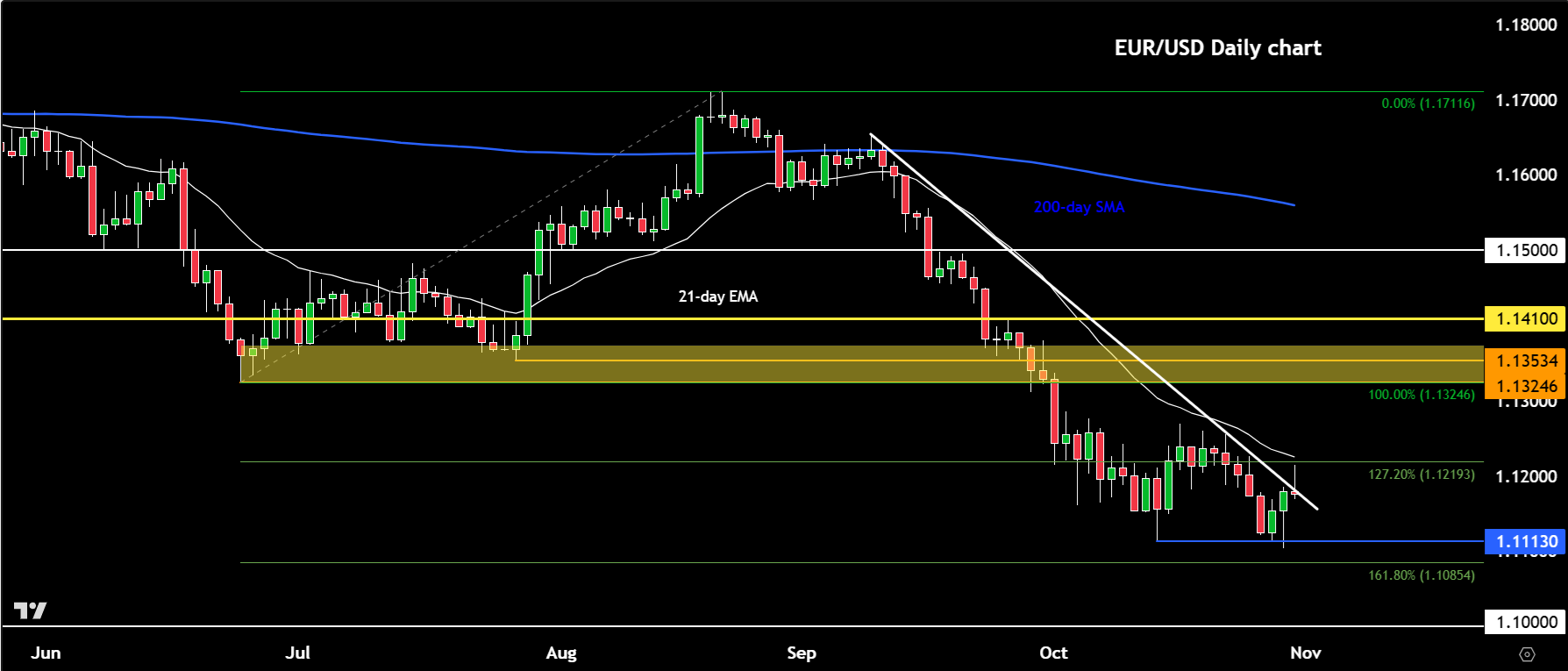
Price was testing trend line and resistance near 1.1200 area at the time of writing, where it was encountering some resistance.
If the EUR/USD manages to clear 1.1200–1.1250 in the coming sessions, then this could pave the way for a run towards 1.1320-1.1355 area, where it may encounter some resistance.
If the selling resumes and we go below the 1.1110/1.1100 area, then the next stop could be the 1.10 handle.

Related tags:


The complete CFD trading experience
Award-winning platforms, competitive spreads, low commissions and dedicated support.
We live and breathe the markets and are dedicated to helping traders realise their ambitions as we continue to set the industry bar.
Economic calendar
Web Trader platform
Our sophisticated web-based platform is packed with features.
Related articles
EUR/USD Forecast: FOREX Friday | October 30, 2026
While the energy shock is a major heading for the euro, the single currency remains supported by a hawkish European Central Bank while growth data in the Eurozone has also been surprisingly resilient. Meanwhile, the dollar faces some near-term positioning risks as markets look ahead to the US midterm elections and given the renewed weakness in technology stocks.
EUR/USD Analysis: Euro Confidence Remains Limited After the ECB
The trading week is approaching its end and, for now, a neutral tone continues to dominate the euro's short-term price action. EUR/USD has recorded a move of only around -0.15% during the week, highlighting the pair's inability to establish a clear direction in favor of either the euro or the U.S. dollar.


US Dollar Price Action Setups in Central Bank Week
We’ve heard from the Fed, ECB and BoC with the BoJ up next later tonight and DXY trajectory hangs in the balance depending on how hawkish the Bank of Japan might turn out to be.

StoneX Europe Ltd may make third party material available on this website which may contain information included but not limited to the conditions of financial markets. The material is for information purposes only and does not contain, and should not be construed as containing, investment advice and/or investment recommendation and/or an investment research and/or an offer of or solicitation for any transactions in financial instruments; any decision to enter into a specific transaction shall be made by the client following an assessment by him/her of their situation.
StoneX Europe Ltd makes no representation or warranty and assumes no liability as to the accuracy or completeness of the information provided, nor any loss arising from any investment based on a recommendation, forecast or other information supplied. You should always seek independent advice as to your suitability to speculate in any related markets and your ability to assume the associated risks, if you are at all unsure. We are not under any obligation to update any such material. Any opinion made may be personal to the author and may not reflect the opinion of StoneX Europe Ltd.