



EUR/USD outlook: PMI day arrives as Fed hike bets bolster the dollar
EUR/USD enters PMI day under pressure after fresh calls for multiple Fed rate hikes helped lift the dollar. With 1.1400 looming below, the surveys may determine whether support holds or finally gives way.
Share this:

- PMI day puts EUR/USD support in focus
- Fed hike bets keep dollar supported
- Euro faces crucial test at 1.1400
- Strong US data widens transatlantic divide
PMI day takes centre stage (in Europe)
PMI day is upon us, perhaps the most brilliantly orchestrated non-event in financial markets. S&P Global has essentially taken a sentiment survey and managed to plonk it right in the middle of what has traditionally been one of the quieter periods of the month for scheduled economic data. The result? It receives far more attention than it probably deserves.
That's not to say the surveys are irrelevant. They do have some relationship with subsequent hard economic data, and markets will happily react when the results deviate significantly from expectations. But let's not pretend they're anything more than what they are: a survey. In the United States, traders tend to pay far more attention to the ISM reports, which are broader in construction and carry a longer pedigree. In China, the influence has whittled away over the years. Europe remains the notable exception, where PMI day can still move markets, particularly the euro.
As such, EUR/USD looms as the pair to watch today with PMI releases due from both sides of the Atlantic.
The two PMI components that matter
Source: TradingView
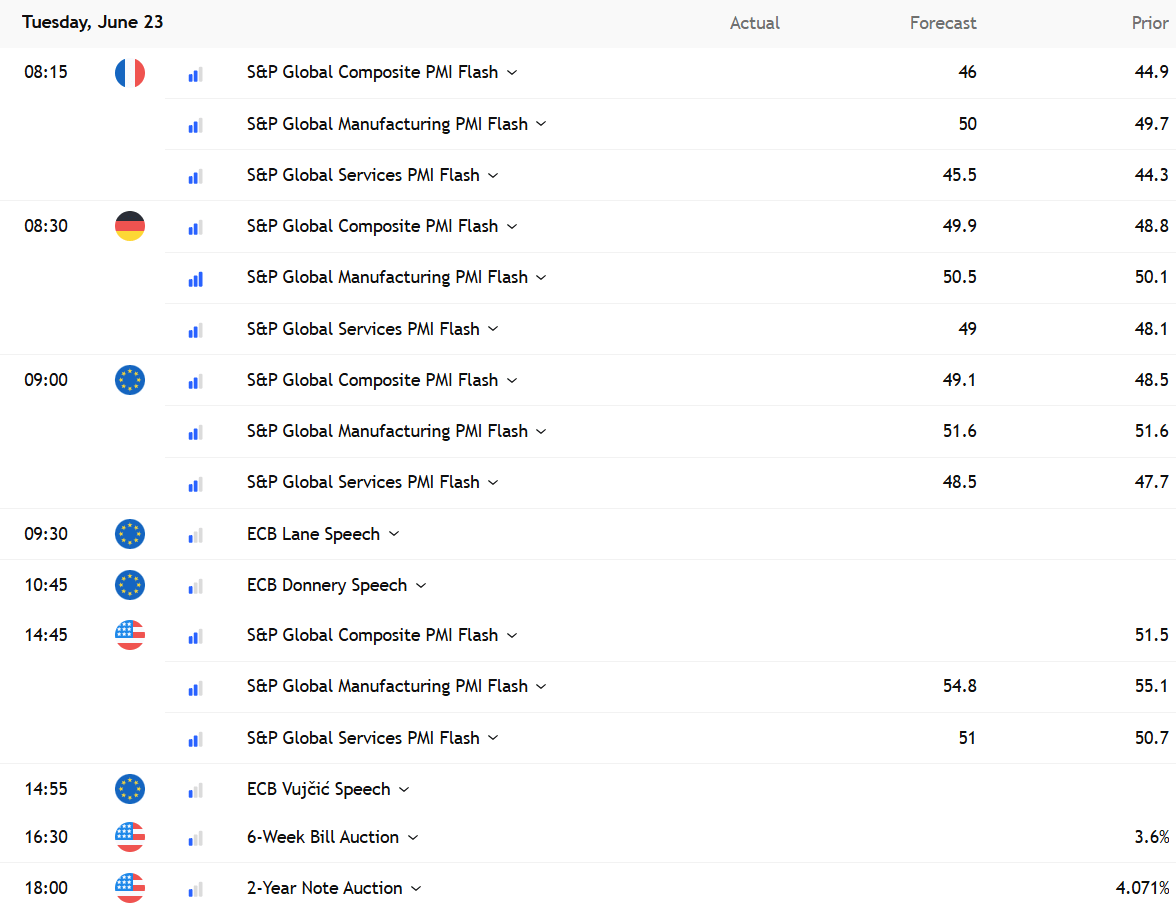
The enthusiasm of European economists for the release is perhaps best illustrated by the level of detail contained in the consensus forecasts. Despite being a flash estimate based on only 85-90% of responses, forecasters have happily gone to work producing precise projections for each of the major components.
For the euro area, consensus expects a modest improvement in the composite and services measures, although both are forecast to remain below the 50 level separating expansion from contraction. Manufacturing is expected to hold just above that threshold. Beyond the headlines, the key focus will be on new orders and prices. With the recent energy shock lifting costs across the region, traders will be looking for clues on whether demand is beginning to soften and whether inflationary pressures are proving more persistent than anticipated.
The US surveys are expected to show activity continuing to expand across both manufacturing and services. As with the euro area report, new orders and prices may be the most important details beneath the surface. Strong demand and firm price pressures would fit with the prevailing narrative of a resilient economy and a Federal Reserve that may need to resume raising rates later this year. Anything that challenges that view could, at the margin, soften the dollar.
The Fed repricing gathers pace
The dollar's strength on Monday was notable given it came alongside a sharp unwind in crude oil prices, breaking a relationship that has often held in recent months. Despite the decline in energy prices, buyers emerged early in Asia, helping to lift the greenback broadly.
Source: TradingView
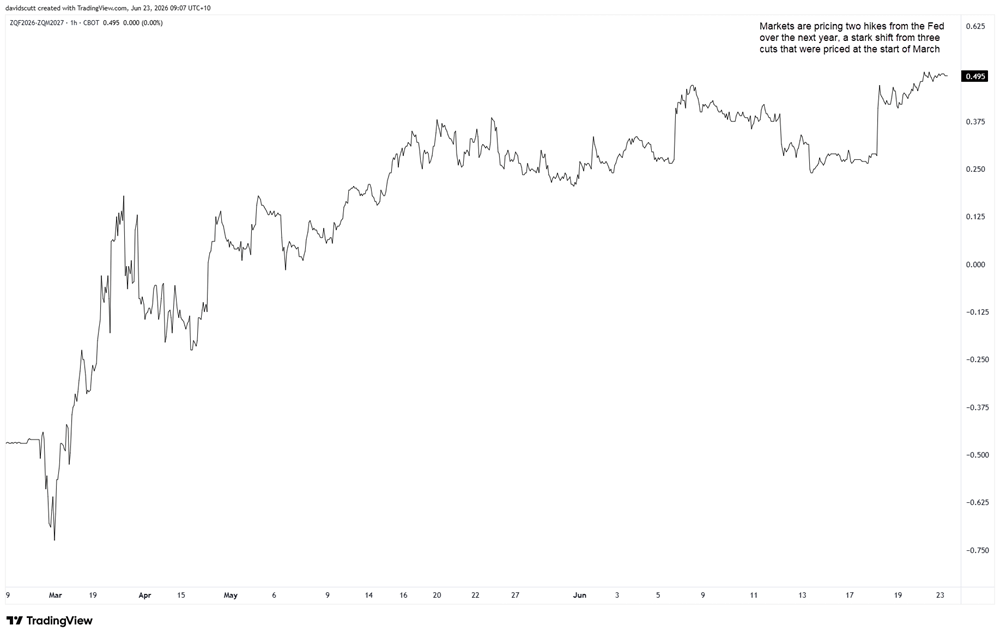
Part of the explanation may have come from a further shift in Fed expectations. Reports emerged that both Bank of America and Deutsche Bank now expect the Federal Reserve to resume raising rates this year, reinforcing a move already evident in market pricing. The prospect of multiple rate hikes, following last week's hawkish pivot from Fed Chair Kevin Warsh, helped underpin demand for the dollar.
Source: LSEG
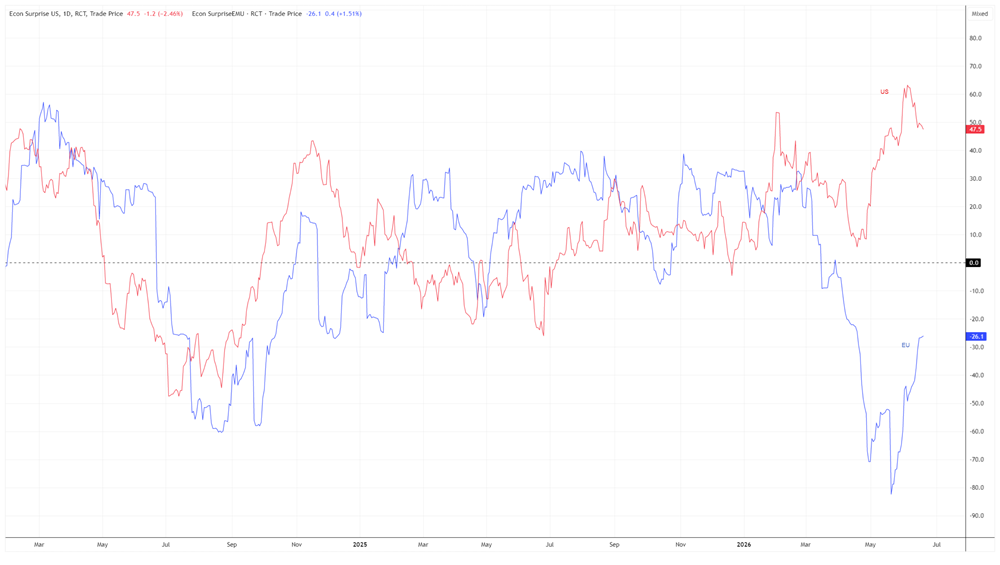
The shift in expectations is not overly surprising from a fundamental perspective. Citi's Economic Surprise Index, which tracks whether economic data are outperforming or underperforming expectations, has continued to move in favour of the United States, reflecting a run of stronger-than-expected releases. Combined with signs of a renewed inflationary impulse, it helps explain why markets are increasingly discussing additional Fed tightening. Unlike Europe, where policymakers are grappling with weak growth and an energy-driven inflation shock, the case for higher rates in the United States is being underpinned by economic resilience and persistent price pressures.
That divergence is showing up in EUR/USD.
The battle around 1.1400

Source: TradingView
Be it the price action, the message from the oscillators, or the fact the pair now sits in a clear downtrend beneath all its key medium and longer-term moving averages, it continues to favour playing EUR/USD from the short side. That puts the March swing low at 1.1412 and the psychologically important 1.1400 big figure firmly in focus.
The pair begins Wednesday's session just above that zone. While buyers have managed to defend it over the past two sessions, the rebounds have been marginal at best. As a result, it remains the key level to watch heading into today's PMI releases.
Should the post-Fed decline extend, particularly if EUR/USD closes beneath 1.1400, the lower boundary of the support zone, it may embolden bears to look for a far larger unwind. Below the March lows, there is little in the way of meaningful technical support until 1.1200, making it the next major downside level to watch. Shorts could be established on a break beneath 1.1400, using a stop above the level for protection while targeting lower levels.
On the topside, if support between 1.1412 and 1.1400 holds, attention shifts to 1.1500 and then the 23.6% Fibonacci retracement of the January-March decline at 1.1570. Beyond that sits a formidable moving average zone comprising the 50, 100 and 200-day averages.
The message from the oscillators remains unequivocally bearish. RSI (14) has broken its modest uptrend and continues to trend lower, sitting just above 30. MACD is delivering a complementary signal, having registered a bearish crossover while continuing to diverge from the signal line. Downside pressure is building, keeping the focus squarely on the support zone ahead of today's PMI releases.


The complete CFD trading experience
Award-winning platforms, competitive spreads, low commissions and dedicated support.
We live and breathe the markets and are dedicated to helping traders realise their ambitions as we continue to set the industry bar.
Economic calendar
Web Trader platform
Our sophisticated web-based platform is packed with features.
Related articles

USD/JPY weekly outlook: Quarter turn scrambles rates regime
USD/JPY’s tight relationship with front-end US rates broke down sharply last week, but quarter-turn flows and positioning suggest the disconnect may prove temporary.

USD/CAD forecast: rally could accelerate above June highs at 1.4250
USD/CAD recovered quickly after weaker US jobs data, keeping the bullish trend in focus. A move above the June highs could accelerate the rally as inflation keeps the Fed under pressure.


USD Sets Fresh Yearly High as EUR/USD Drops Dramatically, USD/JPY Stable
Well, it was a week of USD strength that wasn’t entirely pushed by USD/JPY, as a strong sell-off in EUR/USD has pushed the major pair to its most oversold state in a decade.
StoneX Europe Ltd may make third party material available on this website which may contain information included but not limited to the conditions of financial markets. The material is for information purposes only and does not contain, and should not be construed as containing, investment advice and/or investment recommendation and/or an investment research and/or an offer of or solicitation for any transactions in financial instruments; any decision to enter into a specific transaction shall be made by the client following an assessment by him/her of their situation.
StoneX Europe Ltd makes no representation or warranty and assumes no liability as to the accuracy or completeness of the information provided, nor any loss arising from any investment based on a recommendation, forecast or other information supplied. You should always seek independent advice as to your suitability to speculate in any related markets and your ability to assume the associated risks, if you are at all unsure. We are not under any obligation to update any such material. Any opinion made may be personal to the author and may not reflect the opinion of StoneX Europe Ltd.