





For What Its Worth BOJ is Ready to Go Next Week
Although the BOJ is ready to provide more stimulus, it’s not likely to have an affect on yen.
Share this:

Yesterday, Japan’s Prime Minister Abe announced an additional fiscal package worth JPY 430.8bln. This is in addition to the fiscal actions already take by the administration. It is estimated Japan will need JPY 10tln-JPY 20tln to fight the coronavirus. On the other hand, The Bank of Japan (BOJ) have been speaking endlessly about the numerous tools they have to provide more stimulus into the economy. They also have been talking about how they are “monitoring fx movements”. In the old days, the BOJ would intervene in the fx markets and run USD/JPY up 2 big figures to take pressure off the rising yen. However, traders began to catch on to this trick, and would begin selling yen pairs as soon as the BOJ was done buying. In a few days, USD/JPY would be lower than where it was when the BOJ started selling yen!! Today BOJ members just talk. For most Central Banks, speaking can be a powerful tool to guide the markets as to where monetary policy may be headed next. Not in Japan.
The BOJ is set to meet next week at their regularly scheduled interest rate meeting. Earlier today, the BOJ said they are “likely to ease monetary policy next week to prevent market volatility from affecting business sentiment; more ETF buying seen as among the likely options” (Sources). This is equivalent to pouring a glass of water into the ocean. It really doesn’t matter what the BOJ says or does, the trading community has little faith in them.
The Japanese Yen has always been considered a “flight to safety”. Why? Because markets have become aware that the BOJ is always there to bail them in, in worst case scenario. (I must mention here that the FED and the ECB don’t seem to far behind over the last 10 years). In the 15-minute bar, when the BOJ “talk” was released on the wires, USD/JPY briefly traded from 104.70 to 105.00. Sellers took advantage of the bounce to sell. And the bar closed at 104.57. 30 minutes later, price was 20 pips lower near 104.37.
Source: Tradingview, City Index
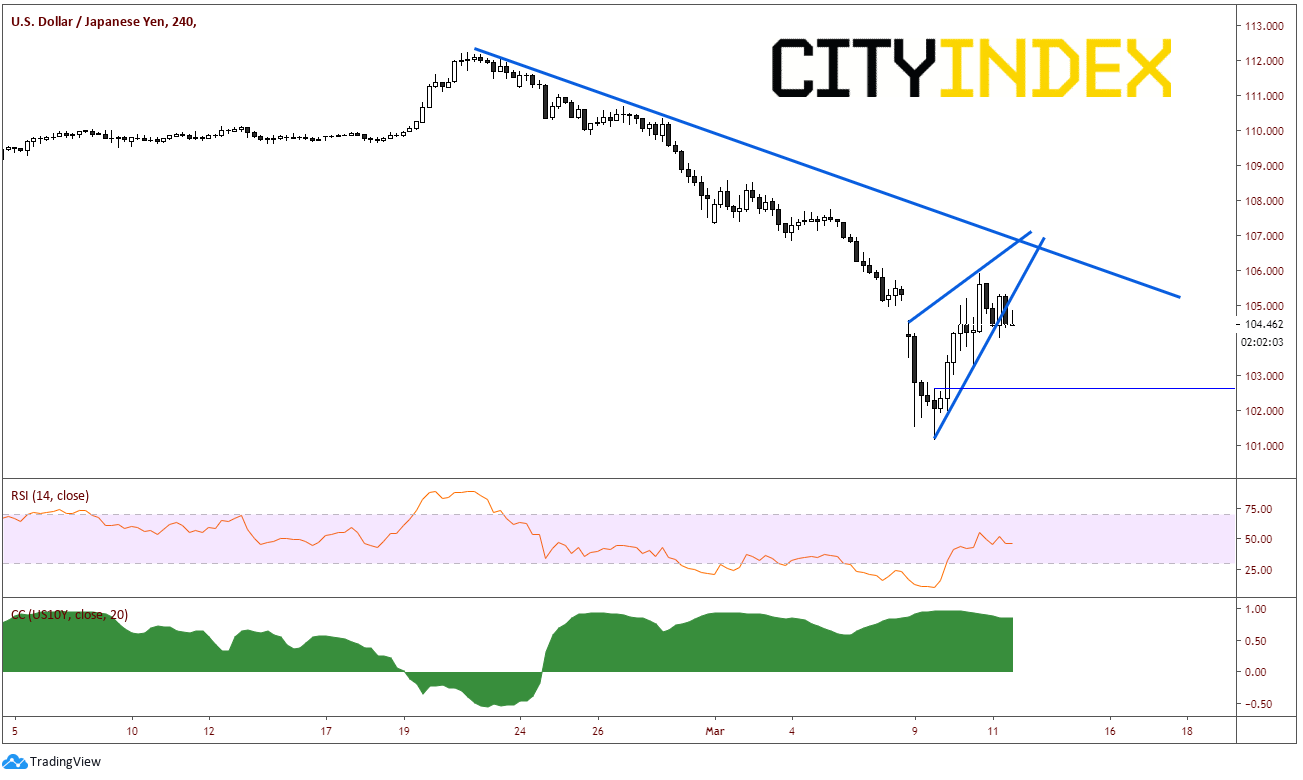
Astute traders who want to try to find direction for the USD/JPY will watch the US 10-Year Yields. Notice the correlation coefficient at the bottom of the chart. The correlation coefficient is +0.85. A correlation of +1.00 means that the 2 instruments more perfectly with each other on a 1 to 1 basis. +0.85 means that 85% of the time they move together.
Source: Tradingview, City Index
USD/JPY has been in a downtrend since mid-February, and yesterday filled that gap from over the weekend. In doing so, price has created a rising wedge and is currently moving outside the wedge. Initial resistance is the bottom line of the wedge near 105.30. Resistance above there is the downward sloping trendline from mid-February near 106.70. (There is horizontal resistance there as well. Horizontal support comes across that the top of the hammer bottom near 102.60, and again at Sunday night’s (Monday’s trading session) lows near 101.18.
Although the BOJ is ready to provide more stimulus at the next BOJ meeting, it’s not likely to have much of an affect on the yen. A “Whatever It Takes” comment will probably not even help! Watching the US 10-year yield will help give traders a better sense of where USD/JPY is headed next.
Yesterday, Japan’s Prime Minister Abe announced an additional fiscal package worth JPY 430.8bln. This is in addition to the fiscal actions already take by the administration. It is estimated Japan will need JPY 10tln-JPY 20tln to fight the coronavirus. On the other hand, The Bank of Japan (BOJ) have been speaking endlessly about the numerous tools they have to provide more stimulus into the economy. They also have been talking about how they are “monitoring fx movements”. In the old days, the BOJ would intervene in the fx markets and run USD/JPY up 2 big figures to take pressure off the rising yen. However, traders began to catch on to this trick, and would begin selling yen pairs as soon as the BOJ was done buying. In a few days, USD/JPY would be lower than where it was when the BOJ started selling yen!! Today BOJ members just talk. For most Central Banks, speaking can be a powerful tool to guide the markets as to where monetary policy may be headed next. Not in Japan.
The BOJ is set to meet next week at their regularly scheduled interest rate meeting. Earlier today, the BOJ said they are “likely to ease monetary policy next week to prevent market volatility from affecting business sentiment; more ETF buying seen as among the likely options” (Sources). This is equivalent to pouring a glass of water into the ocean. It really doesn’t matter what the BOJ says or does, the trading community has little faith in them.
The Japanese Yen has always been considered a “flight to safety”. Why? Because markets have become aware that the BOJ is always there to bail them in, in worst case scenario. (I must mention here that the FED and the ECB don’t seem to far behind over the last 10 years). In the 15-minute bar, when the BOJ “talk” was released on the wires, USD/JPY briefly traded from 104.70 to 105.00. Sellers took advantage of the bounce to sell. And the bar closed at 104.57. 30 minutes later, price was 20 pips lower near 104.37.
Source: Tradingview, FOREX.com
Astute traders who want to try to find direction for the USD/JPY will watch the US 10-Year Yields. Notice the correlation coefficient at the bottom of the chart. The correlation coefficient is +0.85. A correlation of +1.00 means that the 2 instruments more perfectly with each other on a 1 to 1 basis. +0.85 means that 85% of the time they move together.
Source: Tradingview, FOREX.com
USD/JPY has been in a downtrend since mid-February, and yesterday filled that gap from over the weekend. In doing so, price has created a rising wedge and is currently moving outside the wedge. Initial resistance is the bottom line of the wedge near 105.30. Resistance above there is the downward sloping trendline from mid-February near 106.70. (There is horizontal resistance there as well. Horizontal support comes across that the top of the hammer bottom near 102.60, and again at Sunday night’s (Monday’s trading session) lows near 101.18.
Although the BOJ is ready to provide more stimulus at the next BOJ meeting, it’s not likely to have much of an affect on the yen. A “Whatever It Takes” comment will probably not even help! Watching the US 10-year yield will help give traders a better sense of where USD/JPY is headed next.
Latest market news




The complete CFD trading experience
Award-winning platforms, competitive spreads, low commissions and dedicated support.
We live and breathe the markets and are dedicated to helping traders realise their ambitions as we continue to set the industry bar.
Economic calendar
Web Trader platform
Our sophisticated web-based platform is packed with features.
Related articles
EUR/USD Q4 2026 Outlook: Euro at a Crossroads as Fed, ECB Tighten 9 25 2026
EUR/USD enters Q4 at a pivotal inflection point as competing Fed-ECB policy paths and persistent inflation risks collide with major technical support.

USD/JPY Q4 2026 Outlook: Hawkish Fed Pricing Clashes With Intervention Risk
The year-end tug-of-war is clear: hawkish Fed pricing supports USD/JPY, while intervention risk limits the upside.


USD/CAD and USD/MXN Q4 2026 Outlook: Will the U.S. Dollar Dominate North America Again?
The final stretch of 2026 is approaching, and North America's major currencies have begun to show a shift in the strength dynamics seen earlier in the year. New expectations of a more aggressive monetary policy stance, particularly in the United States, could be significantly reshaping the outlook for the region. At the same time, this backdrop, combined with potential trade tensions across North America, may become one of the most important drivers of currency performance in the months ahead.

StoneX Europe Ltd may make third party material available on this website which may contain information included but not limited to the conditions of financial markets. The material is for information purposes only and does not contain, and should not be construed as containing, investment advice and/or investment recommendation and/or an investment research and/or an offer of or solicitation for any transactions in financial instruments; any decision to enter into a specific transaction shall be made by the client following an assessment by him/her of their situation.
StoneX Europe Ltd makes no representation or warranty and assumes no liability as to the accuracy or completeness of the information provided, nor any loss arising from any investment based on a recommendation, forecast or other information supplied. You should always seek independent advice as to your suitability to speculate in any related markets and your ability to assume the associated risks, if you are at all unsure. We are not under any obligation to update any such material. Any opinion made may be personal to the author and may not reflect the opinion of StoneX Europe Ltd.