



Gold outlook: XAU/USD holds above key support ahead of FOMC
Gold forecast hangs in the balance as the metal is clinging to $4,000 ahead of the Fed, but higher oil prices and firm yields are making it hard for the metal to turn its rebound into a sustained rally. But can that change soon?
Share this:

Gold has struggled to build on its rebound from $4,000 ahead of today's Fed decision, easing back overnight after surrendering part of Tuesday's gains. With higher oil prices keeping inflation risks and bond yields elevated, while central banks continue to accumulate gold in their reserves, the near-term gold forecast remains uncertain until the metal can produce a meaningful higher high.
- Gold has steadied around $4,000 after last week's 4% sell-off, but the rebound still lacks conviction ahead of the Fed.
- Higher oil prices threaten to keep inflation and yields elevated, raising the opportunity cost of holding a non-yielding asset.
- Central-bank buying offers a structural floor, while a sustained move above $4,075 to $4,106 would be the first sign that sellers are losing control.
Watch the Full Video
Fed decision puts inflation back in focus
Having briefly slipped below $4,000 during last week's 4% sell-off, gold has at least managed to stabilise in the opening sessions of this week. Whether this marks the start of a genuine recovery or merely a pause in the broader correction may depend on the Fed.
With some calm returning to the AI trade, investors have turned back to what is arguably the more immediate macro threat: higher energy prices, renewed inflation pressure and what that means for monetary policy. Despite September's hotter-than-expected inflation figures, the Fed is widely expected to leave interest rates unchanged today, so its signal on the next move matters more.
The speed with which markets priced out an October rate hike was somewhat surprising. The September CPI report had initially pushed the probability of a hike above 50%, but comments from Philip Jefferson, Michelle Bowman and Christopher Waller subsequently suggested there was little urgency to tighten further, and those expectations duly faded.
For gold, however, the underlying problem has not gone away. Higher oil prices risk keeping inflation elevated, which could force central banks to hold policy restrictive for longer. That keeps bond yields relatively attractive and raises the opportunity cost of holding a non-yielding asset, which goes some way to explaining why the metal has struggled to sustain its rebounds.
Why isn't gold bouncing more strongly?
Gold is being pulled in opposite directions by the same force: inflation. In theory, persistent price pressure should support demand for the metal as a store of value and a hedge against the erosion of purchasing power. But if inflation proves sticky enough to keep central banks hawkish, rising nominal and real yields work against it.
That tension has become increasingly acute as oil prices have surged again. With government bonds still offering attractive returns, gold finds it harder to compete in the short term, which helps explain why even relatively sharp intraday recoveries have so far failed to develop into sustained rallies.
Central banks offer a structural floor
There is, however, another side to the equation. Central-bank buying remains an important source of demand, and one that is far less sensitive to short-term swings in bond yields. Purchases from countries including China have provided a structural underpinning for the market and reinforced the longer-term case for holding the metal.
That does not mean official demand can prevent further declines, but it does make the case for a prolonged bear market less convincing. If official buying stays strong, sizeable dips could increasingly attract longer-term buyers across the physical, ETF and futures markets, putting a floor under prices even while the macro backdrop remains difficult.
The scale of the correction is already considerable. Gold has fallen nearly 30% from its January peak, while silver has suffered an even sharper drop of around 55%, breaking below its summer lows and moving deep into a long-term support zone between $50 and $55. Gold, by contrast, has so far held above its summer low around $3,942. After declines of this magnitude, both metals look increasingly vulnerable to a counter-trend bounce, although for gold I would still want to see a bullish trigger before turning more constructive.
Technical gold forecast and key levels to watch
From a technical analysis point of view, gold has found some support around $4,000 over the past couple of sessions, but the picture remains bearish until we see a meaningful higher high. The metal has managed only two weekly gains in the past nine weeks, a measure of how persistent the selling has been, which makes it difficult to argue that a durable bottom is already in place. Even so, markets rarely move in straight lines, and I would not be surprised to see gold carve out a base around current levels.
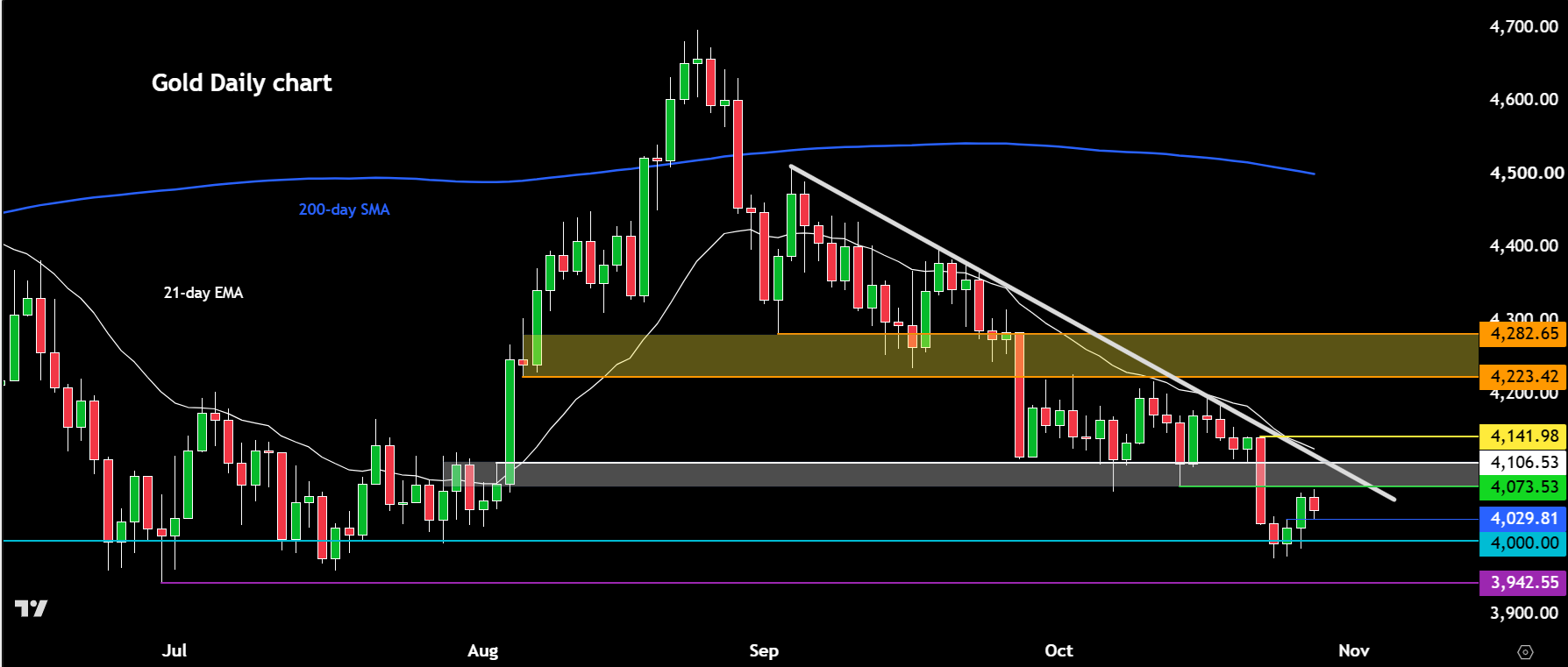
The first important test on any rebound comes in between $4,075 and $4,106 on XAUUSD. Once support and the base of the rally that began in early August, the area could now turn into resistance. A sustained move back above it would therefore be significant, suggesting that sellers are struggling to defend the breakdown and that the sell-off may have run its course. A decisive break above the descending trend line connecting the recent highs, followed by a move through $4,142, the high of the thrust candle that led to the breakdown, would provide a stronger signal that momentum is turning. Until then, I would treat rallies with some caution. Gold may be close to finding a floor, but it still needs to prove it.
Frequently Asked Questions
Why is gold struggling to rally ahead of the Fed?
Higher oil prices risk keeping inflation and bond yields elevated, which raises the opportunity cost of holding gold and has stopped rebounds from developing into sustained rallies.
What are the key levels to watch on gold?
Support is around $4,000, with the summer low around $3,942 the key downside target for the bears. Resistance comes in between $4,075 and $4,106, followed by $4,142.
Has silver found a bottom?
Not yet. I would want to see silver reclaim and hold above the July low at $54.77, then break its short-term bearish trend line, before concluding that a low is in place.
-- Written by Fawad Razaqzada, Market Analyst | Follow Fawad on Twitter @Trader_F_R
Related tags:
Latest market news




The complete CFD trading experience
Award-winning platforms, competitive spreads, low commissions and dedicated support.
We live and breathe the markets and are dedicated to helping traders realise their ambitions as we continue to set the industry bar.
Economic calendar
Web Trader platform
Our sophisticated web-based platform is packed with features.
Related articles
Gold Bounces from $4k – Are Bears Finished?
Gold has so far bounced from the $4k level following last week’s sell-off but whether a low is in-place will highly depend on how the Central Bank meetings remaining on the calendar for the rest of this week roll out.

DAX forecast: AI optimism offers relief ahead of central bank meetings
The DAX is finding some relief from the recent improvement in risk appetite, with investors becoming less concerned about the sustainability of the AI trade

Gold outlook: XAU/USD holds above key support ahead of FOMC
Gold forecast hangs in the balance as the metal is clinging to $4,000 ahead of the Fed, but higher oil prices and firm yields are making it hard for the metal to turn its rebound into a sustained rally. But can that change soon?
StoneX Europe Ltd may make third party material available on this website which may contain information included but not limited to the conditions of financial markets. The material is for information purposes only and does not contain, and should not be construed as containing, investment advice and/or investment recommendation and/or an investment research and/or an offer of or solicitation for any transactions in financial instruments; any decision to enter into a specific transaction shall be made by the client following an assessment by him/her of their situation.
StoneX Europe Ltd makes no representation or warranty and assumes no liability as to the accuracy or completeness of the information provided, nor any loss arising from any investment based on a recommendation, forecast or other information supplied. You should always seek independent advice as to your suitability to speculate in any related markets and your ability to assume the associated risks, if you are at all unsure. We are not under any obligation to update any such material. Any opinion made may be personal to the author and may not reflect the opinion of StoneX Europe Ltd.