




How will German election impact the euro 3 scenarios to watch
In the lead up to the hotly-contested election, we’ll share a series of articles analyzing how major markets may react under different scenarios, starting with today’s look at the euro...
Share this:

As readers may already know, Germans head to the polls on Sunday September 26 to elect a new Bundestag, or federal parliament. In all likelihood, two or three parties will have to form a coalition after the initial results to decide who will succeed Angela Merkel, who is standing down after 16 years as chancellor.
*For more on what’s at stake generally, as well as background on the process and major candidates, see my colleague Rebecca Cattlin’s report “How to trade the German election 2021”*
In the lead up to the hotly-contested election, we’ll share a series of articles analyzing how major markets may react under different scenarios, starting with today’s look at the euro.
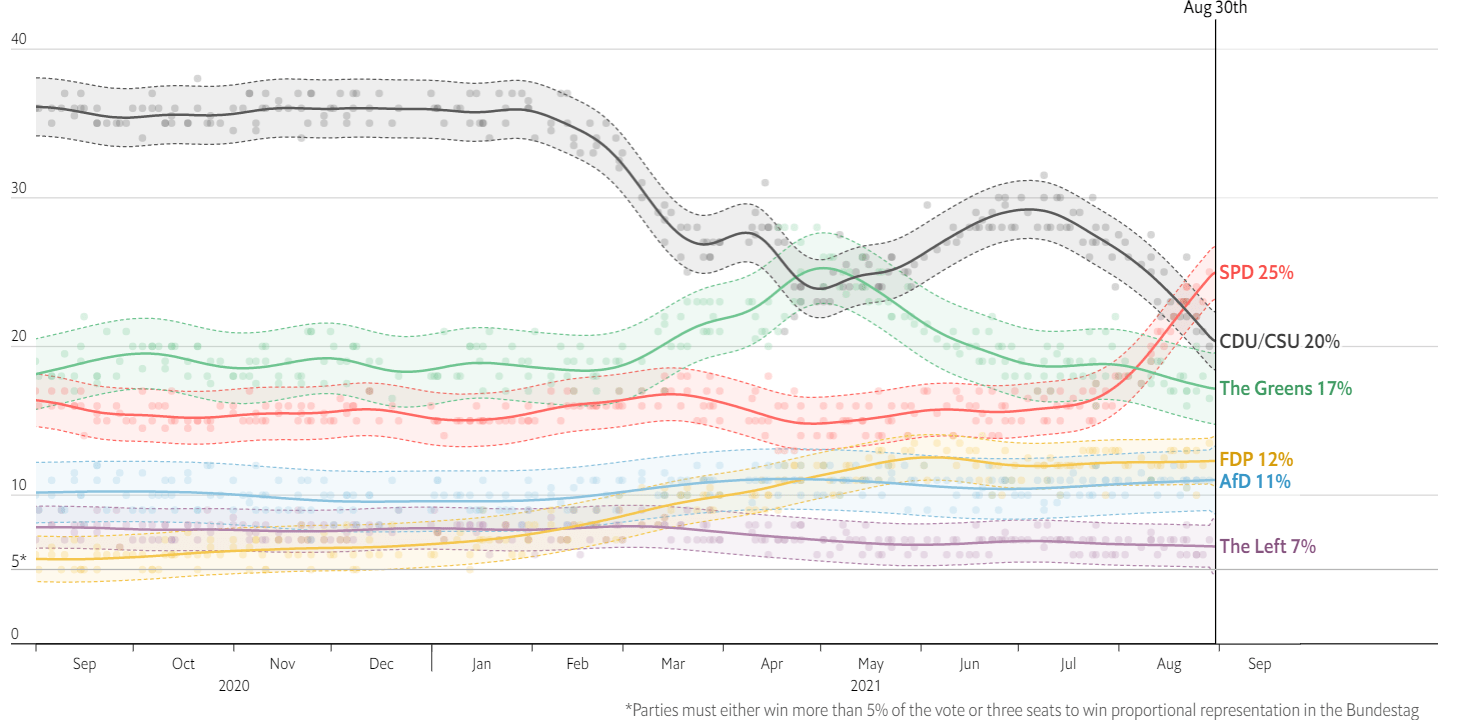
Germany’s economy is the by far the largest in the Eurozone, accounting for nearly 30% of the area’s total GDP, so major political developments in the country are highly relevant to anyone trading the single currency. After more than a decade and a half of rule by Merkel’s conservative Christian Democratic Union / Christian Social Union (CDU/CSU) party, the polls are pointing to a tightly-contested race between the CDU/CSU, the center-left Social Democratic Party (SPD) and the liberal Green party:
Source: The Economist
Below, we explore the possible implications for the euro under coalitions led by each of these three parties, though of course the coalition partner(s) will also have a major impact on policies and the market’s reaction:
1) An SPD-led coalition
With a (marginal) lead in the polls as we go to press, a coalition led by the center-left SPD is among the most likely scenarios. While serving as the junior coalition partner with the CDU/CSU for the past eight years, the SPD was able to enact an increase to the minimum wage and changes to labor laws. Led by Germany’s current finance minister and vice-chancellor Olaf Scholz, an SPD-led coalition may be the most “status quo” scenario for euro traders, despite the change in the leading party.
The SPD may be more likely than the CDU to push for additional fiscal stimulus (though not to an extreme extent), which could provide a short-term boost to Germany’s economy and the euro as the country continues to manage the fallout from the ongoing COVID pandemic.
2) A CDU/CSU-led coalition
Angela Merkel will be a tough act to follow, and that responsibility may well fall on Armin Laschet, the premier of North Rhine-Westphalia, Germany’s most populous state. With the CDU/CSU and SPD seemingly at odds after eight years of a coalition, a CDU/CSU victory later this month would likely result in a new coalition and a conservative shift in policy. If that leads to less fiscal stimulus and/or immigration, it could weigh on the growth prospects for Germany’s economy and provide a potential headwind for the euro.
3) A green-led coalition
It’s said that markets absolutely hate uncertainty, and a victory by the left-leaning Green party, led by Annalena Baerbock, would certainly introduce a heavy dose of uncertainty into Germany’s politics. The party advocates for an ambitious climate-change policy, widespread public investment and deeper European integration, which could certainly provide a near-term economic boost for the country, but if that pushes the European Central Bank to keep its monetary policy easier for longer, the euro may struggle as traders come to terms with a dramatic shift in policy expectations.
While the above outlines three different high-level scenarios to watch, along with the potential implications for euro, there are countless permutations of coalitions that traders will have to sift through in the wake of the election.
Be sure to stay tuned for more our analysis and any relevant updates in the final stretch before, and initial reaction after, this month’s highly-anticipated election results!
How to trade with City Index
You can trade easily trade with City Index by using these four easy steps:
- Open an account, or log in if you’re already a customer
• Open an account in the UK
• Open an account in Australia
• Open an account in Singapore
- Search for the company you want to trade in our award-winning platform
- Choose your position and size, and your stop and limit levels
- Place the trade
As readers may already know, Germans head to the polls on Sunday September 26 to elect a new Bundestag, or federal parliament. In all likelihood, two or three parties will have to form a coalition after the initial results to decide who will succeed Angela Merkel, who is standing down after 16 years as chancellor.
*For more on what’s at stake generally, as well as background on the process and major candidates, see my colleague Rebecca Cattlin’s report “How to trade the German election 2021”*
In the lead up to the hotly-contested election, we’ll share a series of articles analyzing how major markets may react under different scenarios, starting with today’s look at the euro.
Germany’s economy is the by far the largest in the Eurozone, accounting for nearly 30% of the area’s total GDP, so major political developments in the country are highly relevant to anyone trading the single currency. After more than a decade and a half of rule by Merkel’s conservative Christian Democratic Union / Christian Social Union (CDU/CSU) party, the polls are pointing to a tightly-contested race between the CDU/CSU, the center-left Social Democratic Party (SPD) and the liberal Green party:
Source: The Economist
Below, we explore the possible implications for the euro under coalitions led by each of these three parties, though of course the coalition partner(s) will also have a major impact on policies and the market’s reaction:
1) An SPD-led coalition
With a (marginal) lead in the polls as we go to press, a coalition led by the center-left SPD is among the most likely scenarios. While serving as the junior coalition partner with the CDU/CSU for the past eight years, the SPDwas able to enact an increase to the minimum wage and changes to labor laws. Led by Germany’s current finance minister and vice-chancellor Olaf Scholz, an SPD-led coalition may be the most “status quo” scenario for euro traders, despite the change in the leading party.
The SPD may be more likely than the CDU to push for additional fiscal stimulus (though not to an extreme extent), which could provide a short-term boost to Germany’s economy and the euro as the country continues to manage the fallout from the ongoing COVID pandemic.
2) A CDU/CSU-led coalition
Angela Merkel will be a tough act to follow, and that responsibility may well fall on Armin Laschet, the premier of North Rhine-Westphalia, Germany’s most populous state. With the CDU/CSU and SPD seemingly at odds after eight years of a coalition, a CDU/CSU victory later this month would likely result in a new coalition and a conservative shift in policy. If that leads to less fiscal stimulus and/or immigration, it could weigh on the growth prospects for Germany’s economy and provide a potential headwind for the euro.
3) A green-led coalition
It’s said that markets absolutely hate uncertainty, and a victory by the left-leaning Green party, led by Annalena Baerbock, would certainly introduce a heavy dose of uncertainty into Germany’s politics. The party advocates for an ambitious climate-change policy, widespread public investment and deeper European integration, which could certainly provide a near-term economic boost for the country, but if that pushes the European Central Bank to keep its monetary policy easier for longer, the euro may struggle as traders come to terms with a dramatic shift in policy expectations.
While the above outlines three different high-level scenarios to watch, along with the potential implications for euro, there are countless permutations of coalitions that traders will have to sift through in the wake of the election.
Be sure to stay tuned for more our analysis and any relevant updates in the final stretch before, and initial reaction after, this month’s highly-anticipated election results!
How to trade with FOREX.com
Follow these easy steps to start trading with FOREX.com today:
- Open a Forex.com account, or log-in if you’re already a customer.
- Search for the pair you want to trade in our award-winning platform.
- Choose your position and size, and your stop and limit levels.
- Place the trade.
Related tags:
Latest market news




The complete CFD trading experience
Award-winning platforms, competitive spreads, low commissions and dedicated support.
We live and breathe the markets and are dedicated to helping traders realise their ambitions as we continue to set the industry bar.
Economic calendar
Web Trader platform
Our sophisticated web-based platform is packed with features.
Related articles
Swiss Franc Short-term Outlook: USD/CHF Selloff Nears Critical Support Ahead of NFP 11 4 2026
USD/CHF bears are closing in on critical trend support, with the next reaction likely to determine whether the October decline has further to run.

US Midterm Fallout: What Does the “Blue Tsunami” Mean for the S&P 500?
Democrats made sweeping gains in the US midterm elections, winning control of both the House and Senate - what does it mean for the S&P 500 and the AI trade?
USD/CAD Forecast: Canadian Dollar Gains Ground After U.S. Midterm Elections
The trading week continues to unfold and the recovery in the Canadian dollar has once again become a relevant theme in the short term. This can be clearly seen in the recent performance of USD/CAD, which is down nearly 0.4% during the session, reflecting a consistent recovery in the CAD against the U.S. dollar.
StoneX Europe Ltd may make third party material available on this website which may contain information included but not limited to the conditions of financial markets. The material is for information purposes only and does not contain, and should not be construed as containing, investment advice and/or investment recommendation and/or an investment research and/or an offer of or solicitation for any transactions in financial instruments; any decision to enter into a specific transaction shall be made by the client following an assessment by him/her of their situation.
StoneX Europe Ltd makes no representation or warranty and assumes no liability as to the accuracy or completeness of the information provided, nor any loss arising from any investment based on a recommendation, forecast or other information supplied. You should always seek independent advice as to your suitability to speculate in any related markets and your ability to assume the associated risks, if you are at all unsure. We are not under any obligation to update any such material. Any opinion made may be personal to the author and may not reflect the opinion of StoneX Europe Ltd.