






Japanese Yen Payrolls Preview: USD/JPY Primed for Breakout Ahead of Double Data Hit
If you think this week's calm in USD/JPY will last, think again. With the U.S. labour market and inflation in focus, history suggests volatility is just around the corner.
Share this:

USD/JPY Payrolls Primer
USD/JPY has been rangebound this week heading into a period laden with major risk events, as flagged in the week-ahead report released last weekend. Given the historical precedent around this time of the month, the flakey price action seen recently may soon give way to something more meaningful, with U.S. nonfarm payrolls and CPI set to shake things up. These reports could act as catalysts to either reignite the broader bearish trend or trigger a sharp bullish reversal, especially given how pessimistic sentiment towards the U.S. outlook is among investors right now.
Major Volatility Events Near
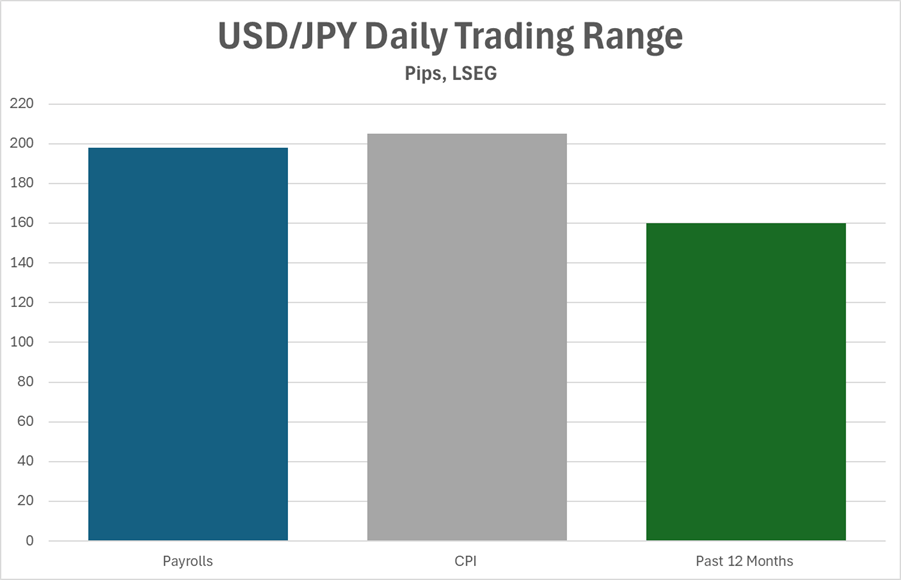
While USD/JPY has been especially volatile over the past year—driven by divergent monetary policy settings, new political leadership in both nations, heightened geopolitical tensions, and another U.S.-initiated trade war—payrolls and CPI reports have consistently packed a punch.
Source: LSEG, David Scutt
Over the past 12 months, USD/JPY’s average daily trading range has been 160 pips, or 1.07% of the prior close. On payrolls days, that climbs to 198 pips (1.32%), and on CPI days it’s even higher at 205 pips (1.35%).
Granted, these are just averages—and a data release alone doesn’t guarantee fireworks. But when a surprise hits, the moves can be big. Of the last 12 payrolls reports, the largest reaction was 2.25%, with the smallest at 0.66%. For CPI, the range was even wider—2.68% at the top and 0.76% at the bottom.
Unemployment Key Figure
Source: TradingView (U.S. EDT Shown)
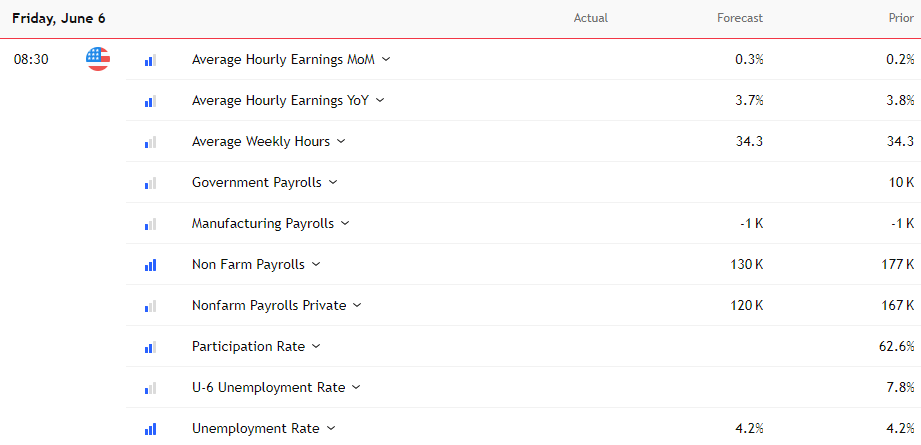
Even if Friday’s payrolls release produces an average-sized move, the modest range we’ve seen this week could easily be broken, depending on the details in both the establishment and household surveys. Initially, markets tend to respond to whether payrolls beat or miss expectations, often brushing aside significant revisions to prior reports. But if the payrolls figure sends a conflicting signal to the unemployment rate, don’t be surprised if the latter drives direction once initial volatility fades. After all, when Fed officials release economic projections, they forecast unemployment, not payrolls. And given the mechanics of the household survey, the labour force participation rate arguably carries just as much weight for the Fed given the implications for unemployment and wage pressures.
USD/JPY Range May Come Under Threat
Source: TradingView
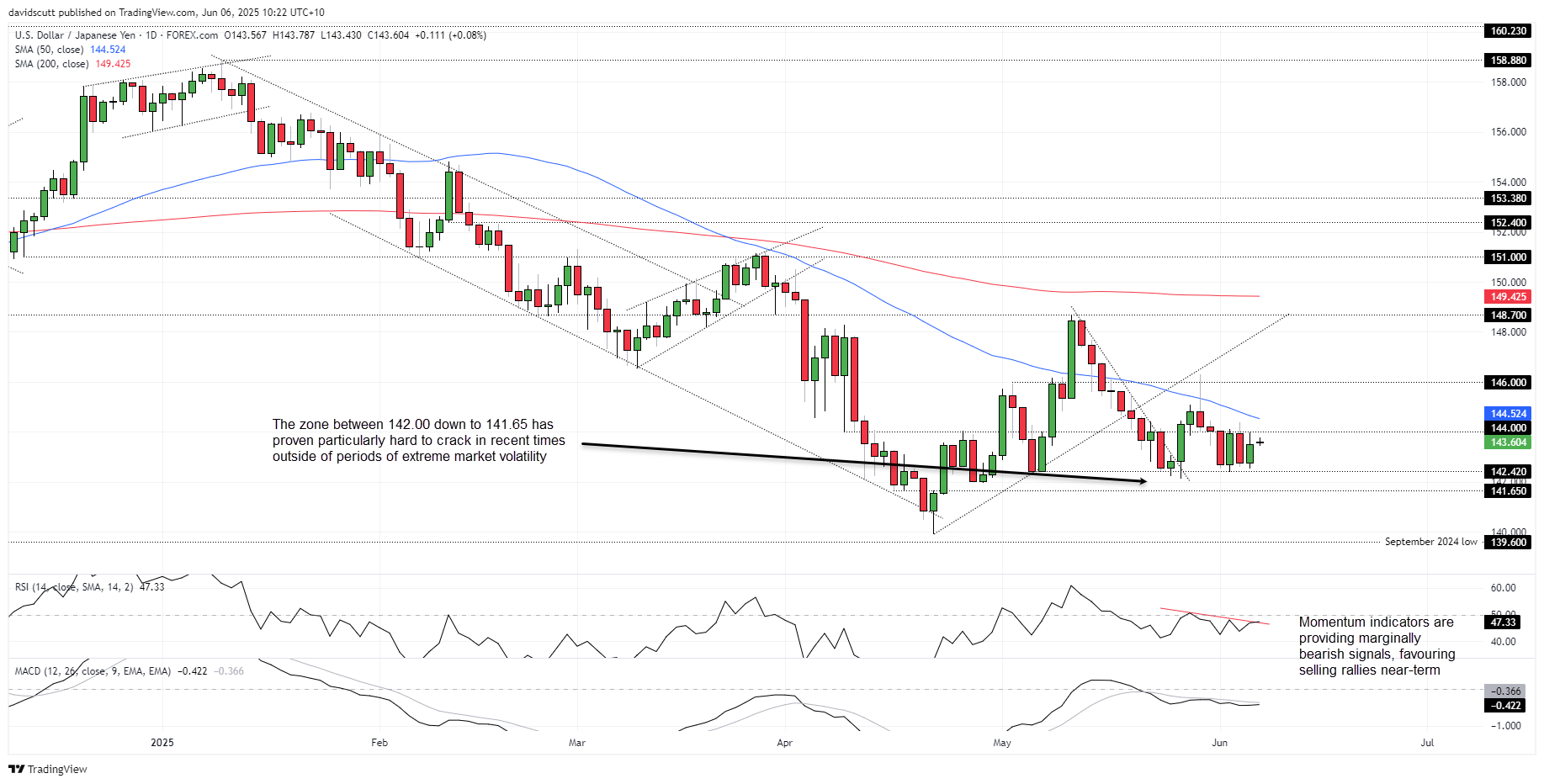
USD/JPY trades in the lower half of its recent range heading into the payrolls report. Each day this week, the price has tested and failed at 144, reinforcing its importance. On the downside, 142.42 was tagged once and bounced, adding to five prior failed attempts to close below the level since early May. That gives traders a well-defined range to work with ahead of the release.
With RSI (14) sitting marginally below 50 and trending lower, and MACD beneath the signal line in negative territory, momentum tilts to the downside—suggesting selling rallies may offer better risk-reward than buying dips in the current environment.
Beneath 142.42, the May 27 low of 142.12 is the next level of interest. A break there could put sub-142 levels back in play. While minor support is located at 141.65, recent dips below 142 have tended to reverse quickly—outside of periods of extreme market stress. That makes price action below 142 especially important, if it trades there. A clean break of 141.65 would increase the likelihood of a retest of the April swing low at 139.88.
Above 144, Wednesday’s high of 144.40 is the next level to watch. A break above could trigger a squeeze toward the 50-day moving average or resistance at 146, depending on the payrolls details and how risk assets respond.
Lately, stronger economic data has been met with a positive response across risk assets, even as it reduces the likelihood of near-term Fed cuts—suggesting that for now, good news is still good news.
-- Written by David Scutt
Follow David on Twitter @scutty
How to trade with City Index
You can trade with City Index by following these four easy steps:
- Open an account, or log in if you’re already a customer
• Open an account in the UK
• Open an account in Australia
• Open an account in Singapore
- Search for the market you want to trade in our award-winning platform
- Choose your position and size, and your stop and limit levels
- Place the trade
Related tags:
Latest market news




The complete CFD trading experience
Award-winning platforms, competitive spreads, low commissions and dedicated support.
We live and breathe the markets and are dedicated to helping traders realise their ambitions as we continue to set the industry bar.
Economic calendar
Web Trader platform
Our sophisticated web-based platform is packed with features.
Related articles
Canadian Dollar Short-term Outlook: USD/CAD Plunge Stalls at Pivotal Support—Range Break in Focus 11 5 2026
Friday’s U.S. and Canadian employment reports could trigger a decisive USD/CAD move as bulls and bears battle for control at critical support.

GBP/USD Forecast: BoE Caution Leaves the Pound Searching for Direction
Although GBP/USD has gained close to 0.5% over the last three trading sessions, reflecting a period of relative strength for the British pound, today's session has started to show a more neutral tone and the bullish momentum seen earlier in the week has begun to slow.

NFP Preview: New Government, Same Jobs Market?
Traders are still sifting through the fallout of the US midterm elections, just in time to get hit with another volatility: The monthly Non-Farm Payrolls (NFP) report - what will the jobs report show, and what could it mean for the US dollar?

StoneX Europe Ltd may make third party material available on this website which may contain information included but not limited to the conditions of financial markets. The material is for information purposes only and does not contain, and should not be construed as containing, investment advice and/or investment recommendation and/or an investment research and/or an offer of or solicitation for any transactions in financial instruments; any decision to enter into a specific transaction shall be made by the client following an assessment by him/her of their situation.
StoneX Europe Ltd makes no representation or warranty and assumes no liability as to the accuracy or completeness of the information provided, nor any loss arising from any investment based on a recommendation, forecast or other information supplied. You should always seek independent advice as to your suitability to speculate in any related markets and your ability to assume the associated risks, if you are at all unsure. We are not under any obligation to update any such material. Any opinion made may be personal to the author and may not reflect the opinion of StoneX Europe Ltd.