



US dollar price action setups: EUR/USD, USD/JPY expose asymmetry as Hormuz deadline looms
Another TACO may be the base case, but with both the euro and yen under pressure, the downside risks look far larger if that view is wrong.
Share this:

- Markets leaning towards another TACO into Trump deadline
- EUR/USD, USD/JPY under pressure despite hikes priced
- Left tail risk large if escalation delivered
Summary
Markets are leaning heavily towards another TACO, and EUR/USD and USD/JPY sit at the centre of that view. Both the euro and yen are weakening despite multiple hikes being priced for the ECB and BOJ, reflecting their exposure to energy supply risks. If that’s tested again, both pairs look vulnerable to further downside, while another TACO would see that pressure unwind quickly.
TACO pricing vs left tail risk
The 8pm US EDT deadline for Iran to reopen the Strait of Hormuz is today’s defining risk event, yet markets are clearly priced for another TACO, an acronym for “Trump Always Chickens Out”, reflecting the pattern where aggressive rhetoric and hard deadlines give way to last-minute de-escalation.
That pricing isn’t coming from what Trump has said, it’s coming from what he’s done. Traders have been conditioned to expect de-escalation when rhetoric is at its most aggressive, with real escalation tending to arrive when there have been signs of apparent conciliatory efforts between the two sides, not outright ultimatums like this. That’s why, despite Trump warning Iran could be “taken out”, labelling Tuesday “Power Plant Day, and Bridge Day”, and threatening that “every power plant in Iran will be out of business, burning, exploding, and never to be used again” and “every bridge in Iran will be decimated”, risk isn’t getting walloped.
Instead, the base case is familiar. Another TACO, either via an apparent deal announced on Truth Social, with Iran often disputing the veracity of such announcements, or a further extension to negotiations, with timing risk skewed towards the Tokyo open where similar announcements have landed in recent weeks.
That leaves a binary outcome day with risks heavily skewed to the left tail. Another TACO is clearly the higher probability outcome, and if delivered, risk should rally, volatility should compress, and currencies hit by energy insecurity find relief, while the USD likely wilts as those supports unwind.
“Power Plant Day” sits at the other end, low probability but high impact. If it’s delivered, it’s all bets off. Risk assets get hammered, realised and implied volatility spike, the USD almost certainly surges, and energy prices rip higher as markets price in a meaningful increase in the probability of lasting supply disruption from the Gulf.
That’s the immediate event risk, but the inflation impulse is already building regardless of how this resolves.
Central banks boxed in
The US ISM services prices paid gauge jumped to 70.7 in March, the highest since October 2022 and the largest increase in over a decade, signalling energy is already feeding through into broader services inflation.
Source: TradingView
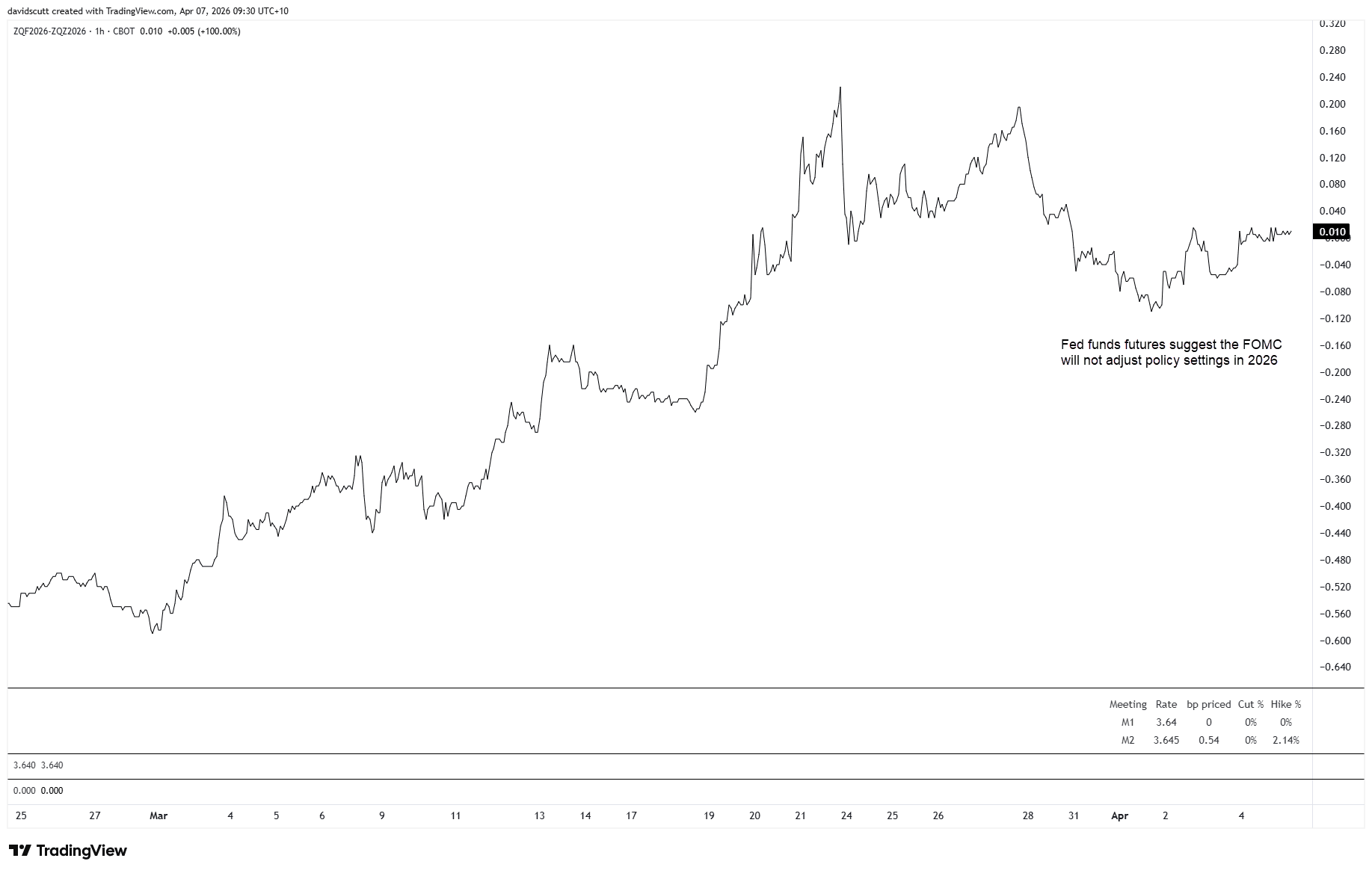
That’s the bind for central banks. Growth risks are rising, but inflation is reaccelerating, limiting their ability to respond with easier policy, helping explain why Fed funds futures price almost no chance of a move from the Fed through the remainder of 2026, while other developed market central banks are increasingly being priced to deliver hikes, not cuts.
And it’s showing up clearly in FX. Markets are pricing multiple hikes from both the ECB and BOJ this year, but it’s doing little to support either currency, with the euro and yen both under pressure as energy importers in this environment.
EUR/USD sell-on-rallies bias intact
Source: TradingView
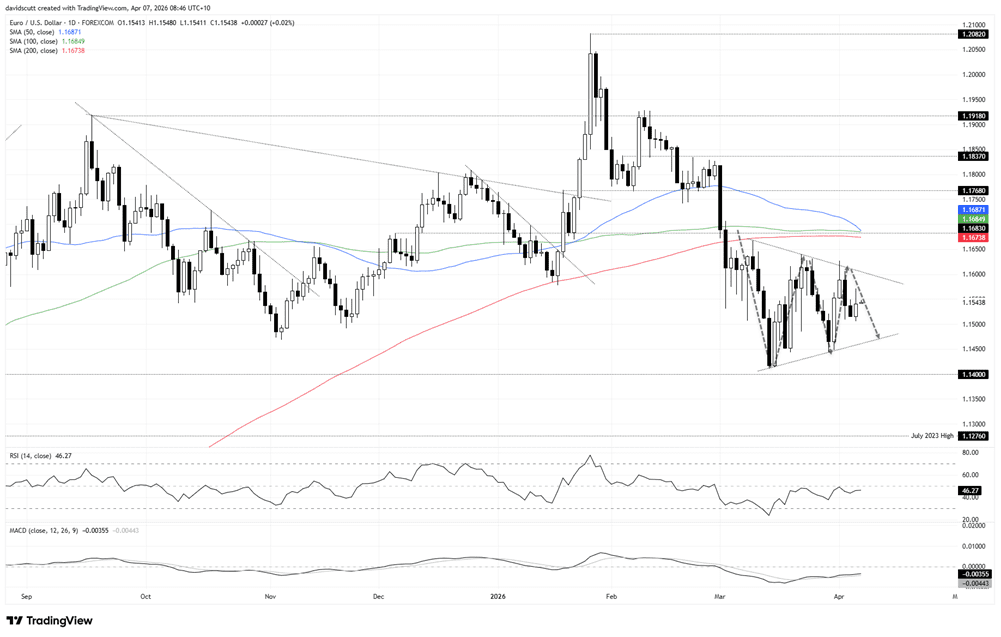
EUR/USD remains a sell-on-rallies play, having broken beneath each of the key medium and longer-term moving averages, setting a sequence of lower highs since peaking in late January. While RSI (14) and MACD point to diminishing downside pressure, the former remains sub-50 and the latter in negative territory despite crossing the signal line from below, keeping the broader bias intact but warning against chasing weakness.
More recently, the price has been coiling within a compression structure over the past month. Having entered from above, a downside break is favoured from a technical perspective, although the geopolitical situation in the Gulf will likely be the ultimate determinant.
Over the past two sessions, the price has run into sellers above 1.1550, making that the initial reference point overhead on Tuesday. Bids have been parked ahead of 1.1500, creating a tighter range within the broader compression structure.
If we see another TACO, offers above 1.1550 risk being overrun, opening a move towards downtrend resistance near 1.1600. A clean topside break of the structure would then run into a major hurdle, with the 200, 100 and 50DMAs clustered either side of 1.1683, a level that has acted as both support and resistance earlier this year.
If we instead get “Power Plant Day”, bids around 1.1500 would likely be cannon fodder, leaving uptrend support near 1.1470 vulnerable. A break there would expose 1.1450, 1.1410 and 1.1400 as the next downside levels to watch.
USD/JPY: 160 caps for now
Source: TradingView
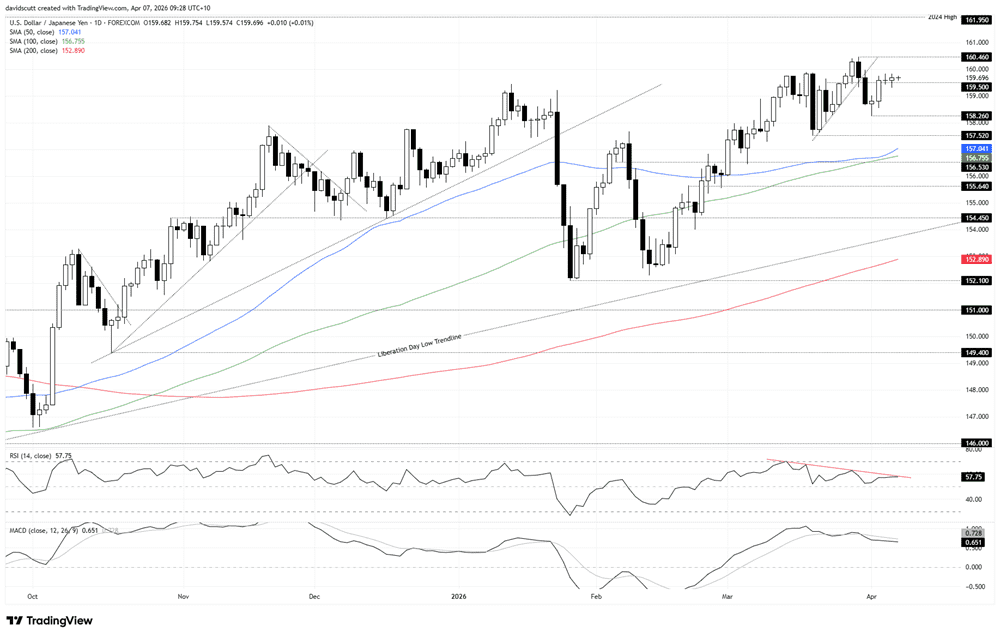
USD/JPY rallies continue to stall beneath 160, with the level acting as a soft cap given the risk of jawboning and/or outright intervention from the BOJ on behalf of the government. Intervention in this environment would likely prove ineffective beyond the very short term without a fundamental catalyst for USD weakness, but the threat alone has been enough to deter a clean bullish break, especially with TACO moments arriving thick and fast.
If we get another one on Tuesday, bids beneath 159.50 risk being overrun, putting 158.26 on the radar, the low from April 1. Below that, 157.52, the 50 and 100DMAs, and 156.53 are the downside levels to watch.
On the topside, the March 30 high at 160.46 is the immediate reference above 160. A clean break there would leave the price on a collision course for a retest of the 2024 high at 161.95. In an environment of actual escalation in the Middle East, the price may test that level even with intervention risk looming.
The signal from momentum is fading rather than reversing. RSI (14) and MACD are no longer pushing higher, aligning with the hesitation in the price around 160, but not yet pointing to a meaningful shift in direction, leaving the broader buy-on-dips structure intact for now.


The complete CFD trading experience
Award-winning platforms, competitive spreads, low commissions and dedicated support.
We live and breathe the markets and are dedicated to helping traders realise their ambitions as we continue to set the industry bar.
Economic calendar
Web Trader platform
Our sophisticated web-based platform is packed with features.
Related articles

USD/JPY weekly outlook: Quarter turn scrambles rates regime
USD/JPY’s tight relationship with front-end US rates broke down sharply last week, but quarter-turn flows and positioning suggest the disconnect may prove temporary.

USD/CAD forecast: rally could accelerate above June highs at 1.4250
USD/CAD recovered quickly after weaker US jobs data, keeping the bullish trend in focus. A move above the June highs could accelerate the rally as inflation keeps the Fed under pressure.


USD Sets Fresh Yearly High as EUR/USD Drops Dramatically, USD/JPY Stable
Well, it was a week of USD strength that wasn’t entirely pushed by USD/JPY, as a strong sell-off in EUR/USD has pushed the major pair to its most oversold state in a decade.
StoneX Europe Ltd may make third party material available on this website which may contain information included but not limited to the conditions of financial markets. The material is for information purposes only and does not contain, and should not be construed as containing, investment advice and/or investment recommendation and/or an investment research and/or an offer of or solicitation for any transactions in financial instruments; any decision to enter into a specific transaction shall be made by the client following an assessment by him/her of their situation.
StoneX Europe Ltd makes no representation or warranty and assumes no liability as to the accuracy or completeness of the information provided, nor any loss arising from any investment based on a recommendation, forecast or other information supplied. You should always seek independent advice as to your suitability to speculate in any related markets and your ability to assume the associated risks, if you are at all unsure. We are not under any obligation to update any such material. Any opinion made may be personal to the author and may not reflect the opinion of StoneX Europe Ltd.