


USD/JPY forecast becoming negative as US-Japan yield differentials narrow
Today’s US data releases were mixed but with the focus being on employment, it was the weakest ADP private payrolls report since 2023 that caused the most damage as the US dollar, already lower on the session, continued to slide late in the day in Europe.
Share this:

Today’s US data releases were mixed but with the focus being on employment, it was the weakest ADP private payrolls report since 2023 that caused the most damage as the US dollar, already lower on the session, continued to slide late in the day in Europe. The dollar’s latest retreat has dragged USD/JPY lower once more, undoing all of yesterday’s mild recovery. With broader FX markets showing renewed appetite for alternatives to the greenback, the pair is back under pressure – and the story now feels increasingly driven by shifting rate expectations. The USD/JPY forecast could turn more decisively bearish if 155.00 support gives way as Japanese yields continue to press higher.
Japanese bond markets – canary in coal mine
With the greenback increasingly constrained by rate-cut expectations from the Fed next week, and the yen buoyed by a hike from the Bank of Japan a week later, the bias for the pair stays skewed to the downside. This is also reflecting tightening of the yield differential between Japan and the US, in the favour of the former:
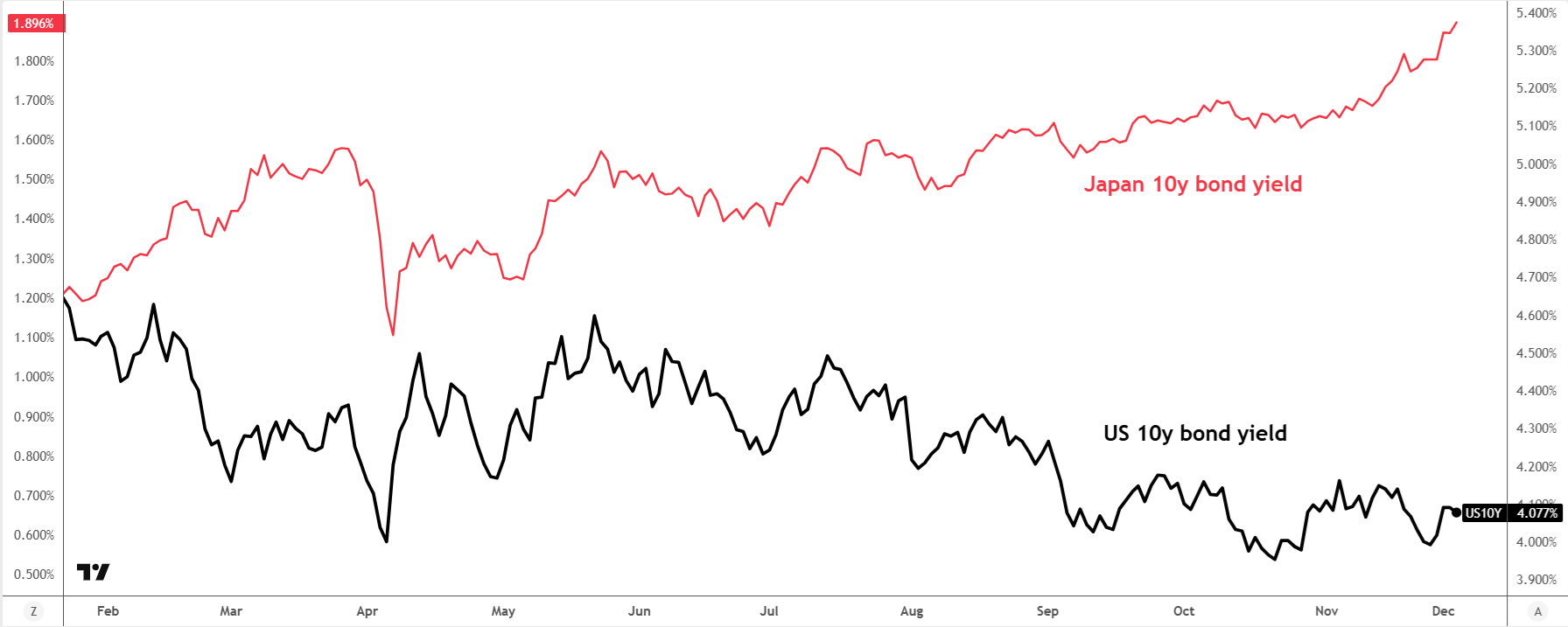
Yesterday’s calm in Japanese markets came after strong demand at a 10-year JGB auction helped steady nerves following Governor Ueda’s unexpectedly hawkish remarks the day before. Those comments had sparked a global wobble, reigniting fears of a yen-funded carry trade unwind and pushing JGB yields sharply higher. The auction provided temporary relief, sending USD/JPY upward with it. But today, bond prices have fallen back in Japan, and this is keeping downward pressure on the USD/JPY, and to a lesser degree the stock markets.
So, today the tone has shifted again. As the dollar resumed its decline, some yen pairs have weakened. The underlying story hasn’t changed: markets still expect a hike from the BoJ at its 19 December meeting. Elevated JGB yields could reassert yen strength more meaningfully, especially if the next wave of US data leans dovish or if equity markets turn choppy.
A softer dollar sets the tone
The pullback in the US dollar today has played a central role in weakening USD/JPY. To some degree, the move wasn’t driven by anything yen-specific; rather, it was a broad dollar decline that buoyed EUR/USD, GBP/USD and most major pairs. The euro, in particular, found support not only from the softer dollar but also from better-than-expected European services PMIs and a slightly more constructive tone surrounding US–Russia negotiations on Ukraine. It all contributed to a more upbeat European session – and by extension, fresh downward pressure on the dollar.
So, the backdrop remains dollar-negative. Following Monday’s softer ISM manufacturing reading, we had a negative ADP print today of -32K vs +5K expected. This was the worst reading since 2023. While the ISM services PMI was a bit better than expected, this failed to lift the dollar. This week’s data is largely confirming what traders already suspected: US data is cooling at the margin, and nothing this week is likely to change the market’s conviction that the Fed is heading towards a December cut.
Even if ADP had popped higher, or even if jobless claims come in higher tomorrow, the timing works against the dollar. None of these releases are likely to influence next week’s Fed meeting, so rate-cut expectations are essentially insulated from surprise. This keeps the greenback vulnerable to further downside – particularly against lower-yielders like the yen, where the bond markets are pointing to strength for the currency.
But then when you look at the rising Japanese bond yields, you can understand where the additional pressure on the USD/JPY is coming from.
Technical USD/JPY forecast: still watching 155.00
The USD/JPY briefly slipped below 155.00 earlier this week before rebounding and yesterday reached 156.00, where it then resumed its slide. With the dollar under pressure again today, the pair was once more drifting towards that key support at the time of writing.
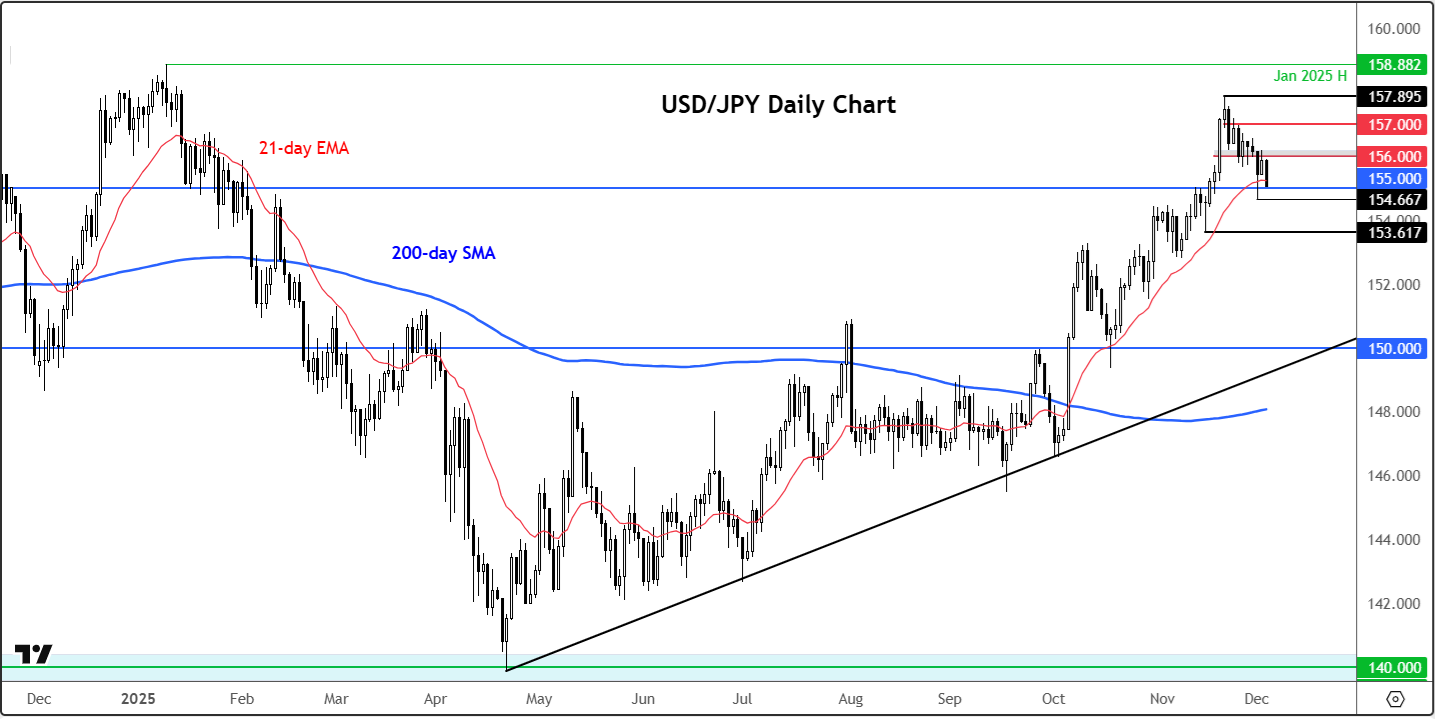
Should the 155.00 support give way decisively, then round numbers such as 154.00 and 153.00 come into view next on the USD/JPY chart.
Meanwhile, initial resistance is now seen around 155.40/50 area ahead of that key 156.00 barrier. Above the latter, things will look bullish again, in which case 156.50 and 157.00 could be the next bullish targets.
Key takeaway
So, the key takeaway point is that the USD/JPY feels increasingly vulnerable amid the moves in the bond markets. The dollar’s renewed decline, softer US data, and lingering risks around JGB volatility all point to a market that is struggling to find a reason to keep the pair above 155.00 support. Unless the Fed surprises or Ueda significantly softens his tone, the bias for the USD/JPY forecast remains for further downside in the days ahead.
Source for all charts used in this article: TradingView.com

-- Written by Fawad Razaqzada, Market Analyst
Follow Fawad on Twitter @Trader_F_R
Related tags:
Latest market news




The complete CFD trading experience
Award-winning platforms, competitive spreads, low commissions and dedicated support.
We live and breathe the markets and are dedicated to helping traders realise their ambitions as we continue to set the industry bar.
Economic calendar
Web Trader platform
Our sophisticated web-based platform is packed with features.
Related articles
Gold Q4 2026 outlook: Resilience in the face of rallying dollar and yields
As we headed towards the latter stages of Q3 and into Q4, the Fed had just hiked rates in a hawkish FOMC meeting, while the likes of the ECB and BoJ had also tightened their respective policies. Oil prices remained elevated amid the prolonged US-Iran conflict. Meanwhile, bond yields were breaking out, and the dollar was higher across the board. Yet, remarkably, gold was still holding in the positive territory for the third quarter, even if it had weakened somewhat in September.
EUR/USD Q4 2026 Outlook: Euro at a Crossroads as Fed, ECB Tighten 9 25 2026
EUR/USD enters Q4 at a pivotal inflection point as competing Fed-ECB policy paths and persistent inflation risks collide with major technical support.

USD/JPY Q4 2026 Outlook: Hawkish Fed Pricing Clashes With Intervention Risk
The year-end tug-of-war is clear: hawkish Fed pricing supports USD/JPY, while intervention risk limits the upside.

StoneX Europe Ltd may make third party material available on this website which may contain information included but not limited to the conditions of financial markets. The material is for information purposes only and does not contain, and should not be construed as containing, investment advice and/or investment recommendation and/or an investment research and/or an offer of or solicitation for any transactions in financial instruments; any decision to enter into a specific transaction shall be made by the client following an assessment by him/her of their situation.
StoneX Europe Ltd makes no representation or warranty and assumes no liability as to the accuracy or completeness of the information provided, nor any loss arising from any investment based on a recommendation, forecast or other information supplied. You should always seek independent advice as to your suitability to speculate in any related markets and your ability to assume the associated risks, if you are at all unsure. We are not under any obligation to update any such material. Any opinion made may be personal to the author and may not reflect the opinion of StoneX Europe Ltd.