



USD/JPY Forecast: Currency Pair of the Week | December 1, 2025
The yen has staged an assertive bid at the start of this week, fuelled by further gains in Japanese bond yields amid a hawkish repricing of interest rates in Japan. Among the yen pairs, the USD/JPY was down over 100 pips by the late afternoon London trade, with the pair also weighed down by the general softness observed in US dollar.
Share this:

Yen rallies as Japanese yields surge
The yen has staged an assertive bid at the start of this week, fuelled by further gains in Japanese bond yields amid a hawkish repricing of interest rates in Japan. Among the yen pairs, the USD/JPY was down over 100 pips by the late afternoon London trade, with the pair also weighed down by the general softness observed in US dollar. The mood was quite bearish in the crypto space with stocks also under pressure, amid concerns that the long-running yen-funded carry trade was being unwound. The USD/JPY forecast now looks to be tilted towards the downside as the market finally wakes up to the idea that the era of the one-way yen carry may be running out of steam.
BoJ December hike appears more likely now
Giving the bond markets a jolt was Bank of Japan Governor Kazuo Ueda, who delivered unexpectedly hawkish remarks, sending market pricing for a December hike from less than 15 basis points to 21 bp in a matter of hours. Investors were caught leaning the wrong way, assuming new Prime Minister Sanae Takaichi would act as the palace guard for dovish policy. Ueda decisively dispelled that idea, signalling no meaningful political resistance to higher rates and warning that delaying tightening could risk an uncomfortable spike in inflation. As the new filtered through, the Japanese bond market sell-off gathered pace, and that helped to lift both the yen and concerns about the unwinding of the carry trade.
Markets hits by unwind the carry trade fears
With Japanese Government Bond (JGB) yields lurching higher in recent days, this has effectively been pressing the brakes on cheap-yen funding many traders have used to leverage their positions. In other words, we are seeing a bit of a reverse-carry reaction which has rippled across risk assets today, pressuring speculative corners of the market as global investors unwind leveraged bets previously buoyed by rock-bottom Japanese yields.
Ueda laid out the BOJ’s framework with plain intent, stressing that upcoming wage data will be pivotal for December’s policy decision. He argued that a combination of proactive fiscal measures from Tokyo and a recalibration of monetary support from the BOJ should help steer Japan towards sustainable growth. This is a clear pushback against the narrative that Japan would remain parked indefinitely at zero rates.
The market’s response has been notable: USD/JPY traded roughly 0.7% lower as the Nikkei futures and JGBs broke down. But it is clear that the pair remains structurally overvalued at these levels. If the reverse-carry trade truly reawakens amid conviction that the BOJ could actually be taken seriously this time, then we could see the USD/JPY tumble back towards the low 150s again in short order.
What about the US dollar?
The Fed’s two most decisive data inputs — CPI and non-farm payrolls — won’t arrive until after the December rate decision next week. That drastically dilutes this week’s ability to spring any material surprises in as far as rate cut expectations are concerned.
ISM Manufacturing PMI remains in contraction as we just found out today with a print of 48.2, down from 49.0 the month before. On Wednesday, analysts anticipate flat ADP payrolls growth with risks tilting negative. Thursday’s Challenger job cuts could reintroduce softer employment signals, while Friday’s core PCE inflation is expected around 0.2% month-on-month — mild enough to keep rate-cut conversations alive without much fuss.
Meanwhile, a new Fed Chair appointment could land in the coming days, with market chatter pointing toward Kevin Hassett, whose dovish inclinations may add an additional layer of pressure on the greenback if confirmed.
Where does this all the USD/JPY forecast?
What matters moving forward the most is the evolving rate differential, and risk appetite, more than anything else. Japan is inching towards tightening, while the US remains anchored to easing expectations. This dynamic normally points towards a downward force on the USD/JPY forecast.
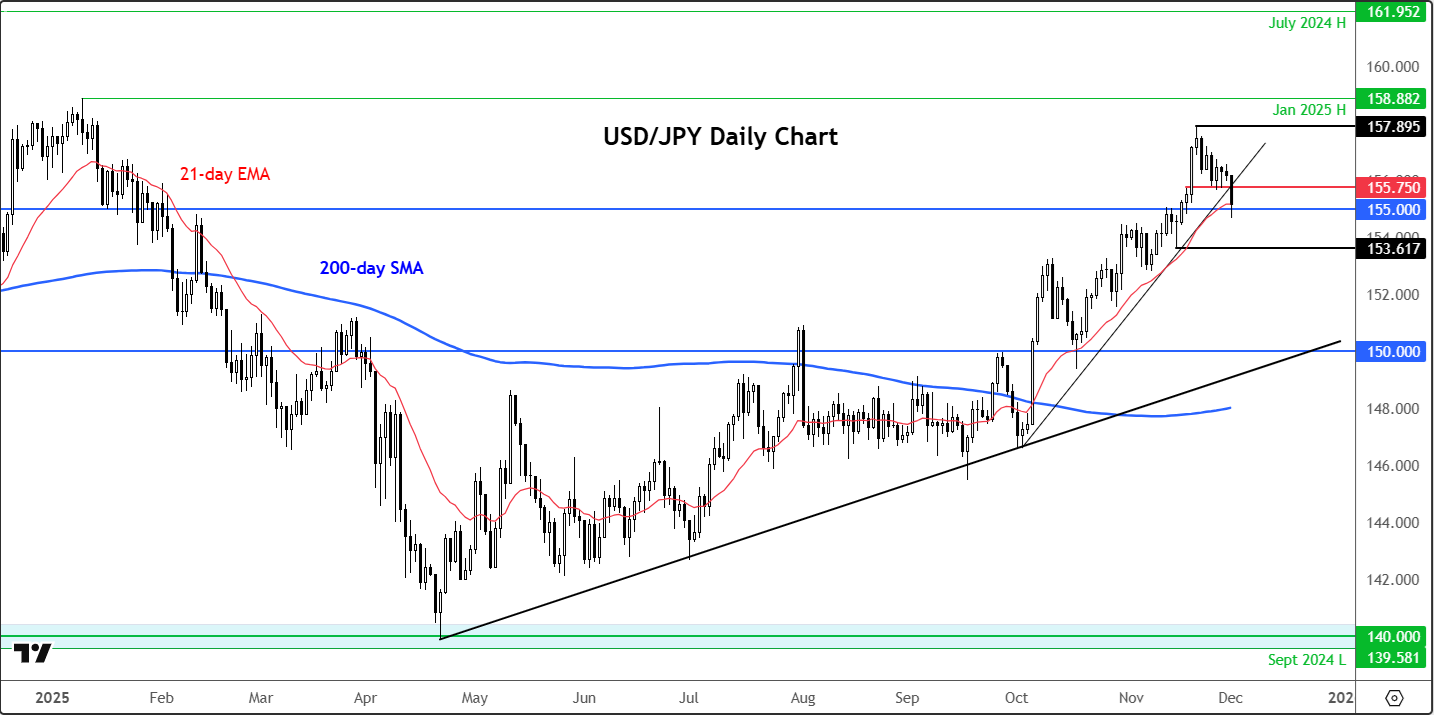
If the USD/JPY chart holds below the now broken 155.75 level, this should keep the bears in charge of price action in the short-term. And in the coming days if the pair closes decisively below 155.00 then this should further fuel the selling pressure, as this will effectively confirm the break of the trend line. However, if 155.75 level is reclaimed, then the bearish idea would become less compelling.

-- Written by Fawad Razaqzada, Market Analyst
Follow Fawad on Twitter @Trader_F_R

The complete CFD trading experience
Award-winning platforms, competitive spreads, low commissions and dedicated support.
We live and breathe the markets and are dedicated to helping traders realise their ambitions as we continue to set the industry bar.
Economic calendar
Web Trader platform
Our sophisticated web-based platform is packed with features.
Related articles

USD/JPY weekly outlook: Quarter turn scrambles rates regime
USD/JPY’s tight relationship with front-end US rates broke down sharply last week, but quarter-turn flows and positioning suggest the disconnect may prove temporary.


USD/CAD forecast: rally could accelerate above June highs at 1.4250
USD/CAD recovered quickly after weaker US jobs data, keeping the bullish trend in focus. A move above the June highs could accelerate the rally as inflation keeps the Fed under pressure.

USD Sets Fresh Yearly High as EUR/USD Drops Dramatically, USD/JPY Stable
Well, it was a week of USD strength that wasn’t entirely pushed by USD/JPY, as a strong sell-off in EUR/USD has pushed the major pair to its most oversold state in a decade.

StoneX Europe Ltd may make third party material available on this website which may contain information included but not limited to the conditions of financial markets. The material is for information purposes only and does not contain, and should not be construed as containing, investment advice and/or investment recommendation and/or an investment research and/or an offer of or solicitation for any transactions in financial instruments; any decision to enter into a specific transaction shall be made by the client following an assessment by him/her of their situation.
StoneX Europe Ltd makes no representation or warranty and assumes no liability as to the accuracy or completeness of the information provided, nor any loss arising from any investment based on a recommendation, forecast or other information supplied. You should always seek independent advice as to your suitability to speculate in any related markets and your ability to assume the associated risks, if you are at all unsure. We are not under any obligation to update any such material. Any opinion made may be personal to the author and may not reflect the opinion of StoneX Europe Ltd.