



USD/JPY Q4 Outlook: Risks tilted higher as fundamentals battle BOJ intervention threat
USD/JPY likely to continue grinding higher as bulls navigate the evolving threat posed by potential Bank of Japan intervention.
Share this:

USDJPY has morphed into a play on yield differentials between the United States and Japan rather than the risk appetite barometer it once was, meaning forecasts involving the pair are really a reflection of what’s likely to happen with interest rates. As such, whether the Federal Reserve continues running monetary policy at restrictive levels, or if the Bank of Japan (BOJ) manages to unwind its array of easing measures, will likely play a significant role in determining how USD/JPY closes out 2023.
This report will look at the likelihood of those scenarios, along with the threat posed by potential intervention from the BOJ to support the Japanese yen against the greenback.
Will the Fed remain hawkish?
Yes, even it doesn’t intend to lift the funds rate again. The Fed has made it clear it intends to hold policy restrictive until confident inflation will return to 2%, signaling the likelihood of one more rate hike this year and just two rate cuts in 2024 based on the median member forecast offered in September.
If economic data points to the need for policy to remain restrictive, markets may do much of the Fed’s work for them, tightening financial conditions for the real economy by increasing bond yields, increasing borrowing spreads for corporates and households, a stronger US dollar and greater volatility in asset prices. The longer this persists, the lesser the risk the Fed will need to hike again.
Looking specifically at US bond yields, the only way we’re likely to see a meaningful pullback over the next few months will be if a major risk-off event for markets occurs or the US inflation outlook rapidly changes. Both appear unlikely in the short-to-medium term. That’s important when it comes to the US side of the US-Japan yield differential equation.
Can the BOJ abandon negative interest rate policy (NIRP)?
Extremely unlikely before the end of the year. The odds don’t improve significantly over a longer-term time horizon, either. Right now, the BOJ can’t abandon ultra-easy monetary policy settings because the ‘virtuous cycle’ between wage growth and inflation is not yet self-sustaining. Yes, Japan has inflation but it’s battling sluggish economic growth, terrible demographics and a deflationary mindset entrenched across its population, making a sustainable pickup in wages next year anything but certain.
Until that becomes a far more plausible scenario, the BOJ is unlikely to significantly alter yield curve control – the policy of suppressing bond yields lower than where market forces would normally dictate – nor lift its key overnight policy rate from -0.1%.
The problem facing the BOJ is that time is not its side. It will likely be well into next year before it can unwind ultra-easy policy settings, if it gets there at all. The odds are remote at best. At a time when other developed central banks are expected to begin easing, policy normalisation from the BOJ would likely result in a rapid strengthening in the yen, amplifying deflationary forces through cheaper imports while simultaneously making its export sector less competitive, risking slower economic growth. Good luck trying to foster inflation in that type of environment.
Put simply, until BOJ can normalise policy, Japanese yields are unlikely to lift much beyond current levels, acting to keep the spread with US bonds at elevated levels.
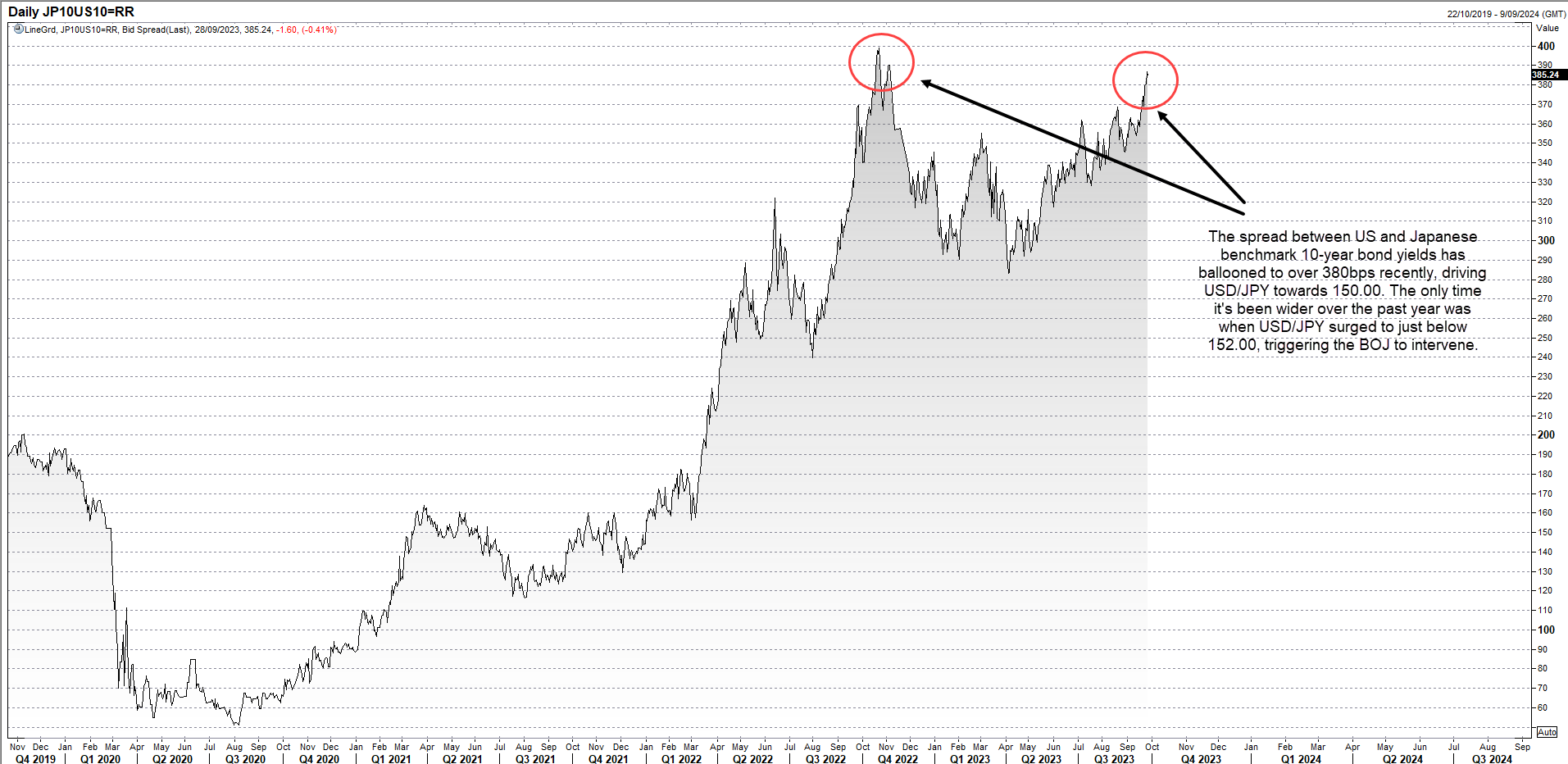
Source: Refinitiv
Evaluating the BOJ intervention threat
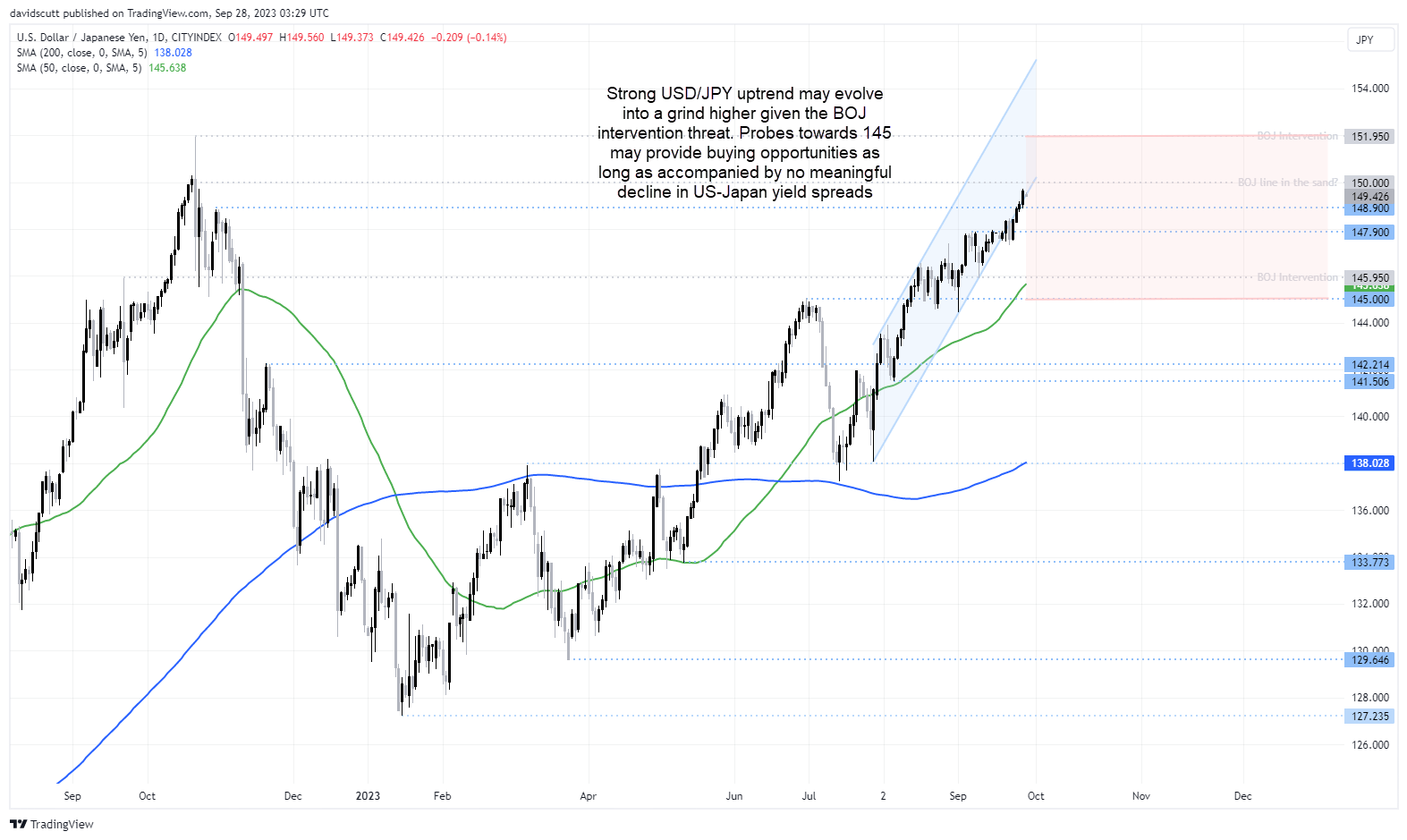
If the BOJ acts on behalf of the government to boost the value of the yen by intervening in the currency market, it will be near-useless beyond the immediate impact if not accompanied by a narrowing in yield differentials. Regardless of how Japanese policymakers frame persistent weakness in the yen, it’s being driven by fundamental factors of their own doing. If the BOJ were to intervene without a compression in yield differentials, it would likely result in markets attempting to reverse the move once the apparent threat of further intervention has subsided.
USD/JPY outlook
With yield differentials between Japan and US likely to remain steady to higher given the prevailing monetary policy divergence between the BoJ and Fed, the directional risks for USD/JPY are moderately higher. However, the threat of BOJ intervention must be considered given the similarities in conditions to when it intervened in 2022. Put together, range trade between 145.00 to 152.00 looks probable over a three-month time horizon with directional risks outside this range biased higher.
-- Written by David Scutt
Follow David on Twitter @scutty
How to trade with City Index
You can trade with City Index by following these four easy steps:
- Open an account, or log in if you’re already a customer
• Open an account in the UK
• Open an account in Australia
• Open an account in Singapore
- Search for the market you want to trade in our award-winning platform
- Choose your position and size, and your stop and limit levels
- Place the trade
Latest market news



The complete CFD trading experience
Award-winning platforms, competitive spreads, low commissions and dedicated support.
We live and breathe the markets and are dedicated to helping traders realise their ambitions as we continue to set the industry bar.
Economic calendar
Web Trader platform
Our sophisticated web-based platform is packed with features.
Related articles

USD/JPY Q4 2026 Outlook: Hawkish Fed Pricing Clashes With Intervention Risk
The year-end tug-of-war is clear: hawkish Fed pricing supports USD/JPY, while intervention risk limits the upside.

USD/CAD and USD/MXN Q4 2026 Outlook: Will the U.S. Dollar Dominate North America Again?
The final stretch of 2026 is approaching, and North America's major currencies have begun to show a shift in the strength dynamics seen earlier in the year. New expectations of a more aggressive monetary policy stance, particularly in the United States, could be significantly reshaping the outlook for the region. At the same time, this backdrop, combined with potential trade tensions across North America, may become one of the most important drivers of currency performance in the months ahead.


Japanese Yen Forecast: USD/JPY 4% Rally Challenges Post-Intervention Downtrend 9 24 2026
USD/JPY momentum has shifted sharply higher, putting a major resistance confluence in focus as U.S. and Japanese event risk builds.

StoneX Europe Ltd may make third party material available on this website which may contain information included but not limited to the conditions of financial markets. The material is for information purposes only and does not contain, and should not be construed as containing, investment advice and/or investment recommendation and/or an investment research and/or an offer of or solicitation for any transactions in financial instruments; any decision to enter into a specific transaction shall be made by the client following an assessment by him/her of their situation.
StoneX Europe Ltd makes no representation or warranty and assumes no liability as to the accuracy or completeness of the information provided, nor any loss arising from any investment based on a recommendation, forecast or other information supplied. You should always seek independent advice as to your suitability to speculate in any related markets and your ability to assume the associated risks, if you are at all unsure. We are not under any obligation to update any such material. Any opinion made may be personal to the author and may not reflect the opinion of StoneX Europe Ltd.