



USD/CAD Forecast: Canadian dollar weakens as tariff fears return
The week continues to move in favor of the US dollar against its main rivals, and this is also reflected in USD/CAD price action. Over the last three trading sessions, the pair has gained more than 0.6%, showing that the Canadian dollar continues to lose ground in a meaningful way.
Share this:

The week continues to move in favor of the US dollar against its main rivals, and this is also reflected in USD/CAD price action. Over the last three trading sessions, the pair has gained more than 0.6%, showing that the Canadian dollar continues to lose ground in a meaningful way.
Buying pressure has remained in place mainly because the US dollar had already started to stabilize amid confusion around the Middle East. However, during today’s session, new updates around potential US tariffs also emerged, bringing renewed attention to dollar strength. If these uncertainty-driven dynamics remain in place, buying pressure could continue to be relevant in USD/CAD.


Are tariff fears coming back?
The trading session brought back short-term uncertainty after some comments from the US administration once again raised the possibility of new tariffs. The new plan considers tariffs of at least 10% on 16 economies globally, including Canada, England, and the European Union. There was also mention of more aggressive 12.5% tariffs for countries such as China and Japan.
Although these measures would not take effect immediately, the proposal brings back concerns over a possible trade war, like the tensions that shaped much of 2025. Hearings are expected over the coming weeks to clarify the scope of these measures. In Canada’s case, the key detail is that products complying with the USMCA trade agreement would be exempt from these tariffs. However, this does not fully remove global trade uncertainty or rule out renewed friction between Canada and the United States.
This event has once again become relevant for market risk perception. The broader backdrop was already marked by confusion around the Middle East conflict, which had helped stabilize demand for US dollars in the short term. Now, new comments around potential trade tensions may be reinforcing that stability, as the dollar often acts as one of the market’s preferred liquidity safe-haven currencies during periods of geopolitical or trade uncertainty.
In fact, after the latest tariff updates, DXY, which measures the dollar’s strength against its main rivals, is trading above the 99.5-point area and is moving closer to the 100-point reference level. It also maintains a short-term upward slope, suggesting that demand for dollars has stabilized meaningfully, likely as a response to the latest uncertainty across markets.

Source: Marketwatch
With this in mind, the potential return of trade tensions is important and helps explain the stronger stability in the US dollar. This effect may be making it harder for the Canadian dollar to recover ground in the short term. For this reason, if the uncertainty environment persists, the buying pressure seen in USD/CAD could remain relevant over the coming trading sessions.
The bond market also remains relevant
In recent sessions, both US and Canadian bond markets have shown a similar dynamic. 10-year yields have recovered, with a daily increase of 0.88% in Canada and 1.17% in the United States. This shows that both bond markets are moving in a relatively similar way at the moment.
However, the key factor is that US 10-year Treasuries are still offering a yield close to 4.5%, well above Canadian 10-year bonds, which are trading around 3.5%. Therefore, even though both markets have recently moved in the same direction, the fixed income advantage still favors the United States.
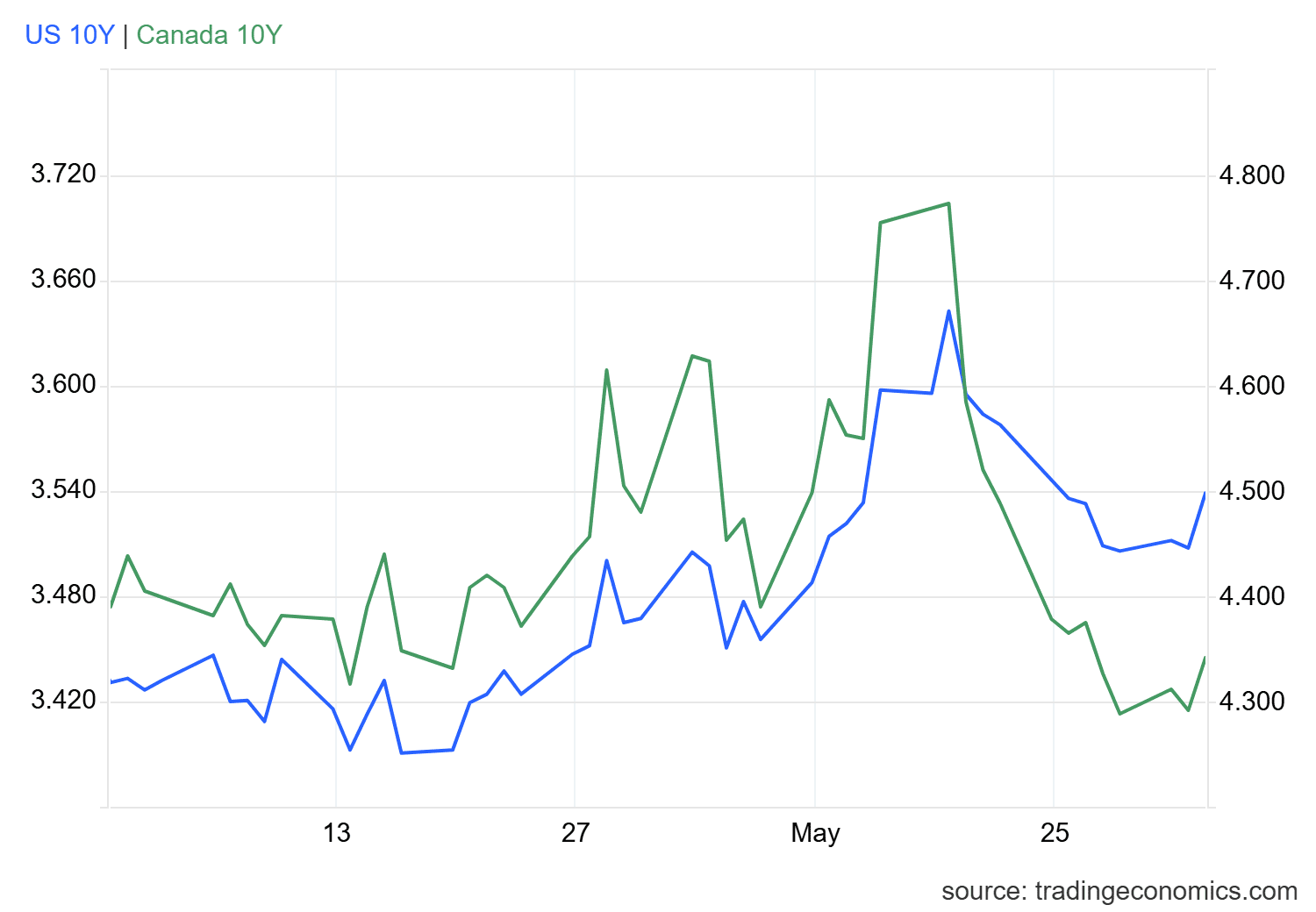
Source: TradingEconomics
This matters because, if the US bond market continues to offer a more attractive yield, it may keep drawing international capital flows into these instruments. Higher US yields can help sustain demand for dollar-denominated securities and, at the same time, support demand for the US currency.
In contrast, Canada’s lower bond yields could limit the relative appeal of its fixed income instruments. This comparative advantage has previously supported USD strength against the CAD, and if the yield differential remains in place, it could continue to be an important factor behind buying pressure in USD/CAD over the coming sessions.
Technical outlook for USD/CAD

Source: StoneX, Tradingview
- Major bearish trendline enters a risk zone: Although the dominant structure on the daily chart has remained a long bearish trendline for several months, the recent price recovery has started to challenge this formation in the short term. If buying pressure continues to stabilize over the coming sessions, this bearish structure could lose relevance and open the door to a stronger buying bias in the pair’s price action.
- RSI: The RSI continues to move consistently above the neutral 50 area, indicating that average bullish momentum over the last 14 sessions remains dominant. As long as this behavior holds, the buying bias could remain relevant over the medium term. However, it is also important to note that the indicator is now close to the overbought 70 level, which could warn of a possible excess of short-term bullish strength and leave room for mild selling corrections over the coming sessions.
- MACD: A similar scenario can be seen in the MACD, as the histogram remains above the neutral 0 level. This suggests that the average strength of short-term moving averages continues to show a bullish bias, which could remain relevant in USD/CAD price action over the medium term.
Key levels:
- 1.39215 – Relevant resistance: An important high level located above the 50- and 200-period moving averages. Price movements toward this level would begin to reflect a more consistent buying bias and could generate a full breakout of the long-term bearish trendline, opening the door to a more relevant bullish structure over the coming weeks.
- 1.38129 – Near-term barrier: A neutral zone that coincides with the 200-period simple moving average. This level could act as the first tentative barrier if bearish corrections begin to appear in the short term.
- 1.37503 – Crucial support: A nearby support level that corresponds to the area marked by the 50-period moving average. Price action that manages to break below this level could reactivate a selling bias and give continuity to the bearish trendline as the dominant chart structure over the following weeks of trading.
Written by Julian Pineda, CFA, CMT – Market Analyst
Follow him on: @julianpineda25

The complete CFD trading experience
Award-winning platforms, competitive spreads, low commissions and dedicated support.
We live and breathe the markets and are dedicated to helping traders realise their ambitions as we continue to set the industry bar.
Economic calendar
Web Trader platform
Our sophisticated web-based platform is packed with features.
Related articles

AUD/USD coils ahead of US CPI as breakout risk builds
The Aussie is coiling beneath 0.7000 ahead of US CPI, with its relationship with US front-end yields strengthening sharply just as markets question whether the Fed will need to hike again this month.

Pre-CPI USD Price Action Setups: EUR/USD, USD/JPY, GBP/USD, USD/CAD
Tomorrow brings an important inflation print as Treasury yields have started to stall and expectations for rate hikes have pared back. But another jolt to inflation could tilt those odds and impact price action across the USD complex.


US CPI Preview: Follow the Fed and Look Past the Hot Headline
A 0.6% m/m reading in headline CPI, while scary at first glance, is already expected and presumably discounted into the current market prices. Instead, the “core” reading will be more impactful for the Fed and markets - see what it means for the US dollar!

StoneX Europe Ltd may make third party material available on this website which may contain information included but not limited to the conditions of financial markets. The material is for information purposes only and does not contain, and should not be construed as containing, investment advice and/or investment recommendation and/or an investment research and/or an offer of or solicitation for any transactions in financial instruments; any decision to enter into a specific transaction shall be made by the client following an assessment by him/her of their situation.
StoneX Europe Ltd makes no representation or warranty and assumes no liability as to the accuracy or completeness of the information provided, nor any loss arising from any investment based on a recommendation, forecast or other information supplied. You should always seek independent advice as to your suitability to speculate in any related markets and your ability to assume the associated risks, if you are at all unsure. We are not under any obligation to update any such material. Any opinion made may be personal to the author and may not reflect the opinion of StoneX Europe Ltd.