



Why EUR/USD’s near-term bias could flip bearish below 1.0640
While both the ECB and the Fed will be raising interest rates in the latter half of the year, recent headlines suggest that the case for continued growth in the US economy is stronger than in Europe
Share this:

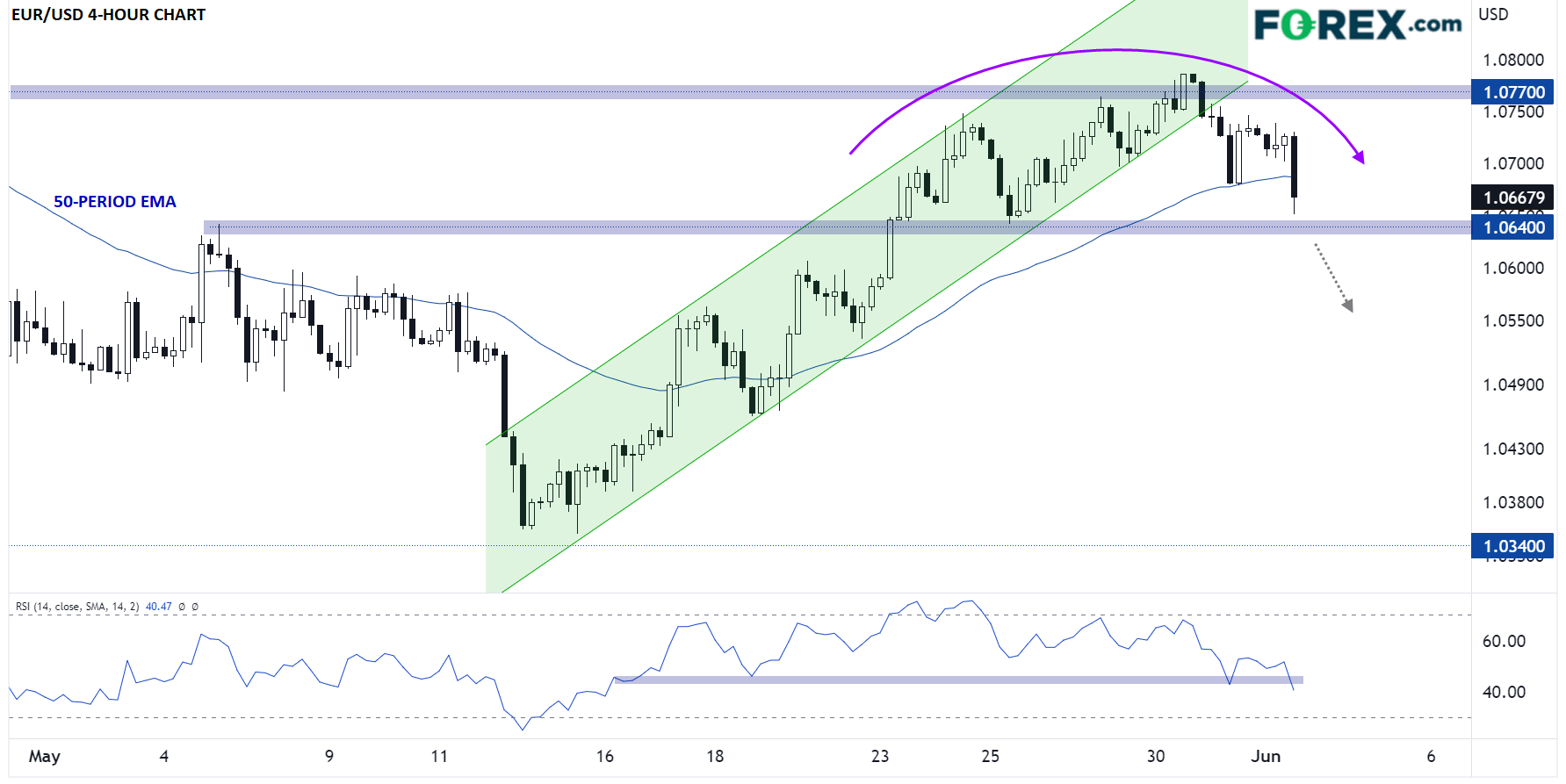
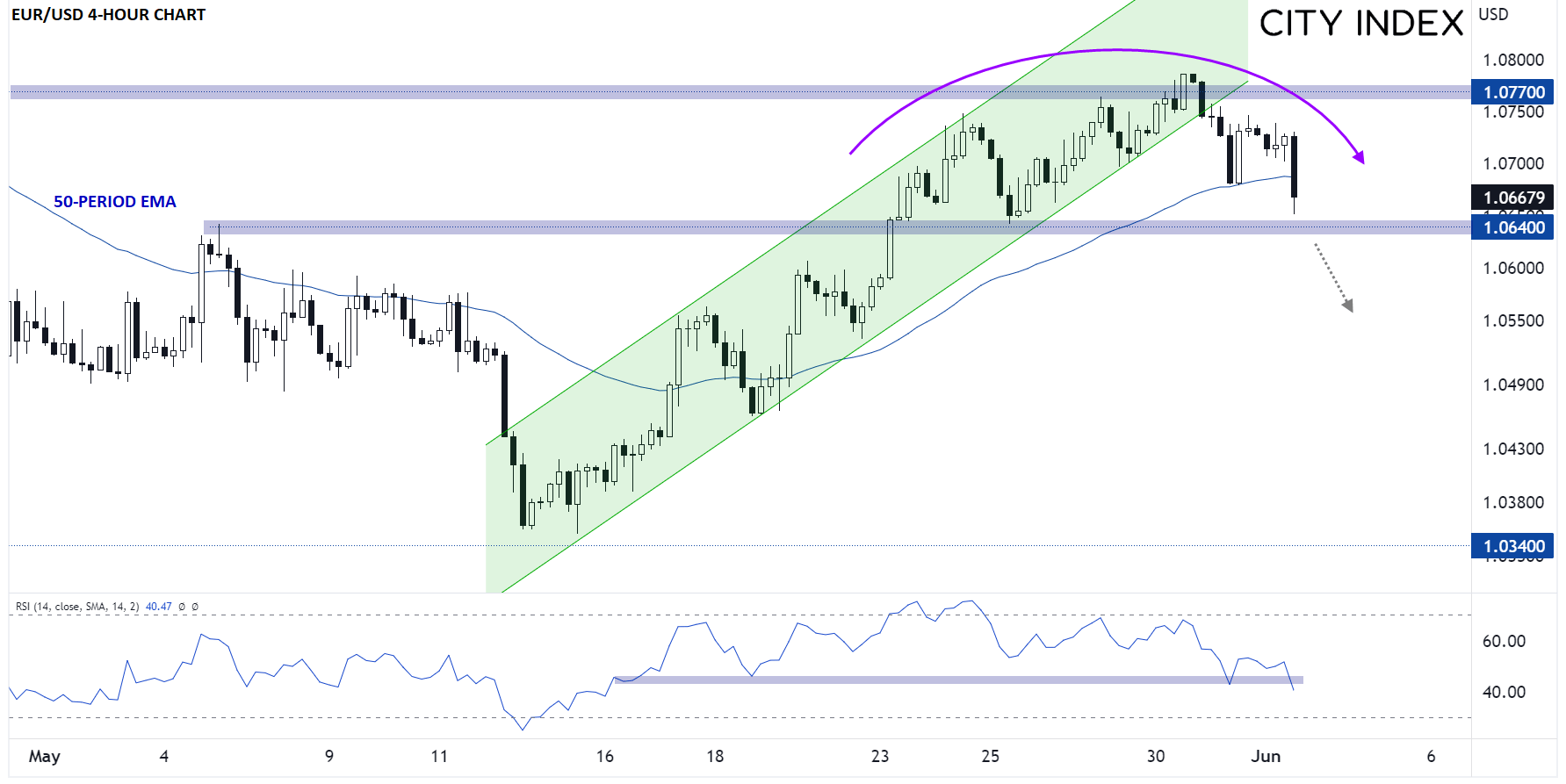
Last week, we noted that that the world’s most widely-traded currency pair was rising within a near-term bullish channel and looking to retest key resistance in the 1.0770 area. As the updated chart below shows, EUR/USD did indeed retest that area, but bulls were unable to muster enough strength to push the pair above it.
Source: StoneX, TradingView
Now, EUR/USD has definitively broken down from that channel and is within about 20 pips of previous-resistance-turned-support in the 1.0640 zone. The idea that former resistance levels, or ceilings on price, can turn into future support levels, or floors under price, once they’re broken (and vice versa) is called the polarity principle, and in this case it suggests that a break back below the 1.0640 level would shift the near-term bias to bearish for a move back down toward 1.0500. Indeed, the pair’s 4-hour RSI indicator has already dropped to its lowest level in more than two weeks, signaling that buying pressure is rapidly dissipating.
From a fundamental perspective, the immediate catalyst for today’s selloff in EUR/USD is better-than-expected economic data out of the US, where both this morning’s ISM Manufacturing PMI report and the JOLTS job openings report came in strong. Meanwhile, the European Union’s decision to ban most Russian oil imports by the end of the year, while principled, may have the short-term effect of slowing economic growth and further entrenching inflation.
In other words, while both the ECB and the Fed will be raising interest rates in the latter half of the year, recent headlines suggest that the case for continued growth in the US economy is stronger than in Europe, and that could keep the greenback on the front foot in the coming days.
How to trade with City Index
You can trade with City Index by following these four easy steps:
- Open an account, or log in if you’re already a customer
• Open an account in the UK
• Open an account in Australia
• Open an account in Singapore
- Search for the market you want to trade in our award-winning platform
- Choose your position and size, and your stop and limit levels
- Place the trade
Related tags:




The complete CFD trading experience
Award-winning platforms, competitive spreads, low commissions and dedicated support.
We live and breathe the markets and are dedicated to helping traders realise their ambitions as we continue to set the industry bar.
Economic calendar
Web Trader platform
Our sophisticated web-based platform is packed with features.
Related articles
USD/JPY Weekly Outlook: Fed Hikes, AI Volatility and a Sleeping Yen
USD/JPY is tracking the direction of US rates without responding with its usual magnitude. Can Jensen Huang and the payrolls lottery wake the pair from its slumber?

EURUSD, Nasdaq Outlook: Multi-Year Trends Provide Support for EURUSD and Nasdaq
EURUSD, Nasdaq Outlook: Steep market sell-offs driven by interest-rate concerns and AI valuation risks are pushing the EURUSD and Nasdaq toward key multi-year support levels near 1.0880 and 24,800. These levels could determine whether the longer-term uptrends continue or a broader market unwind unfolds.


Iron Ore Bears Face a December Test
There's no shortage of iron ore at Chinese ports, but seasonality and price action suggest there may be better opportunities on the long side in the near term.
StoneX Europe Ltd may make third party material available on this website which may contain information included but not limited to the conditions of financial markets. The material is for information purposes only and does not contain, and should not be construed as containing, investment advice and/or investment recommendation and/or an investment research and/or an offer of or solicitation for any transactions in financial instruments; any decision to enter into a specific transaction shall be made by the client following an assessment by him/her of their situation.
StoneX Europe Ltd makes no representation or warranty and assumes no liability as to the accuracy or completeness of the information provided, nor any loss arising from any investment based on a recommendation, forecast or other information supplied. You should always seek independent advice as to your suitability to speculate in any related markets and your ability to assume the associated risks, if you are at all unsure. We are not under any obligation to update any such material. Any opinion made may be personal to the author and may not reflect the opinion of StoneX Europe Ltd.