



AUD/USD Forecast: Messy jobs report fails to shift focus from energy price surge
Australia's jobs report looks noisy rather than weak, with conflicting signals across employment, hours and participation. Markets didn’t hesitate to look past it, with the focus firmly on inflation and the implications for RBA policy.
Share this:

- Noisy Australia jobs report, trend measures tell a steadier story
- RBA hike pricing climbs as energy shock lifts inflation expectations
- AUD/USD lifts in Asia as overnight USD surge corrects
The signal problem
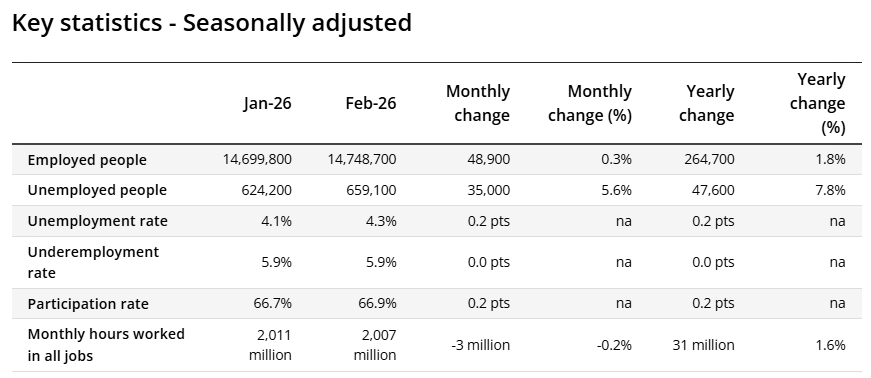
The February Australian labour force report is messy once you look beneath the surface, making it difficult to draw a clean signal from the headline moves. There’s a risk we’re looking at statistical noise rather than a meaningful shift in conditions, something the trend measures support.
Source: ABS
Employment rose by 49,000 from January, but the split between full-time and part-time work muddied the waters. Part-time roles jumped by 79,000 while full-time employment fell by 30,000, reversing the pattern of the prior two months. That lines up with the 0.2% decline in hours worked, pointing to softer labour utilisation rather than a weakening in demand.
The increase in unemployment was driven more by supply than demand. Participation rose to 66.9%, driven by older Australians remaining in or re-entering the workforce rather than retiring, helping push the unemployment rate up to 4.3%. The ABS noted fewer people moved from unemployment into jobs and more remained unemployed, but the broader signal still looks mixed.
Importantly, wider measures of labour market conditions were steady. Underemployment, covering those who have a job but want and are available to work more hours, held steady at 5.9%, while the trend unemployment rate edged lower to 4.2%.
Set against the RBA’s February forecasts, conditions still look relatively firm. The Bank expects unemployment to average 5.3% in the first half of 2026, and even with the lift this month, the average soi far remains below that level.
Inflation impulse takes over
Source: TradingView
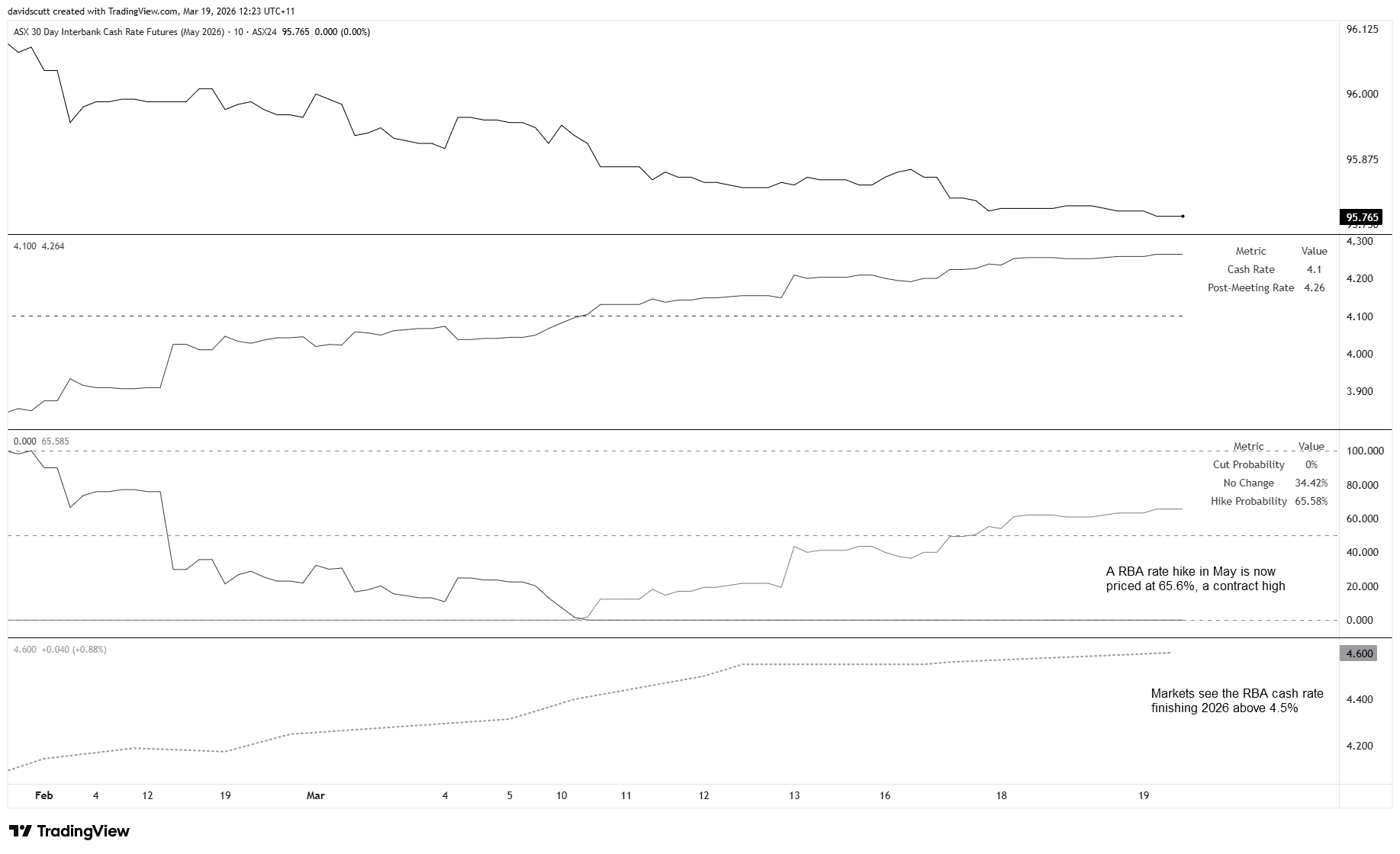
Markets ignored the detail entirely with pricing for a May RBA hike pushing to contract highs, with implied odds moving above 65%. That move looks driven less by anything in this report and more by the inflation impulse coming from offshore, with surging energy prices tied to the Iran conflict lifting inflation expectations and, in turn, rate hike expectations.
Adding to the sense traders have their eyes elsewhere, AUD/USD pushed to session highs shortly after the report's release.
Asia corrects the flush
The pair was hammered overnight on the back of surging energy prices as Middle Eastern tensions intensified, with Israel and Iran launching attacks against gas infrastructure, boosting the USD. The greenback also found support from the March FOMC which carried a notably hawkish tone, with only one dissent against holding rates steady. There was also focus on Jerome Powell acknowledging he would remain at the Fed while a Department of Justice investigation into cost blowouts tied to building renovations is ongoing, including as chair until if and when Kevin Warsh secures approval from lawmakers.
Source: TradingView
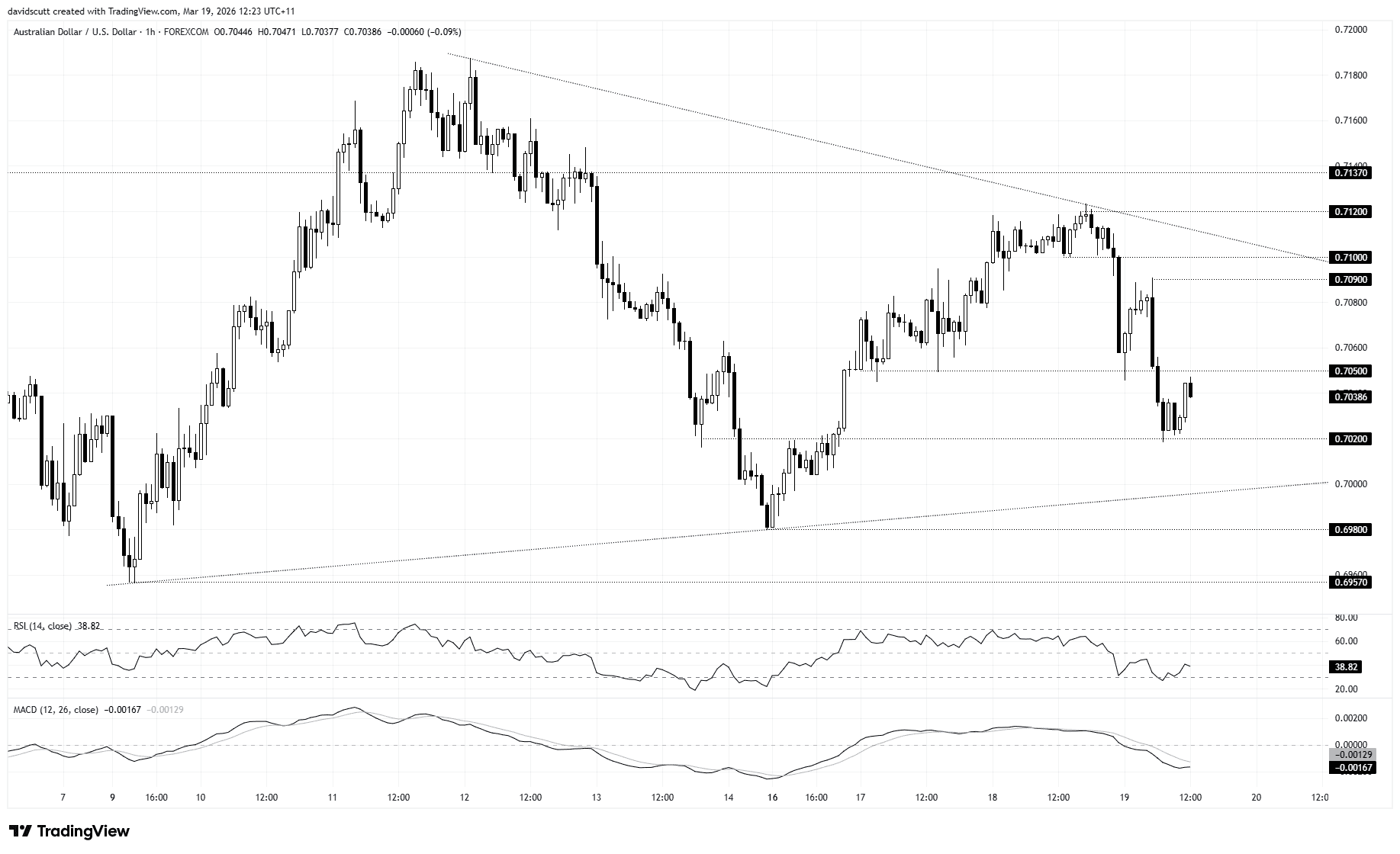
The bounce in Asia looks corrective following that downside flush, something often seen following large moves during North American trade. The Aussie found support ahead of 0.7020 following the Fed before rebounding towards 0.7050, a level that had previously acted as support prior to the break lower. That defines the initial range on the hourly.
Above, 0.7090 marks the high struck just before the Fed, with 0.7100 sitting just above as another former support level that may now act as resistance. Just beyond that sits the downtrend from the YTD highs set earlier this month, making it an important reference point.
Below 0.7020, the uptrend from the March 9 lows sits just under 0.7000, a level that has consistently attracted buyers in recent weeks. A break of that trend would bring the 0.6980 swing low from last week into play.
Momentum signals suggest downside pressure may be easing. RSI (14) has started to print higher lows while remaining below 50, while MACD is curling back towards the signal line but remains in negative territory, pointing to downside risks becoming less pronounced rather than reversing outright.

Open an account in minutes
Experience award-winning platforms with fast and secure execution, and enjoy tight spreads from 0.5 pts on FX and 0.3 pts on indices.
Economic calendar
Web Trader platform
Our sophisticated web-based platform is packed with features.
Related articles

USD/JPY weekly outlook: Quarter turn scrambles rates regime
USD/JPY’s tight relationship with front-end US rates broke down sharply last week, but quarter-turn flows and positioning suggest the disconnect may prove temporary.
USD/CAD forecast: rally could accelerate above June highs at 1.4250
USD/CAD recovered quickly after weaker US jobs data, keeping the bullish trend in focus. A move above the June highs could accelerate the rally as inflation keeps the Fed under pressure.


USD Sets Fresh Yearly High as EUR/USD Drops Dramatically, USD/JPY Stable
Well, it was a week of USD strength that wasn’t entirely pushed by USD/JPY, as a strong sell-off in EUR/USD has pushed the major pair to its most oversold state in a decade.
This report is intended for general circulation only. It should not be construed as a recommendation, or an offer (or solicitation of an offer) to buy or sell any financial products. The information provided does not take into account your specific investment objectives, financial situation or particular needs. Before you act on any recommendation that may be contained in this report, independent advice ought to be sought from a financial adviser regarding the suitability of the investment product, taking into account your specific investment objectives, financial situation or particular needs.
StoneX Financial Pte. Ltd., may distribute reports produced by its respective foreign entities or affiliates within the StoneX group of companies or third parties pursuant to an arrangement under Regulation 32C of the Financial Advisers Regulations. Where the report is distributed to a person in Singapore who is not an accredited investor, expert investor or an institutional investor (as defined in the Securities Futures Act), StoneX Financial Pte. Ltd. accepts legal responsibility to such persons for the contents of the report only to the extent required by law. Singapore recipients should contact StoneX Financial Pte. Ltd. at 6826 9988 for matters arising from, or in connection with the report.
In the case of all other recipients of this report, to the extent permitted by applicable laws and regulations neither StoneX Financial Pte. Ltd. nor its associated companies will be responsible or liable for any loss or damage incurred arising out of, or in connection with, any use of the information contained in this report and all such liability is hereby expressly disclaimed. No representation or warranty is made, express or implied, that the content of this report is complete or accurate.
StoneX Financial Pte. Ltd. is not under any obligation to update this report.
Trading CFDs carries a high level of risk that may not be suitable for some investors. Consider your investment objectives, level of experience, financial resources, risk appetite and other relevant circumstances carefully. The possibility exists that you could lose some or all of your investments, including your initial deposits. If in doubt, please seek independent expert advice. Visit www.forex.com/en-sg/terms-and-policies for the complete Risk Disclosure Statement.