


Brazil Elections: Is Investor Confidence Beginning to Fade?
One of the most relevant events for emerging markets in recent sessions has been the outcome of Brazil’s presidential election. Following Lula da Silva’s victory in the second round, investor sentiment began to deteriorate noticeably. This can be observed in both the iShares MSCI Brazil ETF and the VanEck Brazil Small-Cap ETF, two important benchmarks for tracking the Brazilian equity market, both of which have posted declines of more than 15% at the start of the week.
Share this:

One of the most relevant events for emerging markets in recent sessions has been the outcome of Brazil’s presidential election. Following Lula da Silva’s victory in the second round, investor sentiment began to deteriorate noticeably. This can be observed in both the iShares MSCI Brazil ETF and the VanEck Brazil Small-Cap ETF, two important benchmarks for tracking the Brazilian equity market, both of which have posted declines of more than 15% at the start of the week.
For now, this reaction appears to be driven primarily by growing political and fiscal uncertainty. The election result has led investors to reassess risks related to public spending, fiscal discipline and debt dynamics over the coming years, a situation that could continue weighing on Brazilian financial assets in the near term.

An Election Surprise
Since the first round of voting on October 4, Brazil’s election process had become an important focal point for financial markets. At that stage, Flavio Bolsonaro, representing the political right, surprised markets by securing nearly 47% of the vote compared with approximately 45% for Lula da Silva. The result materially altered market expectations and increased confidence in a potential Bolsonaro victory in the runoff election.
Following the first-round result, Brazilian equities recovered consistently as investors began to reduce part of the fiscal risk premium embedded in local assets. The market also started to price in a potentially more favorable fiscal discipline scenario and a lower degree of government intervention in the economy.
However, the biggest surprise came during the second round. Lula successfully reversed the disadvantage seen weeks earlier and ultimately won the election with 51.8% of the vote versus 48.2% for Bolsonaro. What makes this result particularly relevant is that it significantly changed the narrative that had been developing after the first round and caught a large portion of the market off guard.
This matters because the immediate reaction was a rise in uncertainty and an increase in the risk premium demanded by investors to hold Brazilian assets. Markets have once again shifted their attention toward concerns related to higher public spending, fiscal deficits and debt growth, factors that have historically generated caution among investors.
The impact was quickly reflected in the fixed-income market. Brazilian 10-year government bond yields, which had been moderating toward the 13% area before the election, surged sharply to nearly 15.45%. This movement suggests that investors are demanding a higher return to maintain exposure to Brazilian assets, reflecting a rising perception of sovereign risk and a deterioration in confidence immediately following the election result.
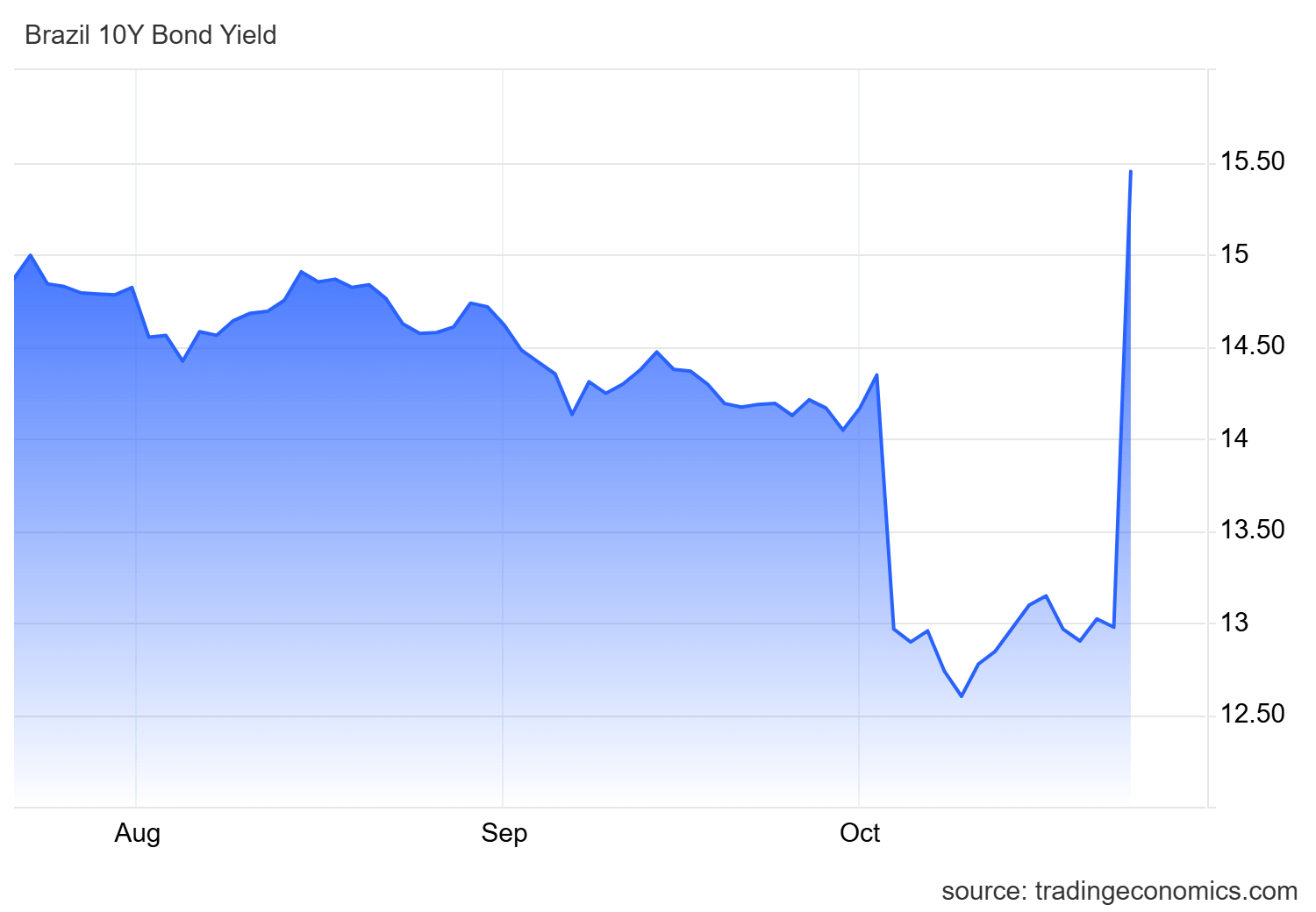
Source: TradingEconomics
The reaction was not limited to the bond market. The decline in investor confidence quickly spread to equities as well. Major companies such as Petrobras recorded declines close to 14%, while Santander Brasil fell approximately 13% during the session.
This development is important because it highlights how the election result has affected multiple segments of Brazil’s financial markets. It is within this context that the VanEck Brazil Small-Cap ETF and the iShares MSCI Brazil ETF become particularly relevant, since both vehicles provide broad exposure to Brazilian equities.
The selling pressure observed in these ETFs reflects a significant reduction in investor confidence regarding the short-term stability of the Brazilian stock market. At the same time, the rise in bond yields may increase the relative attractiveness of fixed-income investments compared to equities, potentially encouraging additional capital outflows from certain equity segments.
As long as concerns surrounding fiscal risk remain elevated and bond yields continue to trade at high levels, selling pressure across Brazil’s equity market could remain an important theme in the sessions ahead.
Technical Forecast for the iShares MSCI Brazil ETF
Source: StoneX Tradingview
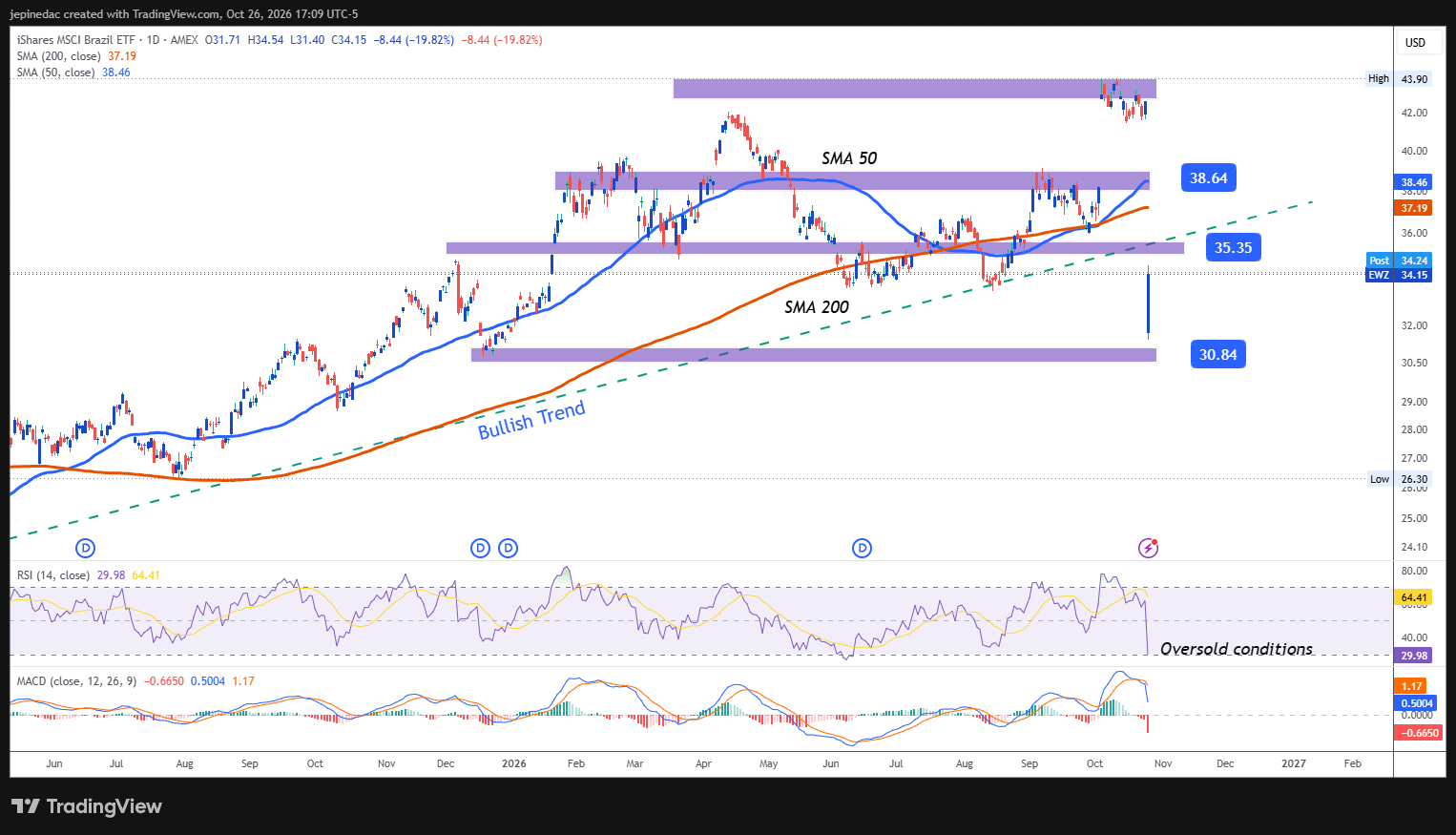
- The previous bullish trend is beginning to lose relevance: Since the first months of 2025, the ETF had managed to sustain an important bullish trendline that remained the dominant technical structure on the chart. However, following the election result, the decline in investor confidence triggered a sharp drop toward the $34 area, a move that has started to place the trendline that supported price action over recent months under significant pressure. For now, selling pressure is not yet strong enough to confirm the beginning of a structured bearish trend. However, it has been sufficient to alter the broader market structure and introduce a phase of uncertainty that could eventually favor the development of a more consistent consolidation range if confidence fails to recover in the coming sessions.
- RSI: The RSI has moved below the 50 neutral level, indicating that selling momentum has become dominant in recent trading sessions. However, it is also important to note that the decline has been so aggressive that the indicator is now approaching the 30 oversold zone, a development that could signal excessive recent selling pressure and potentially open the door to short-term bullish corrections.
- MACD: The MACD histogram continues to develop well below the 0 neutral line, suggesting that short-term moving averages are maintaining a consistent bearish structure. As long as this behavior remains in place, it could continue supporting a dominant bearish bias in the sessions ahead.
Key Levels:
- 38.64 – Key Resistance: A level that coincides with highs observed several weeks ago and currently aligns with the 50-period simple moving average. A move back toward this area could reduce the recent selling pressure and restore relevance to the previous bullish trendline as the dominant structure on the chart.
- 35.35 – Near-Term Barrier: A level that aligns with an important retracement zone observed in recent weeks and currently represents one of the main equilibrium areas on the chart. It could become the key reference level to watch in the event of short-term bullish corrections.
- 30.84 – Key Support: An area not seen since December 2025 that currently represents the most important downside barrier on the chart. A sustained move below this level could signal a significant structural change and favor the development of a more consistent bearish trend over the coming weeks.
Written by Julian Pineda, CFA, CMT – Market Analyst
Follow him on: @julianpineda25




Open an account in minutes
Experience award-winning platforms with fast and secure execution, and enjoy tight spreads from 0.5 pts on FX and 0.3 pts on indices.
Economic calendar
Web Trader platform
Our sophisticated web-based platform is packed with features.
Related articles
Brazil Elections: Is Investor Confidence Beginning to Fade?
One of the most relevant events for emerging markets in recent sessions has been the outcome of Brazil’s presidential election. Following Lula da Silva’s victory in the second round, investor sentiment began to deteriorate noticeably. This can be observed in both the iShares MSCI Brazil ETF and the VanEck Brazil Small-Cap ETF, two important benchmarks for tracking the Brazilian equity market, both of which have posted declines of more than 15% at the start of the week.

Crude Oil Weekly Outlook: Elections Test Brent–WTI Resistance Levels
Crude Oil Weekly Outlook: Brent–WTI spread tests long-term resistance as monthly RSI reaches overbought territory and key elections approach. Brent and WTI levels and risks ahead.


Dow Jones Analysis: Is the DJIA Making a Comeback?
Recent trading sessions have become increasingly relevant for the Dow Jones, as the index has started to regain bullish momentum heading into the end of the week. Over the last three sessions, the DJIA has advanced by more than 0.6%, allowing buying pressure to regain prominence and raising the possibility of a more consistent short-term recovery.
This report is intended for general circulation only. It should not be construed as a recommendation, or an offer (or solicitation of an offer) to buy or sell any financial products. The information provided does not take into account your specific investment objectives, financial situation or particular needs. Before you act on any recommendation that may be contained in this report, independent advice ought to be sought from a financial adviser regarding the suitability of the investment product, taking into account your specific investment objectives, financial situation or particular needs.
StoneX Financial Pte. Ltd., may distribute reports produced by its respective foreign entities or affiliates within the StoneX group of companies or third parties pursuant to an arrangement under Regulation 32C of the Financial Advisers Regulations. Where the report is distributed to a person in Singapore who is not an accredited investor, expert investor or an institutional investor (as defined in the Securities Futures Act), StoneX Financial Pte. Ltd. accepts legal responsibility to such persons for the contents of the report only to the extent required by law. Singapore recipients should contact StoneX Financial Pte. Ltd. at 6826 9988 for matters arising from, or in connection with the report.
In the case of all other recipients of this report, to the extent permitted by applicable laws and regulations neither StoneX Financial Pte. Ltd. nor its associated companies will be responsible or liable for any loss or damage incurred arising out of, or in connection with, any use of the information contained in this report and all such liability is hereby expressly disclaimed. No representation or warranty is made, express or implied, that the content of this report is complete or accurate.
StoneX Financial Pte. Ltd. is not under any obligation to update this report.
Trading CFDs carries a high level of risk that may not be suitable for some investors. Consider your investment objectives, level of experience, financial resources, risk appetite and other relevant circumstances carefully. The possibility exists that you could lose some or all of your investments, including your initial deposits. If in doubt, please seek independent expert advice. Visit www.forex.com/en-sg/terms-and-policies for the complete Risk Disclosure Statement.