



Chinese Yuan Forecast: How, and Why, Beijing is Quietly Devaluing the Yuan
Traders may be able to use USD/CNH as a potential signal into the CCP’s outlook toward the ongoing trade tensions - see how!
Share this:

Chinese Yuan Key Points
- USD/CNH has remained remarkably stable near 7.30 since President Trump launched a trade war against China.
- However, with the US Dollar Index falling by nearly 10% so far this year, that means that the Chinese yuan has depreciated sharply against other major currencies, making its exports more competitive to non-US partners.
- Traders may be able to use USD/CNH as a potential signal into the CCP’s outlook toward the ongoing trade tensions.
For a government that has never shied away from taking an active role in markets, China’s ruling party has seemingly taken a laissez faire approach to its currency despite the Trump Administration’s crippling tariffs on the country.
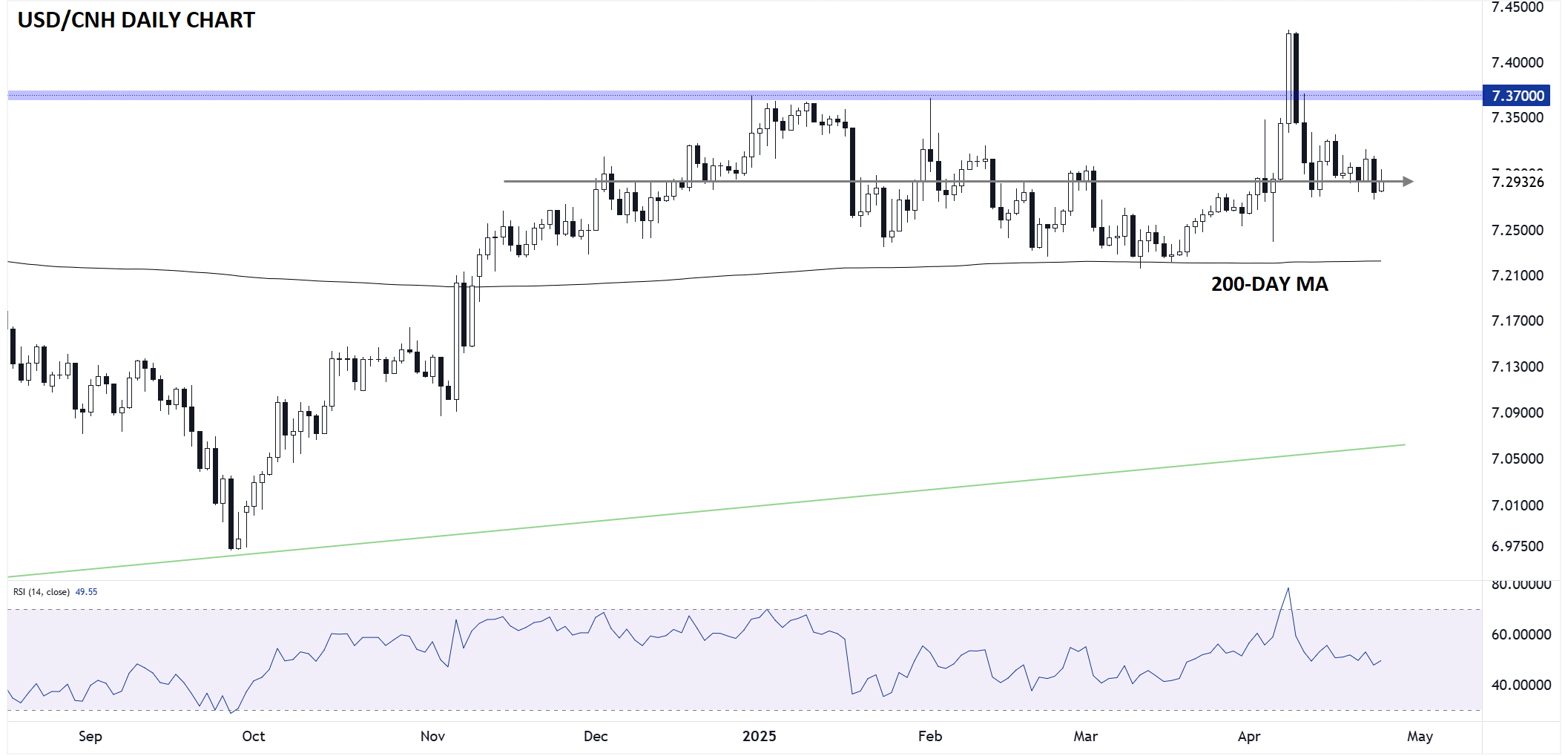
Using the “offshore” (Hong Kong) version of the currency pair, the USD/CNH chart below shows that the Chinese yuan is essentially unchanged at 7.30 against the US dollar since the week after the US election:
Source: StoneX, TradingView
Since then, USD/CNH has bounced around between about 7.20 and 7.40, and the 200-day MA remains flat near 7.22, confirming a (geopolitically surprising) lack of a clear trend.
With the US clearly acting as the aggressor in the current stage of the trade war between the world’s two largest economies, why WOULDN’T China devalue its currency to try to soften the blow from US tariffs?
The answer is that China has, unequivocally, allowed the yuan to depreciate… just not relative to the US dollar. With the US Dollar Index trading down nearly -10% in 2025 alone, holding steady against the greenback implies that the Chinese yuan has depreciated meaningfully against other major currencies, making its exports more competitive with everyone besides the US. To wit, the yuan is trading at 10-year lows against the euro, 9-year lows against the British pound, 2-year lows against the Japanese yen, and just tested 3-year lows against the Australian dollar earlier this month.
By allowing the yuan to fall in value against other global currencies, China can seek to strike trade deals with non-US counterparts at more favorable terms. Ultimately, 100%+ tariffs between the US and China serve as an effective trade embargo between the two superpowers far beyond the scale of what a currency devaluation can offset, especially for a less volatile pair like USD/CNH, which has moved in a range of about 20% total since the start of the Great Financial Crisis in late 2007.
Moving forward, traders may be able to use USD/CNH as a potential signal into the CCP’s outlook toward the ongoing trade tensions. While the Chinese yuan has not significantly budged against the US dollar in recent months, that very stability may be the message.
Traders should view USD/CNH not just as a reflection of market forces, but as a barometer of Beijing’s tolerance for economic pressure. A sharp move lower in USD/CNH (i.e. yuan strength) could signal a willingness from Chinese authorities to stabilize external relationships or reduce import costs—perhaps ahead of a major diplomatic overture. Conversely, any sudden yuan weakness against the dollar might suggest China is preparing to absorb more pain in the trade war, opting to bolster competitiveness elsewhere as it battens down the hatches for a prolonged battle.
In a world where capital controls, state influence, and geopolitical posturing blur the usual rules of forex markets, USD/CNH remains one of the clearest windows into the Chinese Communist Party’s near-term strategic mindset. Keep a close eye on not just on the level, but on the velocity and direction of moves in the Chinese yuan to decode where the next shift in global trade dynamics may emerge.
-- Written by Matt Weller, Global Head of Research
Check out Matt’s Daily Market Update videos on YouTube and be sure to follow Matt on Twitter: @MWellerFX



Open an account in minutes
Experience award-winning platforms with fast and secure execution, and enjoy tight spreads from 0.5 pts on FX and 0.3 pts on indices.
Economic calendar
Web Trader platform
Our sophisticated web-based platform is packed with features.
Related articles

Swiss Franc Technical Outlook: USD/CHF Reversal Puts Major Support in Focus 10 21 2026
USD/CHF bears are looking to build on last week’s sharp reversal, with a looming support test threatening the broader recovery.


New Zealand inflation report puts spotlight on hawkish RBNZ pricing
New Zealand's recovery is barely underway, yet markets have priced a series of RBNZ rate hikes. Thursday's inflation report will put that hawkish recalibration under the microscope.


British Pound Rallies into CPI as BoE Hike Bets Firm - GBP/USD, GBP/AUD
Sterling rallies ahead of UK inflation as BoE hike bets firm. GBP/USD tests resistance while GBP/AUD forms a potential bullish reversal.

This report is intended for general circulation only. It should not be construed as a recommendation, or an offer (or solicitation of an offer) to buy or sell any financial products. The information provided does not take into account your specific investment objectives, financial situation or particular needs. Before you act on any recommendation that may be contained in this report, independent advice ought to be sought from a financial adviser regarding the suitability of the investment product, taking into account your specific investment objectives, financial situation or particular needs.
StoneX Financial Pte. Ltd., may distribute reports produced by its respective foreign entities or affiliates within the StoneX group of companies or third parties pursuant to an arrangement under Regulation 32C of the Financial Advisers Regulations. Where the report is distributed to a person in Singapore who is not an accredited investor, expert investor or an institutional investor (as defined in the Securities Futures Act), StoneX Financial Pte. Ltd. accepts legal responsibility to such persons for the contents of the report only to the extent required by law. Singapore recipients should contact StoneX Financial Pte. Ltd. at 6826 9988 for matters arising from, or in connection with the report.
In the case of all other recipients of this report, to the extent permitted by applicable laws and regulations neither StoneX Financial Pte. Ltd. nor its associated companies will be responsible or liable for any loss or damage incurred arising out of, or in connection with, any use of the information contained in this report and all such liability is hereby expressly disclaimed. No representation or warranty is made, express or implied, that the content of this report is complete or accurate.
StoneX Financial Pte. Ltd. is not under any obligation to update this report.
Trading CFDs carries a high level of risk that may not be suitable for some investors. Consider your investment objectives, level of experience, financial resources, risk appetite and other relevant circumstances carefully. The possibility exists that you could lose some or all of your investments, including your initial deposits. If in doubt, please seek independent expert advice. Visit www.forex.com/en-sg/terms-and-policies for the complete Risk Disclosure Statement.