



USD/MXN Analysis: The Mexican Peso Continues to Strengthen, Moving Closer to the 18.00 Level
Over the past five trading sessions, USD/MXN has recorded a decline of more than 0.6% in favor of the Mexican peso, maintaining a consistent bearish bias in the short term. Selling pressure remains driven by Mexico’s high interest rate and the recent weakness in the U.S. dollar.
Share this:

Over the past five trading sessions, USD/MXN has recorded a decline of more than 0.6% in favor of the Mexican peso, maintaining a consistent bearish bias in the short term. Selling pressure remains driven by Mexico’s high interest rate and the recent weakness in the U.S. dollar. As long as these factors persist, bearish momentum will likely continue dominating the pair’s movements in the coming sessions.


Why Does the Peso Remain So Stable?
The final Bank of Mexico decision of the year will take place on December 18, a meeting that will not only define the current rate but may also signal the bank’s stance for 2026. The governor has emphasized that the institution does not have a predetermined path, noting that inflation has not yet reached the 3.00% target—October data showed 3.5%—and that the central bank is still assessing Mexico’s economic performance heading into the end of 2025.
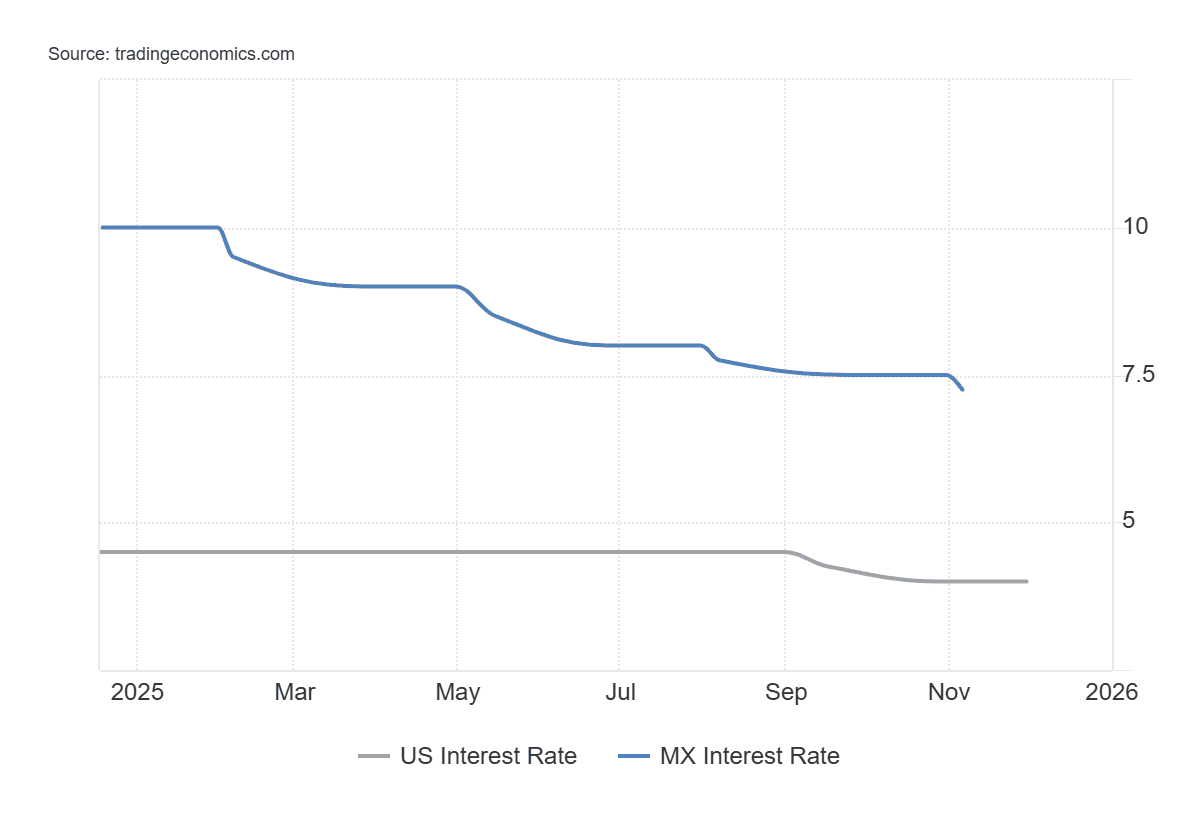
A major factor supporting the peso is the wide interest rate differential versus the United States: 7.25% in Mexico compared with the Federal Reserve’s 4.00%. Banxico has also suggested that there is no certainty of a sustained rate-cutting cycle, keeping Mexican bond yields attractive. This continues to incentivize capital inflows into the country, boosting demand for pesos and reinforcing its stability against the dollar.
Source: TradingEconomics
Taken together, this interest-rate advantage has been one of the main pillars of the peso’s strength. If Banxico chooses to maintain elevated rates into early 2026, the peso may retain a solid catalyst, prolonging bearish pressure on USD/MXN in the medium term.
Is the U.S. Dollar Failing to Recover?
In contrast with Mexico’s outlook, the Federal Reserve appears to be moving toward a more dovish stance, with expectations of a 0.25% cut from the current 4.00%. This outlook has weakened demand for the U.S. dollar, as lower rates reduce the appeal of dollar-denominated investments and limit foreign capital inflows that typically support the currency.
This weakness is clearly reflected in the DXY index, which has fallen toward the 98-point area—its lowest level since late October. This reinforces the perception of a dollar experiencing persistent downward pressure, driven by a more flexible U.S. monetary policy.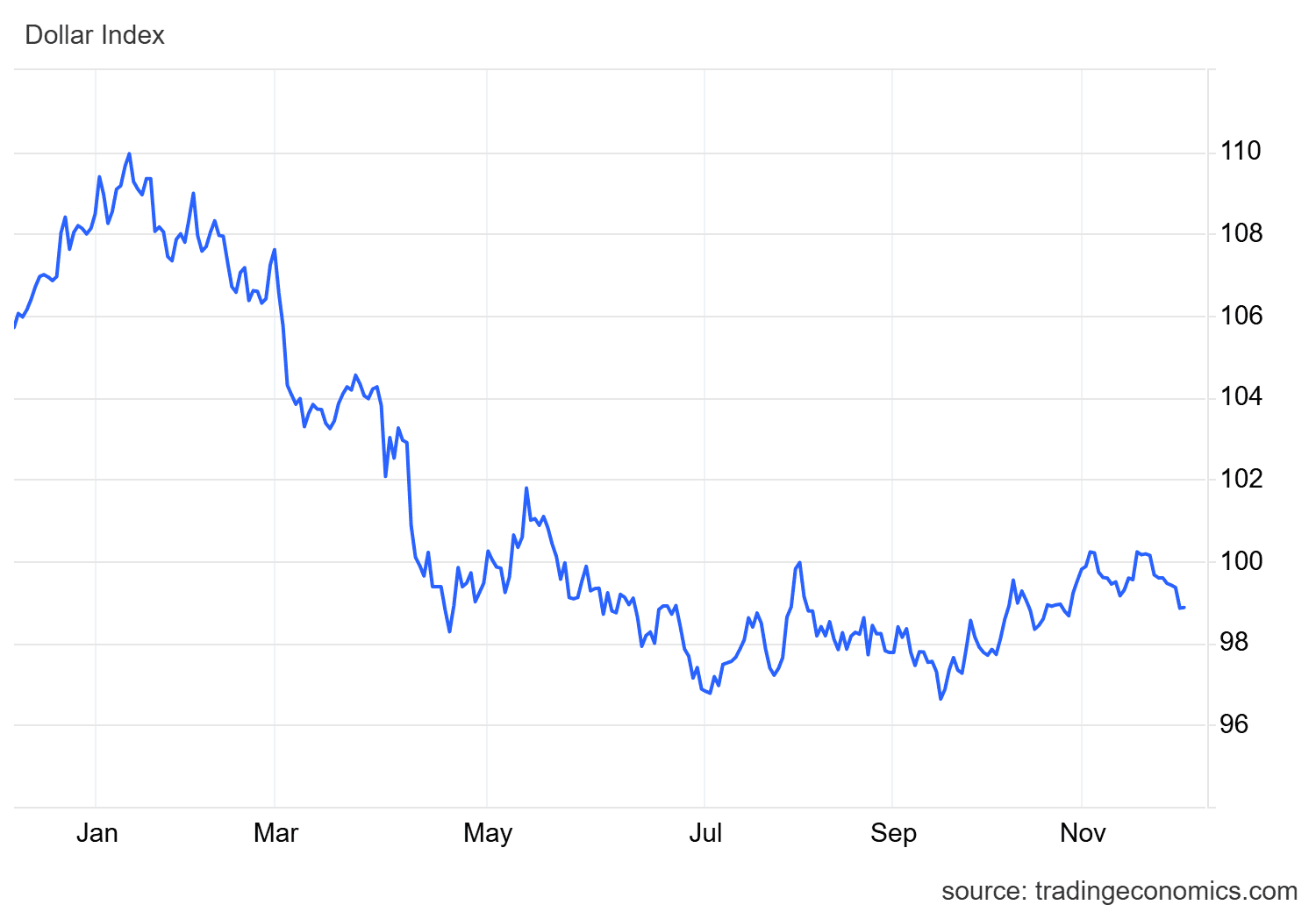
Source: TradingEconomics
As the dollar continues to lose strength, the Mexican peso has steadily regained ground. If the DXY remains weak, the peso could continue to be seen as a relatively more attractive currency, sustaining bearish pressure on USD/MXN in the coming weeks.
USD/MXN Technical Outlook
Source: StoneX, Tradingview
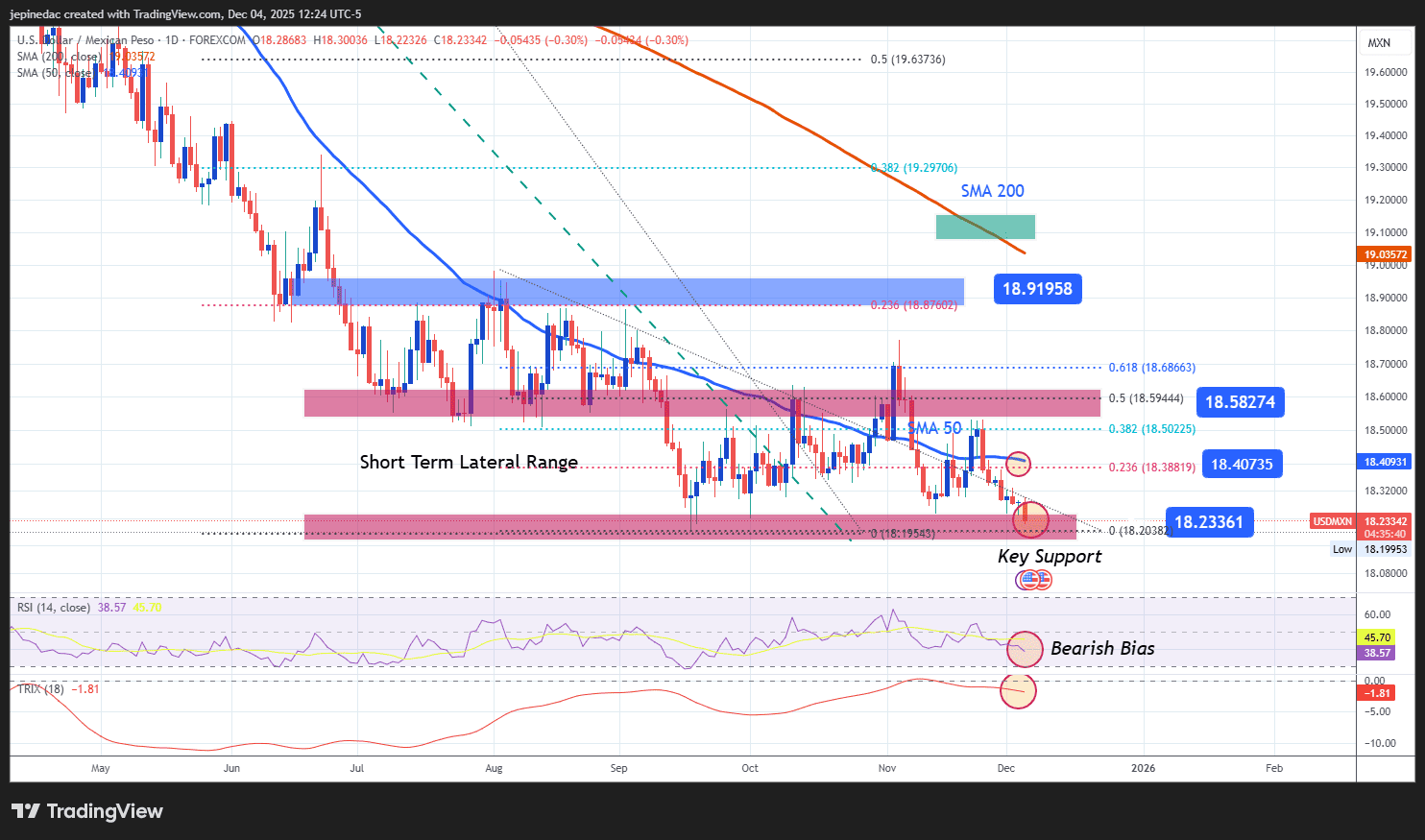
- Sideways Range at Risk: Since early September, USD/MXN has traded within a lateral range between 18.50 (upper boundary) and 18.20 (lower boundary). For months, price movements have not been strong enough to break this structure, reflecting a period of market consolidation. However, recent bearish action has pushed the pair back toward the lower boundary. If selling pressure continues, a break below the range could occur, giving way to a more defined bearish trend into the year’s end.
- RSI: The RSI maintains a downward slope below the 50 level, indicating a dominant bearish impulse over the last 14 sessions. If RSI readings continue below the neutral zone, a more consistent selling pressure could emerge in the short term.
- TRIX: The TRIX line continues moving below 0, signaling that the average strength of exponential moving averages remains bearish. If this pattern persists, selling pressure could intensify as the end of the year approaches.
Key Levels:
- 18.59 – Main Resistance: This level marks the upper limit of the lateral range. A breakout above it could trigger a more meaningful bullish bias and open the door to a medium-term uptrend.
- 18.40 – Nearby Barrier: Aligned with the 50-period simple moving average and the 23.6% Fibonacci retracement. As long as price remains near this area, the sideways channel may continue, allowing the neutral bias to dominate.
- 18.22 – Key Support: This marks the most important pullback zone seen in recent weeks. A break below this level would reactivate the bearish trend that dominated much of the year and could end the current consolidation phase in USD/MXN.
Written by Julian Pineda, CFA – Market Analyst
Follow him at: @julianpineda25

Open an account in minutes
Experience award-winning platforms with fast and secure execution, and enjoy tight spreads from 0.5 pts on FX and 0.3 pts on indices.
Economic calendar
Web Trader platform
Our sophisticated web-based platform is packed with features.
Related articles

USD/JPY weekly outlook: Quarter turn scrambles rates regime
USD/JPY’s tight relationship with front-end US rates broke down sharply last week, but quarter-turn flows and positioning suggest the disconnect may prove temporary.


Gold Update: XAU/USD Remains Under Pressure Even After the NFP Report
As the trading week comes to an end, weakness around gold price action remains evident in the short term. This can be seen in the performance of the past two sessions, where the metal has declined by approximately 0.3%. Although the move has not been particularly aggressive, it highlights that buying pressure continues to struggle to regain control of the market.

USD/CAD forecast: rally could accelerate above June highs at 1.4250
USD/CAD recovered quickly after weaker US jobs data, keeping the bullish trend in focus. A move above the June highs could accelerate the rally as inflation keeps the Fed under pressure.

This report is intended for general circulation only. It should not be construed as a recommendation, or an offer (or solicitation of an offer) to buy or sell any financial products. The information provided does not take into account your specific investment objectives, financial situation or particular needs. Before you act on any recommendation that may be contained in this report, independent advice ought to be sought from a financial adviser regarding the suitability of the investment product, taking into account your specific investment objectives, financial situation or particular needs.
StoneX Financial Pte. Ltd., may distribute reports produced by its respective foreign entities or affiliates within the StoneX group of companies or third parties pursuant to an arrangement under Regulation 32C of the Financial Advisers Regulations. Where the report is distributed to a person in Singapore who is not an accredited investor, expert investor or an institutional investor (as defined in the Securities Futures Act), StoneX Financial Pte. Ltd. accepts legal responsibility to such persons for the contents of the report only to the extent required by law. Singapore recipients should contact StoneX Financial Pte. Ltd. at 6826 9988 for matters arising from, or in connection with the report.
In the case of all other recipients of this report, to the extent permitted by applicable laws and regulations neither StoneX Financial Pte. Ltd. nor its associated companies will be responsible or liable for any loss or damage incurred arising out of, or in connection with, any use of the information contained in this report and all such liability is hereby expressly disclaimed. No representation or warranty is made, express or implied, that the content of this report is complete or accurate.
StoneX Financial Pte. Ltd. is not under any obligation to update this report.
Trading CFDs carries a high level of risk that may not be suitable for some investors. Consider your investment objectives, level of experience, financial resources, risk appetite and other relevant circumstances carefully. The possibility exists that you could lose some or all of your investments, including your initial deposits. If in doubt, please seek independent expert advice. Visit www.forex.com/en-sg/terms-and-policies for the complete Risk Disclosure Statement.